



Chatbot For Healthcare: Key Use Cases, Benefits, & Risks Of AI

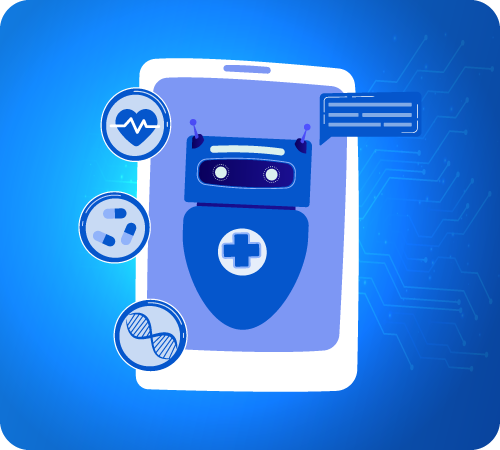
A chatbot for healthcare is a game changer for the medical industry, as it helps professionals serve patients 24*7. The conversational artificial intelligence chatbot reduces caseloads by assisting patients with easy access to healthcare. 

Using technology in healthcare is not a new concept. Healthcare professionals are already using various types of artificial intelligence, like machine learning, predictive analytics, etc., to address multiple issues. 

Thanks to new technology inventions, many healthcare organizations are leveraging the power of medical chatbots. If you are a healthcare provider wanting to integrate AI healthcare chatbots, this guide is for you. 

In this ultimate guide, we will discuss everything you need to know before implementing chatbot technology in healthcare. 

What Are Conversational AI Chatbots? 

There is no denying that chatbots in healthcare are becoming more critical than ever. According to Allied Market Research, the global healthcare chatbot market that accounted for $116.9 million in 2018 will cross $345.3 million by the end of 2026. That said, we can expect more implementation of chatbots in healthcare organizations. 

But before we dig deeper into chatbot technology in healthcare, let’s start with what a chatbot can do. In medical terms, healthcare bots are designed to provide guidance and appropriate help to patients digitally. Instead of searching online and understanding the cause of their symptoms, chatbots offer reliable and accurate information to patients. 

Many professionals believe that chatbots are designed to help patients who aren’t sure about the severity of their diseases. Chatbots work by collecting basic information from patients. Then, based on the input, healthcare AI bots provide patients with more information about their conditions. In addition, the chatbot can suggest the next steps or connect patients with doctors based on their health condition. 

Key Use Cases Of AI Healthcare Chatbot In Healthcare

Let us learn how healthcare providers can use chatbots to improve the patient experience. 

Health Tracking 

Many patients require daily health monitoring and tracking. Healthcare chatbots can be used to create a link between the patient and the doctor. Not only does the chatbot provide a detailed record of a patient’s health condition to the doctor, but it also assesses how well-prescribed medicines work to improve a patient’s health. 

Symptom Checking 

Chatbots can offer symptom checking to patients without them having to leave their homes. The Natural Language Processing (NLP) technology of chatbots helps patients to check their symptoms online and understand their medical condition. 

Patients can input their requests in the conversational AI in healthcare. The bot can access the information and narrow down the cause behind their symptoms. Thus, it will help patients determine whether they need professional treatment. 

Schedule Medical Appointments 

Scheduling doctor appointments has never been an easy feat. Patients have to wait in long queues, making it hard to get quick health information. Chatbots are proven to be a fantastic solution to this problem due to round-the-clock availability. 

Patients can quickly access medical information via chatbot by using its message interface. Plus, a well-designed healthcare chatbot can schedule medical appointments based on the doctor’s availability and the patient’s health. 

AI-powered chatbots can also send follow-up messages or reminders via email, text, or voice messages to remind patients about their appointments. The best part about scheduling appointments via chatbot is that the staff won’t get overwhelmed when inquiries become high. 

Easy Hiring & Employee Training 

Hiring and onboarding new employees can be cumbersome and time-consuming, especially in a large healthcare company. That’s why they implement AI chatbots to make the job of the HR department easy. 

Chatbots, for instance, can help new employees receive information about the company. In addition, new joiners can use the chatbot to automate multiple tasks, including maternity leave, requests for vacation time, etc. 

Answer Frequently Asked Questions 

One of the primary use cases of medical chatbots is providing timely answers to questions based on patient data. Many healthcare organizations can deploy an interactive chatbot feature on their homepage to answer common questions.

For example, a chatbot can help website visitors understand payment tariffs, insurance information, business hours, etc. This, in turn, lowers the workload on the in-house team and helps patients get quick information without any wait times. 

If you are planning to get started with a project related to machine learning or artificial intelligence system development, contact Inferenz experts. The AI and ML professionals will help you integrate advanced technology into your organization without spending out of your budget. 

Benefits Of Medical Chatbots For Healthcare 

In today’s technology-driven world, every industry is leveraging the power of AI, and the medical industry is no different. Chatbots for healthcare can automate repetitive and mundane tasks, so healthcare experts can focus on complex ones. Below we cover a few common benefits of chatbots for healthcare. 

  • Chatbots help patients get immediate responses, improving patient engagement, providing better care, and reducing wait time. 
  • AI-enabled healthcare chatbot understands patient behavior to deliver personalized recommendations in real-time. 
  • Delegating repetitive tasks to medical chatbots can help organizations reduce the need for human resources. 
  • Patients with minor medical issues can chat with the bot to get simpler medical advice based on their medical history. 

Risks Associated With Using Healthcare Chatbots 

Similar to other technologies, a healthcare chatbot comes with a few disadvantages and shortcomings. Chatbots can work with doctors to provide immediate care, but they can never replace doctors in the healthcare industry. Ultimately, it’s the doctor who will provide physical and mental health assistance. 

User privacy is the main concern when it comes to using AI chatbots to provide medical assistance. That said, medical professionals need to implement data safety measures and ensure their platforms are resistant to cyber-attacks. 

The Future Of Chatbot Technology In The Healthcare Industry 

AI-enabled chatbots can be used to check patients’ symptoms online, book appointments, contact doctors via video call, or answer simple medical questions. 

That said, it is clear that healthcare chatbots are transforming the healthcare sector. We can expect many more organizations to deploy machine learning and artificial intelligence technologies in healthcare to streamline their processes. 

If you want to know how healthcare organizations can use modern technologies to stay ahead, contact Inferenz experts today. Our professionals will help you in your health tech project or answer your questions related to chatbots for healthcare deployment.

Create A Chatbot Using ChatGPT: Step-By-Step Tutorial For Beginners

If you want to create a chatbot using ChatGPT, this 5-minute guide is all you need to read. 

ChatGPT (or Chat Generative Pre-trained Transformer) is an artificial intelligence tool developed by OpenAI. The chatbot is capable of answering questions on a variety of topics. ChatGPT creator, OpenAI recently introduced the ChatGPT API to developers and the public. 

ChatGPT Plus, powered by the new GPT-3.5 turbo model, has been recently released by OpenAI at a 10x lower price. These steps have opened the door for endless opportunities in the field of artificial intelligence. Even if you are a non-coder, you can create a chatbot using ChatGPT API for free.  

In this ChatGPT tutorial for beginners, we will reveal a step-by-step guide on how to create a personalized AI with ChatGPT API.

Steps To Set Up Software Environment For AI Chatbot

To create a chatbot using ChatGPT, you will need a ChatGPT API. It is relatively easy to use, and developers can send requests to the API with desired input text and functionality. You can access the API using Python, JavaScript, and Ruby. Though all these programming languages are easy to integrate, we will use Python to explain the chatbot development. Some other tools you will require include OpenAI, Pip, and Gradio libraries. 

Step 1: Start By Installing Python

First things first, you need to install Python by downloading the latest version for Windows. Click on https://www.python.org/downloads/ and then download python 3.11.2. 

Before clicking on the “Install Now,” make sure you enable the checkbox for “Add Python.exe to PATH” present at the bottom of the page. Now press “Install Now” and follow the usual steps to install Python. 

Pro Tip: Open the terminal on your PC or use Command Prompt “python –version” to check if Python is installed appropriately. 

Step 2: Upgrade Pip

When you install Python, Pip automatically gets installed on your system. It is a package manager for Python that plays a crucial role in creating a chatbot by allowing you to install thousands of Python libraries. However, it’s essential to upgrade it before you proceed. Here are a few simple steps that will help you upgrade Pip. 

  • Open Terminal and run the command “python -m pip install -U pip.” 
  • Install the OpenAI library to interact with ChatGPT via API. Then run the command “pip install openai.” 
  • Next, install Gradio, which helps you develop a friendly web interface. It allows you to demo your AI chatbot or share the chatbot on the Internet through a shareable link. Use the command “pip install gradio.” 
  • Lastly, download a code editor to edit codes easily. You can use Notepad++, VS code, Caret app, or Sublime Text. 

Once you have installed everything, your software environment is ready. 

Step 3: Get The OpenAI API Key For Free

You need an API key from OpenAI to create a chatbot using ChatGPT. OpenAI is currently offering free API keys for the first three months. ChatGPT users will have a free credit worth $18. 

  • Create a free account by clicking on https://platform.openai.com/signup. If you have an existing account, log in by filling in your details. 
  • At the right corner of the page, click on your profile. Select “View API keys” using the drop-down menu. 
  • Now you can click on “Create new secret key.” Make sure you copy the API key to your Notepad file. 
  • As there are private keys, make sure you do not share or display them in public. 

If you need any help in artificial intelligence or machine learning projects, contact Inferenz experts today. 

Easy Steps To Build Your Own Chatbot With ChatGPT API

Now we will build an AI chatbot using OpenAI’s latest GPT-3.5 turbo model. 

  • Open Notepad++ or any code editor and paste the code. You can even generate code using ChatGPT or Copilot — two popular tools that help in code development. 
  • Add your API key that we have generated before. 
  • Now save the code by clicking on File and then Save As using the drop-down menu. 
  • Set the file name by adding “.py” at the end and save it to “All files.” 
  • Move to the saved file location, right-click on it, and select “Copy as path.” 
  • Open the terminal, enter Python, add a space, paste the copied path, and hit enter.
  • On the below page, you will find local and public URLs. Copy the local URL and then paste it into the browser. 

That’s it! You have built your own AI chatbot with ChatGPT API. Now, you can share the public URL with anyone, as it will be live for 72 hours. You can stop the server anytime by pressing Ctrl + C. 

Start Your Artificial Intelligence Project In 2023

ChatGPT is a relatively easy-to-use artificial intelligence chatbot. It can carry out human-like conversations or write codes using the correct prompts. Besides creating a conversational chatbot, ChatGPT API can be used for a variety of purposes. You can use it to create content, translate languages, summarize text, etc. 

If you are still perplexed about how to implement artificial intelligence or machine learning in your project, feel free to contact Inferenz experts. The AI professionals will help you from start to finish so you can create a chatbot using ChatGPT tailored to your business needs.

Artificial Intelligence In Healthcare: Benefits & Use Cases Of AI

Artificial intelligence in healthcare is a broader term that refers to using machine learning algorithms to human-like behavior. As the global pandemic has weakened the roots of the healthcare sector, many healthcare professionals are opting for digital solutions to overcome the new challenges. Artificial intelligence is one of the best technologies revolutionizing every sector, and the healthcare industry is no different.

AI impacts how healthcare workers diagnose diseases and care for their patients. The main aim of deep learning, natural language processing, artificial intelligence systems, and machine learning is to help professionals identify medical solutions faster and make informed clinical decisions.

AI software analyzes large healthcare data sets and identifies specific patterns and insights to improve the efficiency and outcome of the treatment provided. In this article, we’ll dive deeper into the use cases of artificial intelligence in healthcare and how AI benefits the healthcare industry.

Use Cases Of AI In Healthcare

Multiple studies suggest that AI plays a vital role in the healthcare industry and access the complex healthcare data. Here is what the studies suggest:

  • Over 93% of healthcare providers strongly agree that AI and machine learning technologies help them access hidden or unobtainable value.
  • 69% of healthcare companies have adopted artificial intelligence solutions for preliminary diagnosis and administrative assistance.
  • As per EIT Health and McKinsey, systems powered by AI help improve patient care, drive operational gains, and support professionals in achieving better patient outcomes.

Here is the infographic representation of benefits and use cases of artificial intelligence in healthcare.

Now, let us check out the best uses of artificial intelligence in the healthcare industry.

Medical Imaging Analysis

Artificial Intelligence is one of the best tools that help healthcare experts review images and scans to gain essential insights. Instead of manually studying vast amounts of data, AI algorithms can speed up the analysis process to extract crucial information and use it for disease treatment.

Detect Breast Cancer

Regular screening has proven to reduce the risk of breast cancer by detecting it at an early stage. Timely treatments improve medicine efficiency and survival rates. AI tools work effectively, as they process images faster and provide valuable information. This, in turn, helps radiologists to provide immediate care and minimize post-disease risks.

Automate Administrative Tasks

Modern artificial intelligence and machine learning algorithms can help automate administrative tasks. Some tasks that AI can handle include:

  • Healthcare claim management
  • Patient records management
  • Create and process clinical records faster
  • Prior authorization
  • Appointment booking, management, and scheduling

Natural language processing (NLP) also helps providers process information faster and better utilize health data.

Ophthalmology Care

Providing timely ophthalmology care is one of the biggest concerns for healthcare systems. Rapidly aging populations demand timely assistance from specialists. Artificial Intelligence tools compensate for gaps in screening, diagnosis, and patient care. With AI tools, they can perform population-level screening, analyze health, predict changes, and schedule timely visits.

AI Benefits In Healthcare

AI is transforming the healthcare sector. Below we have listed how Artificial intelligence may benefit healthcare in 2024 and beyond.

Accurate & Efficient Diagnosis

Misdiagnosis is a primary concern for healthcare specialists and patients. Implementing AI and digital medical solutions like computer vision helps doctors with accurate analysis of MRI reports, CT scans, mammograms, etc.

Better Patient Care

Poor communication between healthcare providers and patients can lower the efficiency levels of care. Artificial Intelligence can automate patient communication and eliminate tedious tasks like payment issues, reminders, appointment management, etc. As a result, healthcare professionals can better utilize the time saved and focus on providing better care to patients.

Improved Surgical Operations

AI-powered tools help surgeons provide safe and smart surgeries to patients. Robotic-assisted surgeries enable surgeons to achieve higher precision, flexibility, and safety and solve complicated surgery problems. Furthermore, patients that undergo robotic-assisted surgery have shorter hospital stays after the procedure, fewer post-surgery complications, and low pain scores.

Pharma companies can hire expert Al/ML engineers to better utilize the data using advanced technology. Inferenz has recently collaborated with a pharmaceutical company from Germany to help them predict health outcomes with the latest tools. Our AI/ML experts implemented the tools to help doctors understand the vital health parameters to diagnose and treat patients better.

Empower Business With Artificial Intelligence In Healthcare

Artificial Intelligence and Machine Learning algorithms help health workers drive actionable insights from the data. Medical professionals analyze large volumes of unstructured patient data sets to improve treatment decisions.

Not only does the adoption of AI in healthcare improve the care given to patients, but it also helps doctors reduce manual work with automation. If you are a medical professional wanting to leverage the advantages of artificial intelligence in healthcare, contact the team of Inferenz today!

FAQs About AI In Health

  • What are the examples of Artificial Intelligence in healthcare? 

Chatbots, robotic surgeries, virtual nursing assistants, etc., are a few best examples of AI in healthcare.

  • Which problems can AI solve in healthcare?

AI tools are specifically designed to improve the efficiency of treatment. It can help doctors remove complexity from diagnostic procedures and eliminate repetitive and labor-intensive processes.

  • How is AI used in clinical documentation? 

The most common usage of AI in healthcare involves NLP applications that can access, analyze, and classify clinical documentation. The AI-powered systems can analyze unstructured patient data and give incredible insights to doctors.

  • What is AI’s future in healthcare? 

In the future, AI will keep automating the work of clinical and health workers. Repetitive tasks will become fully automated, so healthcare professionals can perform their jobs better and improve outcomes.

Top 10 AI Tools & Frameworks Every AI Engineer Needs To Know

AI tools in 2022 and 2023 are new-gen technology that can process code, solve problems independently, and clean data to improve business operations.

Artificial Intelligence is already a staple of the business world, and thousands of companies compete in today’s ever-changing tech landscape.

If you haven’t yet implemented tools for your AI solutions in your business, here is the list of the best Artificial Intelligence tools you can choose from if you are planning to implement end-to-end growth.

Check out AI Tools For 2023

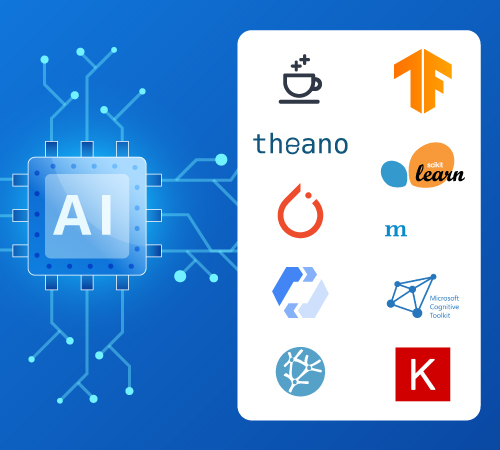
Here is the infographic representation of top 10 AI tools and frameworks every AI engineer needs to know.

top 10 tools for AI

Scikit-Learn

Scikit-Learn is one of the best Artificial Intelligence solutions in the machine learning community for automation processes. Some essential features that make Scikit Learn the top choice of developers include feature extraction, cross-validation, supervised learning algorithms, etc.

  • It runs on a single processor CPU and is built on SciPy.
  • The tool focuses on data modeling rather than manipulating it.
  • It includes a lot of calculations for projects like regular AI and data mining.
  • It is less suitable for complex calculations but can handle simple ones effectively.

TensorFlow

TensorFlow is the most sought-after machine learning and deep learning library. It is a Python-friendly open-source framework that facilitates numerical computation to make future predictions.

  • It utilizes a multi-layered hub arrangement to rapidly set up, train, and send counterfeit neural systems.
  • It runs on CPU and GPU and is built on a deployable scale.
  • Applications made by TensorFlow can be run on Android, iOS, local machines, and the cloud.
  • Developers can easily create graphical visualization and construct neural networks using Tensorboard.

Theano

Theano stands apart from other conversational intelligence solutions as it exploits the PC’s GPU. The high speed of popular AI platforms makes them profitable for computationally complex undertakings and profound learning.

  • Theano is specifically designed to integrate with Python.
  • It is an AI-powered library that helps developers to develop, optimize, and launch code projects.
  • It is built with ML (Machine Learning models) capabilities to obtain actionable insights.
  • It can independently diagnose and solve bugs with little to no external support.

Caffe 

Caffe is another popular open-source AI system that has a Python interface. Due to its high processing power, which is more than 60 million images per day, Caffe is a popular Artificial Intelligence application for faster projects.

  • Caffe structure is a BSD-authorized C++ library with a Python interface.
  • The profound learning structure is popular for its high speed, quality, and articulation.
  • One of the best examples of the Caffe framework includes Google’s DeepDream.

Apache MxNet

Apache MxNet is an advanced Artificial Intelligence platform and framework adopted by Amazon. Its deep learning framework based on AWS allows for trading computation time for memory.

  • MxNet, an application created with scalability in mind, has easy-to-use support for multi-GPU.
  • With MxNet, you can quickly write custom layers in high-level languages.
  • TVM support is available, which will improve deployment support and run on new device types.

Keras

Keras is a high-level open-source framework that uses a neural network library. It is specially designed for the team looking for a user-friendly framework with a Python interface.

  • It runs seamlessly on CPU and GPU.
  • It is useful for fast prototyping that facilitates state-of-the-art experiment completion.
  • An AI framework like Keras is suitable for creating a functioning prototype.

PyTorch

The next comprehensive AI model built on Python is PyTorch, which is similar to TensorFlow. It is created by Facebook and is in relentless reception development.

  • It is suitable for projects that require faster development.
  • PyTorch can handle large and complex projects that TensorFlow cannot manage.
  • It is incredibly flexible and has rich APIs for the library extension.

CNTK

Built on similar lines as TensorFlow, CNTK is a Microsoft Cognitive Toolkit. Anyone can try CNTK as it is under an open license. However, CNTK is challenging to deploy and requires special skills and expertise.

  • With CNTK, you can quickly combine model types like recurrent networks, convolution nets, and DNNs.
  • It has wider APIs like Java C, C++, Python, etc.
  • CNTK majorly focuses on creating deep learning neural networks.

AutoML

One of the most robust and recent additions to Artificial Intelligence is AutoML. It can automate all the processes involved in articulating a real-world problem with the help of ML techniques.

  • Beginners can also use intelligent automation solutions to preprocess and clean data.
  • With AutoML, you can quickly perform data analysis to obtain real-time and data-driven results and optimize model hyperparameters.
  • It can accelerate ML research and help you save time and resources.

OpenNN

OpenNN, or Open Neural Networks, is a popular library for neural network simulation. The OpenNN library, written in C++, is essential to deep learning research.

  • OpenNN is an advanced technology that even experienced developers can use.
  • It features a Neural Designer that is suitable for advanced analytics.
  • The AI tool provides graphs and tables for data entry interpretation.

AI Tools

Integrate Top AI Tools To Grow Your Business 

Enterprises have realized the benefits of Artificial Intelligence in business, and around 37% of companies use AI tools in some form. Not only will the AI application integration power the company, but it will also improve business efficiency through data management.

Inferenz is a team of AI and ML experts who can help your business with AI-powered tools. The experts will analyze your business needs and ensure that you choose the right AI tools that fuel business growth with real-time insights.

FAQs

  • Which are the best AI tools? 

Some of the best technologies available are MxNet, PyTorch, TensorFlow, OpenNN, etc.

  • What are AI tools and AI platforms? 

An Artificial Intelligence tool and platform allows developers to create intelligent business applications.

  • What are the three types of AI? 

Three AI types include Artificial narrow intelligence (ANI), Artificial general intelligence (AGI), and Artificial superintelligence (ASI).

  • Why are AI tools important? 

AI solutions are specifically designed to help enterprises to make better business decisions, improve speed and accuracy, boost core business processes, and so on.

Top 5 Game-Changing AI Applications In The Sports Industry

The adoption of AI in the FIFA World Cup 2022 will allow video match officials to get real-time offside alerts and improve the viewer experience. With modern data tools and algorithms, Artificial Intelligence has completely transformed how we interact with the world and brands market their products. In the sports industry, technology is becoming more prevalent as it helps teams with post-game analysis, improves fan experience, and enhances player performance.

Although AI technology is in its nascent stage, the sports industry is witnessing endless use cases and benefits of emerging tech. FIFA World Cup 2022 will use AI to detect social media abuse among the players, making it an AI-powered world cup. This guide will reveal the role of emerging techs, the top 5 AI trends for the sports industry, and the innovative ways to use them.

ALSO READ: Data Science in Healthcare: 8 Use Cases No One Will Tell You

Role Of Artificial Intelligence In the Sports Industry

The advent of new technologies, such as Artificial Intelligence, Augmented Reality, Machine Learning, etc., has changed the face of every industry, including sports. Brands, viewers, and players use Artificial Intelligence tools in multiple ways to improve strategizing, advertising, broadcasting, and player training.

Game-Changing-AI-Applications-in-the-Sports-Industry-FIFA-WORLD-CUP-2022-WATCH-ONLINE

One of the biggest brands, Adidas, has jumped onto the bandwagon for FIFA World Cup 2022 by creating NFT characters for advertisement. Likewise, other brands are incorporating different ways to leverage the new technology and gain an edge against the competition. The new wave of AI in the sports industry will transform the way players used to watch the FIFA World Cup, and brands use it to promote their services.

5 AI Trends For The Sports Industry

The benefits of AI in the sports industry are endless, and that is why the AI segment is expected to reach $19.2 billion by 2030. Many biggest names in the sports industry are leveraging the power of AI, including Major League Baseball (MLB), the National Football League (NFL), and the National Basketball Association (NBA). FIFA World Cup 2022 is adopting Artificial Intelligence to enhance viewers’ experience and help players improve their training and play. Below is the list of top AI applications or use cases in the sports industry.

  • Improve Viewer Experience

Sports teams are incorporating Artificial Intelligence to enhance the fan experience and make them feel valued with personalized service. A few use cases of AI to improve viewer experience include creating virtual reality experiences and matching fans with their stadium seats. AI tools help offer personalized content to viewers and help them interact with their favorite players via chatbot. With advanced tech, it is possible to monitor social media to see what fans say about FIFA World Cup 2022 and the players to avoid hatred and abusive content.

  • Predictive Modeling

Another major AI trend in FIFA World Cup 2022 is predictive modeling, which helps teams predict future trends. The information gathered from a player’s past performance can be utilized to predict future trends and identify which players are likely to get injured. AI helps predict breakout seasons, injuries, and underperformance to help sports teams make strategic decisions.

  • Customized Training Programs 

The trend of customized training programs is growing by leaps and bounds, especially in the FIFA World Cup 2022. Athletes use AI tools to create personalized training programs that meet their needs and help them monitor their progress to improve performance. With the information received from AI tools, athletes can revamp their gaming strategy and overall game.

  • Prevent Injuries

The team has to incur financial damage if a player gets injured during a match. AI promises to prevent monetary loss due to injuries by helping teams monitor players’ health beforehand. The AI tool tracks the various health parameters of the individual and identifies the players at risk of injury.

  • Better Sports Equipment

Big companies are using AI to manufacture better, more accurate, and more powerful sports equipment. Adidas, for instance, recently developed an AI-powered soccer ball with an adjustable flight path to improve accuracy. The primary role of using Artificial Intelligence during the manufacturing of sports products is to improve their performance and accuracy, leading to improved gaming.

Brands can integrate the latest technologies to market their products and services on various social media platforms, including Twitter, Snapchat, Instagram, etc., during the FIFA World Cup 2022 and remain ahead of the competition.

Enter The World Of AI With Inferenz Experts

Artificial Intelligence is revolutionizing the sports industry by improving player safety and gaming strategy with predictive modeling. Aside from players, marketers are bringing Web3 to FIFA World Cup 2022 to improve their marketing strategy, engage more customers, and drive sales.

As you see, the future of the sports industry goes hand-in-hand with emerging technologies like Artificial Intelligence. If you are an enterprise owner looking to improve your strategies in FIFA World Cup 2022 with AI tools, get in touch with the skilled team of Inferenz to build AI applications.

Alternatives To Twitter: 5 Social Media Platforms That Could Replace Twitter

With #RIPTwitter trending, people are looking for alternatives to Twitter. “TWITTER IS THE WORST! But also the best,” — says Elon Musk’s recent tweet, giving people a reason to talk. However, people agree more with the former statement than the latter. Soon after he became the new CEO of Twitter, #TwitterMigration became a hot trend. This came after the announcement of mass layoffs news by Musk, where he asked Twitter employees to resign for no definite reason.

Now the term trending on social media platforms is #RIPTwitter, which puts the future of the social media app a little dicey. The hashtag became trending after Twitter employees offered their resignations to Musk before time instead of allegedly signing the ultimatum and agreeing to the new working rules. Witnessing the plans of Elon Musk for the platform, many people are flocking to the alternatives to Twitter. This article will reveal the top 5 social media platforms capable of replacing Twitter and other trending news about the social media platform.

ALSO READ: Benefits Of Big Data Analytics In The Healthcare Industry

Alternative-to-Twitter-in-2023-discord

5 Alternatives To Twitter In 2023

Elon Musk’s decision to purchase Twitter for $44 billion and the changes made to the social media application have frustrated some users. As a result, people are looking to switch from Twitter to its alternatives. Below is the list of top social media platforms with features and functionalities that could replace Twitter in 2023.

  • Mastodon

Mastodon, an open-source software application, is one of the most Twitter-like alternatives available on the market. The popularity of the Twitter alternative was proved by the open-source group’s CEO Eugen Rochko’s tweet declaring that Mastodon got over 1 million users since 27 October, when Elon Musk became the new CEO of Twitter. WIRED also said that millions of people are fleeting to Mastodon after Elon took over Twitter. It has two useful tools — debirdify and Fedifinder — that allow users to search and find all the people they’ve been following on Twitter.

  • Tumblr

Tumblr is one of the oldest social media platforms for people searching for Twitter alternatives. While Twitter has a character limit, Tumblr allows users to write and share whatever they want. It is a comprehensive social networking service that is becoming popular among influencers due to its similar functionality to Twitter. So, it wouldn’t be surprising if Tumblr is the next best alternative to Elon Musk’s Twitter 2.0.

  • Gab

Gab is the perfect combination of Twitter and Facebook to put people and free speech first. With the #RIPTwitter and #TwitterMigration trending, many flocks consider Gab as an alt-right alternative to Twitter. Gab is a fully-decentralized social media platform that allows users to publish posts, join groups, live stream, buy products, and initiate private chats — a lot of the same functions as Twitter.

  • CoHost

CoHost is another popular alternative to Twitter people are talking about. There are numerous charms of the platform over Elon Musk’s Twitter, such as no character limit and more creativity. Users can even add CSS notes to their posts in addition to fully functional games. However, CoHost is not as popular as the other alternatives to Twitter in the list.

  • GETTR

GETTR, launched by Jason Miller (Donald Trump’s former senior advisor), is a new social media platform for conservative people who are irked by Elon Musk’s changes to the app. Many users praise the app with the names such as back to free speech, escape from digital tyranny, and more.

New Wave Of Twitter’s Mass Layoff News 

According to Twitter’s mass layoffs news, Musk fired around 50% of the workforce. After firing half of the employees, Elon Musk has recently laid off 4,400 contractual Twitter workers. Platformer’s founder, Casey Newton, reportedly said contractors aren’t notified about the layoffs. He added workers on contract are allegedly losing access to email and Slack — indicating the new wave of layoffs.

Elon Musk asked the workers to commit to a hardcore culture or leave their three months of severance pay. In response to this, the employees decided to resign from their positions. Musk recently replied to a tweet, “I’m not super worried regarding the mass resignations, as the best employees are staying.” However, the effect of mass resignation can be seen as Twitter temporarily closed all its offices and suspended badge access.

Elon Musk, who heads SpaceX and Tesla, is focused on building Twitter 2.0 and making it successful as soon as possible — following a mass layoff strategy. He said he would grant the blue-tick verification label from November 29 to those willing to buy premium services and pay USD 8 a month.

Future Of Elon Musk’s Twitter 2.0

Elon Musk taking over Twitter, firing employees, and starting the new wave of mass layoffs is the most trending topic. The company’s office has been abruptly shut down until Monday, November 21, 2022, indicating some more news from Twitter’s headquarters. Stay tuned to know what happens next.

If you want to stay updated with the latest news on Blockchain, Metaverse, Artificial Intelligence, Predictive Analysis, Data Migration, etc., subscribe to the Inferenz newsletter!

Artificial Intelligence System Development

Artificial Intelligence system exists everywhere around. There are a variety of ways in which its existence can be felt. AI has been defined in a number of different ways from its inception, but the simplest way to define AI is to stick to the one given by the pioneers of this field, John McCarthy and Marvin Minsky, in 1959. Artificial Intelligence is the ability of any program or machine to perform tasks that require humans to apply intelligence to do the same. There has been a lot of work done by a lot of people in this domain. One of the most famous works by Alan Turing in 1950 was an attempt to determine whether or not machines could be tagged with artificial intelligence.

How do Artificial Intelligence Systems work?

Artificial Intelligent systems work around three cognitive skills i.e., learning, reasoning, and self-correction. The development of Artificial Intelligence systems requires specialized hardware and software to make the algorithms work. AI development systems take advantage of these skills by combining large data sets with intelligent iterative algorithms. This lets AI systems learn from the patterns and features in the data they analyze. Each time an AI system performs a data cycle, it tests and measures its own performance and tries to improve its performance over a period of time. To understand how AI actually works, we need to understand that AI is not a single computer program or application but an entire discipline or science.

Artificial Intelligence System Development

Many companies in Ahmedabad and elsewhere are working on AI systems, including machine learning, deep learning, natural language processing, and other areas. Natural Language Processing is widely applied in text mining. It may be used to summarize chunks of text, getting insight from the text by understanding its specifics. Machine Learning models are basically mathematical models used to predict patterns in data, prediction of events, and classification of a variety of objects.

ALSO READ: Dent Detection on vehicles due to Hailstorm

Deep learning is a form of machine learning which can learn from unstructured, unlabeled data without human supervision. Computer vision allows systems to derive meaningful information from visual inputs in the form of digital images or videos. Cloud services help to shape the AI use cases effectively. Top Artificial Intelligence companies are developing systems that can handle huge amounts of data. Many companies in Ahmedabad are also developing chatbots that can be integrated into any website which pops up when you land there. These chatbots have become common these days for offering customer service, marketing services and IT service helpdesk, etc.

With its broad applications in different sectors, Artificial Intelligence has become instrumental in aiding people’s life with complex problems. Although Artificial Intelligence cannot completely replace humans, it has definitely changed the way we live, and businesses work. AI systems try to emulate human consciousness and intuitiveness with the aim of changing society.

Applications of Artificial Intelligence

There are a number of applications of Artificial Intelligence for sectors like healthcare, retail, eCommerce, hospitality, and many more. Inferenz Tech is one of the rapidly expanding companies focused on Artificial Intelligence Systems Development.

The goal of such systems is to solve critical business problems with advanced technology, particularly Artificial Intelligence, to automate business processes by examining the issues in depth. Irrespective of which application area Artificial intelligence is applied, it helps in reducing errors in the workflows and increases the likelihood of accuracy. A major challenge for AI is to find ways to express common-sense knowledge and experiences so that humans can perform everyday activities, such as having long conversations or navigating busy streets. Ordinary digital computers may need to develop new machines capable of running such programs and supporting the complexities of human thinking.

Conclusion

Artificial intelligence continues its move to become a part of our personal and work life. A career in AI today not only guarantees a decent salary in top Artificial Intelligence System Development Companies but also promises opportunities to help you grow. It plays an important role not only in the computer and space industries but also in industries directly connected to the general public, such as the medical, automobile, banking, and agricultural sectors. So, start your journey toward a successful career in Artificial Intelligence.