











OpenSearch Use Cases: Where Search, Analytics, and Observability Come Together 

Summary 

OpenSearch is a flexible platform used for search, analytics, observability, and security across modern data environments. This article explains how it supports full-text search, log monitoring, threat detection, business analytics, and research use cases at scale. 

Introduction 

OpenSearch is an open-source, distributed search and analytics platform managed by AWS. It supports full-text search, real-time analytics, observability, and security monitoring at scale.  

Across enterprise systems, cloud environments, and research settings, OpenSearch helps teams index, analyze, and act on large volumes of data with speed and flexibility. 

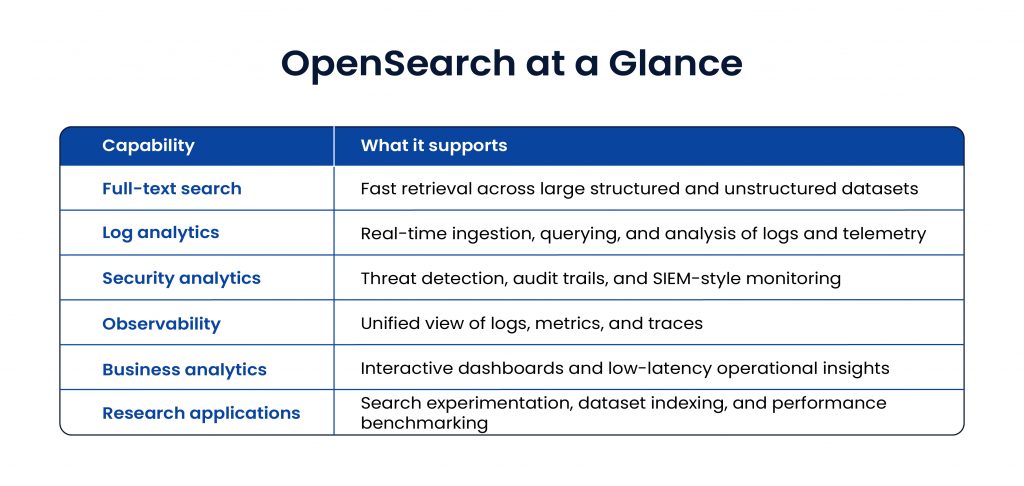
OpenSearch at a Glance 

OpenSearch at a Glance

What Is OpenSearch? 

OpenSearch is an open-source, distributed platform built for search, analytics, and observability. Managed by AWS and supported by the open-source community, it was created to offer a transparent and scalable alternative to proprietary search systems. 

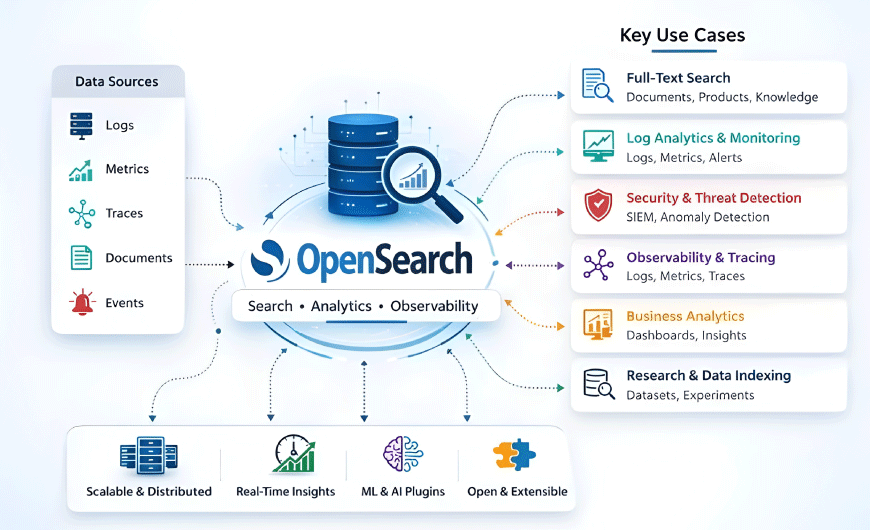
What Is OpenSearch

The platform combines indexing, query processing, machine learning, and visualization within one architecture. Its plugin-based design and compatibility with standard data formats make it suitable for a wide range of environments, from enterprise applications to large cloud-native systems. 

Why OpenSearch Matters? 

Modern systems generate large and varied data streams every second. Businesses need tools that can search documents, monitor infrastructure, detect threats, and analyze operational trends without relying on separate disconnected platforms. 

OpenSearch addresses that need by bringing together several core functions: 

  • Search across large datasets 
  • Real-time analytics on streaming information 
  • Monitoring and observability for distributed systems 
  • Security event analysis and alerting 
  • Flexible deployment for enterprise and research environments 

That makes it useful in both operational and strategic settings. 

Key Use Cases of OpenSearch 

OpenSearch supports far more than basic search. Its architecture makes it useful across monitoring, security, analytics, observability, and research-driven environments where speed, scale, and flexibility matter. 

Full-Text Search and Information Retrieval 

One of the strongest use cases of OpenSearch is high-performance full-text search. It uses inverted indexing and distributed search execution to retrieve results quickly, even across large datasets. Features such as tokenization, language analyzers, and relevance scoring allow teams to build precise and context-aware search experiences. 

This is especially useful in the following scenarios: 

  • Enterprise knowledge repositories 
    Internal documents, support tickets, manuals, and knowledge bases often grow too large for basic search tools. OpenSearch improves findability by supporting semantic relevance and contextual query handling. 
  • E-commerce product search 
    Product catalogs need more than keyword matching. OpenSearch supports filters, facets, ranking logic, and personalization, which helps users find the right products faster. 
  • Digital libraries and academic archives 
    Large document collections demand both speed and accuracy. OpenSearch supports fast corpus exploration while maintaining low response times. 

Another advantage is its extensible query framework. Teams can integrate neural ranking and hybrid search methods that combine keyword and semantic retrieval. 

Log Aggregation and Operational Monitoring 

OpenSearch is widely used for log analytics because it handles time-series data efficiently. Modern applications, cloud services, and distributed systems produce continuous streams of logs that must be collected, stored, and queried in near real time. 

Common uses include: 

  • Centralized ingestion of application, network, and server logs 
  • Performance monitoring through metric analysis 
  • Automated alerting for unusual behavior 
  • Root-cause analysis across distributed environments 

Its built-in anomaly detection capabilities help teams identify unusual patterns before they turn into larger issues. This makes OpenSearch valuable for DevOps teams, SRE functions, and organizations running microservices or cloud-native infrastructure. 

Security Analytics and Threat Detection 

OpenSearch also plays an important role in security operations. It can ingest and analyze events from authentication systems, firewalls, intrusion detection tools, and access control services. By correlating patterns across these data sources, organizations can build strong security monitoring workflows. 

Key applications include: 

  • Detecting abnormal login or access behavior 
  • Identifying possible intrusion attempts 
  • Enriching threat data with intelligence pipelines 
  • Supporting compliance reporting and audit log retention 

Because of this, OpenSearch is often used as the foundation for open SIEM implementations. It gives organizations a more flexible and vendor-neutral way to manage security analytics while reducing dependency on expensive licensing models. 

Observability and Distributed Tracing 

As systems become more distributed, teams need visibility across services, containers, APIs, and infrastructure layers. OpenSearch supports observability by bringing together logs, metrics, and traces in one environment. 

When paired with OpenSearch Dashboards and Trace Analytics, and combined with OpenTelemetry instrumentation, it helps teams: 

  • Trace execution flows across microservices 
  • Analyze latency between service calls 
  • Identify performance bottlenecks 
  • Monitor Kubernetes and container workloads 

This makes OpenSearch a practical choice for teams building resilient cloud platforms. It supports faster troubleshooting and gives engineers a clearer view of system behavior across complex architectures. 

Business Analytics and Decision Intelligence 

OpenSearch is not limited to technical monitoring. It also supports interactive analytics for business teams that need real-time visibility into operations and customer activity. 

Its aggregations engine and fast query performance make it useful for: 

  • Streaming analytics in IoT and industrial systems 
  • Customer behavior analysis on digital platforms 
  • Operational dashboards without complex warehouse dependencies 
  • Low-latency reporting for time-sensitive decisions 

Organizations can use OpenSearch to explore and visualize data without always moving it through heavy, multi-stage analytics pipelines. That gives teams faster access to insights and supports quicker response in operational settings. 

Research and Scientific Computing 

Because OpenSearch is open source and highly configurable, it is increasingly used in research and scientific computing. Academic institutions and technical teams value the ability to test, modify, and benchmark search systems in a reproducible way. 

Typical research applications include: 

  • Indexing large scientific datasets 
  • Managing research corpora 
  • Testing ranking models 
  • Evaluating search relevance methods 
  • Benchmarking distributed query performance at scale 

Its architecture allows researchers to work directly with search behavior and system performance. That creates room for experimentation in information retrieval, distributed systems, and large-scale analytics. 

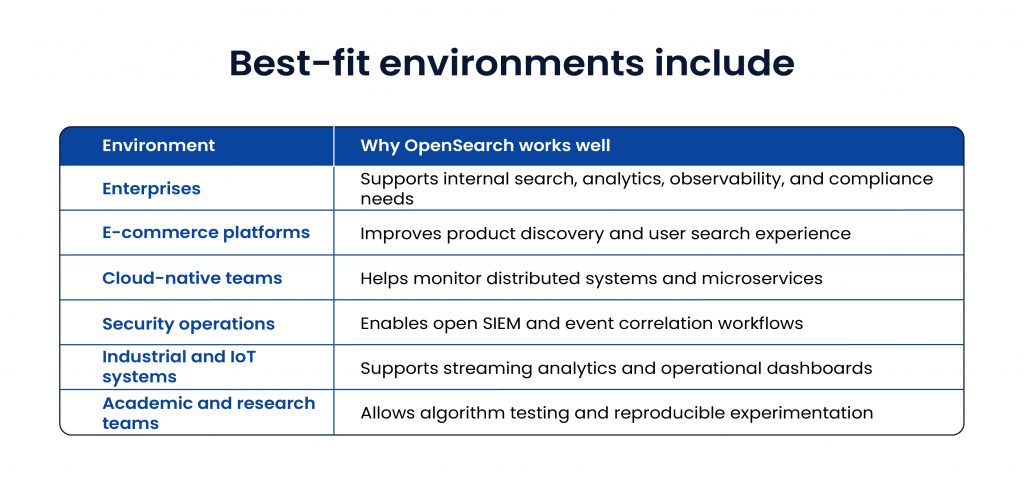
Where OpenSearch Fits Best?

The strength of OpenSearch lies in how broadly it can be applied. It is a strong fit for organizations that need one platform to support several data-heavy functions. 

Core Benefits of OpenSearch 

OpenSearch continues to gain adoption because it offers a practical mix of scale, flexibility, and visibility. 

Key benefits include: 

  • Open-source governance with strong community support 
  • Distributed architecture for high scalability 
  • Extensible plugin ecosystem 
  • Unified support for search, analytics, and observability 
  • Compatibility across varied deployment environments 
  • Lower dependency on proprietary tooling 

These advantages make it relevant for organizations that want both control and performance in their data systems. 

Final Takeaway 

OpenSearch has grown into a flexible platform for much more than search. It supports full-text retrieval, log analytics, security monitoring, observability, business intelligence, and research workloads in one scalable ecosystem. 

For organizations working with growing volumes of operational and business data, OpenSearch offers a clear path to faster search, better visibility, and more responsive analytics. Its broad use across industry and research shows that it remains highly relevant in modern data-driven environments. 

FAQs 

What is OpenSearch mainly used for? 

OpenSearch is mainly used for full-text search, log analytics, observability, security monitoring, and real-time data analysis. It helps organizations search large datasets and monitor systems from a single platform. 

Is OpenSearch good for log analytics? 

Yes, OpenSearch is widely used for log aggregation and log analytics. It can collect, store, query, and visualize logs from servers, applications, and cloud systems in near real time. 

Can OpenSearch be used for observability? 

Yes. OpenSearch supports observability by combining logs, metrics, and traces. With OpenSearch Dashboards and tracing tools, teams can monitor distributed systems and troubleshoot issues faster. 

How does OpenSearch help with security analytics? 

OpenSearch helps security teams analyze events from firewalls, authentication systems, and intrusion detection tools. It supports anomaly detection, event correlation, audit trails, and SIEM-style monitoring. 

Is OpenSearch suitable for e-commerce search? 

Yes, OpenSearch works well for e-commerce search because it supports filtering, faceting, relevance tuning, and personalized product discovery across large catalogs. 

Can OpenSearch be used for business analytics? 

Yes. OpenSearch supports low-latency analytics and interactive dashboards, which makes it useful for operational reporting, customer behavior analysis, and streaming data insights. 

Why do research teams use OpenSearch? 

Research teams use OpenSearch because it is open source, configurable, and suitable for testing ranking models, indexing large datasets, and benchmarking distributed search performance. 

What are the benefits of OpenSearch over proprietary platforms? 

OpenSearch offers open-source flexibility, lower licensing dependency, extensibility through plugins, and strong support for search, analytics, and observability in one system. . 

FinOps in Real-World Practice: Transforming Cloud Spend into Strategic Value

Summary

As cloud adoption grows in fintech, cloud cost management becomes harder because usage and pricing shift every hour. FinOps helps teams link spend to real outcomes like cost per transaction, fraud checks, and feature delivery. Learn how fintech teams apply FinOps in daily operations, using tagging, visibility, forecasting, and automation to turn cloud spend into strategic value.-Cloud spend to strategic value with FinOps

Introduction

Cloud makes fintech faster. Teams can ship features quickly, scale during peak transaction windows, and run analytics without buying hardware. 

The catch is simple: consumption pricing turns every new workload into a variable cost line. And in fintech, workloads spike for reasons that feel “business as usual” such as payout cycles, fraud bursts, seasonal lending, or a partner API change.

FinOps exists to keep that variability from becoming chaos. The FinOps Foundation defines FinOps as an operational framework and cultural practice that maximizes business value from cloud and technology through timely, data-driven decisions and shared financial accountability across engineering, finance, and business teams. 

This guide shows what FinOps looks like when you apply it day to day in fintech environments, where speed, governance, and predictability matter at the same time.

Why fintech teams feel cloud cost pressure sooner

Fintech cloud usage tends to concentrate in a few expensive areas:

  • Always-on customer experiences: low-latency apps, APIs, identity, and observability.
  • Risk and fraud analytics: streaming, feature stores, model training, and bursty compute.
  • Data platforms: warehouses and lakehouses that grow quietly with retention, audit, and regulatory needs.
  • Security controls: logging, monitoring, scanning, and encryption overhead that is necessary, but rarely “free.”

And cloud spend keeps climbing across industries. Gartner forecasts public cloud end-user spending at $723.4B in 2025

So, the question for fintech leaders is rarely “should we spend less?” It’s “how do we spend with intent, and prove it with numbers?”

That’s where FinOps becomes a business discipline, not a billing exercise.

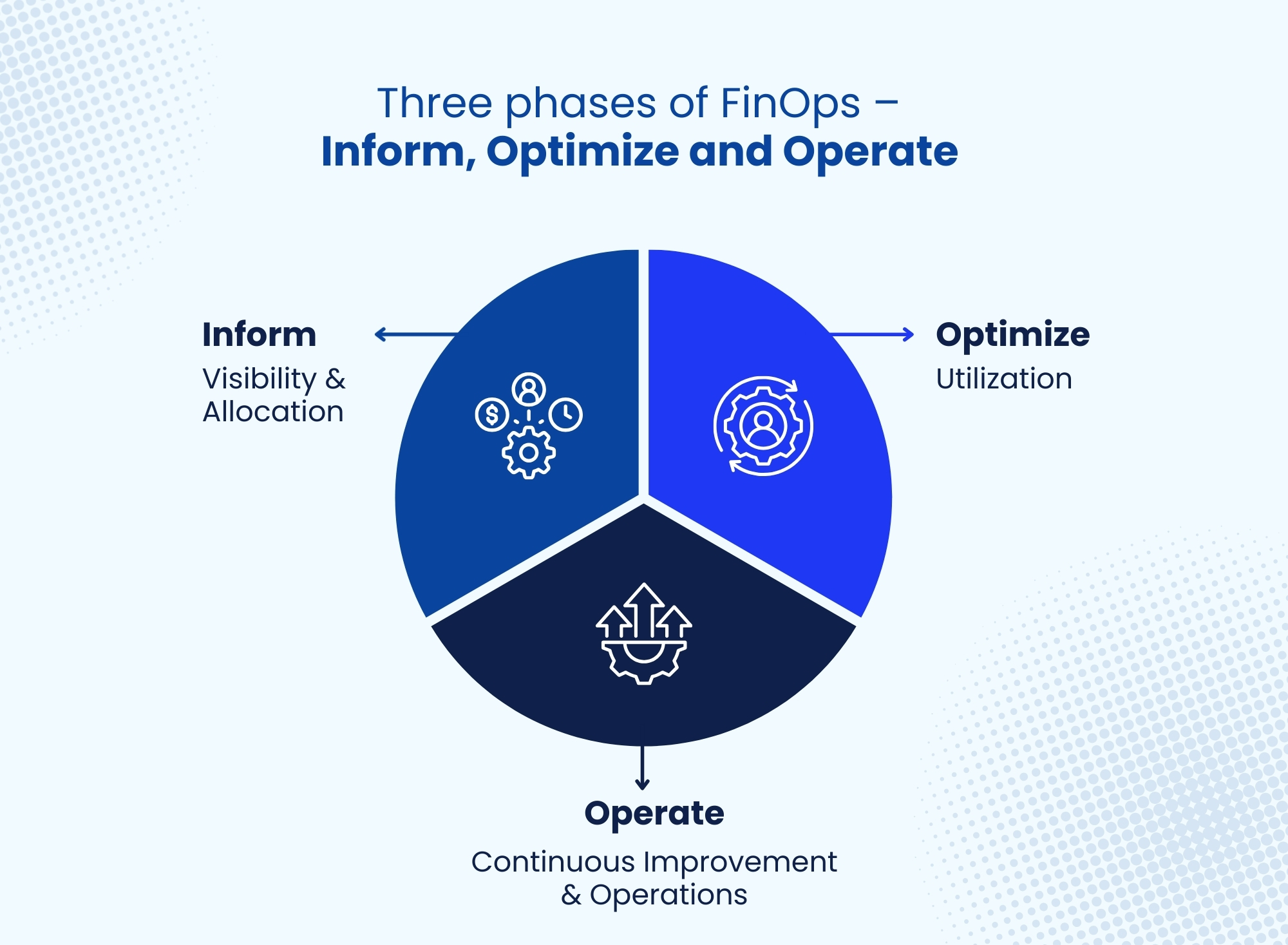
Three phases of FinOps

FinOps in daily operations: the practices that change outcomes

1) Unify teams around shared financial accountability

FinOps works when engineering and finance stop treating cloud cost as someone else’s job. The practical shift looks like this:

  • Finance gets clear ownership views: by product, environment, and business line.
  • Engineering gets fast feedback loops: cost impact is visible before and after a release.
  • Product and leadership get unit economics: cost per transaction, cost per active customer, cost per underwriting decision, cost per fraud check.

Example
Before launching a new real-time payments feature, the platform team reviews expected throughput, storage growth, and observability overhead with finance. They agree on a target unit cost (say, cost per 1,000 transactions) and track it weekly. If unit cost rises, teams investigate whether it came from higher log volume, unbounded retries, or an over-sized compute tier.

What Inferenz typically adds here is the operating model: who owns which cost domains, what gets reviewed weekly versus monthly, and how teams turn cost data into decisions without slowing delivery.

2) Make cost visibility usable with tagging, allocation, and clean data

Visibility is more than a dashboard. It’s consistent, trusted allocation that supports action.

For fintech teams, a tagging and allocation baseline usually includes:

  • Product / business line
  • Environment (prod, staging, dev)
  • Cost center
  • Workload type (API, batch, streaming, ML training, BI)
  • Data classification (helps align cost with governance and audit needs)

Tools such as AWS Cost Explorer and Azure Cost Management help, but they depend on clean tagging and consistent account structure.

Quick win that matters:
Create a “no tag, no launch” gate for production infrastructure as a guardrail that prevents unknown spend from becoming permanent.

Data quality and governance blog

3) Shift from month-end surprises to real-time decisions

FinOps teams operate on short cycles because cloud changes daily. When cost signals arrive a month later, the money is already gone.

In real practice, fintech teams do things like:

  • Auto-shutdown non-critical environments after hours
  • Rightsize compute based on actual utilization
  • Use commitment planning (Savings Plans, Reserved Instances) where usage is steady
  • Move storage to lower-cost tiers with policy-based lifecycle rules

FinOps Foundation guidance frames this as a loop across visibility, optimization, and operations. 

Example
A fraud model retrains nightly. The pipeline grew over time and now runs on larger nodes than needed. FinOps flags the change in cost per training run, the data team confirms stable runtime targets, and the platform team applies right-sizing and schedule controls. The end result is predictable spend without weakening detection.

4) Treat forecasting like a product KPI, not a finance exercise

Forecasting is where fintech teams often struggle because demand is real-time and spiky. Still, you can forecast well if you forecast the right thing.

Instead of asking, “What will AWS bill be next month?”, focus on:

  • forecasted unit volumes (transactions, API calls, onboarding checks)
  • expected model usage (training runs, inference calls)
  • the unit cost curve (cost per 1,000 events)

Then tie cloud spend to those business drivers.

Cloud spend management remains a widespread challenge, which makes forecasting discipline a differentiator.

Where Inferenz fits: building data pipelines that merge billing exports, usage telemetry, and product metrics so forecasts reflect how the business actually runs, beyond what the invoice says.

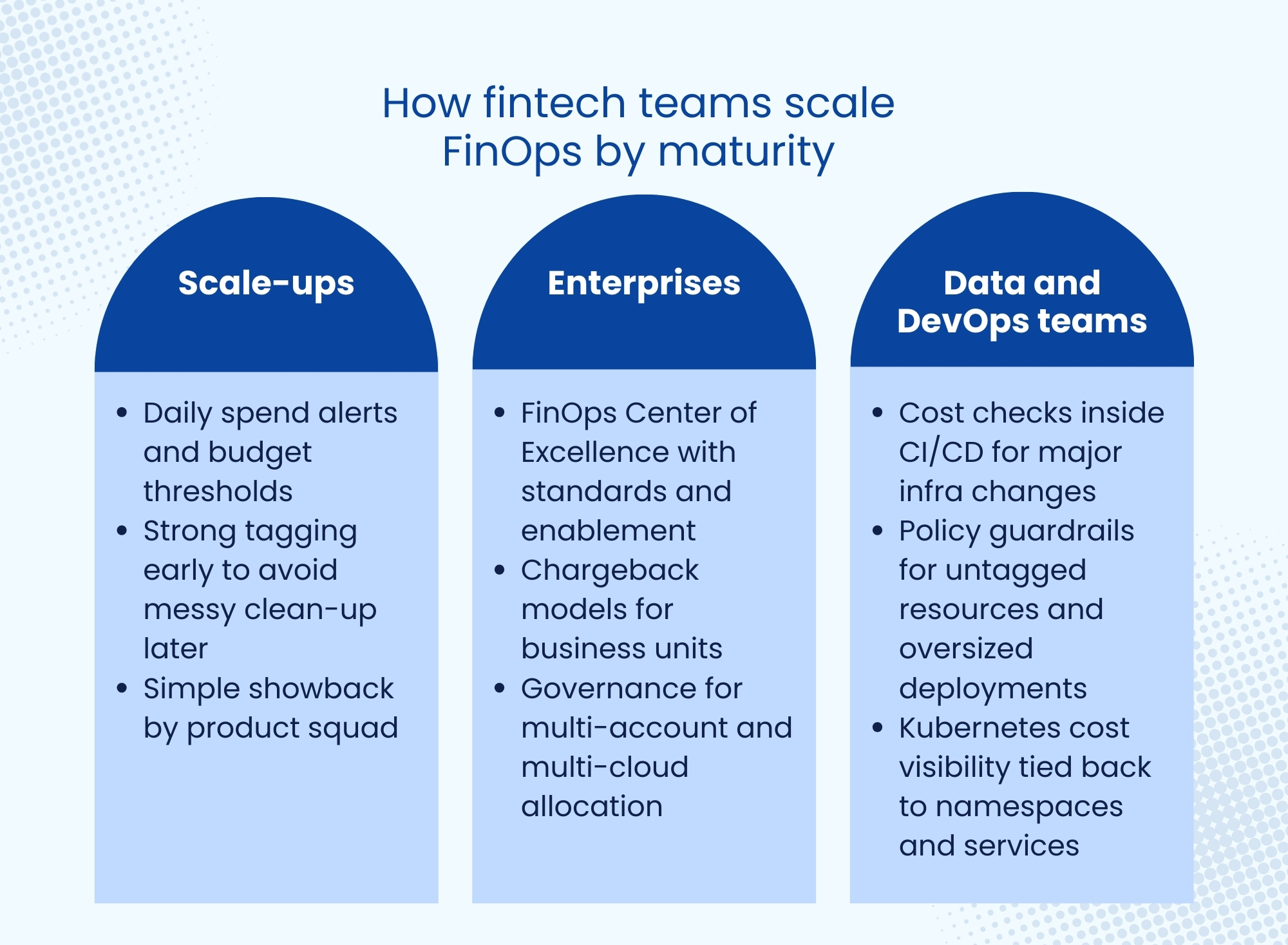
How fintech teams scale FinOps by maturity

How fintech teams scale FinOps by maturity

Common roadblocks and how to get past them

Three obstacles to scaling FinOps

  • Resistance from teams
    Engineers may assume cost controls will slow delivery. Fix that by using automation, clear thresholds, and fast feedback, not manual approvals.
  • Complex pricing and confusing bills
    Cloud pricing is hard. The fix is to translate billing into “engineering terms” such as runtime, storage growth, egress, and query patterns.
  • Inconsistent governance
    If tagging rules vary by team, visibility collapses. Standardize the minimum required tags and enforce them with policy.

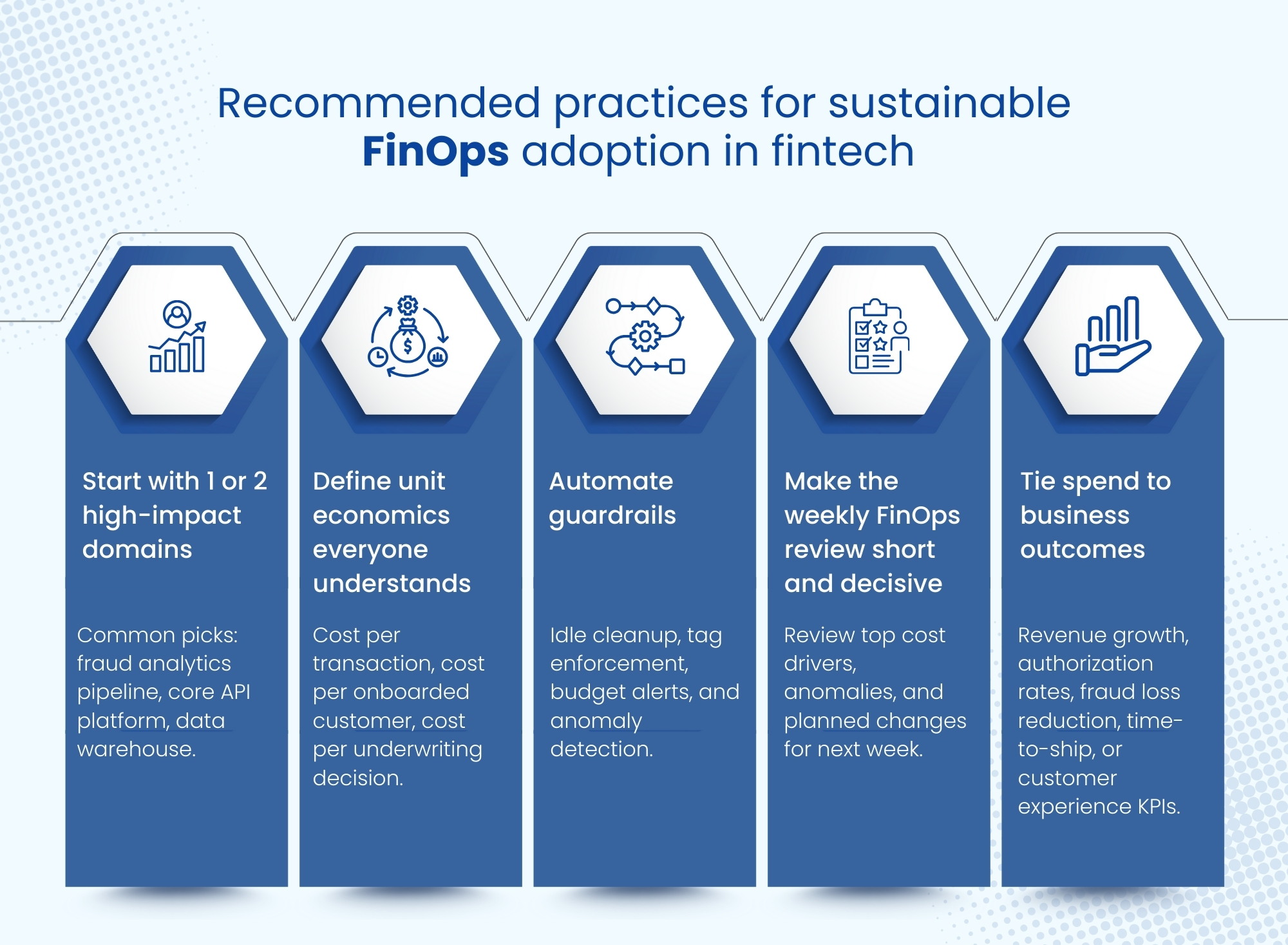
Recommended practices for sustainable FinOps adoption in fintech

Recommended practices for sustainable FinOps adoption in fintech

  1. Start with 1 or 2 high-impact domains
    Common picks: fraud analytics pipeline, core API platform, data warehouse.
  2. Define unit economics everyone understands
    Cost per transaction, cost per onboarded customer, cost per underwriting decision.
  3. Automate guardrails
    Idle cleanup, tag enforcement, budget alerts, and anomaly detection.
  4. Make the weekly FinOps review short and decisive
    Review top cost drivers, anomalies, and planned changes for next week.
  5. Tie spend to business outcomes
    Revenue growth, authorization rates, fraud loss reduction, time-to-ship, or customer experience KPIs.

Final thoughts

FinOps becomes valuable in fintech when it connects cloud spend to product reality: usage, risk controls, and customer outcomes. With the right allocation, unit economics, and automation, teams keep speed while making spend predictable and defensible.

CTA Contact Us

Frequently asked questions

What is FinOps in a fintech cloud environment?

FinOps is how fintech teams manage cloud spend day to day, together. Finance, engineering, and product share ownership so costs stay visible, predictable, and tied to outcomes.

How do you measure cloud unit economics for payments and fraud workloads?

Pick a unit (cost per 1,000 transactions, cost per fraud check, cost per model run). Allocate cloud costs to that unit with tags and workload boundaries, then track the trend weekly.

What tagging strategy works best for cost allocation in regulated teams?

Keep required tags strict and few: Product, Owner, Environment, CostCenter, Workload, DataClass. Enforce tagging at creation time so production spend never shows up as “unknown.”

How do you forecast cloud spend when usage spikes daily?

Forecast the driver first (transactions, checks, model runs), not the bill. Use a rolling weekly forecast with a range (base/high), plus alerts for sudden spikes.