











Manual Precision, Automated Scale: A QA Strategy for Successful Workspace Migration

Summary

Enterprise workspace migrations live or die on one thing, whether users trust the new system enough to abandon the old one. This article breaks down a real-world hybrid QA approach that combined manual validation with Python-driven automation to migrate business-critical reports at scale, retire a costly legacy data warehouse, and restore stakeholder confidence through verified numbers.

Introduction

Enterprise migration programs often focus on architecture, timelines, and cutover plans. But in my experience, one question determines whether migration is truly successful:

Do users trust the new system enough to stop using the old one?

That question becomes especially important during data workspace migrations, where dashboards, reports, and operational decisions depend on numbers being correct every single day. legacy

In a recent large-scale migration program, I supported the transition from a enterprise data warehouse to a modernized cloud-based platform, a core part of successful data and cloud modernization initiatives. The backend migration had largely been completed, but many business-critical reports were still tied to the old workspace.

To retire the legacy environment, every report needed to be validated, reconciled, tested, and approved for release.

What made the difference was not choosing between manual testing or automation. It was combining both.

The Real Challenge in Workspace Migration

From the outside, migrations can look straightforward:

  • Move tables
  • Repoint reports
  • Validate numbers
  • Go live

In reality, migrations are rarely that simple.

Even after the new platform was built, legacy reports were still actively used by the business. That created several risks:

  • Two parallel environments generating similar metrics
  • Conflicting numbers across reports
  • High support overhead
  • Delayed retirement of expensive legacy systems
  • Low stakeholder confidence in migrated outputs

The business goal was clear: complete report migration, decommission the old environment, and ensure zero disruption to reporting operations.

That required a strong QA strategy.

Why Manual Testing Came First

Before introducing automation, manual validation covered key metrics including revenue, headcount, and quantities sold. Historical outputs were compared across six years of data, from 2019 through 2025, for approximately 80 active parks to understand data patterns, business rules, and known exceptions.

This step was non-negotiable.

Automation is powerful. But it should not be the first move when system logic is still being understood. Manual testing answered the questions automation cannot ask on its own:

  • Which source should be treated as authoritative?
  • Were variances caused by logic changes or bad data?
  • Were filters, joins, or calculations inconsistent across reports?
  • Did report visuals reflect correct backend totals?

Without this phase, automation would have scaled confusion faster

When Legacy Data Isn’t the Source of Truth

One of the most important discoveries during testing was that the legacy warehouse was not always correct.

Initial reconciliation between the old and new platforms showed mismatches in revenue and other KPIs. Since the business had relied on the legacy environment for years, it was assumed to be the benchmark.

However, I extended validation to compare the new warehouse against the operational source system.
That independent source confirmed the modern platform was producing the correct results.
This changed the migration narrative entirely.

The question shifted from:
“Why doesn’t the new system match the old one?”
to:
“How quickly can we transition to the accurate system?”

This is where QA becomes more than testing. It becomes a trust-building function.

Scaling with Python Automation

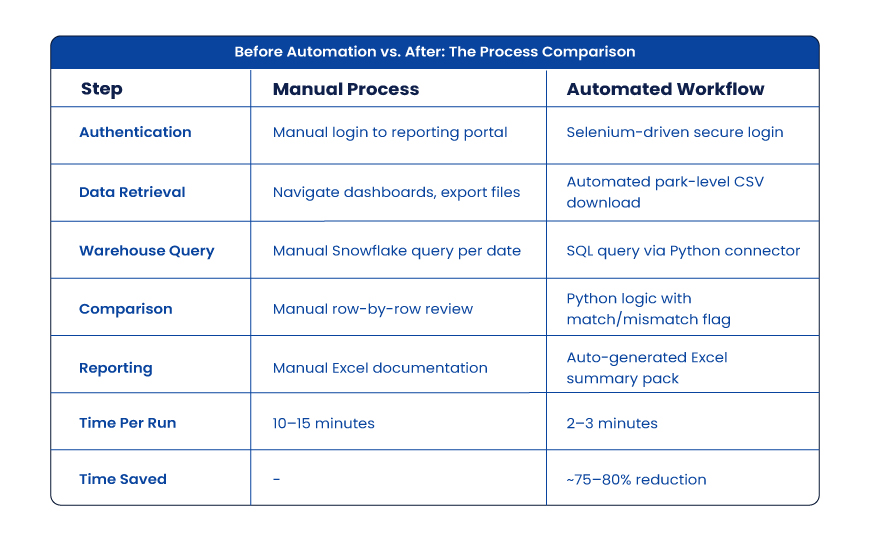
Once the business rules were validated manually, I designed an automation framework using Python, Selenium, SQL, and Excel reporting to reduce repetitive reconciliation effort, similar to other config-driven data automation implementations built for scalable enterprise workflows.

Before Automation vs. After: The Process Comparison

 That speed gain allowed more frequent checks, faster defect isolation, and stronger release readiness.

Automation Delivers Leverage

Once metric logic and report behavior are understood, automation becomes a force multiplier.

In this program, I designed Python-based validation workflows integrating multiple technologies:

  • Python for orchestration and comparison logic
  • SQL for warehouse reconciliation
  • Snowflake for source/target metric extraction
  • Selenium for controlled portal interactions and report retrieval
  • GitHub for version control and maintainability
  • Excel outputs for business-readable evidence packs

This hybrid model reduced repetitive reconciliation cycles dramatically while improving repeatability.

Instead of spending analyst time re-running the same checks manually, teams could focus on exceptions, defects, and release readiness. This is where intelligent automation solutions deliver measurable business impact by eliminating operational friction while improving accuracy.

That is where automation creates strategic value-not replacing testers, but removing waste.

Business Impact Beyond Speed

Across the migration program:

  • 19 reports completed, with remaining reports progressing through the pipeline
  • 75 defects identified and corrected
  • Zero rebuttals raised against QA findings
  • SIT to UAT movement became measurably more efficient
  • Stakeholder confidence improved at the executive level

Most importantly, the organization moved closer to retiring its costly legacy environment and realizing the full ROI from its modern data platform investment.

Why Manual + Automation Is the Winning Formula

Many teams frame this as a binary choice – manual testing or automation, human expertise or scripts. In migration programs, that framing is the problem.

The strongest model runs both tracks in sequence:

  • Manual Precision handles understanding business logic, exploratory testing, edge-case analysis, user acceptance readiness, and data trust validation.
  • Automated Scale handles repeatable reconciliation, regression testing, high-volume comparisons, faster feedback cycles, and continuous confidence checks.

One provides judgment. The other provides speed. You need both, and in that order.

Final Thoughts

Workspace migrations succeed when users confidently stop looking back.

That confidence does not come from architecture diagrams or project plans alone. It comes from proven numbers, tested reports, and reliable validation frameworks.

As QA professionals, our role is no longer just finding defects at the end.In modern migration programs, we help organizations move forward with certainty.And that starts with manual precision, backed by automated scale.

Frequently Asked Questions

1. What is a hybrid QA strategy in data warehouse migration?
A hybrid QA strategy pairs manual testing for business logic discovery with automated testing for high-volume reconciliation. Manual catches edge cases early; automation scales validated checks across reports. The result: faster data migration QA with fewer defects and stronger stakeholder confidence.

2. When should you start automating QA during a migration project?
After manual validation confirms your source of truth, business rules, and pass/fail criteria. Automating before that foundation exists scales bad assumptions. Most enterprise data migration programs need 2–4 weeks of structured manual testing before the first automation script runs.

3. How do you resolve discrepancies between a legacy system and a new platform?
Introduce a third reference: the operational source system. If the new platform matches it and the legacy warehouse doesn’t, the legacy system is wrong. This independent validation approach accelerates stakeholder buy-in and clears the path to cutover faster.

4. What tools are used in automated QA for data migration testing?
The most common stack: Python (orchestration), SQL (reconciliation queries), Snowflake (cloud warehouse extraction), Selenium (portal automation), GitHub (version control), and Excel (stakeholder reporting). Together, they cover most enterprise migration QA use cases end to end.

5. How does migration QA impact AI-driven analytics and AIOps pipelines?
AI models queried against migrated data inherit any undetected errors from the migration layer. A rigorous QA framework, especially one validating multi-year historical data against source systems, reduces hallucinated insights in downstream AI tools. Clean migration data is the prerequisite for trustworthy AI outputs.

Why Most Hospice AI Projects Fail Without Data Readiness?

Summary 

  • Most hospice AI initiatives fail due to poor data readiness, not weak algorithms  
  • Fragmented EMR, referral, and payer data limits predictive accuracy  
  • AI readiness requires unified data, governance, and real-time integration  
  • High-impact use cases include referral automation, predictive care, and revenue integrity  
  • A data-first strategy is critical before investing in AI tools  

Introduction

Walk into any hospice boardroom today and one topic dominates the agenda: AI. 

From predictive analytics to workflow automation, hospice leaders are actively exploring how AI can solve staffing shortages, compliance pressure, and shrinking margins. 

Financial pressure is becoming increasingly difficult for hospice providers to absorb. According to the latest reimbursement update from the Centers for Medicare & Medicaid Services, hospices received a 2.6% increase in Medicare base rate payments for 2026, slightly above the initially proposed 2.4% adjustment. While this translates to approximately $750 million in additional federal hospice spending, many providers continue to face rising labor, compliance, and operational costs that outpace reimbursement growth. The hospice aggregate payment cap also increased to $35,361.44 in 2026, reinforcing the need for organizations to improve efficiency, visibility, and financial control across care operations. 

In this environment, hospice organizations are increasingly being asked to deliver better outcomes without proportional increases in reimbursement, making operational intelligence and data-driven efficiency critical priorities. 

But there is a problem, most conversations overlook. 

AI is only as effective as the data it runs on. And in hospice care, that data is often fragmented, inconsistent, and disconnected. 

As leaders prepare for NPHI 2026 Summit, the real question is not which AI vendor to choose. 

The real question is whether your organization is ready for AI at all. 

Why Do Most Hospice AI Projects Fail? 

Most AI failures in hospice do not happen after deployment. They happen before a model is even trained. 

The root cause is data fragmentation. 

Across many hospice organizations: 

  • Patient records exist across multiple EMRs and legacy systems  
  • Referral data remains locked in fax or unstructured formats  
  • Clinical documentation varies across caregivers  
  • Payer, operational, and care data do not connect  

Individually, these issues seem manageable. Together, they create a system where AI models operate on incomplete and duplicated data. 

This leads to a dangerous outcome. 

AI does not simply produce wrong answers. It produces confident wrong answers. 

In hospice care, that risk directly impacts patient outcomes, compliance, and revenue.

What Does AI-Ready Data Mean in Hospice Care? 

What Does AI-Ready Data Mean in Hospice Care

AI readiness is not about buying technology. It is about building the right data foundation. 

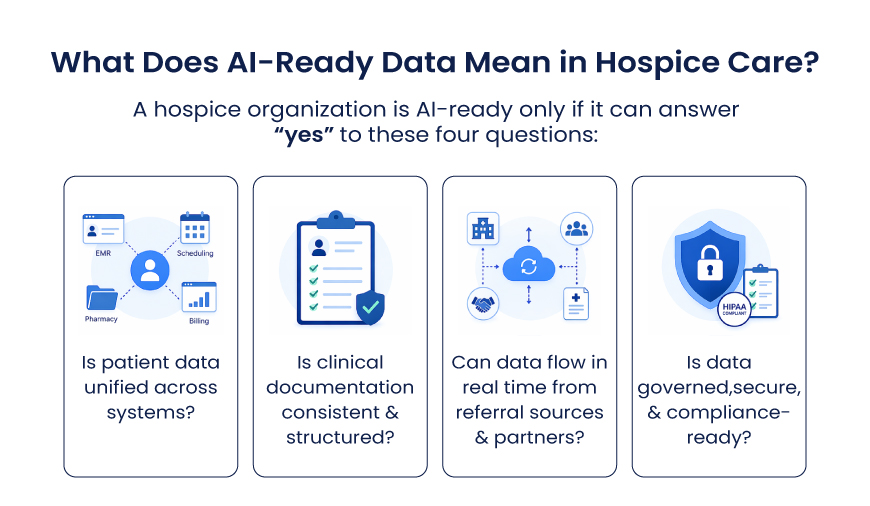
A hospice organization is AI-ready only if it can answer “yes” to these four questions: 

  1. Is patient data unified across systems?  
  1. Is clinical documentation consistent and structured?  
  1. Can data flow in real time from referral sources and partners?  
  1. Is data governed, secure, and compliance-ready?  

This is where most organizations struggle. Not because they lack tools, but because they lack a connected data foundation. 

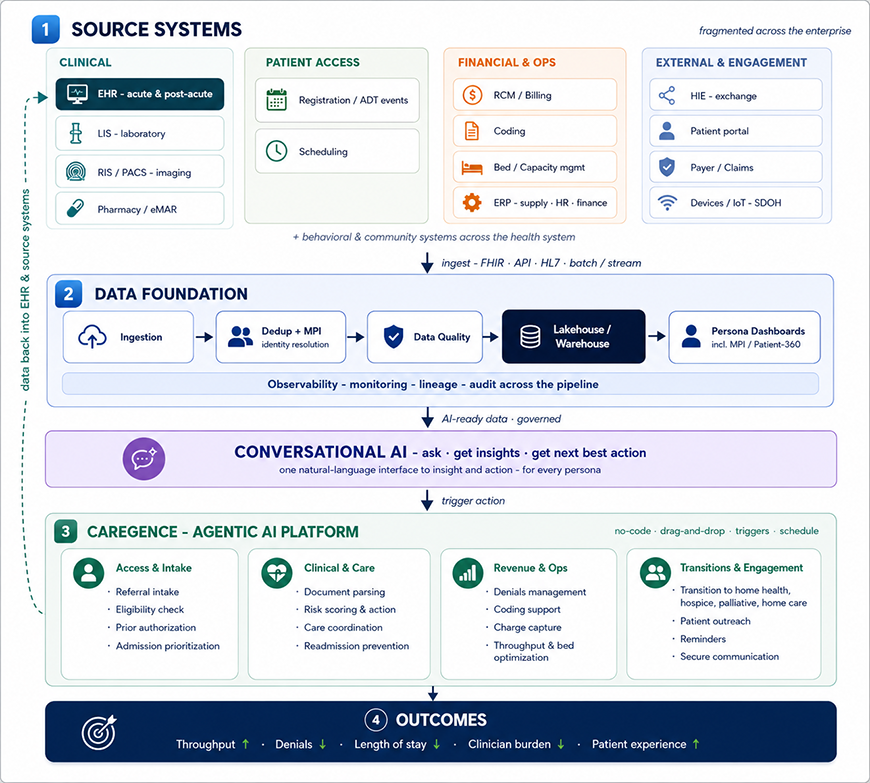
In practice, leading organizations are moving toward a unified approach where clinical, operational, and financial data are brought together into a single layer before any AI is applied. Healthcare workflow automation platforms like Caregence are built around this principle, ensuring that AI operates on a consistent and reliable view of patients, workflows, and outcomes. 

If any of these conditions are missing, AI investments will underperform regardless of the vendor or model quality.

What Data Challenges Prevent AI Adoption in Hospice? 

Most hospice organizations do not lack data. They are lacking usable data. 

Common challenges include: 

  • Duplicate patient records across systems  
  • Unstructured referral intake processes  
  • Siloed clinical, financial, and staffing data  
  • No real-time integration with hospital partners  
  • Manual compliance and audit workflows  

These are operational bottlenecks that directly limit AI effectiveness.

Where AI Creates the Most Value in Hospice Operations 

Where AI Creates the Most Value in Hospice Operations

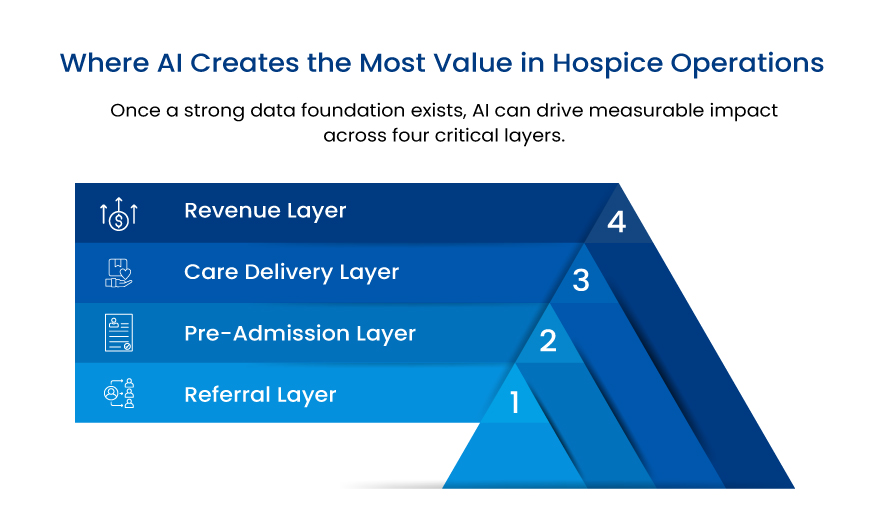
Once a strong data foundation exists, AI can drive measurable impact across four critical layers. 

1. Referral Layer: Where Revenue Is Won or Lost 

Hospitals are now a primary referral source. Speed is everything. 

AI can: 

  • Convert referrals into structured data 
  • Score eligibility in real time 
  • Flag conversion risks early 

Even small improvements here create significant impact at scale. 

2. Pre-Admission Layer: Predict Before You Commit 

AI enables better decision-making before admitting patients. 

With clean data, models can predict: 

  • Length of stay  
  • Patient risk  
  • Cost alignment  

This allows organizations to plan proactively instead of reacting later. 

3. Care Delivery Layer: Proactive, Not Reactive Care 

This is where AI begins to influence clinical outcomes. 

Predictive models can: 

  • Detect deterioration signals  
  • Trigger timely interventions  
  • Support compliance with frameworks like HOPE  

Care shifts from reactive to proactive. 

4. Revenue Layer: Compliance and Financial Protection 

Audit pressure is increasing across hospice organizations. 

AI can: 

  • Align clinical and billing data  
  • Flag inconsistencies  
  • Generate audit-ready documentation  

This reduces financial risk and strengthens compliance.

The Caregiver Equation: Why This Is Also a Workforce Problem 

Most caregiver burnout is driven by friction, not compensation. 

Scheduling inefficiencies, repetitive documentation, and disconnected tools reduce time spent on patient care. 

A connected, data-driven environment can: 

  • Reduce administrative burden  
  • Improve onboarding  
  • Enable better caregiver-patient matching  

Even a small improvement in retention creates significant financial and operational impact. 

Case in point: Inferenz modernized a fragmented enterprise data ecosystem for a large healthcare organization, creating a unified digital front door that improved data accessibility, streamlined patient engagement workflows, and enabled faster, more coordinated care operations across systems through an enterprise data platform modernization initiative. 

How Can Hospice Organizations Become AI-Ready? 

How Can Hospice Organizations Become AI-Ready?

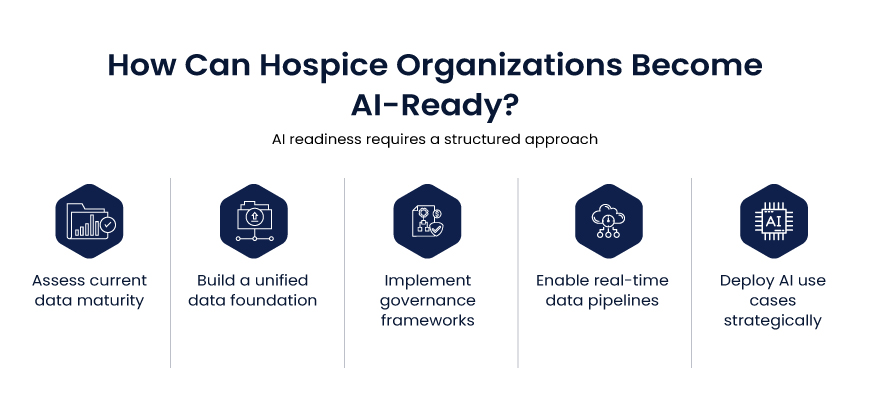
AI readiness requires a structured approach: 

  • Assess current data maturity  
  • Build a unified data foundation  
  • Implement governance frameworks  
  • Enable real-time data pipelines  
  • Deploy AI use cases strategically  

This shift is already operationalized through healthcare-native platforms that unify data, workflows, and AI into a single ecosystem. AI-based workflow automation solutions like Caregence reflect this approach, helping organizations move from fragmented systems to connected, AI-ready operations. 

Key Takeaways 

  • AI success depends on data quality, not algorithms  
  • Fragmented data is the biggest barrier to adoption  
  • Unified data enables predictive intelligence  
  • Compliance and governance are essential  
  • A data-first approach drives ROI  

Conclusion: The Real Decision Hospice Leaders Must Make 

Every AI investment will perform exactly as well as the data behind it. 

Hospice leaders today face pressure across margins, compliance, workforce, and referrals. These are not separate challenges. They all stem from the same issue: fragmented data. 

The decision is not which AI tool to implement. 

The decision is whether to build the data foundation that makes agentic AI work. 

Organizations that move toward a connected, data-first model will lead to the next phase of hospice transformation. Increasingly, this is being enabled through platforms that unify data, workflows, and intelligence into a single layer. Enterprise workflow automation solutions like Caregence represent what this future looks like in practice. 

Ready to Make Your Data AI-Read

FAQs 

What is AI readiness in hospice care? 

AI readiness in hospice means your patient data is unified, deduplicated, and governed well enough for predictive models to trust it. That starts with resolving fragmented records across EMRs into a single patient view. Without it, any AI tool you deploy is making clinical and operational predictions on incomplete information. 

Why does AI fail in hospice organizations? 

Most hospice AI projects fail before a single prediction is made, not because of the algorithm, but because of the data underneath it.  

Patient records spread across multiple EMRs, referral data trapped in fax format, and financial systems that never talk to clinical systems create a foundation that AI models cannot work from reliably. The result is confident predictions based on inaccurate inputs, which is worse than no prediction at all. 

What are the top AI use cases in hospice? 
The four highest-value areas are:  

  • Referral automation (converting fax-based intake into structured, scored records in real time) 
  • Predictive care planning (forecasting LOS, PPS progression, and deterioration risk before clinical decline) 
  • Staffing optimization (matching caregiver skills and geography to patient needs dynamically), and  
  • Revenue integrity (flagging GIP billing patterns that don’t align with clinical documentation before an audit does).  

Each of these requires a clean, unified data layer to work accurately. 

How can hospice leaders prepare for AI adoption? 

Start with the data, not the model.  

That means auditing your current EMR and RCM integrations for gaps, building real-time ingestion pipelines from referral partners and payers, implementing data quality and deduplication frameworks, and establishing governance controls that keep data HIPAA-aligned and CMS-compliant. Organizations that complete this foundation consistently get more from AI tools than those who deploy AI first and fix data problems later. 

What role does compliance play in hospice AI? 

Compliance is both a constraint and a driver.  

CMS’s HOPE tool requires real-time, multi-visit clinical documentation with tight submission windows. Non-compliance risks a 4% Medicare payment reduction. An AI system built on governed, audit-ready data can automate HOPE scheduling, alert on missed Symptom Follow-Up Visits, and submit to iQIES within compliance windows.  

In that context, compliance is one of the clearest ROI arguments for investing in it.