











Summary
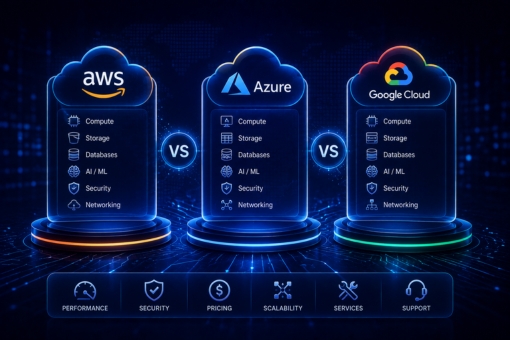
AWS vs Azure vs Google Cloud (GCP) together control more than 65% of the global cloud market. Each platform offers distinct strengths: AWS leads in breadth and global scale, Azure excels in enterprise integration and hybrid cloud, and GCP dominates in data analytics and AI-native workloads. Choosing the right platform depends on your workload type, existing technology stack, and long-term data strategy. This guide delivers a structured, decision-ready comparison to help technology and business leaders make an informed choice.
Introduction: The Cloud Decision That Defines Your Infrastructure
Most organizations recognize that cloud migration is no longer optional. However, selecting the right cloud provider remains one of the most consequential infrastructure decisions a business can make.
The wrong choice leads to vendor lock-in, unexpected costs, performance gaps, and significant rework. Many enterprises invest months in evaluation, only to realize their original choice no longer fits as workloads scale or requirements evolve.
AWS, Microsoft Azure, and Google Cloud Platform each present compelling cases. Furthermore, their feature sets, pricing models, compliance offerings, and ecosystem integrations differ in ways that matter enormously at scale. Therefore, a generic recommendation serves no one well.
This blog breaks down every critical dimension of the AWS vs Azure vs GCP debate, from compute and storage to AI capabilities, pricing, and real-world enterprise fit, so your team can move forward with clarity and confidence.
Understanding the Three Cloud Giants
Amazon Web Services (AWS)
Amazon launched AWS in 2006, and it has since grown into the world’s most comprehensive cloud platform. AWS currently offers more than 200 fully featured services across compute, storage, databases, networking, analytics, IoT, machine learning, and developer tools.
Key platform attributes include:
- Global footprint: 33 geographic regions and 105 availability zones, the largest of any provider
- Market share: AWS holds approximately 31% of the global cloud market as of 2026
- Pricing model: Pay-as-you-go, with Reserved and Savings Plan options for cost optimization
- Enterprise trust: Companies such as Netflix, Coinbase, Expedia, and Coca-Cola rely on AWS at scale
AWS suits organizations that prioritize service breadth, operational flexibility, and the ability to run complex, multi-region workloads. Additionally, its massive community, documentation library, and third-party tool ecosystem reduce the time-to-value for most deployment scenarios.
For enterprises pursuing Cloud Management Solutions at scale, AWS provides one of the most mature operational frameworks available, including AWS Control Tower for governance and AWS Organizations for multi-account management.
Microsoft Azure
Microsoft Azure holds approximately 24% of the cloud market and remains the top choice for enterprises already operating within the Microsoft ecosystem. Azure integrates natively with Microsoft 365, Active Directory, Teams, Dynamics 365, and the broader Power Platform.
Key platform attributes include:
- Enterprise penetration: Azure serves 95% of Fortune 500 companies
- Compliance breadth: 90+ compliance certifications across regulated industries including healthcare, finance, and government
- Hybrid cloud: Azure Arc and Azure Stack extend cloud capabilities directly to on-premises environments
- Global reach: 60+ regions, making it the provider with the broadest geographic coverage
Businesses replacing on-premise infrastructure or adopting hybrid cloud strategies will find Azure the most natural fit. Moreover, Azure’s seamless Active Directory integration simplifies identity management across large organizations.
Google Cloud Platform (GCP)
Google Cloud Platform, originally launched as App Engine in 2008, holds approximately 11% of the global cloud market. While GCP trails AWS and Azure in overall service breadth, it leads in specific high-value domains.
Key platform attributes include:
- Data and AI superiority: BigQuery, Vertex AI, and TensorFlow on GCP represent the most advanced native analytics and machine learning stack available
- Open-source commitment: GCP leads in Kubernetes (which Google originally created), Istio, and Knative adoption
- Network performance: Google’s private global fiber network delivers consistently low-latency performance
- Developer-centric: Strong DevOps integration and container-native architecture
Companies such as Spotify, Toyota, and Equifax leverage GCP specifically for its data capabilities. In particular, organizations pursuing AI-first or data-platform strategies will find GCP’s tooling meaningfully ahead of competitors in those domains.
AWS vs Azure vs GCP: Detailed Feature Comparison
Compute and Virtual Machines
| Capability | AWS | Azure | GCP |
|---|---|---|---|
| Virtual Machines | EC2 (Elastic Compute Cloud) | Azure Virtual Machines | Google Compute Engine |
| PaaS | AWS Elastic Beanstalk | Azure App Service | Google App Engine |
| Containers | EKS / ECS | Azure Kubernetes Service (AKS) | Google Kubernetes Engine (GKE) |
| Serverless | AWS Lambda | Azure Functions | Google Cloud Functions |
AWS EC2 offers the widest instance variety, with hundreds of instance types optimized for compute, memory, storage, and GPU workloads. Azure Virtual Machines benefit from tight Windows Server integration. GKE, however, remains the industry benchmark for managed Kubernetes due to Google’s foundational role in the technology.
Storage Architecture
| Capability | AWS | Azure | GCP |
|---|---|---|---|
| Object Storage | Amazon S3 | Azure Blob Storage | Google Cloud Storage |
| File Storage | Amazon EFS | Azure Files | Filestore |
| Archive Storage | S3 Glacier | Azure Archive | Cloud Storage Archive |
| Data Warehouse | Amazon Redshift | Azure Synapse Analytics | BigQuery |
Amazon S3 is the gold standard for object storage, with near-universal third-party support and a mature feature set. Nevertheless, BigQuery stands out as the most powerful serverless data warehouse for analytical workloads, processing petabytes without infrastructure management.
Networking and Security
| Capability | AWS | Azure | GCP |
|---|---|---|---|
| Virtual Network | Amazon VPC | Azure VNets | Virtual Private Cloud |
| DNS | Amazon Route 53 | Azure DNS | Google Cloud DNS |
| CDN | Amazon CloudFront | Azure CDN | Google Cloud CDN |
| Firewall | Available (full) | Available (full) | Available (limited) |
AWS Route 53 provides advanced traffic routing with latency-based, geolocation, and failover capabilities. Azure’s networking layer integrates more naturally with on-premises networks through ExpressRoute. GCP’s network, however, benefits from Google’s own private infrastructure, delivering exceptional throughput for data-intensive applications.
AI, Machine Learning, and Analytics
This dimension increasingly separates the three providers in 2026.
AWS AI and ML services include SageMaker (end-to-end ML lifecycle), Bedrock (foundation models), Comprehend, Rekognition, Polly, Lex, and Transcribe. AWS Bedrock now provides access to third-party foundation models from Anthropic, Meta, and Mistral.
Azure AI services include Azure Machine Learning, Azure OpenAI Service (with GPT-4o access), Cognitive Services, and Azure Bot Service. Azure’s partnership with OpenAI gives it a distinctive advantage for enterprises building generative AI applications on familiar Microsoft infrastructure.
GCP AI and ML services include Vertex AI, Gemini API, AutoML, and the original TensorFlow ecosystem. Furthermore, GCP’s BigQuery ML allows teams to run machine learning models directly inside the data warehouse without moving data.
For enterprises pursuing Data and Cloud Modernization Services and Solutions, GCP’s integrated data-to-AI stack offers the most cohesive path from raw data ingestion to production model deployment.
Pricing Comparison: What You Actually Pay
Cloud pricing involves compute, storage, data transfer, and managed service costs. Comparing list prices rarely reflects real-world spend.
AWS Pricing Model
AWS charges on a pay-as-you-go basis. Reserved Instances (1-year or 3-year) reduce costs by up to 72% compared to on-demand pricing. AWS Savings Plans offer flexible pricing across instance families and regions. However, data egress costs remain a common source of billing surprises.
Azure Pricing Model
Azure pricing is generally competitive with AWS for Windows-based workloads, particularly because Microsoft licenses are often pre-included or discounted through existing enterprise agreements. Organizations with existing Windows Server and SQL Server licenses can reduce cloud costs significantly through the Azure Hybrid Benefit program. For enterprises already invested in Microsoft’s licensing ecosystem, this combination frequently delivers the lowest effective cost.
GCP Pricing Model
GCP introduced sustained use discounts that apply automatically without requiring upfront commitments. Committed use discounts offer deeper savings on predictable workloads. Additionally, GCP’s per-second billing (versus AWS and Azure’s per-minute minimums) provides incremental savings for short-duration workloads.
For most enterprises, AWS and Azure deliver comparable total cost of ownership, while GCP can undercut both on certain compute-heavy workloads with careful configuration.
Cloud Compliance and Security Posture
AWS Compliance
AWS maintains more than 140 compliance certifications, including FedRAMP, HIPAA, SOC 1/2/3, ISO 27001, and PCI DSS. On-demand access to compliance documentation is available through AWS Artifact. For federal and defense workloads with the highest regulatory requirements, AWS GovCloud (US) provides a dedicated, isolated environment.
Azure Compliance
Azure leads in compliance breadth with 90+ offerings across 50+ regions. Its deep government and regulated industry penetration reflects strong compliance tooling. Azure Blueprints and Policy automate compliance enforcement at scale, making governance management significantly more efficient for large enterprises.
GCP Compliance
GCP maintains a strong compliance posture, though its coverage is narrower than AWS or Azure. It holds FedRAMP High, HIPAA, PCI DSS, and ISO certifications. However, enterprises in heavily regulated sectors such as healthcare or defense will find AWS or Azure more comprehensively documented.
Strengths, Limitations, and Ideal Use Cases
AWS: Best for Scale, Breadth, and Flexibility
Strengths:
- Largest global infrastructure with the most availability zones
- Broadest service catalog with the deepest feature maturity
- Largest partner ecosystem and third-party tool integration
- Strong pay-as-you-go model suitable for variable workloads
Limitations:
- Complex pricing structure requires careful cost governance
- Steep learning curve for teams without prior AWS experience
- Management overhead for large multi-account environments
Ideal for: Enterprises, ISVs, and fast-scaling startups that need maximum flexibility, broad service selection, and global reach.
Azure: Best for Enterprise Integration and Hybrid Cloud
Strengths:
- Seamless integration with Microsoft 365, Active Directory, and Dynamics
- Industry-leading hybrid cloud capabilities through Azure Arc and Stack
- Strong compliance and governance tooling for regulated industries
- Azure OpenAI Service for enterprise generative AI workloads
Limitations:
- Performance can vary by region for non-Microsoft workloads
- Vendor concentration risk for Microsoft-heavy organizations
- Less suitable for greenfield cloud-native applications without existing Microsoft dependencies
Ideal for: Enterprises deeply invested in the Microsoft ecosystem, organizations running hybrid cloud environments, and businesses in regulated industries.
Organizations evaluating CloudOps Services on Azure benefit from its native integration with Microsoft Defender for Cloud, Azure Monitor, and Azure Policy, which simplify day-two operations considerably.
GCP: Best for Data, AI, and Cloud-Native Workloads
Strengths:
- Market-leading data analytics with BigQuery
- Most advanced native AI and ML tooling with Vertex AI and Gemini
- Kubernetes expertise and open-source leadership
- Competitive pricing with automatic sustained-use discounts
Limitations:
- Narrower service catalog compared to AWS and Azure
- Fewer global data center locations
- Smaller partner and support ecosystem
- Higher operational complexity when transitioning from GCP to other platforms
Ideal for: Data-first organizations, AI-native product teams, and companies competing with Amazon that require an alternative to AWS.
How to Choose: A Decision Framework
Rather than declaring a universal winner, consider these decision criteria:
Choose AWS if:
- You require the broadest service portfolio and maximum global availability
- Your team values flexibility and ecosystem independence
- You run diverse workloads across multiple industries and verticals
Azure is the right fit if:
- Your organization runs Microsoft 365, Active Directory, or Dynamics at scale
- You operate in a regulated industry with complex compliance requirements
- You need a robust hybrid cloud strategy connecting on-premises to the cloud
GCP makes the most sense when:
- Data analytics, machine learning, or AI are central to your product strategy
- You prefer open-source-first infrastructure with strong Kubernetes capabilities
- You want competitive pricing with automatic discounts and per-second billing
For most large enterprises, a multi-cloud strategy combining AWS or Azure as the primary platform with GCP for analytics or AI workloads delivers the strongest outcome. In contrast, organizations early in their cloud journey benefit most from committing to a single platform to reduce operational complexity.
Conclusion
The AWS vs Azure vs GCP debate does not produce a single correct answer. Instead, it requires honest assessment of your organization’s technology stack, workload profile, compliance obligations, and long-term data strategy.
AWS offers unmatched depth and global scale, making it the default choice for organizations that value flexibility above all else. Azure delivers the strongest value for enterprises already operating within the Microsoft ecosystem, particularly those navigating hybrid cloud or regulated environments. GCP provides the most advanced data and AI capabilities, making it the preferred choice for organizations where analytics drives competitive advantage.
The most successful enterprises do not choose based on brand recognition alone. They align platform capabilities to specific workload requirements, build governance models that control cost and risk, and retain the ability to evolve their architecture as the cloud landscape continues to change.
For organizations seeking expert guidance on cloud platform selection, architecture design, or migration strategy, working with a specialized partner can compress evaluation timelines and reduce the risk of costly rework. The right platform, implemented correctly, becomes a durable foundation for growth.
Frequently Asked Questions
1. What is the main difference between AWS, Azure, and Google Cloud?
AWS leads in service breadth and global infrastructure, making it the most versatile choice across workload types. Azure integrates most deeply with Microsoft enterprise products and hybrid environments. GCP specializes in data analytics, machine learning, and open-source cloud-native workloads. Each platform serves distinct enterprise needs rather than competing on identical terms.
2. Which cloud platform is cheapest: AWS, Azure, or GCP?
GCP typically offers the lowest list prices for compute, backed by automatic sustained-use discounts and per-second billing. However, Azure often delivers the best effective cost for enterprises with existing Microsoft licensing through its Hybrid Benefit program. AWS provides competitive pricing with Reserved Instances and Savings Plans. Total cost of ownership depends heavily on workload type, commitment level, and licensing agreements already in place.
3. Which cloud provider is most secure?
All three providers meet high security standards and hold major compliance certifications. AWS leads in total compliance certifications at 140+, Azure leads in regulated-industry penetration and governance tooling, and GCP provides strong security for cloud-native workloads. The most important factor is not which provider is inherently more secure, but how well your team configures and manages security controls within the platform you choose.
4. Is AWS still the best cloud platform in 2026?
AWS remains the market leader by revenue and service breadth in 2026. However, Azure has closed the gap significantly in enterprise adoption, and GCP leads in AI and data capabilities. “Best” depends entirely on use case: AWS wins on flexibility and ecosystem, Azure on enterprise integration, and GCP on data and AI. No single provider dominates across all dimensions.
5. Can a business use more than one cloud provider?
Yes, and many large enterprises do. A multi-cloud strategy uses different providers for different workloads, for example, AWS for primary application hosting, GCP for analytics and machine learning, and Azure for Microsoft-integrated workflows. Multi-cloud reduces vendor lock-in and allows workload placement optimization. However, it also increases operational complexity and requires robust cloud governance to manage cost, security, and performance across platforms.
6. How do AWS, Azure, and GCP support AI and machine learning?
AWS provides SageMaker for end-to-end ML lifecycle management and Bedrock for foundation model access. Azure offers Azure Machine Learning and Azure OpenAI Service for enterprise generative AI. GCP provides Vertex AI and BigQuery ML as an integrated data-to-model pipeline. For organizations where AI is a core capability, GCP’s native stack and Azure’s OpenAI partnership represent the most mature options in 2026.
7. Which cloud platform is best for healthcare organizations?
Azure and AWS are the strongest choices for healthcare. Both maintain HIPAA Business Associate Agreements (BAAs), FedRAMP authorization, and extensive healthcare-specific compliance tooling. Azure’s integration with Microsoft healthcare products and its broad regulated-industry footprint gives it a slight edge for clinical systems. AWS, however, provides more flexibility for health tech companies building cloud-native applications.