




Natural Language Analytics: A Simple Doorway to Deeper Home-Care Insight

Summary

Home-care leaders need answers in real time. Our stack joins Snowflake, CrewAI, Neo4j, and GraphRAG; Grok3 writes the SQL, while Azure OpenAI crafts the insights and formats the results for the best-fit chart— all in seconds. A six-step flow rewrites the query, tags intent, adds knowledge-graph context, writes Snowflake-ready SQL, and shapes the result while keeping HIPAA data safe.  

Early runs cut report queues by 90 percent, surfaced overtime risk days sooner, and set the scene for smarter patient-caregiver matching. -Care teams swim in data. Payroll records, visit logs, EMR notes, and staffing rosters sit in different tools and formats.  

Now, when a manager wants a quick view — “Which aides carried more than ten active cases last month?”— they often wait on analysts or write fragile SQL by hand.  

A natural-language-to-SQL (NLQ-to-SQL) layer fixes that gap. It lets any leader ask plain-English questions and see answers powered by natural language analytics 

Large health systems have already shown the impact of agentic AI in research; now the same model can drive natural language processing for sharper caregiver workload insight and smarter staffing balance

What We Built? And Why? 

Our home-care clients kept raising the same pain point: “We have mountains of data, yet simple staffing questions still take a day.” We wanted a proof of concept that showed how NL2SQL, natural language analytics, and agentic AI could shorten that wait to seconds. The goal was not a lab toy but a tool busy branch managers could trust before the next shift roster went live. 

We began with five key parts working as one: 

  • CrewAI agents + FastAPI served the front door. FastAPI gave us a light web layer, while CrewAI split each task—rewrite, intent check, SQL build, chart—for cleaner tests and quick swaps. 
  • Snowflake handled storage and compute. Its near-instant clones let us demo new data models without copying terabytes. 
  • Neo4j plus a GraphRAG step kept the schema map tight. Each user question only pulled tables that mattered, so the large language model stayed on track. 
  • Grok3 on Azure OpenAI acted as the fallback. When Snowflake flagged a syntax error, the agent sent the message back to Grok3, got a cleaned query, and reran it.  
  • Smart Visualizer Service then scanned the result set, picked the best chart type, and shaped the data for instant display—raising successful answers by about 20 percent. 

Security was non-negotiable. Every call ran inside HIPAA guardrails. Role-based views made sure a branch supervisor could see staffing tables but never payroll for another region. We leaned on CrewAI’s Snowflake connector. Although CrewAI does not yet call Snowflake’s new data-agent hooks first unveiled at Snowflake Summit 2025, the built-in link let our agents run inside the warehouse instead of in a sidecar, trimming weeks from our schedule. 

The result is terrific. This living pilot answers real staffing load, overtime, and visit-gap questions in seconds. It proves that a small, well-planned stack can turn scattered caregiver data into clear action—exactly the clarity home-care CIOs ask for every quarter.

Meet the Five Agents that Own their Tasks

We wanted a flow that felt like a relay race rather than a black box. So, we broke the NLQ-to-SQL path into five lean agents, each with a single duty.  

  • Query Rewriter cleans the user question. 
  • Intent Detector tags the goal. 
  • GraphRAG Context Agent calls the knowledge graph to fetch domain terms, KPI rules, and approved joins. 
  • SQL Generator writes Snowflake code. 
  • Visualizer shapes the chart. 

By giving every agent one clear task, we keep bugs local and upgrades quick. Here’s the lineup that powers our natural language analytics for home-care data: 
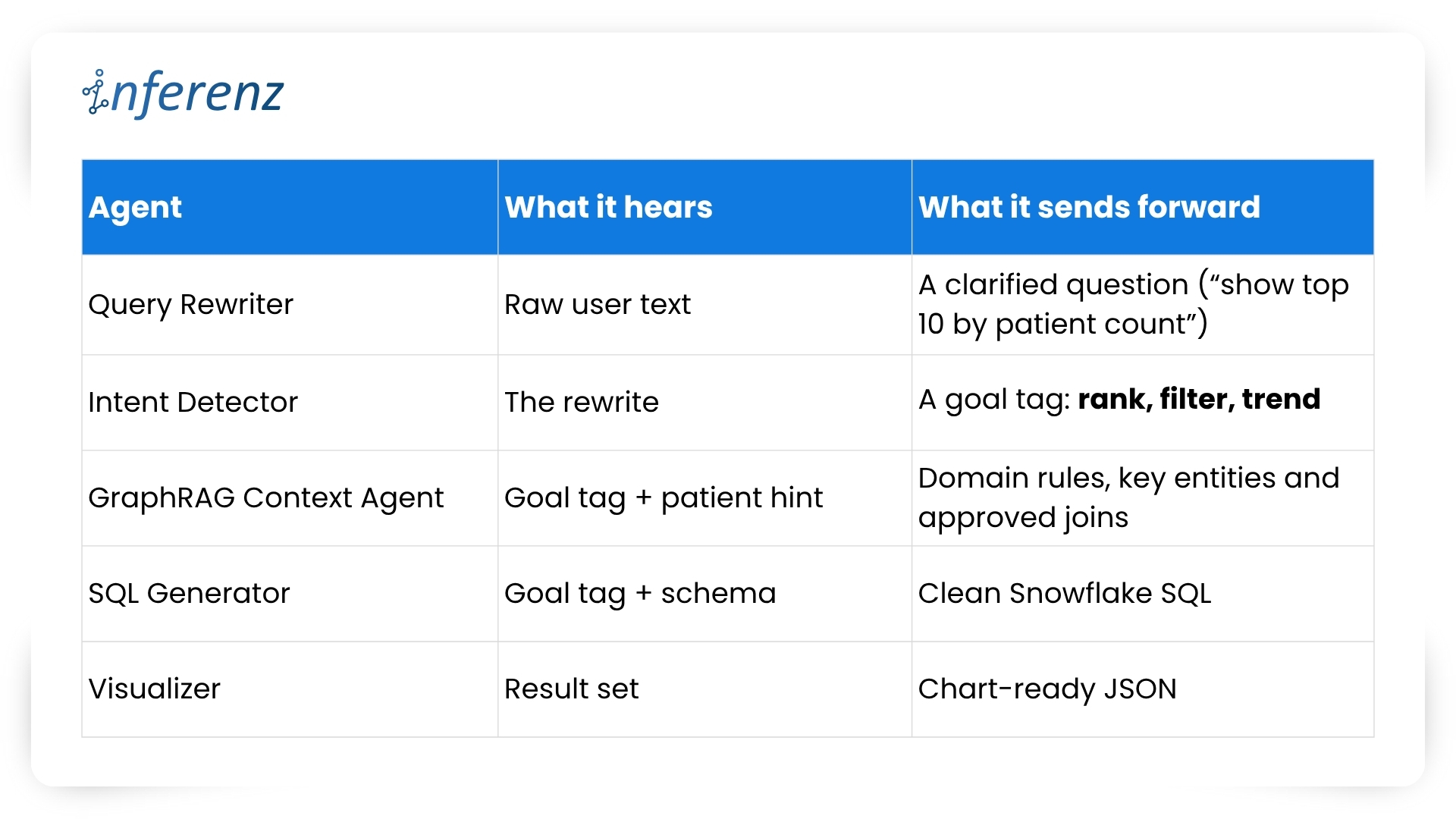
Each agent owns one step. That keeps fixes small and testable. 

The Challenges We Faced 
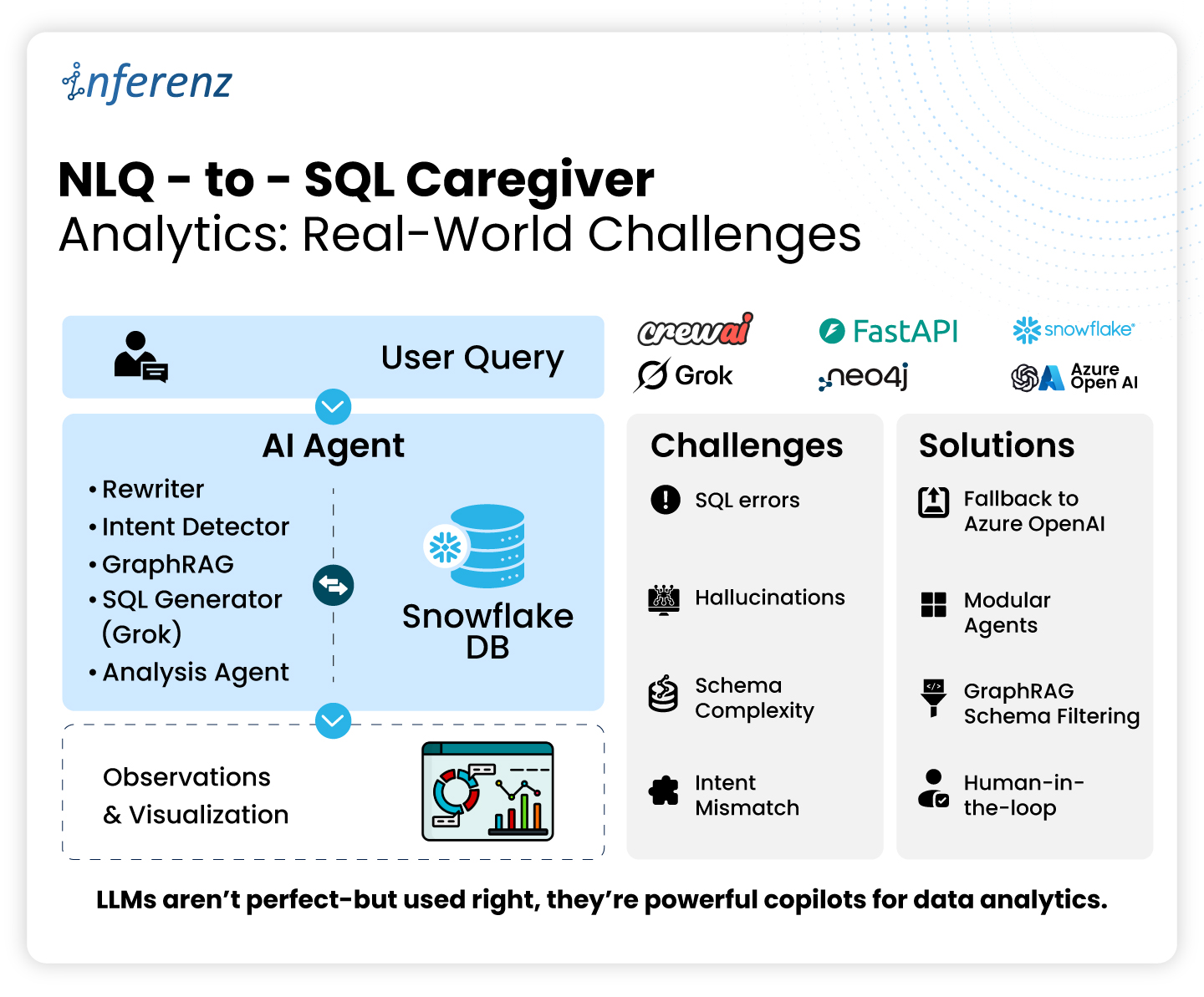
  1. Wrong columns, wrong joins
    Agents guessed table names that looked right but were not in the model. 
  2. Generic SQL
    Public training sets leaned the model toward Postgres-style syntax, which Snowflake then rejected. 
  3. Loose questions
    A user typed “caregiver workload Q1” with no metric or slice. 
  4. Bigger schema, louder noise
    The healthcare data warehouse stored 300+ tables. Many of them were redundant and confusing for the model. 
  5. Context drop in follow-ups
    “Now show only California” lost the link to the prior result. 

How We Fixed Them

  • Error-aware fallback
    When Snowflake raised an error, we fed the message to Fallback agent powered by Grok3. Success jumped by 18%. 
  • GraphRAG pruning
    Neo4j stored a knowledge graph representing tables, columns, KPI definitions, dashboards and their relationships. The SQL agent looked up only what matched the question. Speed and accuracy both rose, considerably. 
  • Prompt tuning
    We shifted prompts from “write SQL” to “return a list of steps you will take, then SQL.” Planning before code cut hallucinations. 
  • Modular tests
    Because each agent is a micro-service, we swapped versions without hitting the front end. 

A Week in Production: Real Questions We Saw

During the first week of our pilot, the natural language analytics layer fielded real-world questions such as: 

  1. “Show caregivers with missed-visit rates over five percent for June.” 
  2. “Chart overtime hours by branch for this year.” 
  3. “Rank each RN by the number of first-time patients they onboarded last quarter.” 

Powered by our stack of AI agents in healthcare and agentic AI, every request returned in seconds and fed an instant bar or line chart. Supervisors used the answers in daily huddles to fine-tune rosters with our AI-based home healthcare scheduling software, easing overload and lowering caregiver burnout risk.  

Recruiting and retention of homecare workers top the 2024 agenda across home health care agencies, while steady insight keeps patient visits—and morale—on track. 

Why It Matters for CIOs in Home Care 

Here’s what real-time home care analytics powered by natural language analytics and agentic AI delivers where it counts. The gains below hit staffing, compliance, cost, and morale—core metrics every CIO tracks. 

  • Faster staffing calls: Natural language analytics turns every staffing query into a quick, voice-style search. Supervisors spot overload, drill down to branch or shift, and move aides before a gap harms patient visits. CIOs gain a real-time safety net that guards service levels without waiting on nightly jobs or manual exports. 
  • Cleaner audits: Each query flows through a governed, repeatable path from question to Snowflake SQL to result. Auditors see one chain of truth instead of scattered sheets. This traceability meets HIPAA demands and slashes review time when payers or state boards knock on the door. 
  • Lower spend: Self-serve insight trims the ticket queue for report writers. Analysts focus on high-value models like readmission risk forecasting, not ad-hoc counts. Contractor hours go down, and the IT budget moves toward strategic AI pilots rather than rote data pulls. 
  • Better morale: When aides view fair caseload dashboards, they feel heard. Balanced rosters cut overtime spikes and shrink the 65 percent churn rate that plagues the field. Stable teams mean steadier care quality, fewer rehiring costs, and higher patient trust. 

InferenzHome Care Analytics Approach with Natural Language

Within our home care analytics solution, we aim to tailor every NLQ layer to healthcare rules and home-care realities: 

  • HIPAA-grade security – Row-level filters and least-privilege roles baked in. 
  • Domain vocab – Knowledge graph included CPT codes, visit types, and state billing terms. 
  • Human-in-loop – Flagged queries route to analysts, not silence. 
  • Agentic AI roadmap – The same CrewAI spine can host new agents for RCM, readmission risk, and staffing forecasts, all within one interface. Snowflake’s agent scaffold announced in June lets us add skills without moving data. 

We are now planning A/B trials where one branch uses NLQ daily and a control branch stays on canned reports. We will track time-to-answer, overtime spend and missed-visit fines.  

Early signs point to double-digit gains, but real proof will close the loop. Stay tuned to this space for more updates. 

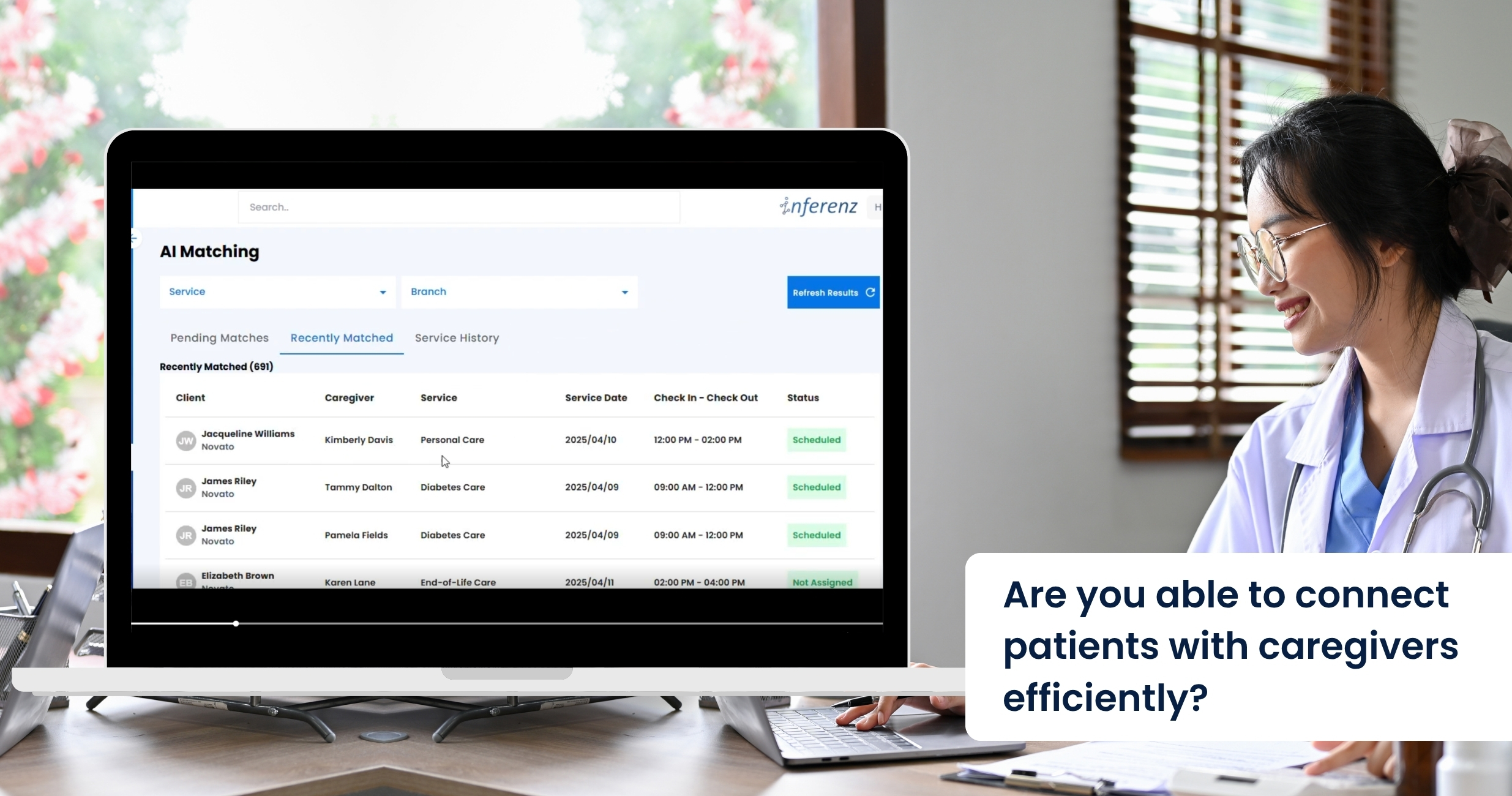
Till  then, you can check our ingenious patient-caregiver matching solution that is already making waves in  the home care industry. 

Frequently Asked Questions

  1. How does NL2SQL-based home care analytics speed our staffing calls?
    The natural language layer turns plain questions into Snowflake SQL in seconds. Supervisors get live caregiver-workload charts without waiting for analysts. 
  2. What protects patient data when we use agentic AI?
    Role-based views, HIPAA-grade encryption, and least-privilege access keep data locked. AI agents touch only the tables each user is cleared to see. 
  3. Will natural language analytics link to our EHR and scheduling software?
    Yes. Standard APIs stream records from EHR, payroll, and visit logs into Snowflake. No rip-and-replace. Your current tools stay in place. 
  4. How fast can we launch the AI agents in healthcare ops like ours?
    A focused pilot with key tables and ten users goes live in four to six weeks thanks to CrewAI modules. 
  5. How does quick insight help reduce caregiver burnout and churn?
    Instant views of missed visits, overtime, and patient mix let managers shift loads before stress builds. Fair rosters lower turnover and boost care quality. 

Patient Caregiver Matching: The AI-Powered Caregiver Connect Solution is Transforming Home Care

Overtime overruns alone threaten to siphon $1.05 billion from U.S. home- and community-care budgets this year, says Avalere Health—proof that shaky patient-caregiver matching is no longer just an operational headache but a bottom-line crisis. 

Schedulers still juggle phone calls, spreadsheets, and rule-based software that crumbles when a caregiver calls in sick. A comprehensive caregiver connect solution powered by agentic AI can flip that script. It watches every shift, learns from each match, and plugs gaps in minutes. No frantic dial-around, no client left waiting. Expect all efficiency with AI in healthcare. 

Problems Faced by the Homecare Industry in Scheduling Appointments


Modern EMR and AMS platforms capture plenty of data, yet most still fail at turning that data into fast, smart schedules. When we ask schedulers and field staff where things fall apart, three patterns rise to the top. 

Manual firefighting 

A single caregiver call-out often touches four or five tools: phone, text thread, spreadsheet, agency software, and finally an “all-staff” blast message. In practice, the rescue takes two to four hours, during which the client risks a missed visit. Home care organizations call this weekend scramble “unsustainable” and link it to high office burnout. 

Every unfilled hour can cost $25–$40 in lost billing. Late or missed wound-care checks raise hospital readmit odds by up to 15% (Loving Home Care study). Schedulers report after-hours stress as a top quit trigger; when one quits, five caregivers follow. 

Data silos 

Most schedulers never see real-time clinical flags. A recent report mentions that only about one in three U.S. home-care agencies have a point-of-care EHR that talks to their patient scheduling tool. The rest rely on notes or phone calls.  

Result: 

  • A wound-care alert sits in the EHR while the AMS assigns a basic aide. 
  • Medication-change notices arrive hours after the caregiver has left. 
  • Coordinators must cross-check two or three systems before offering a shift, slowing coverage. And there is the issue of duplicate patient records that create more chaos and confusion in scheduling. Check out our AI data duplication solution here. 

Without unified data, matches ignore skills that matter most—like current wound-vac certs, language fit, or post-surgery protocols. 

Burnout churn 

Shift imbalance drives turnover faster than pay issues. The 2024 Activated Insights Benchmarking Report put caregiver turnover at 79%—the highest in six years. Schedulers themselves are leaving too; agencies that lose a scheduler often see a linked caregiver exodus.  

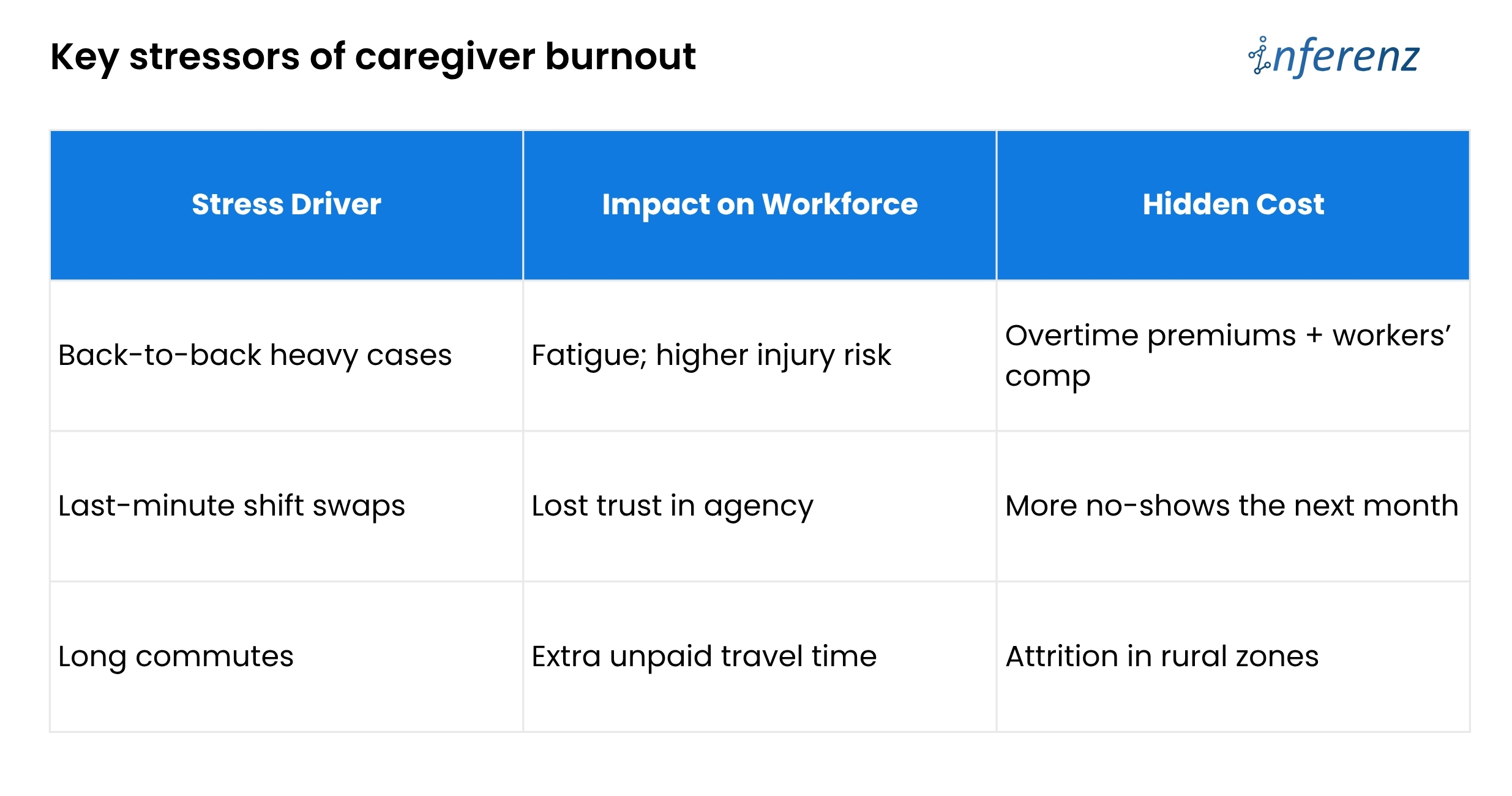
Poor balance means good aides get overbooked, newer aides sit idle, and both groups start scanning job boards. Until schedules pull live clinical data, automate call-out recovery, and watch workload signals, agencies will keep paying for empty visits and exit interviews.  
The article now chalks out how predictive care in Patient Caregiver Matching solution fixes those three weak spots. 

What Is Agentic AI? 

Think of it as a digital care coordinator that can perceive, decide, and act without waiting for humans. Unlike first-gen AI healthcare companies that graft models onto old software, a true agentic layer: 

  1. Learns from every shift – Outcome scores, travel times, and client feedback loop back into the model. 
  2. Optimises on many goals at once – It balances continuity, cost, and worker well-being instead of chasing only fill rate. 
  3. Acts in real time – If traffic halts Nurse Maya, the agent reroutes someone closer and messages all parties automatically. 

The result is a living schedule that keeps adapting—no stale rule set, no bias from tired staff. 

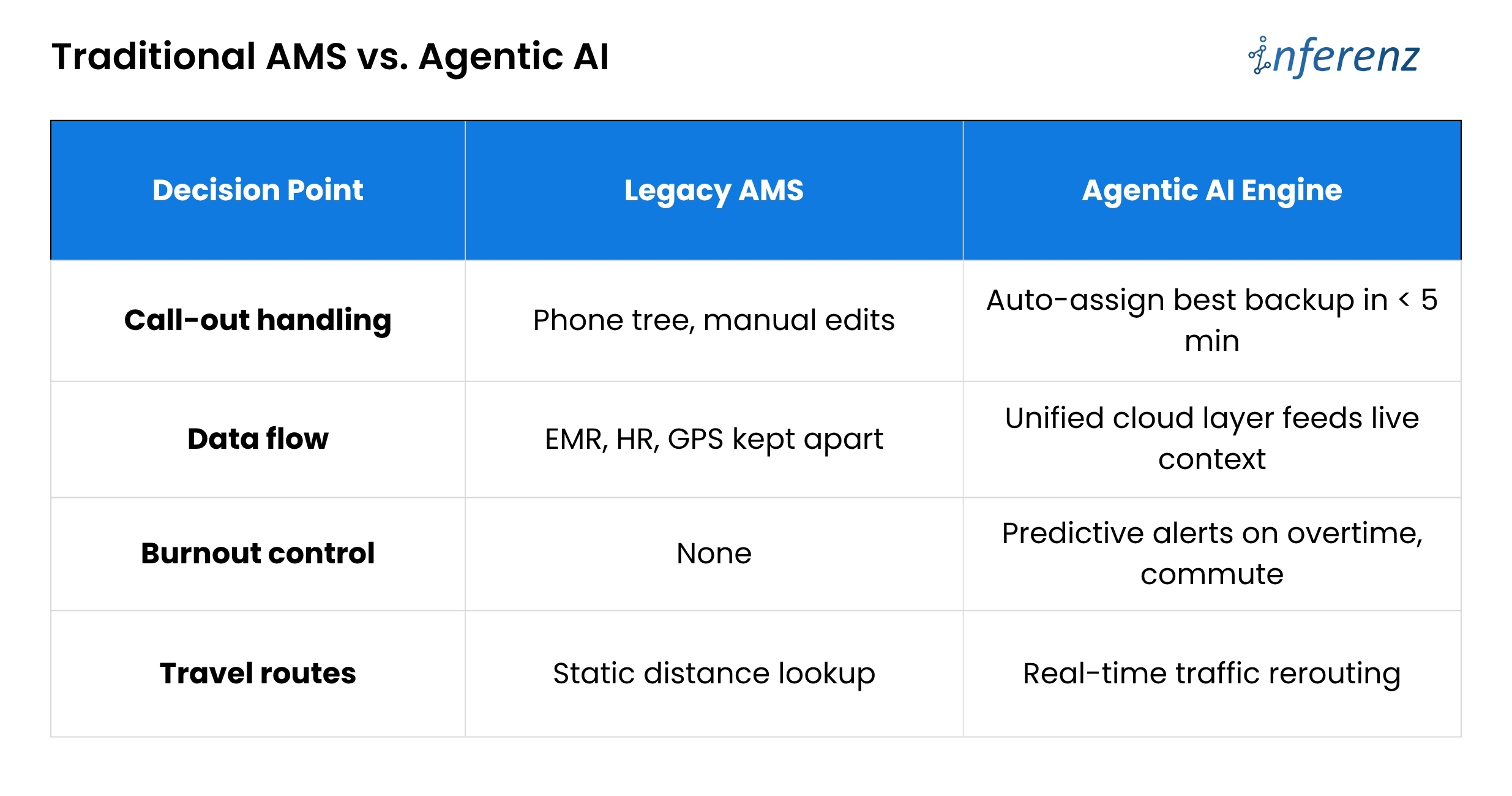
Traditional AMS vs. Agentic AI 

Bottom line: Outdated tools act like a notebook. An AI engine acts like a live dispatcher. 

PCM: the heart of smart scheduling

Patient Caregiver Matching (PCM) sits at the core of the agentic engine. It blends hard data that includes skills, licenses, and shift history with soft cues like language, pet comfort, and even commute stress.  

Each visit logged, each survey filled, feeds a feedback loop that sharpens the next match. 

AI extracts relevant details and binds them in a single narrative. This narrative helps caregivers walk in fully prepared and better informed about their assigned patients.  

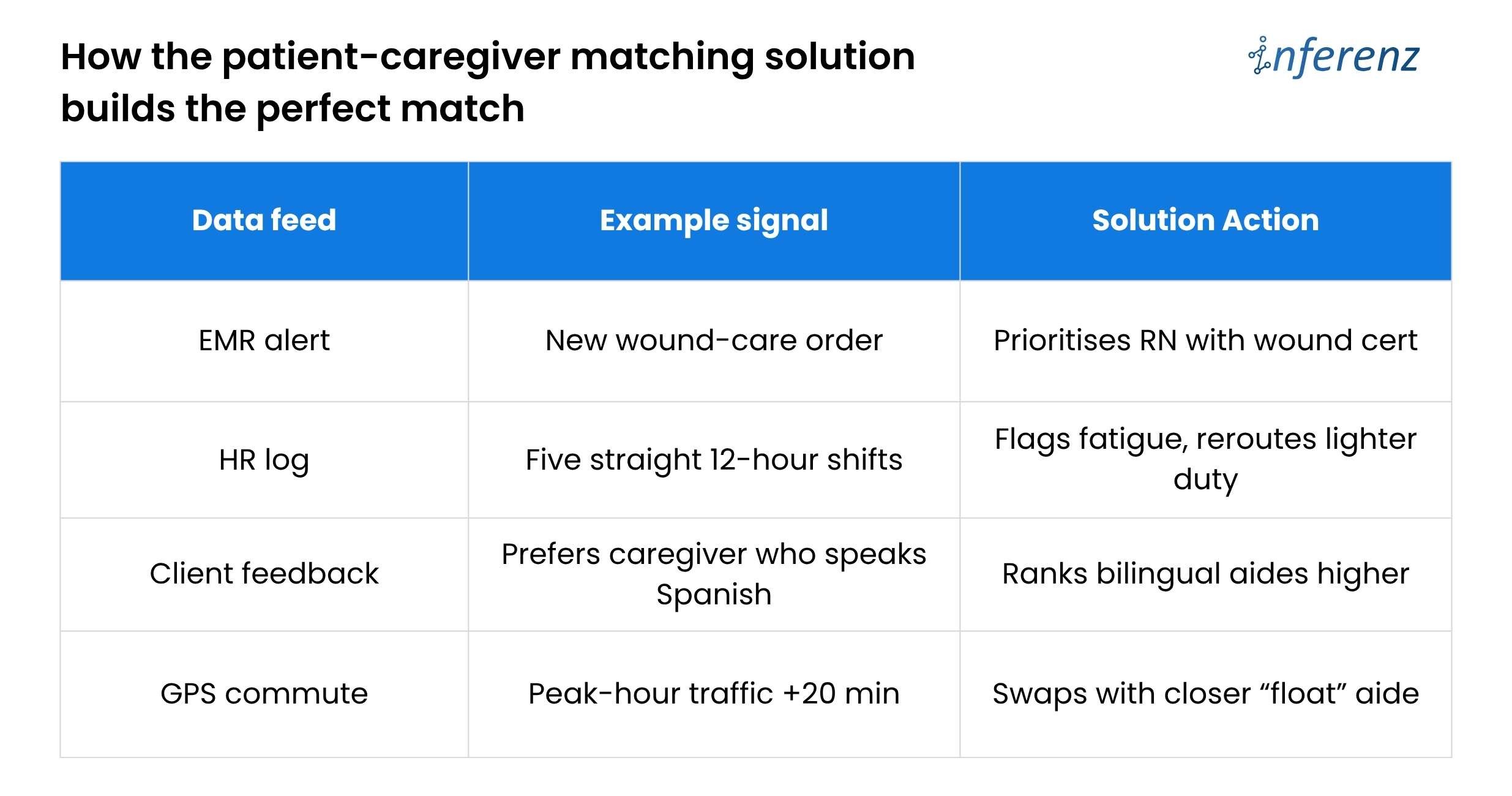
How the patient-caregiver matching solution builds the perfect match 

PCM makes thousands of micro-decisions that a human scheduler simply cannot track in real time.  

Caregiver Connect and Smart Scheduling in Homecare – Three Phases 

Phase 1 – Assist 

  • Role of AI:
    The system watches current openings, checks skill, location, and past ratings, then lists the best caregiver for each visit. It also sends and tracks shift texts for you. 
  • Why it matters:
    Speed is life in home care. By moving the “who is free and right for this client” search to an AI engine, booking time drops by half. A spot that once took twenty calls now locks in minutes. 
  • Effort change:
    Coordinators still approve picks, yet their keyboard time falls about 50%. That freed hour can go to client follow-ups or staff coaching. 

Phase 2 – Co-pilot 

  • Role of AI:
    The tool no longer waits for you to act when a callout hits. It finds the next best caregiver, confirms the shift, and pushes a note into the EMR so nurses see the new name. 
  • Why it matters:
    Missed visits tumble toward zero. Clients stay safe, and the agency avoids fines or angry phone calls on Friday night. 
  • Effort change:
    Because the AI covers most last-minute gaps, schedulers work on harder tasks and see about 70% less day-to-day scramble. 

Phase 3 – Autonomous 

  • Role of AI:
    The agent drafts the full weekly rota, juggles swaps, and even alerts HR when future demand will outrun supply. It chats with caregivers to shift times if traffic or family issues pop up. 
  • Why it matters:
    Fill rate climbs to 98% and holds steady. Fewer gaps mean higher revenue, better reviews, and calmer staff. 
  • Effort change:
    Coordinators shift to oversight. They scan dashboards, spot edge cases, and mentor teams. Routine scheduling work is now background noise handled by the system. 

During Phase 1, a coordinator still approves matches, building trust. By Phase 3, the agent posts a full weekly roster, flags any legal or pay exceptions for quick sign-off, and frees leaders to focus on quality and growth. 

A CXO-level Path to Patient–Caregiver Matching that Actually Works

Home-care agencies lose time and money because scheduling lives in silos. Skills sit in one system, vitals in another, PTO in a third.  

When a caregiver calls out, coordinators must sift through them all. The fix is a Patient Caregiver Matching (PCM) engine that learns and acts in real time—but only if leaders roll it out with equal focus on data, change control, and trust.  

Here is how to move from today’s chaos to tomorrow’s self-tuning roster, without hiring a small army of project managers. 

Start with clean data, not clever code. 

Feed every AMS, EMR, and HR stream into one secure lake through FHIR or other HIPAA-ready APIs. A single source of truth stops double entry and lets the AI see the full picture: licenses, wound alerts, commute times, even overtime risk. Until that lake is live, smart matching cannot begin. 

Prove value in a 90-day branch pilot. 

Switch PCM on for one location and track three simple numbers: shift fill rate, overtime hours, and coordinator minutes per booking. A branch-level test gives hard evidence, keeps risk low, and shows frontline staff that the tool helps rather than replaces them. 

Move to “co-pilot” across the agency. 

Once the pilot hits its marks, let PCM auto-cover call-outs everywhere. Keep one senior scheduler in an “air-traffic control” role to handle edge cases and to reassure teams that humans still guide policy. The daily scramble fades; missed visits trend toward zero. 

Let the AI look three months ahead. 

With real-time cover in place, turn on the forecasting lens. PCM scans referral trends, PTO calendars, and skill gaps, then warns HR before shortages hit. Growth continues without surprise overtime or rushed hiring. 

Build trust into every decision. 

A live roster run by AI only sticks if people believe it is fair and safe.  

Each match stores a plain-language reason such as “Carla assigned for dementia skill, four-mile commute.” Hard caps on weekly hours, license scope, and labor law live inside the rule set, so the engine cannot overstep. Monthly bias scans compare assignments across age, gender, and minority status while retraining drift triggers. The cloud zones keep scheduling live even if one data center fails. 

The payoff 

Weekend duty spreads evenly, time-off requests stick, and early fatigue signs rise to the surface before they become burnout. CXOs gain tighter control over cost and care quality without adding layers of back-office staff. Coordinators finally go home on time. 

“Caregivers who gain more autonomy over their schedule report lower stress.” — Cleveland Clinic flexible scheduling study 

Future-ready edge tapping the private caregiver pool 

Growth pressures will not spare preferred home health care brands. The patient-caregiver matching solution can open an on-demand bench of vetted private caregivers when internal staff hit capacity. The agent weighs cost, compliance, and continuity, then fills gaps without overtime blowouts. 

This “elastic staffing” positions agencies as connected care hubs, not just schedule brokers. It also sidesteps the narrow talent funnel that hammers many healthcare AI companies today. 


FAQs about Patient Caregiver Matching solution by Inferenz 

  1. What problem does Patient Caregiver Matching (PCM) solution fix in home-care scheduling?
    It cuts the costly overtime overruns that pile up when staff call out or shifts go unfilled. By learning from every visit, it matches the right aide in minutes and keeps clients from missing care. 
  2. How does Predictive Care Matching feature choose the best caregiver?
    The feature weighs skills, licenses, client feedback, travel time, and live clinical alerts, then ranks caregivers by overall fit in real time. 
  3. Will the system lower my agency’s overtime cost?
    Yes. Agencies in pilot tests saw overtime hours fall because open shifts got covered early, not at the last second when rates spike. 
  4. Can it handle a call-out at 7 p.m. on Friday?
    It can. The tool auto-selects the next best caregiver, sends the shift offer, and updates your EMR and AMS without manual intervention. 
  5. How does it guard against caregiver burnout churn?
    The engine flags heavy caseloads, long commutes, and back-to-back double shifts, then spreads work more evenly to keep staff fresh. 
  6. What data feeds the matching engine?
    It pulls live inputs from EMR, AMS, HR, and GPS tools, ending the data silos that slow most schedulers. 
  7. How soon will we see a higher shift fill rate?
    Most branches notice smoother coverage inside 30 days, with clear fill-rate gains by the end of a 90-day pilot. 
  8. Does it plug into our current EMR and AMS?
    Yes. A unified data layer links to standard FHIR or vendor APIs, so you keep your existing systems while adding smarter matching. 
  9. Is patient data secure and HIPAA-ready?
    Data stays in an encrypted, cloud-based lake with strict access controls and full audit logs that meet HIPAA standards. 


Databricks Data+AI Summit 2025: Announcements & Insights

Databricks just dropped a wave of updates at Data + AI Summit 2025 —and it’s safe to say, they’re doing more than just adding features. They’re rebuilding the modern data and AI stack from the ground up.  

Databricks Summit 2024 now feels like the dress rehearsal for these announcements! 

Whether you’re an engineer, analyst, or decision-maker, here are the 10 biggest product announcements that will shape how you work with data this year and beyond. 

1- Lakebase 

A Postgres-like metadata engine built for the Lakehouse
Lakebase brings transactional consistency, fast queries, and metadata performance to your lakehouse architecture. It’s the glue layer that makes structured access possible across massive data volumes—without sacrificing openness or scale. 

2- Agent Bricks 

Your enterprise AI agents, now production-grade
Agent Bricks is a new framework that makes it easy to build, evaluate, and deploy AI agents that use your organization’s data via Retrieval-Augmented Generation (RAG). Expect faster time-to-value and lower GenAI experimentation risk. 

3- Spark Declarative Pipelines 

Define your data logic. Let Spark figure out the rest.
With a new declarative syntax, Spark pipelines become cleaner and easier to manage. Think configuration over code. Now your intent would meet automation seamlessly and the pipeline building process gets simplified. 

4- Lakeflow 

Managed orchestration for your data workloads
Databricks Lakeflow helps you build, schedule, and monitor complex data workflows without managing infra. Built to scale with your team’s needs, it replaces scattered DAGs with one consistent orchestration layer. 

5- Lakeflow Designer 

Drag. Drop. Deliver.
A visual canvas for creating ETL pipelines without code. Lakeflow Designer makes pipeline building intuitive for analysts and operators, while still producing production-grade Databricks workflows. 

6- Unity Catalog Metrics 

Governance meets observability
Unity Catalog now offers live metrics for data quality, usage, freshness, and access lineage. This tightens control and makes compliance and trust easier to prove—no more data blind spots. 

7- Lakebridge 

Free, AI-powered data migration into Databricks SQL
Move from Snowflake, Redshift, or legacy warehouses without friction. Lakebridge is a no-cost, open-source migration tool that helps you modernize your stack on your terms. 

8- Databricks AI/BI (formerly Genie) 

BI without the query language
Business users can now ask natural-language questions and get dashboards, metrics, and insights—powered by GenAI and structured on trusted data. It’s self-service analytics, evolved. 

9- Databricks Apps 

Build internal apps on Databricks—securely and scalably
Now you can create and run interactive applications directly on the Databricks platform with enterprise-grade identity control and data governance baked in, for the benefit of the Databricks community. 

10- Databricks Free Edition 

Get started with Databricks—forever free
No credit card. No setup cost. The Free Edition is perfect for developers, learners, and small teams to explore the full power of Databricks. 

What This Means for Databricks users? 

The common thread in all these announcements are 

  • Better Access.  
  • Adherence to Simplicity.  
  • Streamlined Governance.  
  • Prompt AI-readiness. 

Databricks is now no longer just for engineers. With tools like Agent Bricks, Lakeflow Designer, and AI/BI, business teams now can impose their objectives with a front row seat in the data conversation. 

Quick recap 

Inferenz, an official Databricks partner, is already applying the latest updates to power its agentic AI solutions in healthcare. From real-time patient-caregiver matching to workforce analytics and natural language-based insights, our tools are built to act on fresh, unified data.  

Expect faster decisions, earlier risk detection, and zero extra tech layers. As AI in healthcare accelerates, the Databricks ecosystem is setting the pace, and we’re already building caregiver connect solutions with it. 

Want to see it in action? Contact us soon. 


FAQs on the 2025 Databricks Summit Highlights 

  1. What makes the new Lakehouse engine different from a classic warehouse?
    Lakebase brings a transactional layer to the Databricks Lakehouse model, giving you ACID reliability without leaving open-format storage. 
  2. How will the new metrics improve governance?
    The live metrics inside Unity catalog in Databricks give instant views on data quality, freshness, and usage—crucial for audit and compliance teams. 
  3. Where can I monitor pipeline runs built in Lakeflow?
    Every run appears in the new Databricks workflow job dashboard, offering status, lineage, and error details in one place. 
  4. Is there a no-code entry point for building workflows?
    Yes—Lakeflow Designer lets analysts drag and drop tasks, then schedules the flow using the same engine that powers Databricks workspace and its automation. 
  5. What’s new for model tracking and deployment?
    The summit added tighter hooks between Databricks MLflow and Agent Bricks; you can now call models through a unified Databricks API during agent execution. 
  6. Will third-party tools integrate more smoothly?
    Yes—expect richer SDK support through Databricks connect and a growing Databricks marketplace of certified partner solutions. 


Snowflake Summit 2025: Key Highlights and Announcements

Snowflake Summit 2025 was unlike any other summit that happened before. It was a like a magnificent product launchpad, and it did full justice to the action-packed four days as part of the event schedule.  

The data-cloud giant showed how it plans to cut query costs, add trusted AI, and open its platform to every format from Iceberg to Postgres. Leaders teased faster warehouses, live FinOps alerts, and chat-style analytics that turn plain English into charts. They also sealed a $250 million Postgres deal and signed on as the data engine for the LA 28 Olympics. Staggering, isn’t it? 

Why does this matter though, you may ask?  

Because teams everywhere still wrestle with slow reports, rising bills, and security gaps. Snowflake’s new moves promise hands-off tuning, real-time guardrails, and AI tools that stay inside the same secure walls.  

The highlights below break down what shipped, what’s in preview, and how each change could move the needle on cost, speed, and trust. 

Compute that runs faster and costs less 

Gen2 Standard Warehouses hit general availability and already show about 2.1× faster query time in live customer tests. Pair that with Snowflake Adaptive Compute (private preview) and the platform now picks cluster size, parks idle nodes, and pools resources across jobs without manual tuning. 

  • To keep Snowflake pricing in check, the FinOps console adds Cost-Based Anomaly Detection (public preview) and Tag-Based Budgets (GA soon). Both alert teams to cost spikes before month-end surprises.  
  • Workspaces now bundle inline Copilot help, Git sync, and a GA Terraform provider, so builders can code, test, and ship inside one browser tab. 
  • Python 3.9 is live in Notebooks, plus custom Git URLs for smoother CI/CD. 

Take-away:  Faster analytics with less knob-twisting and clearer bills. 

Stronger governance and security 

Horizon Catalog gains an AI Copilot for natural-language search plus Iceberg catalog-linked databases, so data stewards can find and govern tables sitting outside the core warehouse.  

On access control, Snowflake now supports passkeys, authenticator apps, and programmatic tokens, moving the service toward a full MFA-only stance before November 2025.  

For backups, new Immutable Snapshots (preview) keep point-in-time copies that cannot be altered—extra insurance against ransomware. Here are some more updates: 

  • Horizon Catalog adds external-data discovery, letting stewards govern dashboards and other cloud stores from one pane. 
  • Trust Center picks up passkeys, new MFA choices, and leaked-password shielding—tightening the lock before year-end. 
  • Snowflake Trail widens coverage, and Openflow now emits pipeline telemetry for faster root-cause checks. 

Data engineering and the open Lakehouse 

Snowflake Openflow (GA on AWS) is a multimodal ingestion service powered by Apache NiFi. Teams can pull data from hundreds of sources into Snowflake or keep it in place and still query it. 

Lakehouse fans got welcome news: Iceberg queries are now up to 2.4× quicker, and catalog-linked databases let Iceberg tables live under the same roof as native Snowflake tables. 

  • Native dbt Projects and Pandas on Snowflake (both previews) shorten the “extract-transform-load” cycle by letting engineers work inside the platform. 
  • Openflow ships an Oracle-to-Snowflake CDC path, easing the biggest on-prem migration ask we hear from clients. 
  • Iceberg gains VARIANT support and Merge-on-Read, closing format gaps while keeping those 2.4× speed gains. 

AI & analytics for every role 

Here are some updates relevant to AI and analytics from the summit: 

  • Snowflake Intelligence (public preview) turns the familiar ai.snowflake.com chat bar into a way to ask, “Why did sales dip in Q3?” and get charts back in seconds. 
  • Cortex AISQL folds AI operators into normal SQL so analysts can label images or sum up PDFs without leaving the warehouse. Document AI lifts tables straight out of PDFs, while Cortex Search scans it all in seconds—no helper scripts. 
  • Data Science Agent builds data sets, trains models, and sets up pipelines on demand—handy for teams that lack ML engineers.  
  • SnowConvert AI speeds “lift-and-shift” moves off legacy warehouses.  
  • Built-in AI observability traces every LLM call inside Cortex Apps, satisfying audit teams. 
  • Semantic Views hit GA, turning raw tables into shared business logic that both SQL and AI tools can read. 

Together these moves push AI deeper into the Snowflake data cloud while keeping the SQL surface that users already know. 

Apps, marketplace, and collaboration 

The Snowflake Marketplace now lists Agentic Native Apps and Cortex Knowledge Extensions so buyers can install third-party AI helpers inside their own account—no extra data pipes.  

  • Cortex Knowledge Extensions pull curated news and research into agent answers—helpful for care-trend insights. 
  • Teams can now share full Semantic Models with partners, keeping metrics in sync across firms. 
  • Snowflake native apps depend on a framework that picks up versioning, runtime stats, and a compliance badge, meeting release rules. 

Clean-room upgrades and an Egress Cost Optimizer make cross-company sharing cheaper and privacy-aware. 

Acquisitions and partnerships 

  • Postgres joins the party. Snowflake is buying Crunchy Data for roughly $250 million and will offer Snowflake Postgres, a managed enterprise Postgres service that sits right beside Unistore. 
  • Olympic-scale data. Snowflake became the official data collaboration provider for LA 28 Olympics and Team USA, proving that the platform can handle real-time, high-profile workloads. 
  • Ecosystem bet. Snowflake Ventures backed Sema4.ai, whose Team Edition agent will ship as a Snowflake Native App, reinforcing the agentic theme across the marketplace. 

What this means for your stack 

  1. Less handholding, more insight. Automatic compute plus FinOps alerts free engineers to focus on models, not knobs. 
  1. Trusted AI without new silos. Cortex tools and agentic apps stay inside the Snowflake security perimeter, so data governance rules still apply. 
  1. Freedom of choice. With Iceberg support and Postgres on deck, Snowflake no longer forces a single storage format or engine. Use what suits each workload. 

Quick recap 

Snowflake Summit 2025 moved from vision to shipped code: faster compute, visible spend controls, built-in AI agents, and an open stance on formats, from Iceberg to Postgres. The result is a data platform that lets teams ask bigger questions without breaking a sweat. In short, Snowflake just made data work simpler, cheaper, and safer.  

Inferenz, an official Snowflake Select partner, is already wiring these gains into its agentic AI tools for caregiver connect including patient-caregiver matching, workforce analytics, and conversational AI reporting through natural language. The upshot is that healthcare teams can spot risks sooner and act faster, without piling on new tech debt. Expect Healthcare AI companies to follow suit soon enough! 

Connect with us today to know more. 

FAQs on Snowflake Summit 2025 

  1. What were the headline launches at Snowflake Summit 2025?
    Snowflake unveiled Gen2 Standard Warehouses, Adaptive Compute, Horizon Catalog Copilot, Cortex AI SQL, and the managed Snowflake Postgres service—all aimed at faster analytics, lower costs, and broader data-format support.
  2. How will Adaptive Compute affect Snowflake pricing for day-to-day workloads?
    Adaptive Compute auto-sizes clusters and suspends idle nodes, so teams pay only for the minutes they use, reducing surprise bills and smoothing monthly budgets.
  3. What new capabilities arrived in Snowflake Cortex during the summit?
    Cortex gained AI SQL operators for text, image, and audio analysis; built-in LLM observability; and Data Science Agent for no-code model pipelines, making advanced AI tasks accessible by plain SQL.
  4. How does the updated Snowflake Marketplace help developers after these releases?
    The marketplace now features Agentic Native Apps and Cortex Knowledge Extensions, letting users install third-party AI helpers and shared Semantic Models directly inside their Snowflake account with a single click.
  5. Do I need to change anything at snowflake login to test the new features?
    No. Once your account admin enables the relevant previews, the new tools appear in Snowsight under the same secure login, with no extra setup.
  6. Will the summit changes impact snowflake certification paths such as SnowPro Core?
    Yes. The exam guides will add sections on Adaptive Compute, Cortex AI SQL, and Horizon Catalog Copilot. Snowflake recommends reviewing the updated study outline before scheduling an exam.
  7. How do these releases strengthen the overall Snowflake data cloud story?
    They tighten cost control, expand open-format support, embed AI in every layer, and add governance safeguards, reinforcing Snowflake’s position as a one-stop data and AI platform for enterprises.

Navigating Healthcare Data Security & Compliance

As AI technology becomes increasingly integrated into healthcare, ensuring strict healthcare data security and regulatory compliance is essential for its seamless adoption. These AI systems allow healthcare providers to make more accurate interventions, improving care efficiency.

The use of AI algorithms to process different types of healthcare data, such as electronic health records and medical images, has become key to predicting health outcomes and refining individualized treatment plans. However, the sensitive nature of healthcare data makes its protection a primary concern.

Multi-layered encryption, real-time anomaly detection, multi-party computation, and access restrictions are vital to ensure the security of patient data. Healthcare providers must adopt comprehensive security measures, including data masking, federated learning, and robust auditing mechanisms.

Inferenz ensures compliance by leveraging automated systems alongside advanced encryption and access control, facilitating seamless integration of these protocols into AI systems, and providing healthcare organizations with a secure and compliant environment.

Key Compliance Regulations in Healthcare AI

Healthcare compliance regulations consist of laws and standards that safeguard patient privacy and ensure the quality of care. To navigate the complexities of healthcare data security, one needs a deep understanding of the regulations listed below:

HIPAA (Health Insurance Portability and Accountability Act) 1996

HIPAA establishes strict standards for the confidentiality and security of individually identifiable health information. Primary healthcare providers and their business collaborators are required to implement safeguards and notify individuals in the event of a breach.

HITECH Act  2009

The act strengthens HIPAA by enhancing penalties for data breaches and promoting the adoption of electronic health records (EHRs). It emphasizes secure electronic health information exchange, further protecting patient data and encouraging healthcare innovation.

21st Century Cures Act 2016

The act aims to foster scientific innovation, reduce administrative burdens, and improve healthcare data sharing and privacy protections. It also enhances the overall healthcare experience for patients while prioritizing healthcare data security.

GDPR (General Data Protection Regulation) 2018

GDPR applies primarily to the European Union and affects U.S. healthcare organizations handling data of EU citizens. It sets stringent rules for data protection, including health data, and mandates informed consent for data processing.

CCPA (California Consumer Privacy Act) 2020

The CCPA grants California residents control over their personal information, including health data. It mandates transparency in data practices and allows individuals to request the deletion of their data.

HITRUST CSF (Health Information Trust Alliance Common Security Framework)

Even though it is not a regulation, HITRUST provides a security framework for medical facilities. This framework helps ensure compliance with various regulations and protects patient data across platforms.

Information Blocking Rule  2021

Enforced by the Office of the National Coordinator for Health IT (ONC), this rule prohibits information-blocking practices and promotes interoperability while safeguarding the privacy and security of patient information.

Interoperability and Patient Access Final Rule 2021

Enforced by the Centers for Medicare & Medicaid Services (CMS), this rule advances patient data access and exchange. Health systems are required to share electronic patient data upon request, giving patients more control over their healthcare data.

According to the NHS, it’s essential to recognize that these regulations do not encompass AI applications such as software for health management, administrative tools, or clinical support systems for healthcare providers.

As these applications are intended to be used by qualified individuals who can make their own rational decisions based on the AI’s recommendations.

The analysis of global regulatory frameworks for AI in healthcare reveals that regulations predominantly include professional guidelines, voluntary standards, and codes of conduct adopted by both governments and industry players. However, these frameworks are not directly enforced by governments.

Addressing Healthcare Data Security Challenges

While AI enhances healthcare outcomes, it also brings forth challenges related to healthcare data security.

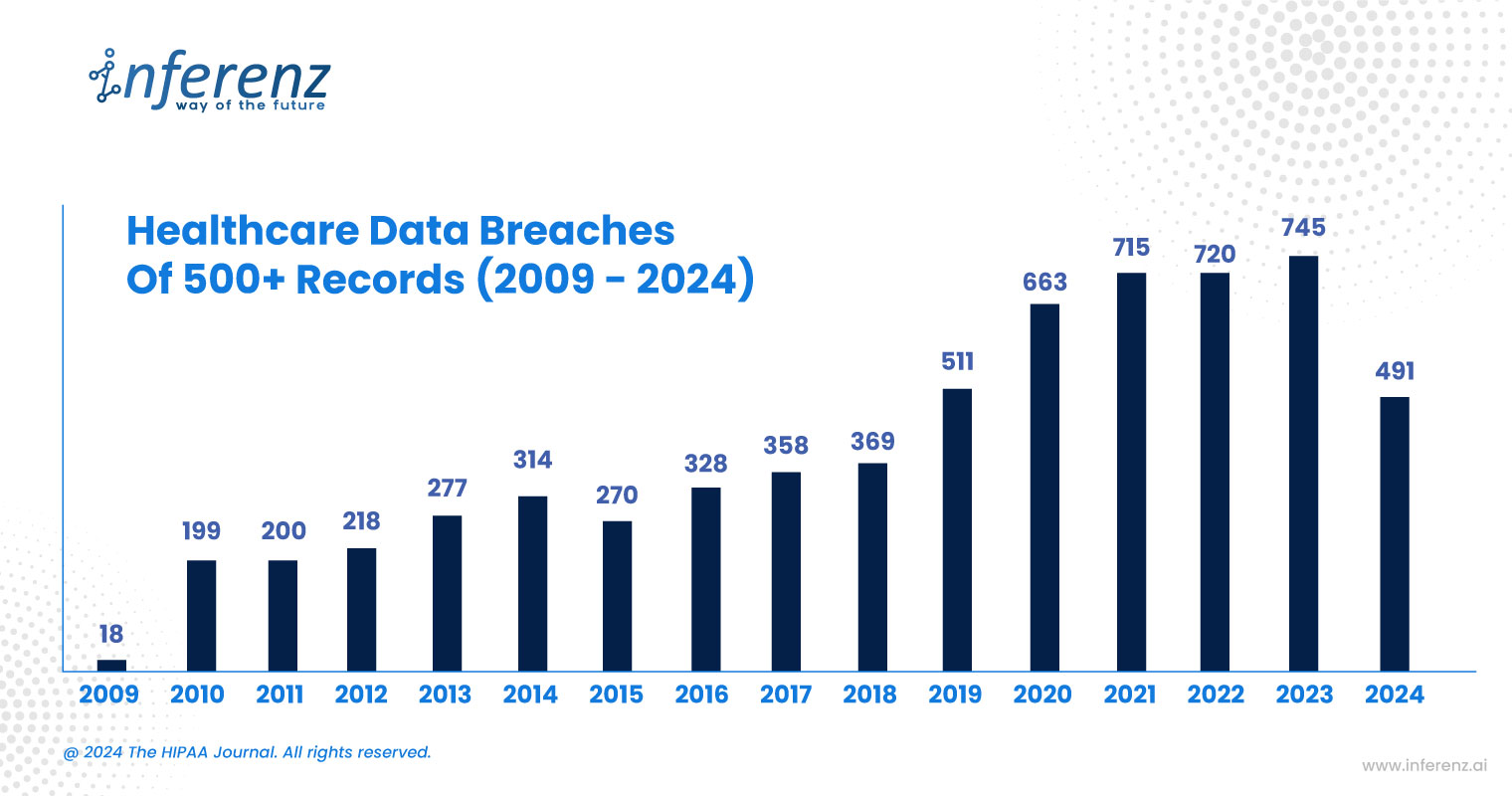
In the most recent period, in line with the Advisory board, the latest updates from California, DC, and Texas suggest that 2023 saw an alarming rise in healthcare data breaches, with 727 reported incidents compromising the data of nearly 133 million individuals.

The HIPAA Journal further reveals that in this year itself, February 2024 witnessed 69.5% of healthcare data breaches attributed to hacking, compromising nearly 5 million records in only one month. Here is a more detailed explanation:

Healthcare Data Security Breaches

The large volumes of sensitive data handled by healthcare organizations, combined with AI systems’ reliance on this data, make them vulnerable to data breaches and cyber-attacks.

Vulnerabilities in Machine Learning Models

ML models are at risk of data leakage, potentially resulting in privacy crises for organizations. As stated by the National Library of Medicine, while machine learning (ML) can significantly enhance physicians’ decision-making, it also introduces vulnerabilities in healthcare systems that are susceptible to attacks.

ML models are particularly vulnerable to various types of attacks, including data poisoning, where the training data is compromised. Evasion attacks, where test data is manipulated to mislead the model invalidation and backdoor exploits.

In response to these concerns, employing techniques like encryption, anonymization, and secure storage is essential for safeguarding sensitive healthcare data. While encryption secures data during both transfer and storage, anonymization minimizes the potential exposure of personal identifiers.

Data engineers and tech leaders are at the forefront of implementing these measures, working to ensure that AI architectures are both secure and scalable.

Inferenz boasts a team of skilled data engineers who specialize in developing AI-driven healthcare solutions that seamlessly integrate top-tier security practices, ensuring data protection and regulatory compliance.

Balancing Compliance and Security in AI Development

As suggested by the Diagnostic and Interventional Radiology Journal, research has shown that AI algorithms may unintentionally absorb biases in their models. Whether intentional or not, such biases could lead to unforeseen challenges in clinical practice.

To prevent bias in AI systems, it is crucial to focus on early-stage strategies in AI development. Here are key principles that are essential to guide AI design and minimize the risk of bias:

  • Transparency: Ensures that data collection and processing methods are clear, fostering trust and accountability in the AI system.
  • Fairness: Promotes equal treatment and considers diversity, preventing discriminatory practices and ensuring that AI systems serve all users impartially.
  • Non-maleficence: Focuses on ensuring AI systems do not cause harm, particularly by avoiding biased, discriminatory, or ineffective decisions that could negatively impact patient outcomes.
  • Privacy: Ensures that data is used responsibly, giving patients control over their information and maintaining the ethical handling of sensitive data.

Thus, by balancing compliance and security at every stage of AI development, from data collection and processing to model deployment, service providers can minimize the risk of breaches and vulnerabilities.

Real-Time Auditing and Cross-Functional Review

For sustained compliance and security, healthcare data security measures should be consistently audited and assessed using real-time monitoring tools for risks such as unauthorized access or breaches in data handling.

Furthermore, robust compliance relies on seamless collaboration between regulatory advisors, data analysts, and healthcare experts. Healthcare law advisors can ensure that the AI systems meet evolving regulatory standards. AI engineers can design and implement security measures, and clinicians can provide insights into clinical requirements.

This cross-functional teamwork will ensure that all aspects of AI system development and deployment are fully compliant with regulations and aligned with best practices for healthcare data security and patient care.

Conclusion

Healthcare data security is critical, and it demands unwavering attention to privacy and regulatory standards. Top executives, Chief Technology Officers (CTOs), and data architects need to work in tandem to ensure that patient data remains protected while pushing the boundaries of AI-driven innovation.

AI in Healthcare: Expert Insights, Use Cases, Future Trends

AI in healthcare is no longer a glimpse into the future but a breakthrough that is happening today. Its role is extremely conspicuous and has brought about a considerable change to many aspects of healthcare.

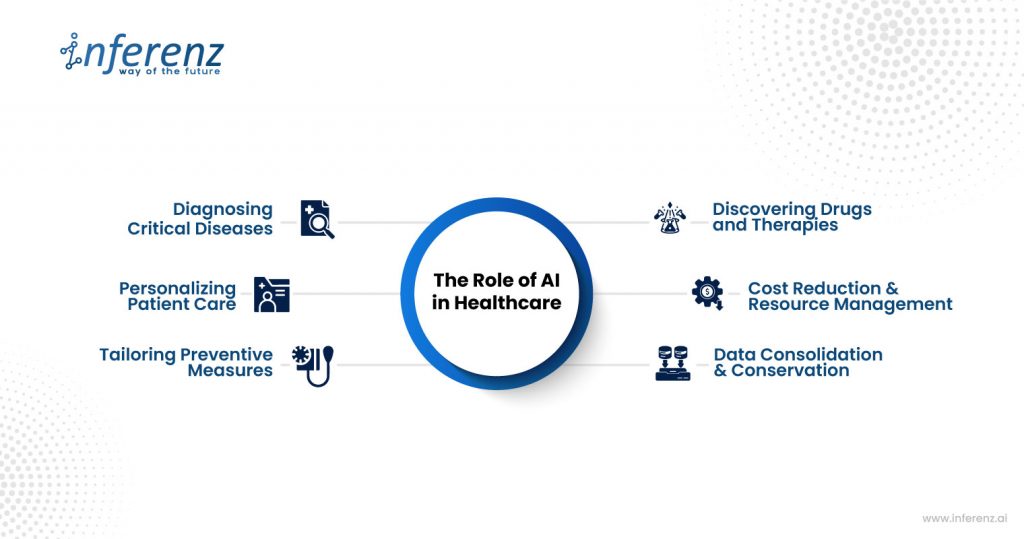
From diagnosing diseases with speed and precision, personalizing patient care, tailoring preventive measures, discovering drugs and therapies, and cost reduction to overseeing administrative workflow, the benefits are far-reaching. By consolidating and conserving data, predicting analytics, and natural language processing, AI has optimized healthcare data.

role of ai in healthcare


Considering the upheaval brought by AI technology in healthcare, evaluating its usage is crucial, as unregulated AI can endanger patient safety and compromise trust in healthcare. Through this article, we will explore the critical role of responsible AI technology and how it is attainable.

Ethical Considerations in AI-Driven Healthcare

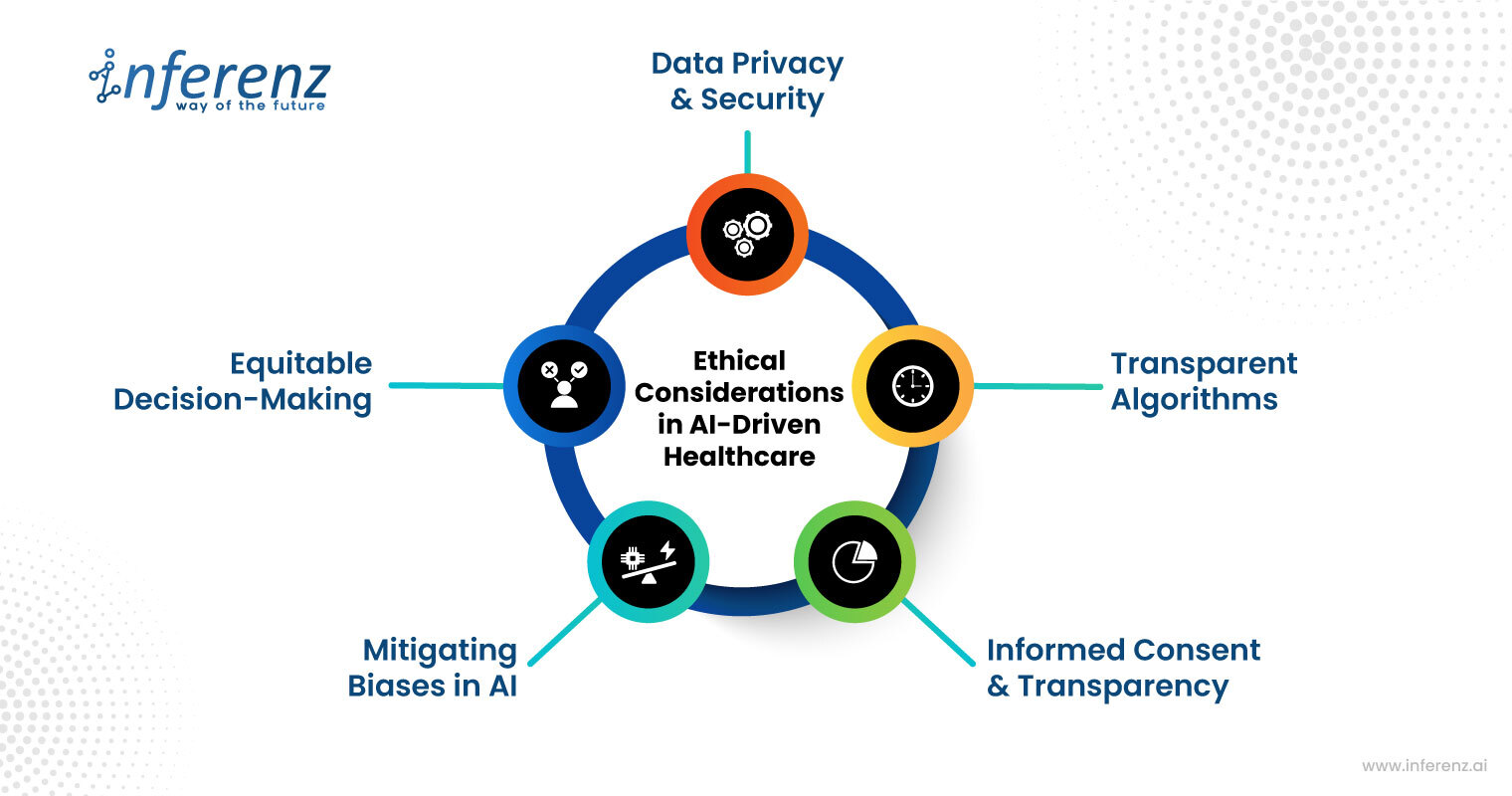
Ethics in AI-driven healthcare is critical as its role in healthcare is one of a silent partner. It impacts the three fundamentals of the industry, which are products, services, and finance. Therefore, rightness in data privacy and security, patient autonomy, roles of stakeholders should be secured. Here are a few examples of ethical considerations in AI-driven healthcare:

Data Privacy & Security

As the volume of healthcare data is growing exponentially, data privacy and security have become primary concerns. Here are a few ways to ensure data privacy and security in healthcare:

Handling Sensitive Patient Data:

As the orientation of the healthcare industry is toward patients, ensuring their data confidentiality is crucial to it. The industry is faced with a wide spectrum of structured, unstructured, and patient-generated health data that necessitates the use of artificial intelligence to process large data sets. 

However, its unmonitored use can anonymize patient information. To mitigate that, healthcare organizations must have stringent compliance with security regulations like HIPAA and GDPR and ensure broadened protection of patients’ sensitive medical data. 

Risk Of Data Breaches and The Need For Robust Security Protocols:

The HIPPA journal’s healthcare data breach statistics have shown an upward trend in data breaches due to hacking incidents and ransomware attacks. In a record stated by OCR, there was a 239% increase in hacking-related data breaches between January 1, 2018, and September 30, 2023, and a 278% increase in ransomware attacks over the same period.

In 2023, 79.7% of data breaches were due to hacking incidents. Such breaches of healthcare data can be averted through widespread data encryption, the use of intrusion and malware detection systems, and strict security audit protocols.

HIPPA report on AI in healthcare

Bias in AI Algorithms

In healthcare generally, biases in AI can emerge from inherent design or learning mechanisms of the algorithm itself. A study published in the Science Journal described how biases in AI algorithms systematically discriminated based on gender, race, and socioeconomic parameters. Here are a few ways to overcome the prejudice in patient care:

Identifying and Mitigating Biases in Healthcare AI

Healthcare has struggled to include women and minorities in research despite knowing they have different risk factors and manifestations of the disease. Also, the algorithm assigned people to high-risk groups based on their socioeconomic status. According to biases, black people had to be sicker than white people before being referred for additional help.

Ethical considerations in AI driven healthcareThe bias in the algorithms that lead to inequities in healthcare can be identified and mitigated by capturing data from varied demography, collaborative research, continuous monitoring, and ensuring accurate and formatted data for use in multiple systems.

Importance of Transparent Algorithms for Equitable Decision-Making:

To ensure transparency in algorithms and support equitable decision-making, the design and implementation of AI algorithms must align with ethical guidelines and industry standards. 

The performance of algorithms must be continuously evaluated to ensure transparency and accountability. There should be mechanisms that regularly audit the AI systems to provide accuracy. 

Patient Consent & Transparency

The role of AI technology in healthcare must complement patient care and not compete with it. The AI decisions must be regularly scrutinized to identify any potential inaccuracy in the judgment

The outcomes must be explained to the patients using explainable AI (XAI) to ensure transparency throughout their treatment. Also, healthcare industries must allow insights and data collection from diverse patients to understand the impact of AI on them and mitigate disparities in their care.

Fair Use of AI in Healthcare Analytics and Decision-Making

Fair use of AI in healthcare means the use of unbiased AI that supports patient autonomy and provides accurate diagnoses and treatments for all patients regardless of their differences. Establishing this fairness requires an understanding of the potential causes of misuse of AI and the development of strategies to mitigate them.

AI in Diagnostics and Treatment Planning

The integration of AI in healthcare offers precision in diagnosis and effective treatment plans. With algorithms, AI can identify anomalies in medical data and offer evidence-based recommendations and insights. It can help monitor patient conditions and provide personalized treatment, thus improving overall patient care. 

Ensuring AI Recommendations Align With Human Clinical Judgment

Healthcare is human-centered, making it imperative that AI recommendations harmonize with human intelligence for enhanced clinical judgments. While AI can process large data sets and provide predictive analysis, it lacks the nuanced judgment and ethical reasoning of humans. 

The healthcare industry must have a collaborative human-in-the-loop model where AI is used as a tool to increase diagnostic accuracy, provide remote health monitoring and personalized treatment, and streamline administrative workflow.

Avoiding Over-reliance on AI

AI has the potential for misinformation, algorithmic bias, and lack of accountability that can endanger patient safety. Therefore, it is important to avoid over-reliance on AI, maintain human oversight to mitigate biases, and explore key ethical concerns, including patient data privacy, security, and discrimination.

By avoiding over-reliance on AI and integrating human oversight, we can ensure that AI technologies align with healthcare values and ethical standards, thereby fostering patient’s trust in healthcare systems. 

AI in Predictive Analytics

AI predictive analytics uses machine learning (ML) algorithms to assess how different diseases progress in individual patients and predict how they might respond to various treatments. This leads to more personalized treatment plans, maximizing effectiveness in healthcare management.

Responsible Use Of AI In Predicting Patient Outcomes

In the context of preventative care and personalized medicine, AI can be used responsibly to process broader medical data, including genetic data, medical history, and lifestyle factors, to identify patterns and make predictions about health outcomes. It can forecast public health risks, provide personalized risk assessments, and support decision-making in preventive medicine.

Ethical Implications Of Using Predictive Data In Patient Care Decisions 

Although AI is a potentially promising application, the ethical implications of using patient data raise concerns about patients’ autonomy in decision-making that could impact the doctor-patient relationship.

As over-reliance on predictive analytics grows, aspects like voluntary participation, informed consent, confidentiality, etc., must be necessitated. It’s crucial to strike a balance between taking advantage of the benefits and safeguarding the patient’s confidential data against misuse. 

Regulatory Landscape and Future Outlook

AI technologies are being rapidly deployed, which could either benefit or harm stakeholders, including healthcare professionals and patients. When using health data, AI systems could have access to sensitive personal information, necessitating robust legal and regulatory frameworks for safeguarding privacy, security, and integrity.

Current AI Regulations in Healthcare

The World Health Organization (WHO) has listed key regulatory considerations on the role of AI in healthcare. WHO emphasizes the following aspects in its listing:

  • Ensure accurate data quality through rigorous evaluations and prevent biases and errors in the AI algorithms.
  • Address risk management, issues like ‘intended use,’ ‘continuous learning, human interventions, training models, and cybersecurity threats.
  • Externally validate data and interpret the intended use of AI to assure safety and facilitate regulation.
  • Encourage dialogue and collaboration among stakeholders, including healthcare developers, regulators, manufacturers, health workers, and patients.
  • Foster trust and transparency in documentation by documenting the entire product lifecycle and tracking development processes.

Future Trends in Responsible AI Governance

The future of AI in healthcare is brimming with promises as it is expected to enhance the functionality of healthcare systems further and positively impact patient care. According to the Mayo Clinic, the future of AI in healthcare could create novel methods to diagnose, treat, predict, prevent, and cure disease. It can select and match patients with the most promising clinical trials and develop remote health-monitoring devices and more. Here are a few areas of development:

  • Adaptive Learning & Real-Time Data Analysis: The future of AI in healthcare will be more equipped with advanced learning capabilities and analyzing data in real-time. It will constantly update its knowledge base and algorithms with new data, research, and outcomes.
  • Adaptive Patient Care: Continuous learning will enable AI to assess patient-specific factors over time better, leading to more personalised and effective healthcare solutions.
  • Accuracy Over the Long Run: As AI gains more exposure to diverse patient cases and conditions, its diagnostic and treatment recommendations are expected to become precise and reliable.

FDA has developed SaMD (Software as a Medical Device) that necessitates the steps AI models must follow to be approved for healthcare. AI developers have to seek review and approval from the FDA when significant medication is involved.

Here are a few more ways to ensure that the future of AI in healthcare is made with greater responsibility: 

  • Maintain algorithmic accountability by building a framework that ensures that AI systems are audited and held accountable for their outcomes.
  • Develop a human-in-the-loop (HITL) model where human judgment is blended with AI technical know-how.
  • Mobilize Fast Healthcare Interoperability Resources (FHIR), a health level seven international (HL7) standard for exchanging healthcare information electronically. 
  • Execute a federal learning approach to train AI models using data from healthcare institutions without sharing sensitive data, ensuring patient privacy while still improving the model’s performance.

Inferenz is a team of skilled professionals that offers healthcare professionals cutting-edge solutions and products. We provide tailor-made machine learning and AI chatbots for healthcare to ensure they align with your business needs.

Contact us today, and let us help you build the right solution that seamlessly fits into the existing system.

 Responsible AI in healthcare

AI in Healthcare FAQs 

What is the future of AI in healthcare? 

The future of AI in healthcare includes tasks ranging from simple to complex—everything from reading radiology images to making clinical diagnoses and treatment plans and providing preventive healthcare measures.

What is the most common use of AI in healthcare?

One of the most common uses of AI in healthcare is training algorithms using data sets such as health records to create models capable of performing tasks like predicting and categorizing outcomes.

How to improve healthcare using AI? 

AI can improve healthcare in many ways, including medical diagnosis, drug discovery, patient safety and experience, and healthcare data management. While AI has many benefits in healthcare, patient education and building trust are also crucial for successful integration.

What are the ethical considerations in AI healthcare? 

Some ethical considerations in healthcare include addressing the biases in AI algorithms, ensuring data privacy, asking for patient consent, and maintaining complete transparency in the decisions.

How does AI reduce costs in healthcare? 

AI can process a vast amount of medical data to identify patterns that improve decision-making and offer more cost-effective treatments. It can also automate certain administrative tasks that reduce patients’ workloads and improve job satisfaction.

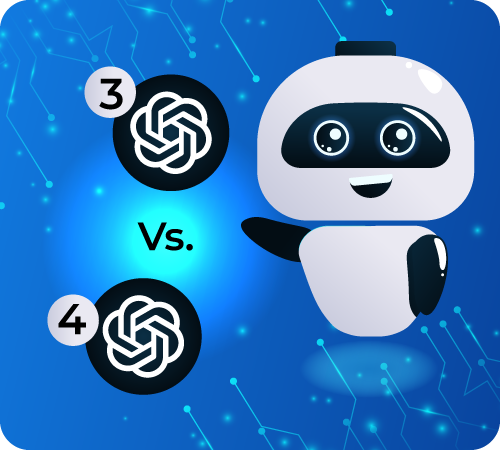
ChatGPT 3 Vs. ChatGPT 4: How They Are Different From GPT 3.5

ChatGPT 3 vs. ChatGPT 4 has become a hotly debated topic since OpenAI released the latest version of the large language model. Since the launch of ChatGPT, the powerful and unique AI chatbot has never failed to amaze users with its abilities. However, it had a few limitations, such as inaccurate data generation, hallucinations, etc. 

OpenAI unveiled its latest creation, GPT-4, to address and eliminate the shortcomings of ChatGPT. The main difference between ChatGPT 3 and GPT-4 is that the latter can generate up to 25,000 words eight times faster than its predecessor. Compared to ChatGPT 3.5, ChatGPT 4 can analyze images and generate answers based on the picture. 

Undoubtedly, GPT-4 is the improved version of ChatGPT 3 and ChatGPT 3.5. But is it worth paying for? Here we have covered everything you need to know about the multimodal developed by OpenAI. 

What Is ChatGPT 4 & How To Access It? 

After the launch of OpenAI’s viral AI chatbot – ChatGPT, various developments in the tech world have occurred. ChatGPT is an app that relies on ChatGPT 3 vs. ChatGPT 4 to produce human-like text. 

Think of it this way: if ChatGPT is a car, GPT is like the engine that powers it. It is the brain behind the app that can be tailored for different purposes like text summarizing, parsing text, copywriting, or translating languages. 

GPT 4 is nearly ten times more advanced than its predecessor, GPT-3.5. It can better understand the inputs and distinguish nuances thanks to its efficiency and accuracy. Hence, it leads to more coherent and accurate responses. 

However, if you are using the current free version of the viral AI chatbot – ChatGPT, you are accessing GPT 3.5. You will need to subscribe to ChatGPT Plus to explore the capabilities of GPT-4.

Differences Between GPT-4 And Its Predecessor GPT 3.5

OpenAI, the developer of GPT 3.5 and GPT-4, said, “We spent six months making GPT-4 safer and more aligned.” They added, “GPT-4 is 82% less likely to respond to disallowed content requests and 40% more likely to generate factual responses than GPT-3.5.” 

Here are a few more differences between the two artificial intelligence models developed by OpenAI – ChatGPT 3 vs. ChatGPT 4. We will compare the models with ChatGPT 3.5 – a model that is used by the free version of ChatGPT to generate texts. 

  • GPT 4 has advanced capabilities and has been designed to generate and interpret the text in various dialects. As the multimodal can respond sensitively to users expressing frustration or sadness, it generates more personalized and genuine responses. 
  • Unlike ChatGPT 3.5, GPT-4 can understand complex tasks that require contextual understanding. In addition, it can process complex mathematical and computational concepts. Be it solving an advanced calculus problem or stimulating chemical reactions, GPT-4 can do it all. 
  • GPT-4 has stronger programming powers than its predecessor. It can debug the existing code or generate code snippets more efficiently and in less time. You never know when GPT-4 will lead ChatGPT and Copilot in terms of code generation. 
  • ChatGPT 3.5 focuses primarily on generating text, whereas GPT 4 is capable of identifying trends in graphs, describing photo content, or generating captions for the images.

GPT 3 was released by OpenAI in 2020 with an impressive 175 billion parameters. In 2022, OpenAI fine-tuned it with the GPT 3.5 series, and within a few months, GPT-4 was launched on March 14, 2023, which can do many more things.

Impact Of New Tools Impact The Tech World In 2023 

Microsoft and Google are two leading companies that have entered the bandwagon after the release of ChatGPT by OpenAI. However, it’s essential to understand that no AI tool is perfect, but it can help individuals and companies in multiple ways. 

Businesses can integrate AI apps or tools to automate mundane tasks and improve employee productivity. These tools can eliminate the unnecessary usage of resources, helping you save money. If you are a business owner wanting to stay ahead, it’s time to develop an AI app that meets the needs of your organization and performs multiple tasks simultaneously.  

Inferenz has dedicated and professional Artificial Intelligence and Machine Learning experts who understand your requirements and develop an AI app. Remember, the ChatGPT 3 vs. ChatGPT 4 debate is the beginning of the AI-driven world, so get ready for the future with your own AI app! 

35 Best ChatGPT Alternatives | Free & Paid

ChatGPT alternatives are emerging as saviors for users tired of hearing, “ChatGPT is at capacity right now.” With OpenAI’s ChatGPT becoming a viral sensation, it’s no surprise that the wait times have been getting longer than the queue for the rollercoaster ride.

With over 100 million users and a constant stream of screenshots flooding our social media feeds, it’s clear that ChatGPT has become the talk of the town. But let’s be real; waiting for the AI tool to become available can be a real drag. 

That’s why we’ve scoured the Internet to curate a list of the 35 best ChatGPT alternatives for 2023. From generic chatbots to customizable AI assistants, this list has every tool covered to help you bypass the “ChatGPT at capacity” message and get the answers you need!

Whether you are looking for free online alternatives to ChatGPT like Google or you want a free AI tool like ChatGPT for code, this article has got you covered! We have covered the soon-to-launch free online alternatives to ChatGPT that you won’t find everywhere else.

The top free AI tools like ChatGPT 2023 that we will discuss include GitHub Copilot for coding, Google’s Bard, Microsoft Bing, and 32 others. So, get ready as we dive deep into the exclusive list of free online alternatives to ChatGPT.

What Is ChatGPT? 

ChatGPT is a powerful large language model chatbot developed by OpenAI. The conversational AI chatbot ChatGPT is trained on nearly hundreds of billions of words from the web. GPT-3.5 powers ChatGPT and helps users to generate text, write codes, or even have a conversation. 

Recently, OpenAI launched its pricing plan for the ChatGPT model, which includes 

  • Free ChatGPT plan 
  • ChatGPT Plus for $20 per month 

How To Use ChatGPT in 2023? 

ChatGPT broke all the records by having more than one million users in a week, which is quite incredible! 

ChatGPT is undoubtedly an excellent tool for curating stories, creating essays, generating blogs, or writing code. However, it’s important to write a detailed prompt to use the ChatGPT efficiently. 

You can check out our guide on how to use ChatGPT with free prompts to understand the nitty-gritty of using the AI chatbot. 

👉 Related: ChatGPT Plugins: How To Use Plugins Beginners Guide 

Why Choose ChatGPT Alternatives In 2023? 

No matter how useful ChatGPT is, it has some downsides and limitations. Although ChatGPT has been free to use since its launch, users are searching for an accurate and reliable AI tool. Let’s see why there is a rising tide of alternatives, despite ChatGPT being the talk of the town. 

  • Due to the soaring popularity of ChatGPT, the site is often at its capacity. 
  • It is not well-trained to respond to events that happened after 2021. 
  • ChatGPT cannot generate AI art or visuals since it is a text-based AI chatbot. 
  • It cannot generate voice responses, nor can it accept voice commands. 
  • Often, the answer generated by ChatGPT involves factual errors or non-existing information. 

Even though the current version of ChatGPT is free, there are fewer chances that the tool will remain free forever. 

Sam Altman, CEO of OpenAI, said, “The average cost of ChatGPT is single-digit per chat.” 

Targeting the limitations of ChatGPT, many big tech companies are rolling out their AI tools. The AI tools come with diverse features, ensuring that you can find exactly what you are looking for. 

35 Top ChatGPT Alternatives in 2023

In this ChatGPT alternative for beginners guide, we reveal the 35 best AI tools similar to ChatGPT. While many of them have similar use cases as that of ChatGPT, others come with a unique set of features. Read along to find some of the best ChatGPT alternatives you should consider in 2023. 

GitHub Copilot – Free

GitHub Copilot utilizes the GPT-3 model to generate codes for users. Copilot by GitHub is one of the top ChatGPT alternatives for coding, as the powerful tool generates syntax in 12 different languages. We have compared the two AI giants, Copilot and ChatGPT, in our detailed guide

Google’s Bard AI – Free

Google released an AI-powered conversational chatbot that works like ChatGPT called Bard AI. The unique feature of Google Bard AI is that its data is not limited to a specific year and is completely free. 

Microsoft Bing AI – Free

Similar to Google, Microsoft announced Bing AI based on OpenAI’s large language model. The revamped search engine of Bing is powered by GPT-4, and Microsoft claims that it is faster and can help users get more accurate results from the web. 

Chatsonic – Paid 

ChatGPT alternative like Chatsonic AI is a writing assistant built explicitly for multi-turn assistants. As it is integrated with Google, users can get results on the latest topics — something which ChatGPT cannot do. 

The founder and CEO of Writesonic alluded to Chatsonic as “an AI tool like ChatGPT but with superpowers.” However, it’s important to note that the impressive ChatGPT alternative is not free to use. Once the free trial of 10,000 words ends, users have to pay around $12.67. 

Claude – Free

ChatGPT has no shortage of competitors in the artificial intelligence world. Claude, developed by the Google-backed company Anthropic, is a powerful AI assistant for businesses and individuals. 

Jasper Chat – Paid

Jasper Chat is a decent alternative to ChatGPT that allows users to generate high-quality content in a short time. The unique feature of Jasper Chat is that users get quick access to the world’s best models, including GPT-4 and others, as soon as they launch. That said, if GPT-5 releases anytime soon, Jasper Chat AI users will get instant access to it — all thanks to Jasper AI’s engine. 

YouChat – Free

Recently, YouChat introduced YouChat 2.0 — another conversational AI ChatGPT alternative that can provide better answers, rich visuals, and reliable information. It uses artificial intelligence and NLP (Natural Language Processing) to generate human-like responses and answer questions. 

OpenAI Playground – Free

If you are locked out of ChatGPT, OpenAI Playground is here to give you a gist of ChatGPT’s capabilities. It lets you experiment with different language learning models, something which ChatGPT does not support. However, it’s worth noting that the tool is not designed for daily users. 

GPT-4 by OpenAI – Paid 

OpenAI, the creator of ChatGPT, has launched a more powerful and accurate version of ChatGPT – GPT-4. You can input text or images to generate content faster than ChatGPT. 

If you want to know more about ChatGPT’s predecessor – GPT-4, check out our detailed newsletter, where we have covered everything about the latest version of the large language model.

Replika – Paid

Replika – the AI companion who cares – is one of the best ChatGPT alternatives for 2023. The AI tool is powered by the GPT-3 language model and learns from the previous inputs. As it has access to the Internet, you can expect the latest news. 

SAM by Meta AI – Free

Meta AI has officially released SAM – an AI tool that can identify objects in images and videos. The best part about the Segment Anything Model is that it can locate objects which were not part of its training. 

Neeva AI – Paid

Unlike ChatGPT, which is trained till September 2021, Neeva AI can provide information about current issues. It has recently released a new AI search app called Gist for a quick browsing experience. Though the AI tool offers a free trial, you have to pay $4.96 per month after it ends. 

Amazon Codewhisperer – Free

Amazon Codewhisperer, developed by Amazon, is an excellent code-writing tool for programmers. Like GitHub’s Copilot, Amazon Codewhisperer can work across a variety of programming languages, including but not limited to Python, Java, C#, etc. 

Perplexity AI – Free 

One of the top ChatGPT alternatives launched recently in the conversational AI space is Perplexity. Powered by OpenAI API, the AI tool provides instant answers to questions. Some other features include voice search, thread history, follow-up questions, and a lot more. 

Elsa Speak – Free 

It’s a free near-human-like English-speaking tutor, as per the creators. The voice AI tutor is currently available in the exclusive private beta. Get ready to translate different languages into English with Elsa! 

Socratic by Google – Free

The kid-friendly chatbot is designed for students who want help with school queries. A few years back, the AI app earned Google Play’s Best Apps of 2017 award. The paid tool is available for $4.99 per month for the first child and 50% off for each extra kid. 

QuillBot Translator – Free

You must have heard about the paraphrasing and AI-powered writing assistant QuillBot. It is one of the best AI writing tools that help users to rewrite any article, paragraph, or sentence. Recently, QuillBot announced a top-tier translator capable of translating 30+ languages. 

Otter.ai – Free + Paid 

Otter.ai is an AI-powered meeting assistant that can write real-time virtual meeting notes, generate summaries, capture slides, or record audio. If you are looking to make your presentations seamless, give a try to this ChatGPT alternative. 

CoGram – Paid

If you are a data science and machine learning enthusiast, CoGram AI is the ideal coding assistant for you. Like Otter.ai, CoGram automatically takes virtual notes in meetings, provides summaries, and syncs with CRM in real-time. 

Chinchilla AI – Coming Soon

Chinchilla AI is a 70-billion-parameter AI language model developed by DeepMind. According to the developers, the large language model is capable of outperforming its competing LLMs like GPT-3. 

Rytr – Free + Paid 

Rytr is an AI-powered writing tool designed for copywriters. It can create a well-generated copy using 40+ use cases and experimenting with 20+ tones. 

PepperType – Free + Paid

From blog posts, blog intros, and product descriptions to Google ad copies, PepperType can write everything for you. It is an easy-to-use tool and generates responses without any downtime. 

MagicEraser – Free 

Though not similar to ChatGPT, MagicEraser is an excellent tool for editing pictures and removing unwanted things in seconds. 

MagickPen – Free + Paid Plan

Based on GPT-3.5, MagickPen is a full-fledged content generator tool. It can help you write articles, translate content, correct grammar, fix code, etc. The AI writer supports multiple languages besides English. 

Tome – Free + Paid

Tome uses GPT-3 and storytelling skills to create proper presentations based on your prompts. You can easily tinker with the elements, add headings, embed live content, or access 3D rendering with the popular ChatGPT alternative. The Tome Pro plan, released recently, offers unlimited AI compute credit and a lot more features. 

Quora Poe – Free

Poe is created by Quora, which allows users to initiate back-and-forth conversations, get quick answers, and experiment with various kinds of AI chatbots. In addition, it enables users to converse with multiple ChatGPT-like tools for free. However, it’s only available for iOS users. 

Caktus AI – Paid

Similar to Socratic by Google, Caktus AI is designed to help students complete their homework. From discussions, questions, and coding, to offering career advice, Caktus AI is one of the best educational tools, whereas ChatGPT is for general assistance across a wide array of topics. 

Tabnine – Paid

If you want an AI coding tool better than ChatGPT, go ahead with Tabnine. It supports the majority of frameworks, libraries, and languages. Recently, Tabnine has established a partnership with Google Cloud to help software developers with quick code completion. 

WordTune – Free 

Another great ChatGPT alternative is WordTune, which can write clear, authentic, and compelling words. You can add it to your Chrome to get started. 

Stock AI – Free

If you find it hard to get images for your blogs for free, try Stock AI. You can use AI-generated stock images for your project without worrying about attribution. 

Character AI – Free

Based on neural language models, the concept of Character AI revolves around personas. Using the alternative to ChatGPT, users can converse with different AI characters, including Tony Stark, Elon Musk, Joe Biden, and a lot more! Character AI claims that active users spend two hours daily on the platform. 

Even though the Character AI is free, you will have to create an account to use the services. 

Browse.ai – Paid 

Whether you want to monitor any website without coding or build a custom no-code data pipeline, Browse AI is a helpful alternative to ChatGPT. The easy-to-search feature lets you quickly find information on complex or large websites. 

Midjourney AI – Paid

Midjourney AI is an AI-powered image generator that can help users streamline their creative process. With the help of the AI tool, you can create high-quality visual content in a short time. And the fun doesn’t end here! Recently, Midjourney released a describe command to help users transform images into words. 

DeepL Write – Free + Paid

DeepL Write is an AI-powered writing assistance tool capable of refining the writing quality and accuracy of the users. If you want to generate plagiarism-free, quality content for your project, try DeepL Write. 

Bloom – Paid 

Regarded as the world’s largest open multilingual language model, Bloom is one of the top alternatives to ChatGPT in 2023. Using the advanced AI tool, users can generate text in nearly 46 languages and 13 programming languages. 

Top ChatGPT Alternatives! 

That’s all from our side! We hope you have found the best alternative to ChatGPT for 2023.

In fact, Elon Musk is planning to build his own free online alternative to ChatGPT by OpenAI like “Based AI.” If he successfully launches the free AI tool, like ChatGPT, in 2023 or beyond, we can expect it to be the major rival standing head-to-head and competing with ChatGPT.

If you are wondering how to develop your own AI tool, contact Inferenz experts today. Our AI and ML experts can help you create a powerful ChatGPT alternative that suits your project requirements! 

AI Chatbots For Businesses: ChatGPT & 12 Best AI Chatbots

Finding the best AI chatbots have become a hot topic lately, and that too for a good reason. Individuals are using conversational AI chatbots to automate repetitive and mundane tasks. Besides, many businesses are leveraging the power of advanced AI chatbot platforms to streamline interactions with customers. 

From welcoming customers on the website to help them during product discovery, an AI-powered chatbot can do it all. But not all chatbots are the same. In order to maximize the benefits of chatbot technology, it’s vital to choose the best AI chatbots for 2023. This guide reveals the best chatbots so you can make the ideal choice for your business. 

What Are Artificial Intelligence Chatbots Online? 

Chatbot technology has come a long way and is reshaping the customer service experience. An AI-enabled chatbot uses machine learning to converse with people. Customers can ask questions to intelligent chatbots online and get quick solutions to their queries. 

As per Statista, the size of the chatbot market is expected to cross 1.25 billion U.S. dollars in 2025. This indicates that more businesses are using chatbots to improve customer service, increase business sales, and boost website engagement. 

Some of the best benefits of using artificial intelligence chatbots in 2023. 

Increased Sales

AI chatbot solutions can recommend products depending on customer demands and requirements. It can upsell and cross-sell products during its conversation with the customers. 

Personalized Shopping Experience 

Customers spend more time with a brand if they offer a personalized shopping experience. Shoppers say they will likely buy from retailers if they receive customized recommendations. Integrating smart chatbots will help you boost sales and improve the online shopping experience. 

Improved Communication 

Many companies prefer integrating the best AI chatbots to improve communication between the brand and customer. As chatbots are available 24*7, they can keep your website visitors engaged and offer quick support. 

13 Best AI Chatbots For Your Business [2023]

Let us now reveal the list of the best AI chatbots available online for businesses. 

ChatGPT

Since ChatGPT’s inception in late 2022, it has been in the news due to its unmatchable capabilities. The conversational AI platform is based on OpenAI’s GPT-3.5 or GPT 4 and is free. You can use ChatGPT by writing detailed and customized prompts to generate answers, letters, emails, and more. However, due to its limited knowledge of world events, it may provide inaccurate results. 

Tidio

Tidio is an artificial intelligence chatbot for your business that uses deep learning to improve customer support and sales generation. This best chatbot tool is easy to use, helping you to create your eCommerce AI chatbot. These AI chatbots use machine learning and natural language processing (NLP) technology to support shoppers and boost sales efficiently. 

Drift

Drift is one of the best AI-powered chatbots, specially designed for B2B brands. The chatbot offers real-time engagement and personalized user experience for buyers. The best part about the powerful AI chatbot is that it can integrate with other tools like Zaiper, MailChimp, Google Analytics, etc. 

atSpoke

One of the best AI chatbots available online in 2023 is atSpoke. It provides employees with all the knowledge they need about customers and business. The internal ticketing system with built-in help desk AI technology allows internal teams to enjoy 5x faster resolutions while automatically answering 40% of requests. 

WP Chatbot

WP-Chatbot can easily integrate with a Facebook Business page and power live and automated interactions with a WordPress site. The easy one-click installation process allows fast addition to live chat. 

Kasisto

The custom chatbot is designed for finance businesses and delivers real-time customer service using deep conversational AI models. It can serve as a virtual assistant for banking customers and improve engagement on various platforms. 

Medwhat

One of the best AI chatbots for personal medical assistance is Medwhat. It can provide medical consulting to patients with relevant information based on their health condition. This chatbot benefits organizations wanting to adopt AI in healthcare and reduce human error. 

Infeedo

One of the most advanced AI chatbots that collect employee feedback for companies is Infeedo. The virtual assistant communicates with the employees to understand those who are unhappy, about to leave, or disengaged. 

WATI 

WATI, officially integrated with WhatsApp, is an AI chatbot application for customer service. Companies that operate on WhatsApp can integrate the tool to improve customer interaction and optimize experiences, leading to more sales. 

Intercom 

Intercom is one of the feature-rich AI software that supports chatbots and live chat and offers messenger-based experiences for prospects. It can answer around 33% of customer queries while providing a personalized experience. 

Watson Assistant 

Developed by IBM, Watson Assistant can efficiently run on messaging channels, websites, mobile apps, or customer service tools. In addition, the AI-powered chatbot is pre-trained with content from your specific industry. This helps the popular AI tool to understand historical chat or call logs, search for answers in the knowledge base, provide straightforward solutions to customers, or guide them to human representatives. 

Infobip

The intelligent chatbot-building platform of Infobip allows you to create and deploy a smart AI-powered virtual assistant for customer service support. The new level of automation, speed, and availability boosts customer satisfaction while reducing overall customer support costs. 

Zendesk Answer Bot

Many brands are leveraging chatbot software to engage their customers and streamline in-house operations. Zendesk Answer Bot is a multilingual tool that works alongside your support team. You can deploy the Zendesk Answer Bot fly solo or use additional technology on top of the Zendesk chatbot within mobile apps or on your website chat. 

AI experts help brands build chatbots that can understand customer queries and offer quick solutions. If you want to know more about developing an AI app, schedule a call with Inferenz experts today! 

Build The Best AI Chatbot Or App With Inferenz Experts 

Undoubtedly, AI chatbot software is a conversational tool that can benefit businesses in multiple ways. Not only can a powerful chatbot improve customer interaction, but it can also help brands boost sales. If you are a business owner wanting to stay ahead and understand the ins and outs of the competitive world, it’s vital to invest in creating your AI app. 

Inferenz has a team of dedicated and professional Artificial Intelligence and Machine Learning experts who understands your business needs and help you get off on the right foot. Whether you are a healthcare or an eCommerce owner, we will help you create the best AI chatbots for business to improve customer support.

ChatGPT Plugins: How To Use Plugins With ChatGPT

ChatGPT plugins are alluded to as the “eyes and ears” for the language model by OpenAI due to their unmatchable capabilities. Since the launch of ChatGPT, the AI tool has swayed the world by storm. Its ability to write code, generate human-like responses, analyze raw data, etc., is the main reason why users prefer using the chatbot. 

However, it is also fraught with drawbacks and limitations. ChatGPT plugins are designed to eliminate these shortcomings by making the chatbot safe to interact with. If you are planning to get access to ChatGPT plugins, this guide is for you. In this ultimate guide, we will walk you through what plugins are, how to use them, their benefits, and much more! 

What Are ChatGPT Plugins? 

Until now, OpenAI ChatGPT failed to access real-time information or solve complex mathematical problems. However, this is going to change now as OpenAI has announced a set of proprietary plugins and the inclusion of third-party plugins. 

You can think of ChatGPT plugins as tools that will help ChatGPT access up-to-date information, ease complicated computation, and integrate third-party services. With the new set of plugins and accurate prompts, ChatGPT can browse the Internet and provide relevant answers to users. 

In addition, ChatGPT will enable users to book tickets, do shopping, share their to-do list to automate tasks, and much more. 

Types Of ChatGPT Plugins & Their Uses

OpenAI, in collaboration with third-party companies, hosted multiple ChatGPT plugins to help users make the most out of using ChatGPT. These include: 

Web Browser Plugin

With the help of a web browser plugin, ChatGPT can access data from the Internet. That said, the web browsing ability of ChatGPT allows users to generate answers to the latest topics or get information that is too recent. 

Code Interpreter Plugin

ChatGPT is capable of writing and debugging code, making it a competitor of Copilot. The code interpreter plugin is limited to python and helps users to run and interpret the code on ChatGPT better than Copilot. 

Retrieval Plugin 

The open-source plugin enhances the usefulness of the system by allowing ChatGPT to obtain a document from its knowledge base. Hence, it helps users to get relevant answers quickly. 

On the other hand, a few plugins created by third-party services include: 

  • Expedia 
  • Zaiper 
  • Wolfram
  • Speak 
  • Slack 
  • Klarna
  • Milo 
  • KAYAK
  • OpenTable
  • Instacart
  • FiscalNote
  • Shopify 

Let us understand how these third-party plugins work: 

Expedia 

This ChatGPT plugin will allow users to converse about traveling with the AI tool. It will act as a travel guide to help users plan trips and check flight prices, vacation rentals, or hotels. 

Wolfram

Wolfram boosts the capabilities of ChatGPT by allowing it to solve complex problems with mathematical and computational information without hallucinations. 

OpenTable 

With OpenTable plugins, users can book a table at a nearby restaurant or place a home delivery for food. In addition, the plugin helps users to learn more about the restaurants in their vicinity with a few clicks. 

InstaCart 

InstaCart makes ordering groceries and other household items easy. To use the plugin, you can list your requirements, and ChatGPT will automatically place the order. 

Kayak

One of the best plugins for OpenAI’s ChatGPT is Kayak which allows ChatGPT users to plan their short or long holidays. From making a list of arrangements to managing and arranging everything in advance, ChatGPT can do it all. 

Benefits Of ChatGPT Plugins 

Plugins for ChatGPT offer multiple benefits to users. Some of the best benefits of using ChatGPT plugins include the following: 

  • Users can access real-time data and use ChatGPT viral AI chatbot as their assistant to automate mundane tasks. 
  • With access to ChatGPT plugins from the plugin store, the AI chatbot can browse a user’s query from the web as well as retrieve data from the Internet. 
  • ChatGPT plugins like code interpreters help users easily write, debug, and run code. 

Plugins will make the AI chatbot more useful and accurate. If you want to develop an AI app that meets your business requirements, contact the Inferenz experts. The team of dedicated professionals will help you with Artificial Intelligence and Machine Learning services to build your AI app. 

How To Join The Waitlist To Access ChatGPT Plugins? 

As ChatGPT plugins are available only to a limited set of insiders and developers, you will have to join the waitlist to use them. Here is the step-by-step answer to how to join the waitlist to get ChatGPT Plugins. 

  • Click on https://openai.com/waitlist/plugins, and you will find the ChatGPT plugin waitlist. 
  • Scroll below the page until you find the “Join waitlist form.” 
  • Start filling in all the required details, such as full name, email, country of residence, use cases, etc. 
  • Once you complete the form filling, click on the “Join waitlist” button. 
  • A confirmation message will be displayed on your screen “Thank you. You will soon hear from us.” 

That’s it! You have successfully joined the waitlist to get access to the ChatGPT plugins. 

Note:- Developers and ChatGPT Plus users are more likely to be selected to try the plugins initially. 

How To Use The ChatGPT Plugins? 

If you are among the selected users, here is how to use the ChatGPT Plugins. 

  1. Click on the official website of GPT-4 (https://openai.com/product/gpt-4) and select “Try on ChatGPT Plus.” 
  2. On the account page, you can either log in or sign up. If you already have an account, click on login to continue and skip to step 7.
  3. If you do not have an account, click on sign up and enter your email address. Click continue. 
  4. Create a strong password and continue to proceed. 
  5. Verify your email using the mail received from OpenAI ChatGPT. From the email, select login. 
  6. Fill in all the required information, such as first name, last name, and your organization’s name. Click continue. 
  7. Now you will be directed to the free version of ChatGPT based on GPT 3.5. Select the “Upgrade to Plus” option on the page’s left side. 
  8. Select the “Upgrade Plan” in the pop-up window and fill in the payment details. 
  9. Choose the plugin model from the ChatGPT chat interface. A drop-down menu will appear. Click on the Plugin Store. 
  10. Install the plugins and get ready to use them to automate tasks. 

ChatGPT will leverage the installed plugins to perform a variety of tasks, fetch answers, or offer real-time information. 

Get Ready For The Artificial Intelligence World 

Artificial intelligence technology is taking the world by storm, with new tools and chatbots entering the market. The recent announcement of plugins for ChatGPT reveals that these plugins will be a true game-changer. Depending on their needs and requirements, individuals and businesses can build their own AI models. 

If you are planning for artificial intelligence system development or want to initiate a new machine learning project, contact Inferenz experts today. Leveraging the power of technology and understanding advanced tools like ChatGPT plugins will ensure your business stays ahead of the competition.