The Intelligent Care Partner: A Strategic Framework for Agentic AI in Home Care Operations

Summary 

Agentic AI is no longer a future consideration for home care. It is an operational necessity. This framework covers the highest-impact use cases, governance requirements, and deployment principles that separate AI initiatives that deliver from ones that stall.

Introduction 

Home care is entering a period of structural pressure. Aging populations, workforce shortages, rising cost of care delivery, payer complexity, and documentation overload are all converging at once. At the same time, expectations from hospitals, families, and payers continue to rise. 

This is not a short-term cycle. It is a permanent shift in how care must be delivered, measured, and proven. 

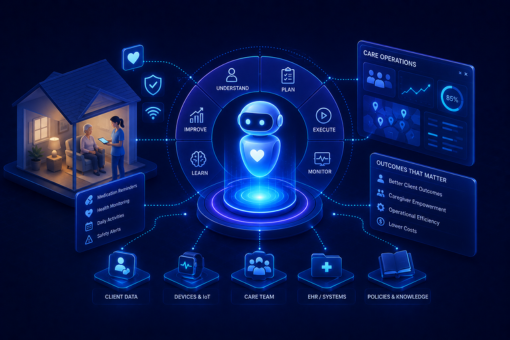
Artificial Intelligence is now moving from automation support to operational backbone. The focus is shifting from isolated AI tools to a comprehensive HIPAA-Compliant Agentic AI Platform for Healthcare that integrates and coordinates workflows, removes friction, and supports real-time decision making across the care continuum. 

As one home care executive recently noted:
“The future of care delivery depends on how well we can scale limited human resources without reducing care quality.” 

For home care leaders, the question is no longer if AI should be adopted. The real question is how to deploy it safely, measurably, and in ways that strengthen care delivery outcomes.

The Strategic Shift: From Task Automation to Care Operations Intelligence 

Home care success now depends on how efficiently organizations can convert referrals into care delivery, manage staff capacity, and demonstrate measurable performance to payers and partners. 

Agentic AI supports this shift by acting as an operational co-pilot, not a replacement for clinical teams. 

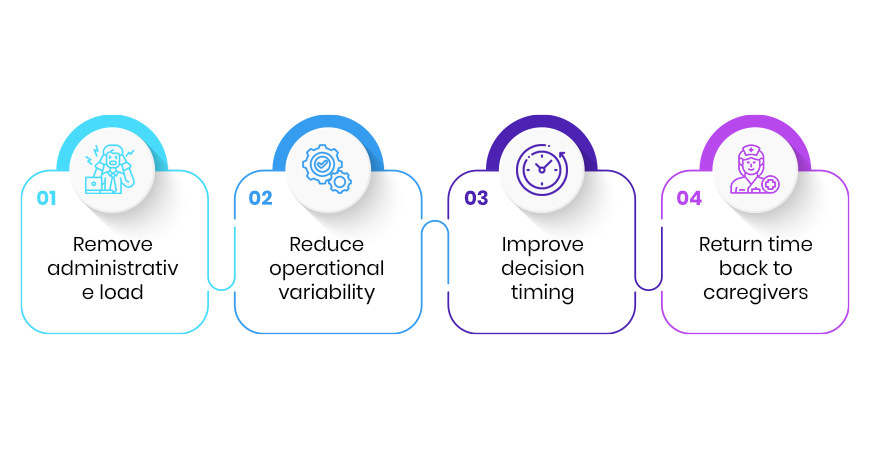
The core philosophy is simple:

The Strategic Shift: From Task Automation to Care Operations Intelligence

This is especially important as workforce shortages become structural. 

AI is not replacing human care. It is protecting it. 

High-Impact Agentic AI Use Cases in Home Care 

Home care presents some of the most operationally complex and high-stakes opportunities for agentic AI. The following AI Use Case in Healthcare represent where the impact is clearest and the ROI most measurable. 

Documentation Intelligence and Clinical Time Recovery 

Documentation remains one of the biggest drivers of caregiver fatigue and operational delay. 

Agentic AI can: 

  • Capture visit conversations through ambient listening 
  • Auto-generate structured visit notes 
  • Support coding and compliance checks 
  • Flag missing documentation in real time 

The result is simple but powerful:
More time with patients. Less time finishing paperwork after shifts. 

As one care leader summarized:
“Technology should remove friction, not add another system to manage.” 

Intake, Referral, and Start-of-Care Acceleration 

Start-of-care delays directly impact revenue cycle timing, patient outcomes, and referral relationships. 

Agentic AI can: 

  • Validate insurance eligibility automatically 
  • Initiate prior authorizations 
  • Clean and normalize referral data 
  • Route cases to the right teams instantly 

This reduces: 

  • Manual follow-ups 
  • Lost referrals 
  • Intake backlog risk 

For agencies operating under value-based contracts, faster start-of-care directly improves performance metrics. 

Workforce Optimization and Caregiver Matching 

Workforce strain is no longer episodic. It is structural. 

Agentic AI can support: 

  • Patient-caregiver matching based on skill, location, acuity, and preferences 
  • Smart schedule balancing 
  • Travel optimization 
  • Burnout risk signals based on workload patterns 

This directly impacts: 

  • Staff retention 
  • Care continuity 
  • Visit reliability 
  • Patient satisfaction 

Care Coordination and Medication Safety 

Home care often operates across fragmented systems. 

Agentic AI can unify: 

  • Clinical data 
  • Medication lists 
  • Risk alerts 
  • Care plan updates 

AI-supported medication reconciliation alone can reduce safety risk and save hours of manual reconciliation work weekly.

Governance: Making AI Safe, Trusted, and Clinically Aligned 

AI adoption in home care requires strict governance and clinical control. 

Key principles include: 

Cross-Functional AI Governance 

  • Clinical leadership 
  • Compliance and legal leadership 
  • Technology leadership 
  • Operations leadership 

Human-in-the-Loop Oversight 

AI supports decisions. Clinicians always make final care decisions. 

Data Security and Private AI Environments 

Healthcare AI must operate in protected environments where patient data is never exposed to public model training.

CTA - Is Your AI Deployment Built to Be Trusted?

Partnership Models That Deliver Measurable Outcomes 

The strongest AI partnerships in home care follow shared outcome accountability. 

Best practice includes: 

  • KPI-linked vendor accountability 
  • Measurable operational improvements 
  • Pilot-first validation 
  • Phased deployment 

If a vendor cannot align to measurable outcomes, long-term value risk increases. 

The Next Phase: Predictive and Experience-Led Home Care 

Home care has always been about what happens between visits. The check-ins that didn’t happen. The risk that wasn’t caught. The family that didn’t know what to ask.  

The next phase of intelligent home care is not about doing more. It is about seeing more, earlier, and acting before the moment passes. 

Family Experience Intelligence 

Families don’t read care plans. They read worry into every unanswered question, every missed call, every term they don’t understand. AI changes that equation. 

AI can: 

  • Translate care plans into plain language 
  • Support family education 
  • Provide non-clinical support and reminders 
  • Identify caregiver or family stress signals 

Predictive Risk Intelligence 

By the time a home care patient is hospitalized, the signals were already there. Agentic AI finds them before they become crises. 

Agentic AI can identify: 

  • Hospitalization risk 
  • Fall risk 
  • Care gap patterns 
  • Staffing mismatch signals 

Predictive Modeling in Healthcare shifts home care from reactive response to proactive intervention in care workflows. 

The Inferenz + Agentic AI Model for Home Care 

At Inferenz, the focus is not on deploying AI tools.
It is on building Agentic AI operating layers across home care workflows. 

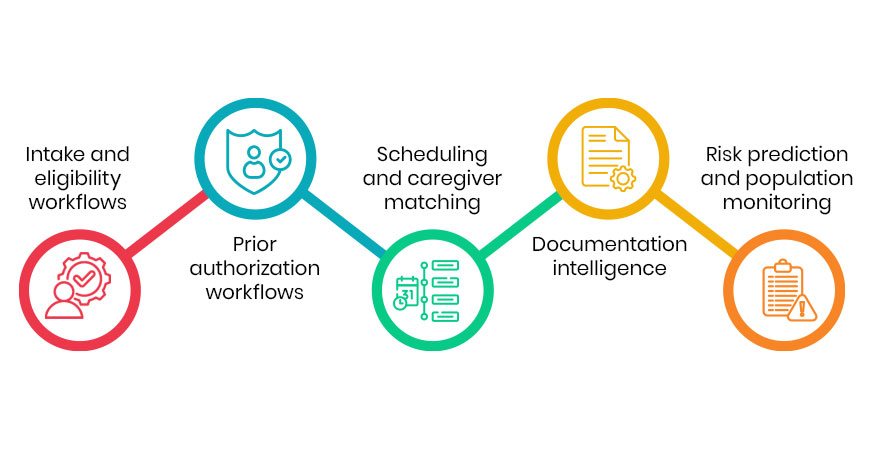
Through platforms like Caregence, organizations can deploy agents across: 

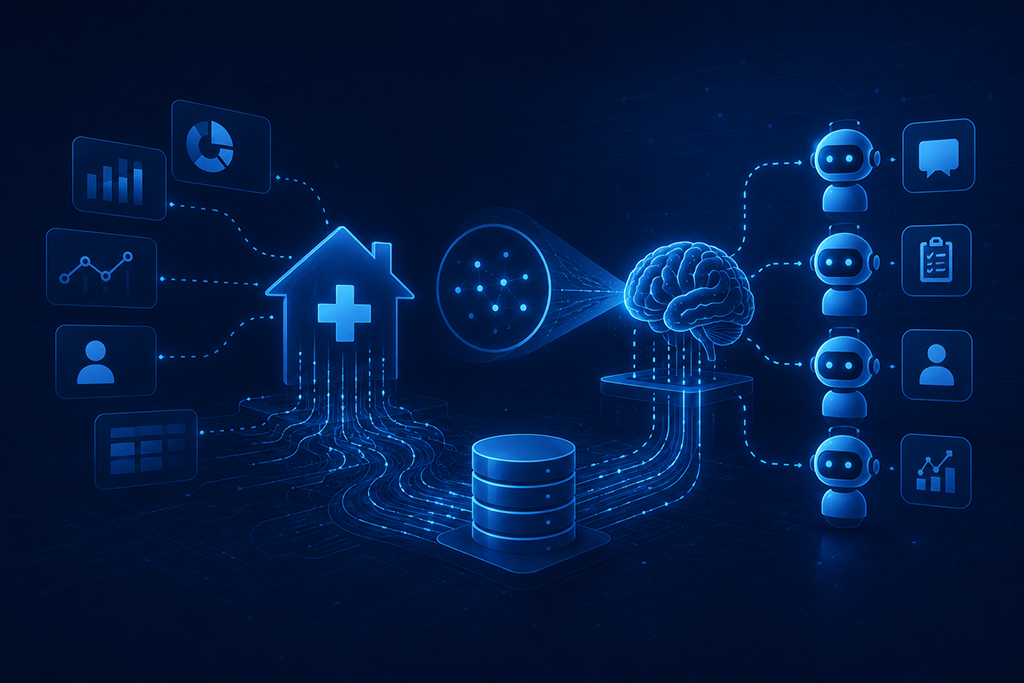
Agentic AI operating layers across home care workflows

The goal is consistent:
Reduce operational noise so care teams can focus on care delivery. 

Conclusion: The Invisible AI Standard in Home Care 

The highest performing AI in home care should feel invisible. 

When it works well: 

  • Caregivers feel supported 
  • Operations feel smoother 
  • Compliance feels easier 
  • Patients experience consistent care 

Agentic AI should work quietly in the background, coordinating care operations while humans focus on compassion, connection, and clinical excellence.

Case Study - Replacing Manual Portal Entry with RPA Automation for a National Home Care Workforce

FAQs

The Home Health Data Visibility Problem and the AI Agents that you Need

Summary

Home health generates more clinical data per patient than almost any other care setting, yet readmissions that remain preventable, keep happening and caregiver turnover sits at 75%. The problem has never been data shortage but data visibility to see patient data as a whole.

The Master Patient Index & Patient 360 solution from Inferenz fixes this by resolving fragmented patient identities into one governed record, then builds a chronological Patient 360 timeline on top of it.

The Real Problem Is Not Data. It Is the Architecture.

I have sat across from enough home health executives to know that “we don’t have the data” is rarely the actual complaint. What they say, when you press them, is closer to: “We have all this data, and I still can’t tell you which patients are trending toward hospitalization this week.”

That is a data architecture problem, not an absence of some clinical system or tool.

The average home health patient generates events across multiple, separate platforms in a single week.

  • The EMR records visits and OASIS assessments.
  • A remote monitoring platform logs vitals between visits.
  • A predictive analytics tool recalculates hospitalization risk scores.
  • A wound care system captures healing progression with images.
  • An ambient documentation tool transcribes clinical conversations.
  • An after-hours triage platform logs patient calls.

Every platform does its individual job well. Not one of them shows you the others.

The supervising care team managing 20-40 patients has no realistic way to correlate a vital spike on the remote monitoring platform with a risk score jump on the analytics tool and a missed visit in the EMR, because those three events exist in three separate systems, behind three separate logins, reviewed by three different people on three different timelines!

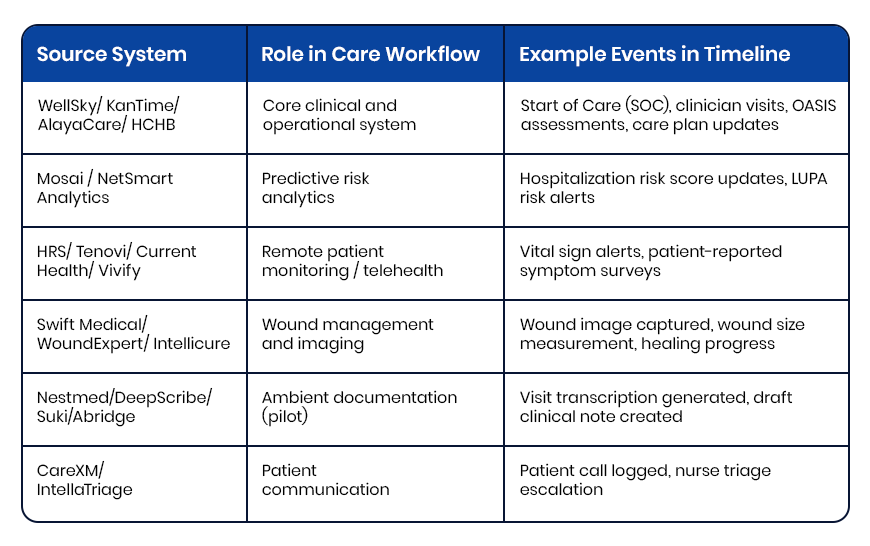
Check out how individual systems perform their individual roles in the care workflow:

how individual systems perform their individual roles in the care workflow

The clinical pattern that would predict the next hospitalization is fully present in the data. It just cannot be read simultaneously.

What Clinical Fragmentation Actually Costs Home Health Agencies

This is where the stakes become concrete.

On patient outcomes

Hospital readmissions remain a major Medicare quality and cost concern, with CMS continuing to tie reimbursement penalties directly to excess 30-day readmission performance. In home health specifically, the deterioration signals that precede those hospitalizations: weight gain trends, rising vital thresholds, declining ADL scores, missed visits, are almost always present in clinical systems days before the ER visit.

On Medicare revenue

A 5% HHVBP payment swing equals $250,000 in annual revenue impact for a $5 million agency. That score is determined by 2024 performance data being calculated right now, as per expanded model. For most agencies, that performance data has never existed in a single unified view. The quality measures driving the score, including Preventable Hospitalization, Discharge Function Score, Discharge to Community, and Medication Management, are each shaped by whether care teams can see patient trajectory across systems in real time.

On workforce retention

Caregiver turnover sits at 75% annually,a staggering number! Nurses report spending up to two hours per shift navigating disconnected systems to assemble clinical context that should take two minutes. Documentation burden is a structural driver of attrition, not a cultural one. Reducing the time a clinician spends chasing information across platforms is a retention investment, not a workflow convenience.

What a Unified Patient Timeline Looks Like in Practice

Before describing how the Patient 360 Journey works technically, it helps to see what changes on a clinical level.

A supervising RN opens a single patient record. Without logging into anything else, she sees:

  • Tuesday: Blood pressure 158/94, threshold exceeded, flagged moderate severity
  • Tuesday: Patient survey reports increased fatigue and mild ankle swelling
  • Three days prior: Hospitalization risk score elevated from 38 to 59, contributing factors flagged
  • Four days prior: Diuretic dose increased per physician order
  • Five days prior: RN visit completed, weight 3.2 lbs above baseline, physician notified
  • Seven days prior: Start of Care, primary diagnosis CHF exacerbation

That sequence tells a complete clinical story. Rising weight. Medication adjustment. Risk score climbing. Fatigue worsening. Blood pressure spiking. The pattern is unmistakable when all events appear in order on one screen. Without a unified timeline, those same events sit across three platforms, reviewed by different people, connected by nobody.

This is what the Patient 360 Journey makes possible, and it is built entirely from data the organization was already generating. And then the Next Best Action Agent takes it further. It uses the visibility with a recommended next step attached. The right action, for the right patient, delivered to the right person before the pattern becomes a crisis. And it is built entirely from data the organization was already generating.

Book a demo CTA

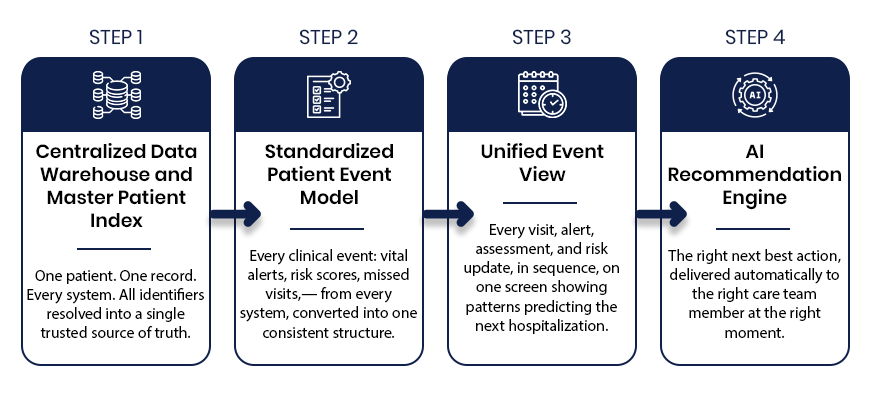
The Patient 360 Journey and the Next Best Action Agent: How They Work in Four Steps

The 360 Patient Journey and the Next Best Action Agent: How They Work in Four Steps

Step 1: Centralized Data Warehouse and Master Patient Index

What it solves: The same patient carries a different identifier in every system. A medical record number in the EMR. A device ID in remote monitoring. A Medicare beneficiary number in the analytics platform.

How it works: The Master Patient Index resolves every identifier, including name, date of birth, Medicare ID, and address, into one canonical patient record using probabilistic matching. One patient. One record. Across every system the organization runs.

Why it matters: Without identity resolution at this level, any downstream unification of clinical data is built on an unreliable foundation. Events get misassigned. Timelines become partial. Clinical decisions get made on incomplete records. The MPI is what makes everything that follows trustworthy.

Step 2: Standardized Patient Event Model

What it solves: Every clinical platform stores data in its own schema, its own timestamp format, its own taxonomy. A vital alert from a remote monitoring platform looks nothing like an OASIS completion from an EMR or a risk score update from a predictive analytics tool.

How it works: Every clinical event from every connected system gets converted into a single standardized structure: event type, timestamp, source system, clinical status, payload summary, and linked events. The care team does not log into six systems to understand one patient. The data arrives already translated into a common language.

Why it matters:For example, six systems with six formats produce six incomplete pictures. One standardized event model produces a complete one.

Step 3: Unified Event Timeline

What it solves: Even with data normalized, clinical teams need a way to see the full patient story in sequence, not as a database export.

How it works: Every normalized event displays in reverse chronological order on a single interface, flagged by severity, color-coded by source system, with linked event relationships visible briefly. The care team sees the complete longitudinal patient journey, from vital spikes and risk score changes to missed visits, wound progression, and after-hours calls, together and in the order they happened.

Why it matters: Patterns are only visible in sequence. The CHF patient whose weight gain, diuretic adjustment, risk score elevation, and vital spike appear as individual data points across three systems looks like four separate mild concerns. On a single unified timeline, they look like what they are: a hospitalization building over five days.

Step 4: AI Recommendation Engine and Next Best Action Agent

What it solves: A unified timeline shows what happened. The Next Best Action Agent tells care teams what to do about it.

How it works: The AI Recommendation Engine reads the complete patient timeline and delivers a specific, prioritized recommended action to the right care team member at the right moment. It surfaces patient summaries, risk drivers, and recommended action plans across every risk level, not just critical cases. The right nurse gets the right instruction automatically: schedule a visit today, escalate to the supervisory RN, request reauthorization before the unit gap widens.

Why it matters: Most clinical AI tools produce dashboards that require interpretation. The Next Best Action Agent produces decisions. There is a meaningful operational difference between a platform that shows a rising risk score and one that tells a specific person to make a specific call within the next four hours.

How Caregence Connects the Intelligence Layer to Clinical Workflows

The Next Best Action Agent runs on Caregence, Inferenz’s agentic AI platform built specifically for home health and hospice organizations. Caregence connects to existing EMR, payer, scheduling, EVV, and RCM systems without requiring agencies to replace a single platform they already use.

It provides the workflow infrastructure for deploying custom AI agents on top of unified patient data, including the Next Best Action Agent, with built-in governance, role-based access, and audit-ready communication tracking.

Think of Caregence as the operating system for proactive care. The Patient 360 Journey provides the unified data foundation for visibility. It is based on Caregence that provides the AI agents that act on it, including the Next Best Action Agent.

The Measurable Impact: From Data Visibility to HHVBP Performance

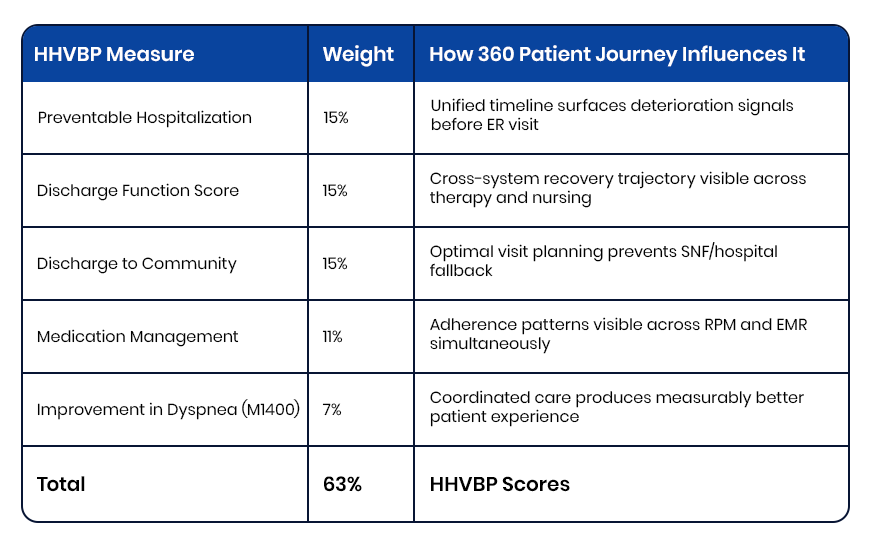
Inferenz’s internal assessment of the Patient 360 Journey and Next Best Action Agent against the full HHVBP measure set found that this four-step process addresses up to 63% of HHVBP quality metrics directly.

The measures most influenced:

The Measurable Impact: From Data Visibility to HHVBP Performance

The agencies that improve HHVBP scores in 2026 will not do it by changing clinical protocols. They will do it by making existing clinical data visible in sequence, in context, and at the moment when action can still change the outcome.

The Bottom Line

Home health and hospice organizations are not data-poor. They are data-fragmented. Every signal needed to prevent the next hospitalization, protect HHVBP reimbursement, reduce documentation burden, and demonstrate outcomes to payers is already being generated inside the organization.

The Patient 360 Journey makes that data readable. Caregence makes it actionable. The Next Best Action Agent makes sure the right person acts on it before the window for intervention closes.

This is what Data to AI to ROI looks like in home health and hospice, built by Inferenz for organizations that cannot afford to keep losing $250,000 on a visibility problem they already have the data to solve.

Frequently Asked Questions

AI-Powered Patient Onboarding: The Smartest Way for Providers to Save Time, Cut Costs, and Improve Care

Background summary

AI-powered patient onboarding is reshaping healthcare operations by automating patient intake, reducing manual workload, and improving care quality. This technology empowers homecare providers to streamline processes, enhance patient satisfaction, and deliver cost-effective, personalized care from day one. First impressions in healthcare shape how patients engage with your team.

Onboarding is often the first real contact a patient has with a homecare provider. At that moment, they fill out forms and seek clarity, support, and direction. The onboarding process though can be slow and confusing.

  • Forms are repetitive.
  • Follow-ups take time.
  • And caregiver assignments don’t always meet patient’s expectations.

These delays impact care delivery. They also drain staff time and slow down billing.
Many healthcare organizations continue to rely on manual intake systems. That means more errors, longer wait times, and lower patient satisfaction scores. It also puts pressure on intake teams, who must chase down missing data or correct mismatches late in the workflow.

AI-powered patient onboarding changes that. It speeds up intake, reduces manual steps, and connects patients with the right caregivers based on skills, location, and availability.
For CXOs leading homecare or healthcare networks, improving the intake process creates measurable gains—in time, cost, and patient outcomes. It’s a decision that improves how the business runs every day.

The state of patient onboarding in US healthcare

Let’s get real: most patient onboarding processes are designed for administrators, not patients.

A recent survey by Accenture found that 36% of patients who switched providers in the past year cited poor onboarding and communication as a key reason. At the same time, the administrative cost of onboarding a new patient can run as high as $200 when factoring in manual data entry, verification, and scheduling time. Multiply that across hundreds or thousands of patients per month, and the financial impact is clear.

Key stats you should know:

  • 2–7 days: Average onboarding time for new patients in traditional workflows.
  • 75%: Share of patients who expect digital-first intake options (McKinsey).
  • $18 billion: Estimated annual cost of redundant admin tasks in US healthcare (CAQH Index).

These numbers aren’t just eye-catching—they’re telling you something. There’s a clear disconnect between what patients expect and what providers are currently offering.

Onboarding, when done right, is not just a compliance formality. It’s a moment of truth. It affects patient retention, caregiver utilization, operational costs, and even Medicare ratings. The good news? Automation and AI can address most of the pain points—without replacing your human staff.

What today’s homecare leaders expect

Healthcare executives aren’t looking for shiny tech. They’re looking for practical outcomes.

A COO doesn’t want another dashboard. They want their intake team to process 100 new patients a day without burning out. A CIO isn’t chasing buzzwords. They want systems that integrate securely with their EHRs, handle data reliably, and actually reduce workload.

Here’s what’s consistently coming up in boardroom conversations when it comes to patient onboarding:

What CXOs want from modern onboarding:

  • Speed without compromising compliance
  • A consistent patient experience across multiple touchpoints
  • Automated caregiver matching based on real data, not manual guesswork
  • Fewer handoffs between systems and departments
  • Clear metrics for tracking onboarding performance and satisfaction

One of the recurring frustrations we’ve heard is this: teams spend more time fixing onboarding errors than actually engaging with patients. That’s not scalable. It’s not efficient. And in today’s landscape, it’s not acceptable.

AI-powered automation offers a fix. But only if it solves real operational problems—without becoming another system that needs babysitting.

AI-powered onboarding: what it actually means

Most leaders agree: onboarding needs to be better. But what does “better” really look like? More importantly, what does AI-powered onboarding actually mean in day-to-day operations?

Let’s break it down without the tech jargon.

At its core, AI-powered onboarding is about speed, precision, and personalization—without burdening your staff or losing regulatory grip. It takes a traditionally manual, fragmented workflow and makes it smarter, connected, and almost invisible to the patient.

So, what does a modern AI-enabled onboarding workflow actually look like?

Imagine a new patient—let’s call her Janet—who’s seeking home health support after a hospital discharge.

Instead of filling out a physical packet or struggling through a clunky portal, she’s greeted by a smart chatbot on her phone. It asks clear, relevant questions. It already knows which forms to show based on her zip code or insurance provider. It even checks that the document photos she uploads (like her insurance card or ID) are valid. The backend? Handled by AI—no need for an admin to sift through every file manually.

In minutes, Janet has completed her intake. She’s matched with a caregiver based on her preferences (language, availability, proximity), and both parties receive a personalized email with the appointment details. It feels seamless.

But under the hood, here’s what’s at play:

Key components of AI-powered patient onboarding

1. Conversational AI for intake

  • A bot guides the patient using questions that feel human and helpful.
  • Questions adapt dynamically based on previous answers.
  • It confirms responses in real-time (e.g., “Did you mean 2023 or 2024?”).
  • If a patient uploads a document twice without success, the system switches to manual entry instead of creating a bottleneck.

✅ Business win: Reduces form abandonment, improves data accuracy, and saves staff time.

2. Document parsing that actually works

  • Patients can upload a variety of file types: PDFs, photos, even ZIP folders with multiple documents.
  • Azure AI extracts key fields like name, DOB, policy number, and address.
  • The data is normalized and mapped to the right fields in your system (e.g., Snowflake database).

✅ Business win: Cuts down 80% of manual data entry, minimizes data errors, and speeds up insurance verification.

3. Custom state management

  • Let’s say Janet drops off midway through onboarding. She gets interrupted.
  • No problem. When she returns, the system remembers exactly where she left off.

✅ Business win: Increases completion rates and reduces patient frustration. Helps your intake metrics look better without any staff intervention.

4. Smart caregiver matching

  • The system looks at more than just availability.
  • It checks caregiver skills, past visit history, languages spoken, and travel distance.
  • It computes a weighted score and recommends the best match—not just a random one.

✅ Business win: Higher match quality means better care, fewer complaints, and improved outcomes. Also helps balance caregiver workload.

5. Scheduling and notifications

  • The system finds the earliest suitable appointment and sends a clear email with the date, time, and contact info.
  • If rescheduling is needed, the link is right there in the email.

✅ Business win: Reduces no-shows, improves transparency, and eliminates back-and-forth calls.

In simpler terms, AI automation doesn’t just speed up onboarding. It improves the quality of the match, the accuracy of the data, and the confidence of the patient walking into their first appointment.

It does what manual teams often struggle with under pressure—at scale and in real time.

Impact on operational efficiency: why CXOs should pay attention

If the previous section showed you the moving parts, this section shows why they matter.

AI-powered onboarding is an operational upgrade that translates into real business value across leadership roles.

For CEOs: faster onboarding = faster revenue

  • The faster a patient is onboarded, the sooner care begins—and the sooner you can bill.
  • In many homecare networks, delays of 2–5 days between referral and care initiation are common. AI cuts this down to under 24 hours.
  • Improved satisfaction during onboarding often reflects in CAHPS and HCAHPS scores, directly influencing your reputation and Medicare payments.

📊 Stat you can use: Healthcare organizations with high onboarding satisfaction scores report up to 25% higher patient retention over a 12-month period. (Source: NRC Health)

For COOs: reducing friction across locations

  • With AI automation, form templates, workflows, and caregiver matching logic stay consistent—whether your teams are in Chicago, Dallas, or Miami.
  • It’s easier to standardize SOPs, train new staff, and maintain service quality.
  • Centralized oversight (via admin dashboards) means your regional heads can spot bottlenecks quickly and resolve them before they escalate.

📊 Time saved: A mid-sized home health agency estimated a 60% drop in average onboarding time across its five regions after implementing AI intake.

For CIOs: secure, scalable, and compliant

  • The tech stack is built on secure, cloud-native tools like Azure AI, Snowflake, and FastAPI.
  • All data handling is HIPAA-compliant, with field-level validations and audit logs.
  • System components integrate easily with EHRs or existing CRMs without rewriting everything from scratch.

💡 Why it matters: You don’t need to rebuild your tech landscape. AI onboarding layers in modularly, with low lift on your internal teams.

Metrics that matter (And that you can actually track)

MetricBefore AIAfter AIChange
Avg. time to onboard2–3 Days<10 Minutes-95%
Form abandonment rate40%<10%-75%
Manual entry errorsHighMinimal-80%
Matched within SLA~60%90%++30%
Admin hours savedN/A4–6 FTEs/monthCost savings


AI onboarding helps patients better than before by removing operational drag and unlocking value from day one.
And most importantly, it’s not hypothetical. It’s already working in real organizations across the US

Automated Patient Onboarding

The tech stack that works

Let’s keep it simple. The system works because it combines proven tools in a patient-centric way. Here’s the ecosystem in plain English:

ComponentWhat it doesWhy it matters
LangChainPowers the chatbot and forms dynamic questionsReduces intake friction, adapts in real-time
Azure AIReads documents like ID cards, insuranceEliminates manual typing, lowers error rate
SnowflakeStores all validated data securelyScales fast, works with analytics and dashboards
Neo4jCreates smart caregiver-patient match logicImproves accuracy and personalization
FastAPIExposes onboarding & matching results via secure APIEasy to integrate with your other systems

Security? ✅ HIPAA-compliant
Integration? ✅ Plug-and-play APIs
Scalability? ✅ Built for large volumes without lag
You don’t need a full digital transformation to get started. This plugs into your existing tech quietly and efficiently.

Challenges and what to watch out for

No system is perfect out of the box. But the common pitfalls with AI onboarding are manageable with the right approach:

  • Training intake staff: Even with automation, your team should know how to troubleshoot or step in if a patient gets stuck.
  • Patient trust in automation: For older adults or less tech-savvy users, the chatbot needs to feel approachable and human.
  • Garbage in, garbage out: Data validation steps are critical. Weak input logic can ruin caregiver matches.

Pro tip: Start with a single-region rollout and use metrics like form abandonment, average onboarding time, and caregiver match score to measure success. If the data looks good in 30 days, expand from there.

How to get started without disrupting operations

You don’t need to rip out your existing systems to make this work. AI onboarding solutions are designed to slide in—not shake up.

Here’s a smart rollout plan:
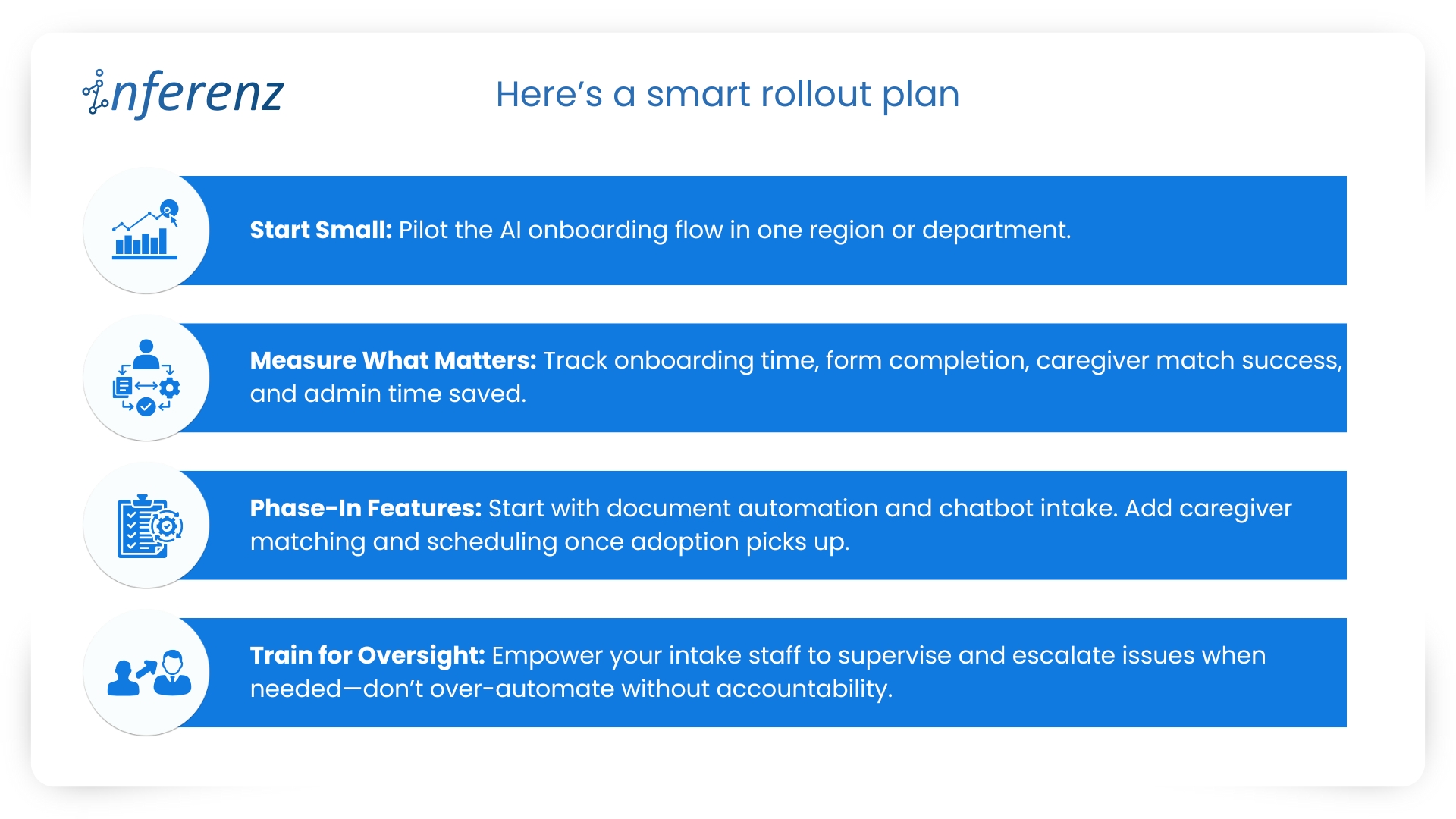
smart rollout plan
💡 Pro Tip: Choose vendors who offer modular deployment, HIPAA-compliance guarantees, and support for EHR integration (like Epic, Cerner).

The future of onboarding: what’s next

AI onboarding is just the beginning. As the healthcare ecosystem evolves, next-gen tools are already taking shape.

Voice-first intake for seniors

Scenario: A 78-year-old in assisted living completes onboarding by simply answering a few questions over a voice assistant or phone call—no typing, no touchscreen.
Sourced statistics: According to CB Insights, over 30% of AI health startups in 2024 are building voice-enabled interfaces for aging populations.

Multilingual bots for inclusive access

Scenario: A caregiver in Florida uses the chatbot in Spanish to complete intake for a new patient. Forms are automatically translated, and backend data remains unified.
Sourced statistics: McKinsey reports that multilingual tech will be a competitive differentiator for Medicaid and community-based care providers by 2026.

Pre-onboarding risk prediction

Scenario: Before a patient is onboarded, the system flags high hospitalization risk based on intake data. A higher-touch care plan is auto-suggested.
Sourced statistics: Gartner’s 2025 predictions on predictive AI in healthcare cite onboarding-level data as a new frontier for early intervention.

Seamless claims triggering

Scenario: Once a patient is onboarded and matched, billing pre-auth is initiated immediately based on care codes linked to intake data.
Sourced statistics: HealthEdge’s payer-tech report shows a 35% reduction in claim delays when intake is linked to backend revenue cycle systems.

Closing note: don’t let your first touchpoint be the weakest link

Here’s the simple truth: If your onboarding experience still runs on PDFs and follow-up calls, you’re losing patients, revenue, and goodwill—quietly, every day.

AI-powered onboarding isn’t about replacing people. It’s about giving your team room to breathe and your patients a reason to stay. And the best part? It pays for itself in efficiency, satisfaction, and speed to care.

If there’s one place to start your AI journey, it’s not billing. It’s onboarding.

Let your first impression be your strongest one.

 

Automated Patient Onboarding

FAQs for CXOs exploring AI-powered onboarding

Agentic AI in Healthcare: How Can CIOs Plan AI Implementation Across Departments

Background summary

Hospitals and home-health teams face repeat snags across Patient Access, ED, Inpatient Nursing, Radiology, Peri-op, and more. They face messy referrals and coverage checks, alert noise, heavy charting, imaging backlogs, or delays, medication risks, missed visits, claim denials, and late insight from feedback.  

Agentic AI tackles the repeat work behind these issues by reading context, deciding next steps, acting inside your EHR or ERP, and writing back with an audit trail, which speeds flow, reduces errors, and steadies cash. This article maps each department to clear Agentic AI capabilities across departments citing proof points and role-based benefits.“Keep the lights on, fix the gaps, then let AI take the grunt work.

That quote, shared by a Mid-Atlantic hospital CIO in April, sums up 2025’s mood in health-system IT suites across the U.S. Cost pressure remains high, yet the conversation has moved from whether to apply AI to where first. 

Healthcare needs AI implementation, now! 

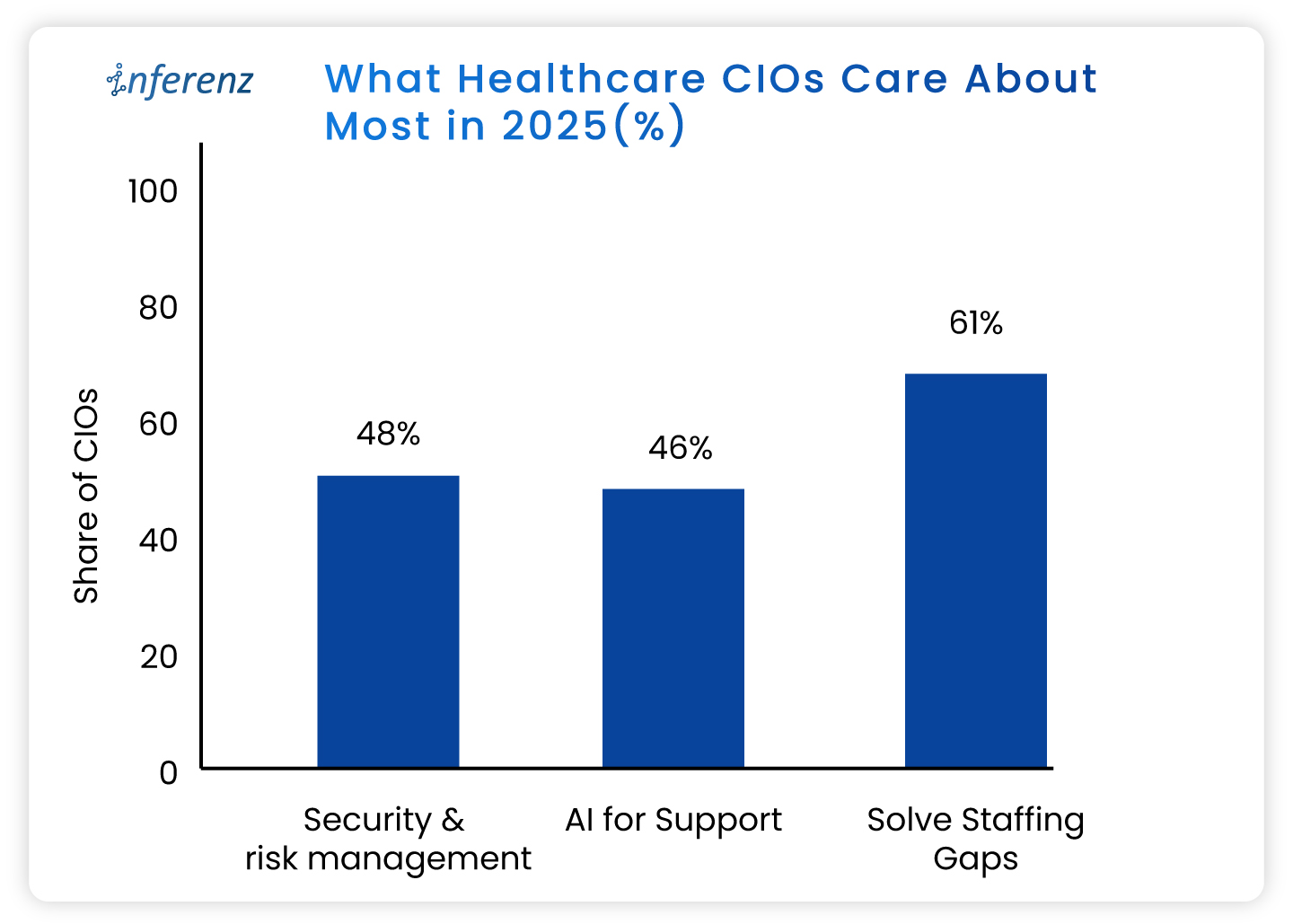
A fresh State of the CIOs survey of 906 healthcare IT leaders puts hard numbers behind the chatter: What Healthcare CIOs Care About Most in 2025


  • Solving IT staffing shortages ranks even higher, flagged by 61%.
    • Recruiting and keeping skilled people is harder than finding capital. 
  • AI for support and workflow relief lands at 46 %, 
    • This trend eclipses past favourites like cloud migrations. 
  • Security and risk management tops the chart at 48%. 
    • Ransomware worries still wake leaders at 3 a.m. 

What do these healthcare CIO priorities tell us? 

  • Staffing pressure makes patient access automation urgent, not optional. 
    • Leaders want bots that shave minutes, not moon-shot labs that promise a payoff five years out. 
  • AI momentum is practical. 
    • CIOs are testing agent-based tools inside revenue cycle, nursing rosters, and patient access because those areas pay back in months, not quarters or years. 
  • Security first means guardrails are non-negotiable. 
    • HIPAA-compliant AI is a must. The implementations need to comply also with HITRUST, and the new HHS cybersecurity proposals out for comment. 

Read more about the top operational issues that have got CIOs worried.  

Now that priorities are in place, let us see how agentic AI can help you simplify and enhance your operations. 

Agentic AI in healthcare, in full-speed action 

Agentic AI work like small digital co-workers that handle repeat work and quick decisions inside your existing systems. Each agent reads context from the EHR or ERP, decides the next step, takes the action, and writes back with a clear audit trail. That is why it fits real operations.  

The question is: where do you start? 

You start where delays hurt most, set a simple outcome, and let agents carry the routine tasks across three phases of care: Start of Care, Care Delivery, and Post Care. The payoff shows up as fewer handoffs, shorter queues, cleaner data, and faster payment cycles. 

Below, we set the context and the core challenge for the major operational areas. Under each, you will see the exact Agentic AI capabilities that meet healthcare AI use cases, using the solution buckets you shared so you can cross-link or pilot right away. 

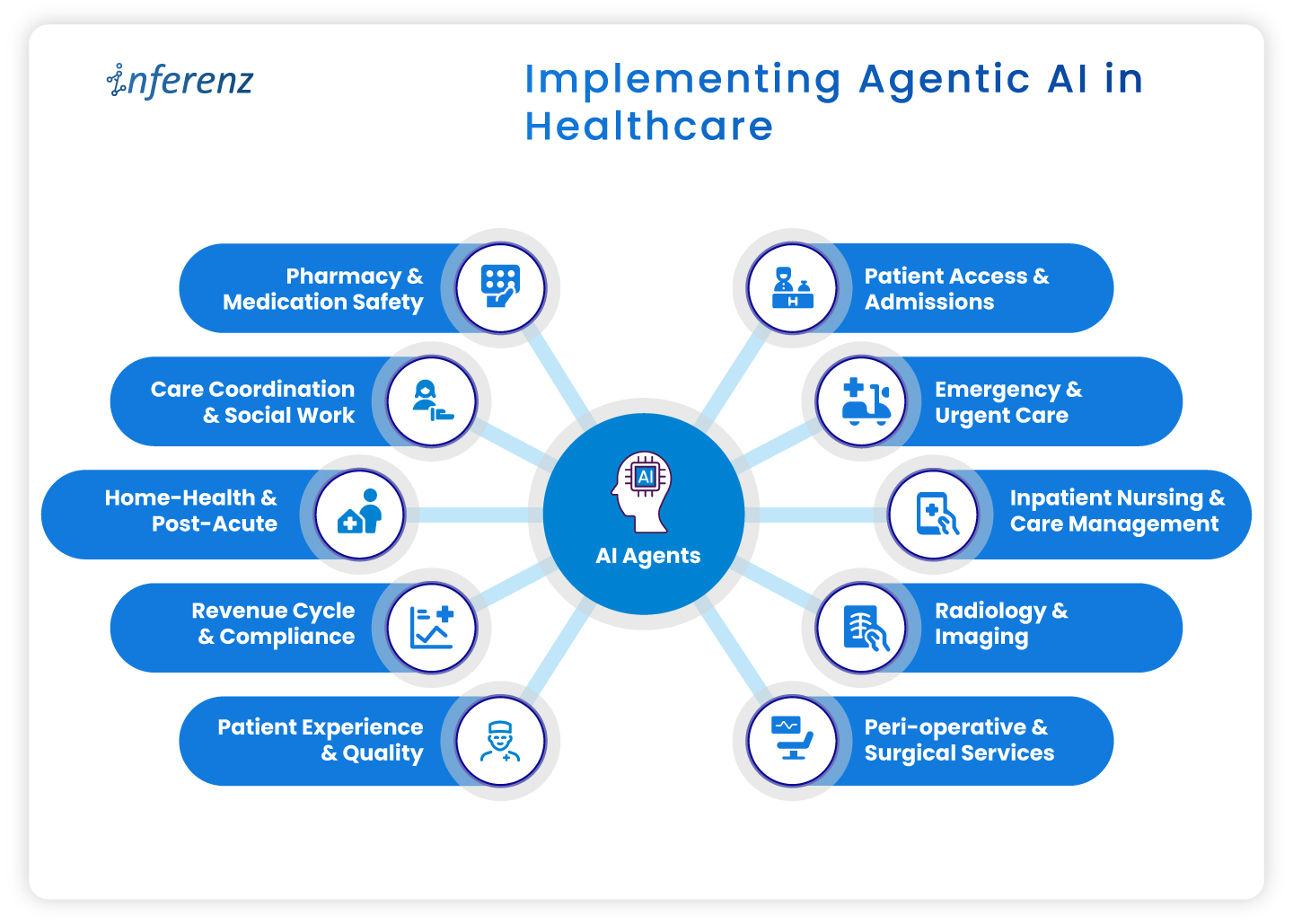
Implementing agentic AI in healthcare 

  • Patient access & admissions 
  • Emergency & urgent care 
  • Inpatient nursing & care management 
  • Radiology & imaging 
  • Peri-operative & surgical services 
  • Pharmacy & medication safety 
  • Care coordination & social work 
  • Home-health & post-acute 
  • Revenue cycle & compliance 
  • Patient experience & quality 

Implementing Agentic AI in Healthcare

1. Patient access & admissions 

Context. Intake teams deal with referrals that arrive in mixed formats, copy data across systems, and chase benefits by phone. Queues grow. First visits slip. 

How agentic AI helps. 

  • Referral & digital intake automation pulls, cleans, and routes referral data into the record. 
  • Eligibility checks & prior authorization verifies coverage and starts approvals without back-and-forth. 
  • Patient outreach sends reminders, prep steps, education, and e-consent through the channel patients prefer. 
  • Digital front desk lets patients book, reschedule, and confirm without a call. 
  • SDOH analytics flags transport or language barriers early to ease patient onboarding efforts. 
  • Intake fraud detection prevents duplicate or false identities at the gate. 

Operational outcome.

Faster first appointments, fewer re-keyed fields, cleaner claims from day one. 

2. Emergency & urgent care 

Context. Clinicians need early signal on deterioration. Alert fatigue and manual triage slow action. 

How agentic AI helps. 

  • Active monitoring streams vitals and new labs to an agent that watches for change. 
  • Alert prioritization filters noise and shows only actionable risks to the right role. 
  • Clinical risk modeling scores sepsis, readmit, or fall risk in near real time. 
  • Natural language copilots summarize recent notes so the team sees context on arrival. 

Operational outcome.  

Faster recognition, fewer false alarms, clearer handoffs. 

3. Inpatient nursing & care management 

Context. Nurses split time between bedside tasks and documentation. Care plans go stale when conditions shift. 

How agentic AI helps. 

  • Dynamic care plan personalization updates tasks and goals mid-cycle based on new data. 
  • AI documentation for clinicians drafts visit notes and care plans from voice or short prompts. ICD-10 and HHRG codes are proposed for review. 
  • Alert prioritization keeps clinicians focused on the few patients who need action now. 
  • Patient Caregiver Matching to align with patient and caregiver schedules dynamically and intelligently to stay ahead of patient needs. 

Operational outcome.  

More bedside time, fewer charting hours, faster response on the floor.

4. Radiology & imaging

Context. Studies arrive faster than they are read. Critical cases can wait behind routine ones. Reporting workflows feel heavy. 

How agentic AI helps. 

  • Clinical risk modeling uses order data, vitals, and history to score urgency, so teams handle the right studies first. 
  • Natural language copilots pre-draft structured impressions from key images and prior reports. 
  • AI documentation turns dictated notes into clean, compliant reports ready for sign-off. 

Operational outcome.  

Quicker turnaround, fewer sticky handoffs between techs and readers. 

5. Peri-operative & surgical services

Context. Small delays at pre-op and PACU ripple across the day. Discharge notes and coding often lag. 

How agentic AI helps. 

  • Dynamic care plan personalization keeps surgical pathways current from pre-op to recovery. 
  • Automated discharge & transition summaries create clear handoffs for floor teams and home-health partners. 
  • Billing/Compliance automation converts post-op documentation into coded encounters and gathers needed attachments. 

Operational outcome.  

Tighter case flow, on-time handoffs, faster coding after wheels-out. 

6. Pharmacy & medication safety

Context. Medication lists change often. Renal function, allergies, and interactions can be missed during rush hours. 

How agentic AI helps. 

  • Clinical risk modeling checks interactions and dose risks against labs and history. 
  • Natural language copilots summarize med rec and highlight conflicts for pharmacists. 
  • AI documentation writes structured notes for interventions and education.  

Operational outcome.  

Fewer preventable events and clearer documentation for audits. 

7. Care coordination & social work

Context. Teams try to close loops across clinics, payers, and community partners. Calls and emails eat hours. 

How agentic AI helps. 

  • SDOH analytics surfaces access risks that block progress. A solution like home care analytics works in this regard backed by natural language without dashboards. 
  • Patient outreach sends targeted messages, education, and transportation prompts. 
  • Automated follow-up schedules check-ins by protocol and milestone, then tracks responses. 
  • Feedback mining & sentiment analysis reads messages and surveys to spot issues before they escalate. 

Operational outcome.  

More completed actions per coordinator and fewer avoidable returns. 

8. Home-health & post-acute 

Context. Visit schedules, caregiver skills, and travel time rarely align. Drop-offs after week one are common. 

How agentic AI helps. 

  • Remote monitoring tracks symptoms or device readings between visits and flags change. 
  • Automated follow-up sends check-ins and instructions that match the care plan. 
  • Retention analytics predicts disengagement and suggests outreach that brings patients back. 

Operational outcome.  

More visits per day, steadier adherence, fewer surprises between appointments. 

9. Revenue cycle & compliance 

Context. Missing fields and late attachments create denials. Manual status checks slow payment. 

How agentic AI helps. 

  • AI documentation and billing/ compliance automation convert care notes into coded, compliant claims with proofs attached. 
  • Eligibility checks & prior authorization starts early at intake, then updates status automatically after visits as part of revenue cycle automation. 
  • Natural language copilots draft appeal letters and collect the right excerpts from the record. 

Operational outcome.  

Cleaner first-pass claims, fewer reworks, faster cash. 

10. Patient experience & quality 

Context. Comments from portals, calls, and surveys get scattered. Teams react late. 

How agentic AI helps. 

  • Feedback mining & sentiment analysis aggregates themes and flags risk in near real time. 
  • Automated discharge & transition summaries set clear expectations and reduce confusion. 
  • Longitudinal recovery prediction compares recovery against expected trends and signals when to step in. 

Operational outcome.  

Fewer escalations, clearer communication, tighter loop closure.  

Wrap-up 

Agentic AI pays off when it sits inside daily work, not beside it. Start with one area where delays or denials sting, choose a small outcome, and pilot the single agent that clears the path. Once the metrics move, extend the same logic to the next step in the care cycle. Hours return to care teams, data gets cleaner, and cash moves faster. 

Next step.  

If this flow matches your roadmap, you will certainly benefit having a short, printable CIO checklist for use-case selection, data access, privacy controls, success metrics, and for each healthcare department. 

Frequently asked questions