











AI-Powered Patient Onboarding: The Smartest Way for Providers to Save Time, Cut Costs, and Improve Care

Background summary

AI-powered patient onboarding is reshaping healthcare operations by automating patient intake, reducing manual workload, and improving care quality. This technology empowers homecare providers to streamline processes, enhance patient satisfaction, and deliver cost-effective, personalized care from day one. First impressions in healthcare shape how patients engage with your team.

Onboarding is often the first real contact a patient has with a homecare provider. At that moment, they fill out forms and seek clarity, support, and direction. The onboarding process though can be slow and confusing.

  • Forms are repetitive.
  • Follow-ups take time.
  • And caregiver assignments don’t always meet patient’s expectations.

These delays impact care delivery. They also drain staff time and slow down billing.
Many healthcare organizations continue to rely on manual intake systems. That means more errors, longer wait times, and lower patient satisfaction scores. It also puts pressure on intake teams, who must chase down missing data or correct mismatches late in the workflow.

AI-powered patient onboarding changes that. It speeds up intake, reduces manual steps, and connects patients with the right caregivers based on skills, location, and availability.
For CXOs leading homecare or healthcare networks, improving the intake process creates measurable gains—in time, cost, and patient outcomes. It’s a decision that improves how the business runs every day.

The state of patient onboarding in US healthcare

Let’s get real: most patient onboarding processes are designed for administrators, not patients.

A recent survey by Accenture found that 36% of patients who switched providers in the past year cited poor onboarding and communication as a key reason. At the same time, the administrative cost of onboarding a new patient can run as high as $200 when factoring in manual data entry, verification, and scheduling time. Multiply that across hundreds or thousands of patients per month, and the financial impact is clear.

Key stats you should know:

  • 2–7 days: Average onboarding time for new patients in traditional workflows.
  • 75%: Share of patients who expect digital-first intake options (McKinsey).
  • $18 billion: Estimated annual cost of redundant admin tasks in US healthcare (CAQH Index).

These numbers aren’t just eye-catching—they’re telling you something. There’s a clear disconnect between what patients expect and what providers are currently offering.

Onboarding, when done right, is not just a compliance formality. It’s a moment of truth. It affects patient retention, caregiver utilization, operational costs, and even Medicare ratings. The good news? Automation and AI can address most of the pain points—without replacing your human staff.

What today’s homecare leaders expect

Healthcare executives aren’t looking for shiny tech. They’re looking for practical outcomes.

A COO doesn’t want another dashboard. They want their intake team to process 100 new patients a day without burning out. A CIO isn’t chasing buzzwords. They want systems that integrate securely with their EHRs, handle data reliably, and actually reduce workload.

Here’s what’s consistently coming up in boardroom conversations when it comes to patient onboarding:

What CXOs want from modern onboarding:

  • Speed without compromising compliance
  • A consistent patient experience across multiple touchpoints
  • Automated caregiver matching based on real data, not manual guesswork
  • Fewer handoffs between systems and departments
  • Clear metrics for tracking onboarding performance and satisfaction

One of the recurring frustrations we’ve heard is this: teams spend more time fixing onboarding errors than actually engaging with patients. That’s not scalable. It’s not efficient. And in today’s landscape, it’s not acceptable.

AI-powered automation offers a fix. But only if it solves real operational problems—without becoming another system that needs babysitting.

AI-powered onboarding: what it actually means

Most leaders agree: onboarding needs to be better. But what does “better” really look like? More importantly, what does AI-powered onboarding actually mean in day-to-day operations?

Let’s break it down without the tech jargon.

At its core, AI-powered onboarding is about speed, precision, and personalization—without burdening your staff or losing regulatory grip. It takes a traditionally manual, fragmented workflow and makes it smarter, connected, and almost invisible to the patient.

So, what does a modern AI-enabled onboarding workflow actually look like?

Imagine a new patient—let’s call her Janet—who’s seeking home health support after a hospital discharge.

Instead of filling out a physical packet or struggling through a clunky portal, she’s greeted by a smart chatbot on her phone. It asks clear, relevant questions. It already knows which forms to show based on her zip code or insurance provider. It even checks that the document photos she uploads (like her insurance card or ID) are valid. The backend? Handled by AI—no need for an admin to sift through every file manually.

In minutes, Janet has completed her intake. She’s matched with a caregiver based on her preferences (language, availability, proximity), and both parties receive a personalized email with the appointment details. It feels seamless.

But under the hood, here’s what’s at play:

Key components of AI-powered patient onboarding

1. Conversational AI for intake

  • A bot guides the patient using questions that feel human and helpful.
  • Questions adapt dynamically based on previous answers.
  • It confirms responses in real-time (e.g., “Did you mean 2023 or 2024?”).
  • If a patient uploads a document twice without success, the system switches to manual entry instead of creating a bottleneck.

✅ Business win: Reduces form abandonment, improves data accuracy, and saves staff time.

2. Document parsing that actually works

  • Patients can upload a variety of file types: PDFs, photos, even ZIP folders with multiple documents.
  • Azure AI extracts key fields like name, DOB, policy number, and address.
  • The data is normalized and mapped to the right fields in your system (e.g., Snowflake database).

✅ Business win: Cuts down 80% of manual data entry, minimizes data errors, and speeds up insurance verification.

3. Custom state management

  • Let’s say Janet drops off midway through onboarding. She gets interrupted.
  • No problem. When she returns, the system remembers exactly where she left off.

✅ Business win: Increases completion rates and reduces patient frustration. Helps your intake metrics look better without any staff intervention.

4. Smart caregiver matching

  • The system looks at more than just availability.
  • It checks caregiver skills, past visit history, languages spoken, and travel distance.
  • It computes a weighted score and recommends the best match—not just a random one.

✅ Business win: Higher match quality means better care, fewer complaints, and improved outcomes. Also helps balance caregiver workload.

5. Scheduling and notifications

  • The system finds the earliest suitable appointment and sends a clear email with the date, time, and contact info.
  • If rescheduling is needed, the link is right there in the email.

✅ Business win: Reduces no-shows, improves transparency, and eliminates back-and-forth calls.

In simpler terms, AI automation doesn’t just speed up onboarding. It improves the quality of the match, the accuracy of the data, and the confidence of the patient walking into their first appointment.

It does what manual teams often struggle with under pressure—at scale and in real time.

Impact on operational efficiency: why CXOs should pay attention

If the previous section showed you the moving parts, this section shows why they matter.

AI-powered onboarding is an operational upgrade that translates into real business value across leadership roles.

For CEOs: faster onboarding = faster revenue

  • The faster a patient is onboarded, the sooner care begins—and the sooner you can bill.
  • In many homecare networks, delays of 2–5 days between referral and care initiation are common. AI cuts this down to under 24 hours.
  • Improved satisfaction during onboarding often reflects in CAHPS and HCAHPS scores, directly influencing your reputation and Medicare payments.

📊 Stat you can use: Healthcare organizations with high onboarding satisfaction scores report up to 25% higher patient retention over a 12-month period. (Source: NRC Health)

For COOs: reducing friction across locations

  • With AI automation, form templates, workflows, and caregiver matching logic stay consistent—whether your teams are in Chicago, Dallas, or Miami.
  • It’s easier to standardize SOPs, train new staff, and maintain service quality.
  • Centralized oversight (via admin dashboards) means your regional heads can spot bottlenecks quickly and resolve them before they escalate.

📊 Time saved: A mid-sized home health agency estimated a 60% drop in average onboarding time across its five regions after implementing AI intake.

For CIOs: secure, scalable, and compliant

  • The tech stack is built on secure, cloud-native tools like Azure AI, Snowflake, and FastAPI.
  • All data handling is HIPAA-compliant, with field-level validations and audit logs.
  • System components integrate easily with EHRs or existing CRMs without rewriting everything from scratch.

💡 Why it matters: You don’t need to rebuild your tech landscape. AI onboarding layers in modularly, with low lift on your internal teams.

Metrics that matter (And that you can actually track)

MetricBefore AIAfter AIChange
Avg. time to onboard2–3 Days<10 Minutes-95%
Form abandonment rate40%<10%-75%
Manual entry errorsHighMinimal-80%
Matched within SLA~60%90%++30%
Admin hours savedN/A4–6 FTEs/monthCost savings


AI onboarding helps patients better than before by removing operational drag and unlocking value from day one.
And most importantly, it’s not hypothetical. It’s already working in real organizations across the US

Automated Patient Onboarding

The tech stack that works

Let’s keep it simple. The system works because it combines proven tools in a patient-centric way. Here’s the ecosystem in plain English:

ComponentWhat it doesWhy it matters
LangChainPowers the chatbot and forms dynamic questionsReduces intake friction, adapts in real-time
Azure AIReads documents like ID cards, insuranceEliminates manual typing, lowers error rate
SnowflakeStores all validated data securelyScales fast, works with analytics and dashboards
Neo4jCreates smart caregiver-patient match logicImproves accuracy and personalization
FastAPIExposes onboarding & matching results via secure APIEasy to integrate with your other systems

Security? ✅ HIPAA-compliant
Integration? ✅ Plug-and-play APIs
Scalability? ✅ Built for large volumes without lag
You don’t need a full digital transformation to get started. This plugs into your existing tech quietly and efficiently.

Challenges and what to watch out for

No system is perfect out of the box. But the common pitfalls with AI onboarding are manageable with the right approach:

  • Training intake staff: Even with automation, your team should know how to troubleshoot or step in if a patient gets stuck.
  • Patient trust in automation: For older adults or less tech-savvy users, the chatbot needs to feel approachable and human.
  • Garbage in, garbage out: Data validation steps are critical. Weak input logic can ruin caregiver matches.

Pro tip: Start with a single-region rollout and use metrics like form abandonment, average onboarding time, and caregiver match score to measure success. If the data looks good in 30 days, expand from there.

How to get started without disrupting operations

You don’t need to rip out your existing systems to make this work. AI onboarding solutions are designed to slide in—not shake up.

Here’s a smart rollout plan:
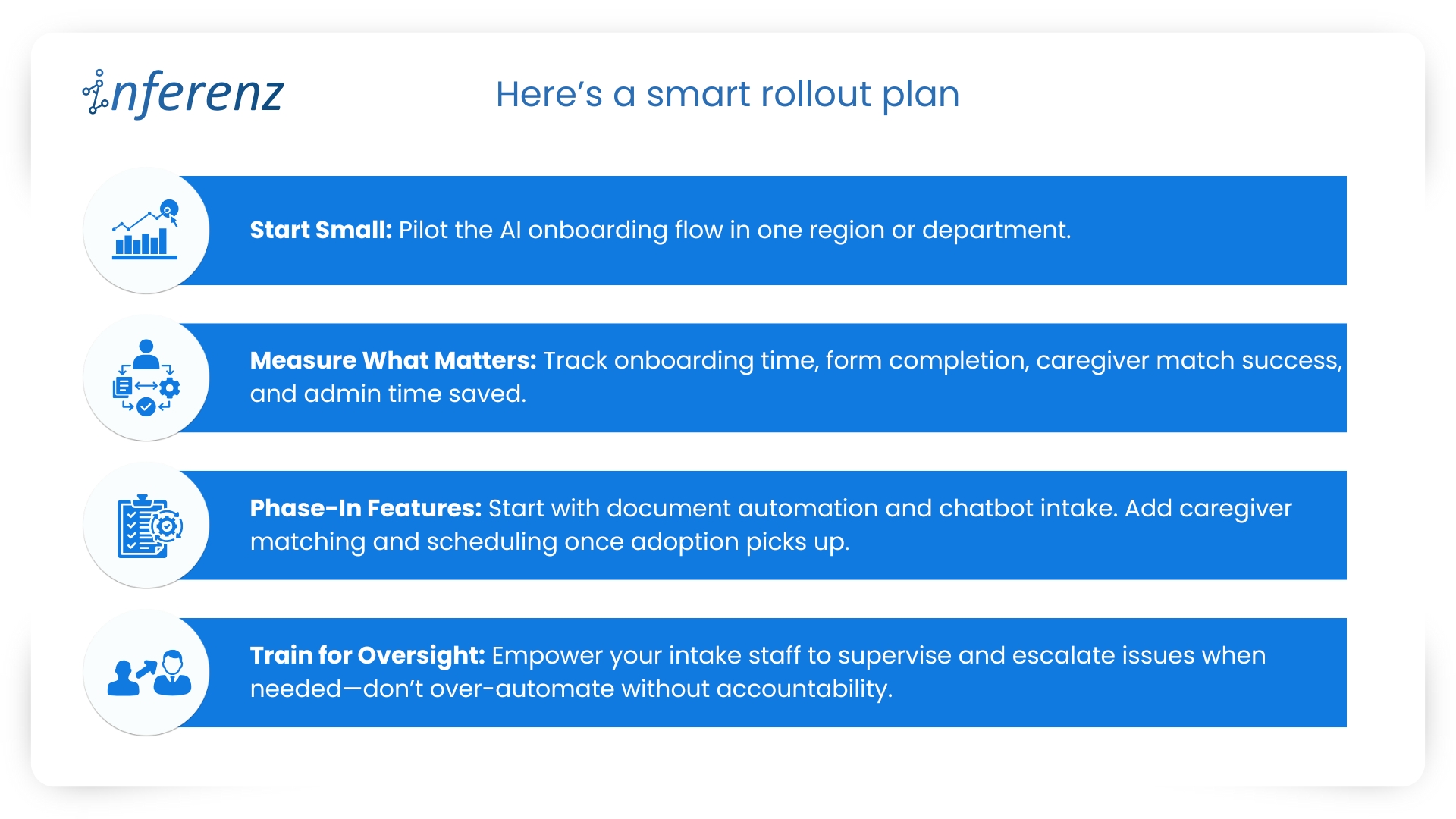
smart rollout plan
💡 Pro Tip: Choose vendors who offer modular deployment, HIPAA-compliance guarantees, and support for EHR integration (like Epic, Cerner).

The future of onboarding: what’s next

AI onboarding is just the beginning. As the healthcare ecosystem evolves, next-gen tools are already taking shape.

Voice-first intake for seniors

Scenario: A 78-year-old in assisted living completes onboarding by simply answering a few questions over a voice assistant or phone call—no typing, no touchscreen.
Sourced statistics: According to CB Insights, over 30% of AI health startups in 2024 are building voice-enabled interfaces for aging populations.

Multilingual bots for inclusive access

Scenario: A caregiver in Florida uses the chatbot in Spanish to complete intake for a new patient. Forms are automatically translated, and backend data remains unified.
Sourced statistics: McKinsey reports that multilingual tech will be a competitive differentiator for Medicaid and community-based care providers by 2026.

Pre-onboarding risk prediction

Scenario: Before a patient is onboarded, the system flags high hospitalization risk based on intake data. A higher-touch care plan is auto-suggested.
Sourced statistics: Gartner’s 2025 predictions on predictive AI in healthcare cite onboarding-level data as a new frontier for early intervention.

Seamless claims triggering

Scenario: Once a patient is onboarded and matched, billing pre-auth is initiated immediately based on care codes linked to intake data.
Sourced statistics: HealthEdge’s payer-tech report shows a 35% reduction in claim delays when intake is linked to backend revenue cycle systems.

Closing note: don’t let your first touchpoint be the weakest link

Here’s the simple truth: If your onboarding experience still runs on PDFs and follow-up calls, you’re losing patients, revenue, and goodwill—quietly, every day.

AI-powered onboarding isn’t about replacing people. It’s about giving your team room to breathe and your patients a reason to stay. And the best part? It pays for itself in efficiency, satisfaction, and speed to care.

If there’s one place to start your AI journey, it’s not billing. It’s onboarding.

Let your first impression be your strongest one.

 

Automated Patient Onboarding

FAQs for CXOs exploring AI-powered onboarding

Agentic AI in Healthcare: How Can CIOs Plan AI Implementation Across Departments

Background summary

Hospitals and home-health teams face repeat snags across Patient Access, ED, Inpatient Nursing, Radiology, Peri-op, and more. They face messy referrals and coverage checks, alert noise, heavy charting, imaging backlogs, or delays, medication risks, missed visits, claim denials, and late insight from feedback.  

Agentic AI tackles the repeat work behind these issues by reading context, deciding next steps, acting inside your EHR or ERP, and writing back with an audit trail, which speeds flow, reduces errors, and steadies cash. This article maps each department to clear Agentic AI capabilities across departments citing proof points and role-based benefits.“Keep the lights on, fix the gaps, then let AI take the grunt work.

That quote, shared by a Mid-Atlantic hospital CIO in April, sums up 2025’s mood in health-system IT suites across the U.S. Cost pressure remains high, yet the conversation has moved from whether to apply AI to where first. 

Healthcare needs AI implementation, now! 

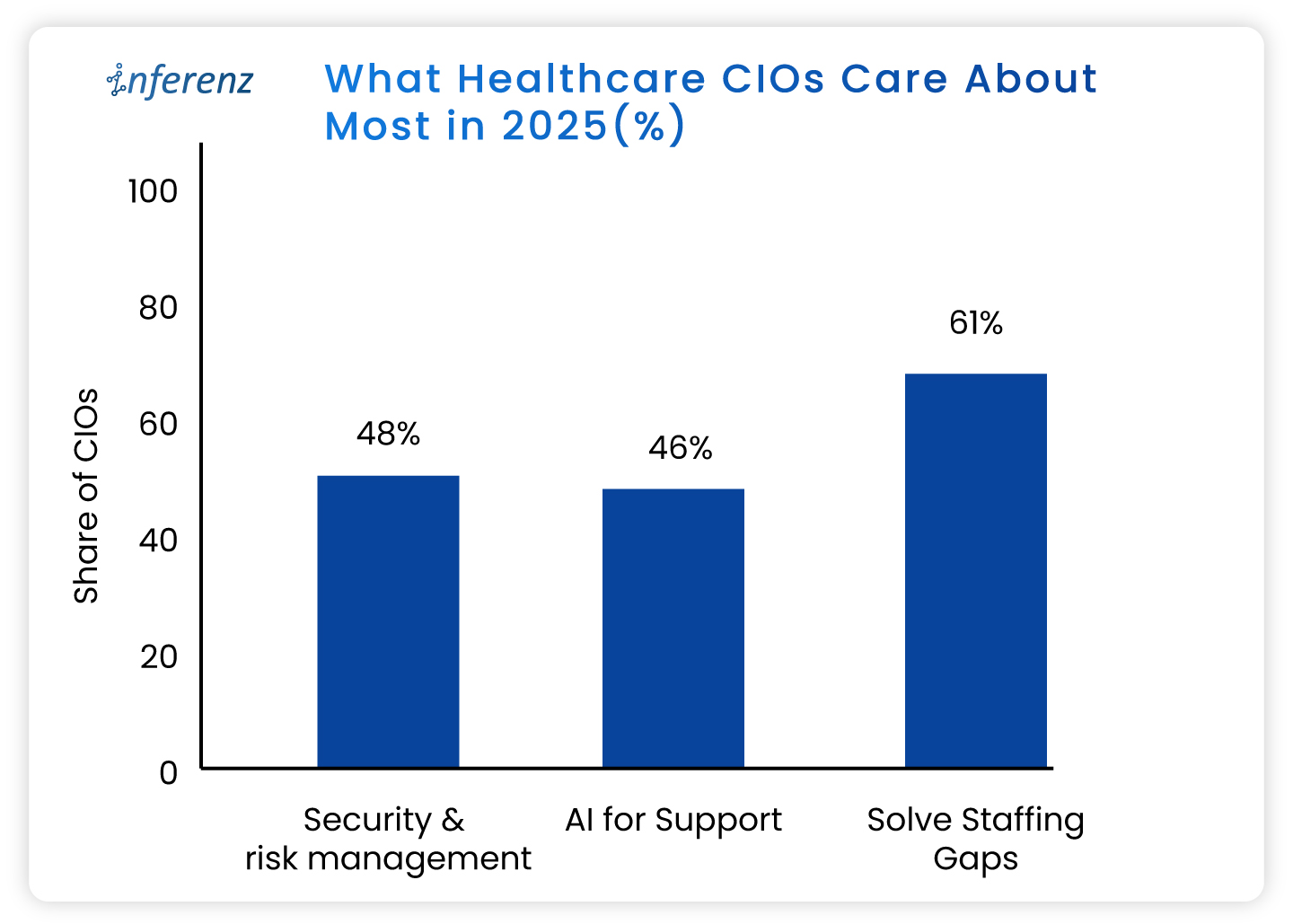
A fresh State of the CIOs survey of 906 healthcare IT leaders puts hard numbers behind the chatter: What Healthcare CIOs Care About Most in 2025


  • Solving IT staffing shortages ranks even higher, flagged by 61%.
    • Recruiting and keeping skilled people is harder than finding capital. 
  • AI for support and workflow relief lands at 46 %, 
    • This trend eclipses past favourites like cloud migrations. 
  • Security and risk management tops the chart at 48%. 
    • Ransomware worries still wake leaders at 3 a.m. 

What do these healthcare CIO priorities tell us? 

  • Staffing pressure makes patient access automation urgent, not optional. 
    • Leaders want bots that shave minutes, not moon-shot labs that promise a payoff five years out. 
  • AI momentum is practical. 
    • CIOs are testing agent-based tools inside revenue cycle, nursing rosters, and patient access because those areas pay back in months, not quarters or years. 
  • Security first means guardrails are non-negotiable. 
    • HIPAA-compliant AI is a must. The implementations need to comply also with HITRUST, and the new HHS cybersecurity proposals out for comment. 

Read more about the top operational issues that have got CIOs worried.  

Now that priorities are in place, let us see how agentic AI can help you simplify and enhance your operations. 

Agentic AI in healthcare, in full-speed action 

Agentic AI work like small digital co-workers that handle repeat work and quick decisions inside your existing systems. Each agent reads context from the EHR or ERP, decides the next step, takes the action, and writes back with a clear audit trail. That is why it fits real operations.  

The question is: where do you start? 

You start where delays hurt most, set a simple outcome, and let agents carry the routine tasks across three phases of care: Start of Care, Care Delivery, and Post Care. The payoff shows up as fewer handoffs, shorter queues, cleaner data, and faster payment cycles. 

Below, we set the context and the core challenge for the major operational areas. Under each, you will see the exact Agentic AI capabilities that meet healthcare AI use cases, using the solution buckets you shared so you can cross-link or pilot right away. 

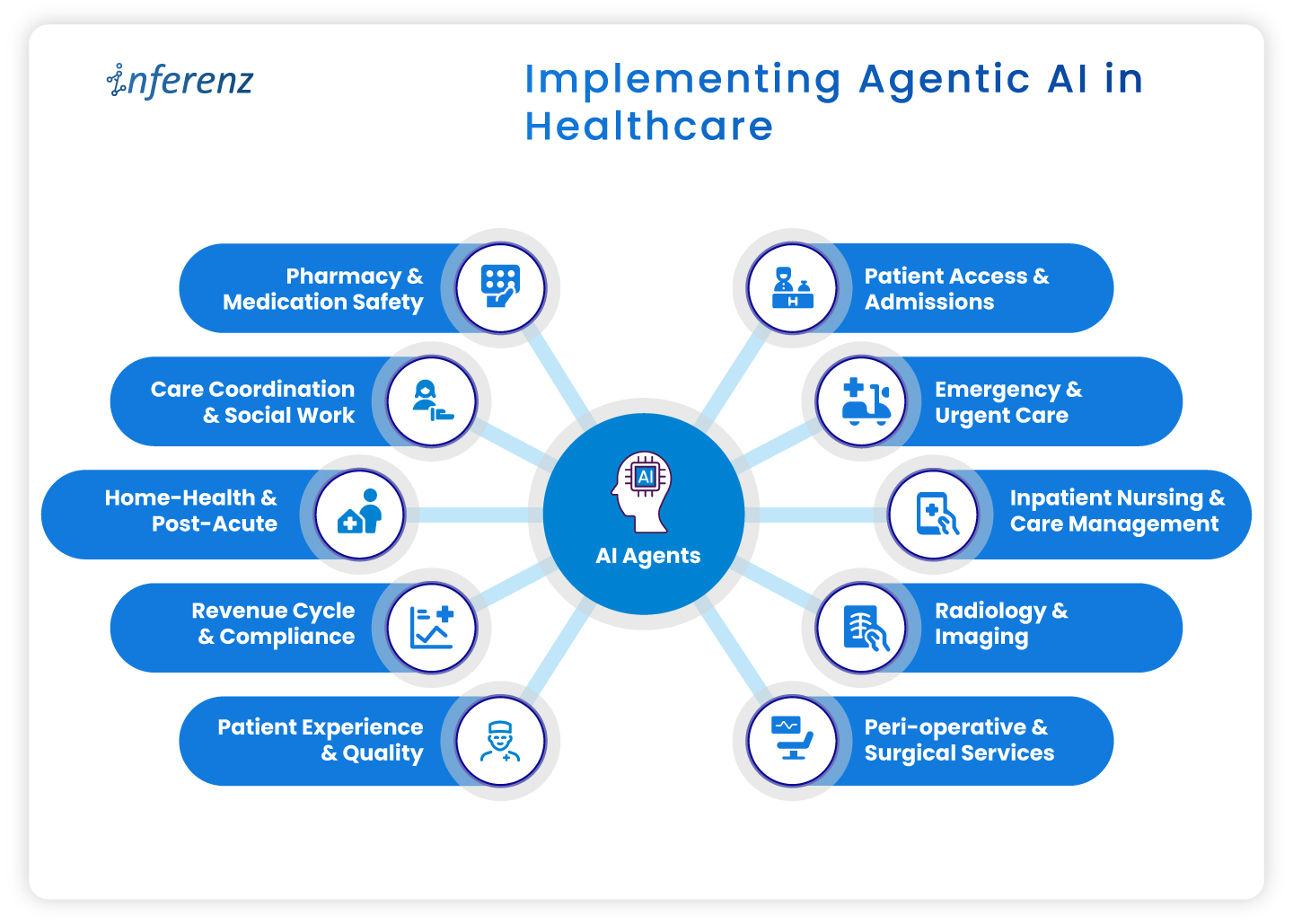
Implementing agentic AI in healthcare 

  • Patient access & admissions 
  • Emergency & urgent care 
  • Inpatient nursing & care management 
  • Radiology & imaging 
  • Peri-operative & surgical services 
  • Pharmacy & medication safety 
  • Care coordination & social work 
  • Home-health & post-acute 
  • Revenue cycle & compliance 
  • Patient experience & quality 

Implementing Agentic AI in Healthcare

1. Patient access & admissions 

Context. Intake teams deal with referrals that arrive in mixed formats, copy data across systems, and chase benefits by phone. Queues grow. First visits slip. 

How agentic AI helps. 

  • Referral & digital intake automation pulls, cleans, and routes referral data into the record. 
  • Eligibility checks & prior authorization verifies coverage and starts approvals without back-and-forth. 
  • Patient outreach sends reminders, prep steps, education, and e-consent through the channel patients prefer. 
  • Digital front desk lets patients book, reschedule, and confirm without a call. 
  • SDOH analytics flags transport or language barriers early to ease patient onboarding efforts. 
  • Intake fraud detection prevents duplicate or false identities at the gate. 

Operational outcome.

Faster first appointments, fewer re-keyed fields, cleaner claims from day one. 

2. Emergency & urgent care 

Context. Clinicians need early signal on deterioration. Alert fatigue and manual triage slow action. 

How agentic AI helps. 

  • Active monitoring streams vitals and new labs to an agent that watches for change. 
  • Alert prioritization filters noise and shows only actionable risks to the right role. 
  • Clinical risk modeling scores sepsis, readmit, or fall risk in near real time. 
  • Natural language copilots summarize recent notes so the team sees context on arrival. 

Operational outcome.  

Faster recognition, fewer false alarms, clearer handoffs. 

3. Inpatient nursing & care management 

Context. Nurses split time between bedside tasks and documentation. Care plans go stale when conditions shift. 

How agentic AI helps. 

  • Dynamic care plan personalization updates tasks and goals mid-cycle based on new data. 
  • AI documentation for clinicians drafts visit notes and care plans from voice or short prompts. ICD-10 and HHRG codes are proposed for review. 
  • Alert prioritization keeps clinicians focused on the few patients who need action now. 
  • Patient Caregiver Matching to align with patient and caregiver schedules dynamically and intelligently to stay ahead of patient needs. 

Operational outcome.  

More bedside time, fewer charting hours, faster response on the floor.

4. Radiology & imaging

Context. Studies arrive faster than they are read. Critical cases can wait behind routine ones. Reporting workflows feel heavy. 

How agentic AI helps. 

  • Clinical risk modeling uses order data, vitals, and history to score urgency, so teams handle the right studies first. 
  • Natural language copilots pre-draft structured impressions from key images and prior reports. 
  • AI documentation turns dictated notes into clean, compliant reports ready for sign-off. 

Operational outcome.  

Quicker turnaround, fewer sticky handoffs between techs and readers. 

5. Peri-operative & surgical services

Context. Small delays at pre-op and PACU ripple across the day. Discharge notes and coding often lag. 

How agentic AI helps. 

  • Dynamic care plan personalization keeps surgical pathways current from pre-op to recovery. 
  • Automated discharge & transition summaries create clear handoffs for floor teams and home-health partners. 
  • Billing/Compliance automation converts post-op documentation into coded encounters and gathers needed attachments. 

Operational outcome.  

Tighter case flow, on-time handoffs, faster coding after wheels-out. 

6. Pharmacy & medication safety

Context. Medication lists change often. Renal function, allergies, and interactions can be missed during rush hours. 

How agentic AI helps. 

  • Clinical risk modeling checks interactions and dose risks against labs and history. 
  • Natural language copilots summarize med rec and highlight conflicts for pharmacists. 
  • AI documentation writes structured notes for interventions and education.  

Operational outcome.  

Fewer preventable events and clearer documentation for audits. 

7. Care coordination & social work

Context. Teams try to close loops across clinics, payers, and community partners. Calls and emails eat hours. 

How agentic AI helps. 

  • SDOH analytics surfaces access risks that block progress. A solution like home care analytics works in this regard backed by natural language without dashboards. 
  • Patient outreach sends targeted messages, education, and transportation prompts. 
  • Automated follow-up schedules check-ins by protocol and milestone, then tracks responses. 
  • Feedback mining & sentiment analysis reads messages and surveys to spot issues before they escalate. 

Operational outcome.  

More completed actions per coordinator and fewer avoidable returns. 

8. Home-health & post-acute 

Context. Visit schedules, caregiver skills, and travel time rarely align. Drop-offs after week one are common. 

How agentic AI helps. 

  • Remote monitoring tracks symptoms or device readings between visits and flags change. 
  • Automated follow-up sends check-ins and instructions that match the care plan. 
  • Retention analytics predicts disengagement and suggests outreach that brings patients back. 

Operational outcome.  

More visits per day, steadier adherence, fewer surprises between appointments. 

9. Revenue cycle & compliance 

Context. Missing fields and late attachments create denials. Manual status checks slow payment. 

How agentic AI helps. 

  • AI documentation and billing/ compliance automation convert care notes into coded, compliant claims with proofs attached. 
  • Eligibility checks & prior authorization starts early at intake, then updates status automatically after visits as part of revenue cycle automation. 
  • Natural language copilots draft appeal letters and collect the right excerpts from the record. 

Operational outcome.  

Cleaner first-pass claims, fewer reworks, faster cash. 

10. Patient experience & quality 

Context. Comments from portals, calls, and surveys get scattered. Teams react late. 

How agentic AI helps. 

  • Feedback mining & sentiment analysis aggregates themes and flags risk in near real time. 
  • Automated discharge & transition summaries set clear expectations and reduce confusion. 
  • Longitudinal recovery prediction compares recovery against expected trends and signals when to step in. 

Operational outcome.  

Fewer escalations, clearer communication, tighter loop closure.  

Wrap-up 

Agentic AI pays off when it sits inside daily work, not beside it. Start with one area where delays or denials sting, choose a small outcome, and pilot the single agent that clears the path. Once the metrics move, extend the same logic to the next step in the care cycle. Hours return to care teams, data gets cleaner, and cash moves faster. 

Next step.  

If this flow matches your roadmap, you will certainly benefit having a short, printable CIO checklist for use-case selection, data access, privacy controls, success metrics, and for each healthcare department. 

Frequently asked questions  

Top operational issues that have got Healthcare CIOs worried

Summary

US hospitals and home-care teams now juggle data silos, paperwork that eats cents of every dollar, and record turnover among doctors, nurses, and caregivers. This article lays out eight pressure points like data fragmentation, revenue leakage, caregiver burnout, and staffing gaps, sharing how each one drains time or cash. It also highlights key Healthcare CIOs challenges and shows how early wins with AI in healthcare and agentic AI hint at practical fixes that reclaim clinical hours, speed payments, and steady the workforce.-America’s healthcare bill keeps climbing, yet the day-to-day experience inside clinics and homes feels under-resourced.  

In 2023, national health spending had already reached $4.9 trillion, equal to 17.6 percent of GDP, and the share is still inching up. Patients see new buildings and apps, but behind the scenes many teams fight the same old bottlenecks. 

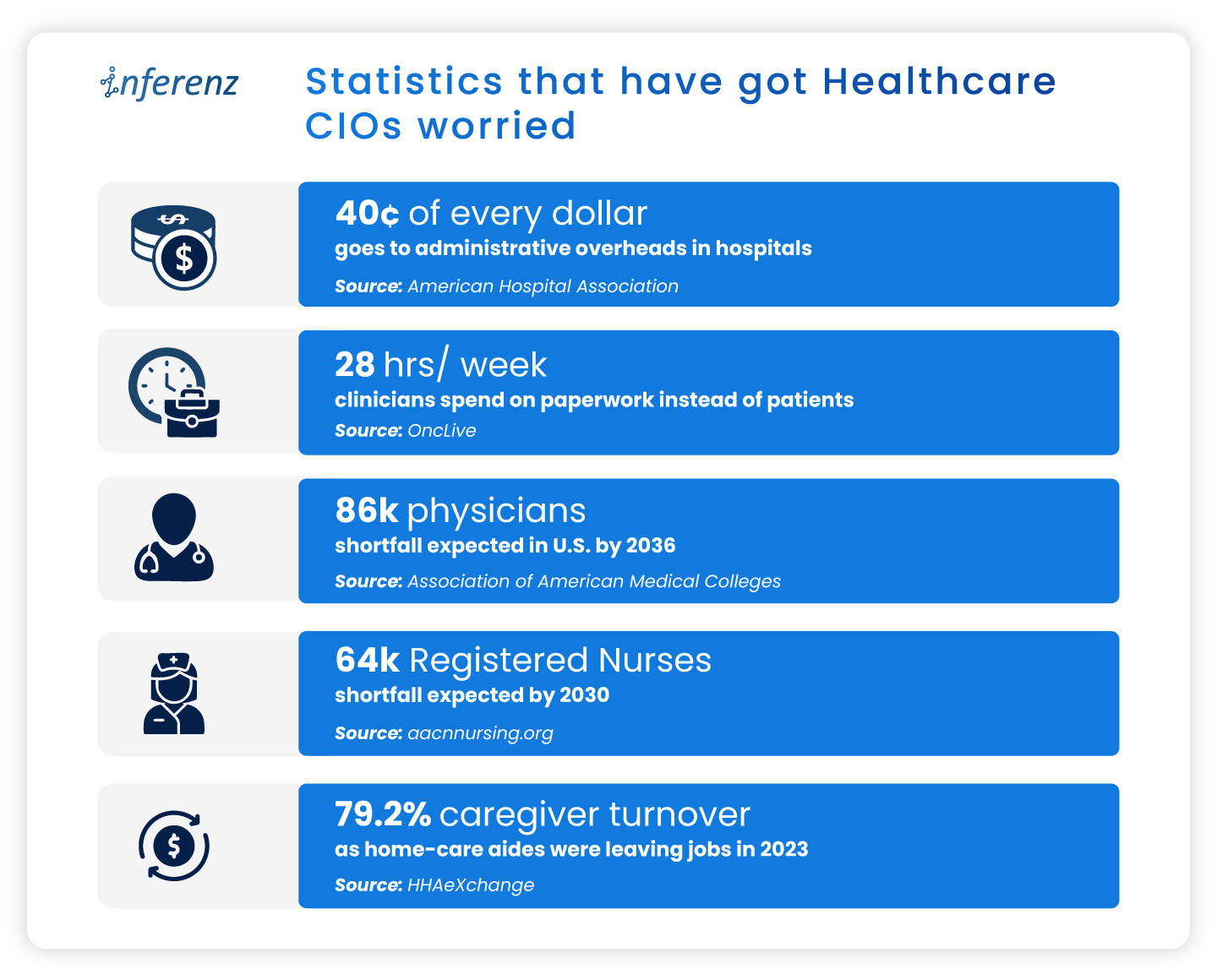
Statistics that have got Healthcare CIOs worried

Statistics that have got Healthcare CIOs worried

These cracks in data, dollars, and staffing weaken everything from preventive visits to complex surgeries.  

Early pilots suggest that well-targeted AI in healthcare—think ambient note-taking, predictive scheduling, real-time claims checks, and other caregiver burnout solutions—can relieve some of the load. The sections that follow unpack where the pain is sharpest before we outline, in a later article, how AI can begin to ease it.

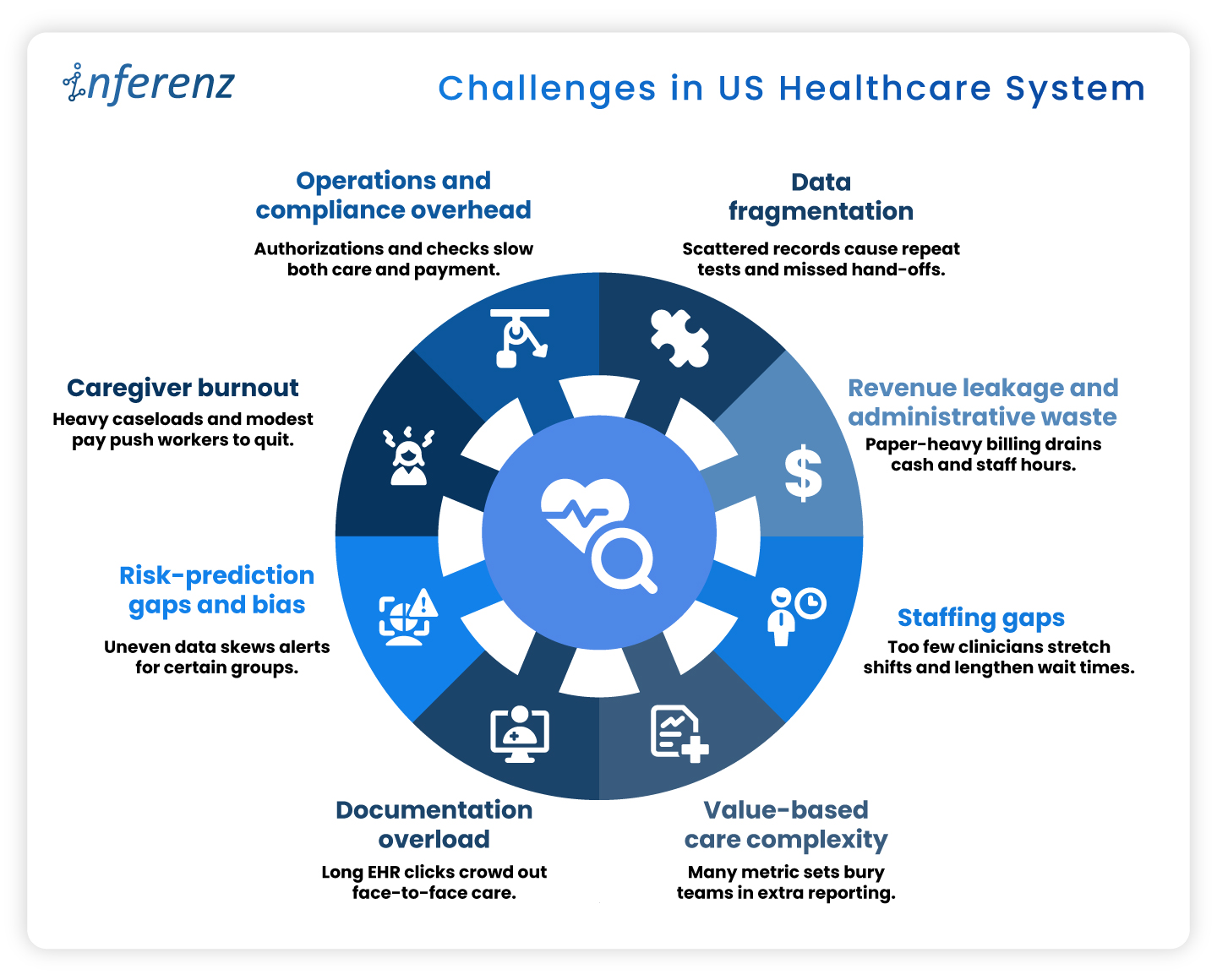
Challenges in US Healthcare System

Challenges in US Healthcare System

1. Data Fragmentation

Fragmented electronic records drive at least $200 billion a year in repeat labs, imaging, and other avoidable services. Patients often move between dozens of disconnected systems, and prior tests rarely follow them, leading to duplicate records too.  

Among chronically ill Medicare beneficiaries, those in the most‐fragmented quartile run $4,542 higher annual costs and show more preventable hospitalizations than peers with integrated care. Scattered data undermines diagnosis accuracy, pushes redundant work onto staff destroying caregiver connect. You need a handy dedupe AI tool to avoid patient representation and other AI solutions to stop inflated claims that payers later dispute. 

2. Revenue Leakage and Administrative Waste

Hospitals run sophisticated clinical services, yet their business offices often look like paper factories. Prior authorizations, claim edits, and duplicate data entry push invoices back for revision and restart the payment clock. Each rework touches coders, billers, and case managers, draining time that could fund patient-facing roles. 

One hard number shows the scale: administrative costs now consume about 40 percent of every hospital dollar spent. When almost half the budget never reaches a bedside, leaders have less room to raise wages, buy new diagnostic tools, or expand rural outreach. The cycle feeds on itself: tight margins lead to leaner billing teams, which can increase denials and stretch accounts-receivable even further. News flash: Efficient revenue cycle management services are the need of the hour!

3. Staffing Gaps

Clinical talent has become the scarcest supply in health care. Retirement-age physicians leave faster than residency slots can refill them, and many younger clinicians choose outpatient or telemedicine roles over hospital call schedules. Nurses face similar pressures, with heavy workloads and limited autonomy pushing them toward travel contracts or careers outside medicine. 

The Association of American Medical Colleges warns that the United States could be short as many as 86,000 physicians by 2036. Staff shortage drives the system: wait times lengthen, overtime soars, and remaining staff shoulder extra shifts that speed burnout. For home-care agencies, thin rosters translate to missed visits and lost revenue when referrals must be declined. 

4. Value-Based Care Complexity

Linking payment to outcomes sounds simple on paper. In practice, every bonus program carries its own data dictionary, audit trail, and submission portal. Teams juggle dozens of Medicare, Medicaid, and commercial contracts, with different look-back periods and attribution rules. 

A landmark Health Affairs study found that physician practices sink about 15 hours per doctor each week into collecting and reporting quality metrics, at an annual cost of $15.4 billion nationwide. That is nearly two working days lost to spreadsheets instead of patient counseling or chronic-care planning. The hidden toll is morale: clinicians see quality work as vital, yet they resent duplicative forms that rarely inform real-time decisions. 

5. Documentation Overload

Electronic health records promised efficiency but often delivered extra clicks. Templates proliferate, alerts pop up mid-exam, and note bloat forces physicians to scroll through pages of copied text. After clinic closes, many providers log back in from home to finish charts. 

Recent research in JAMA Network Open shows primary-care doctors spending a median 36.2 minutes in the EHR for a 30-minute visit. Such documentation overload squeezes appointment slots, delays billing, and fuels frustration on both sides of the screen. Patients wait longer for follow-up calls, and clinicians lose family time, accelerating departure from full-time practice. 

6. Risk-Prediction Gaps and Bias

Predictive models guide everything from sepsis alerts to readmission flags, but they inherit the blind spots of the data beneath them. If some groups receive fewer tests, algorithms may label truly sick patients as low risk. Poor signal leads to poor care and potential legal exposure. 

A University of Michigan study found that white emergency patients received up to 4.5 percent more diagnostic tests than Black patients with similar presentations. When such data bias in records train AI, the resulting tools underrate risk for under-tested populations and can widen outcome gaps that policy aims to shrink. Predictive staffing in healthcare suffers on this front, a lot. 

7. Caregiver Burnout

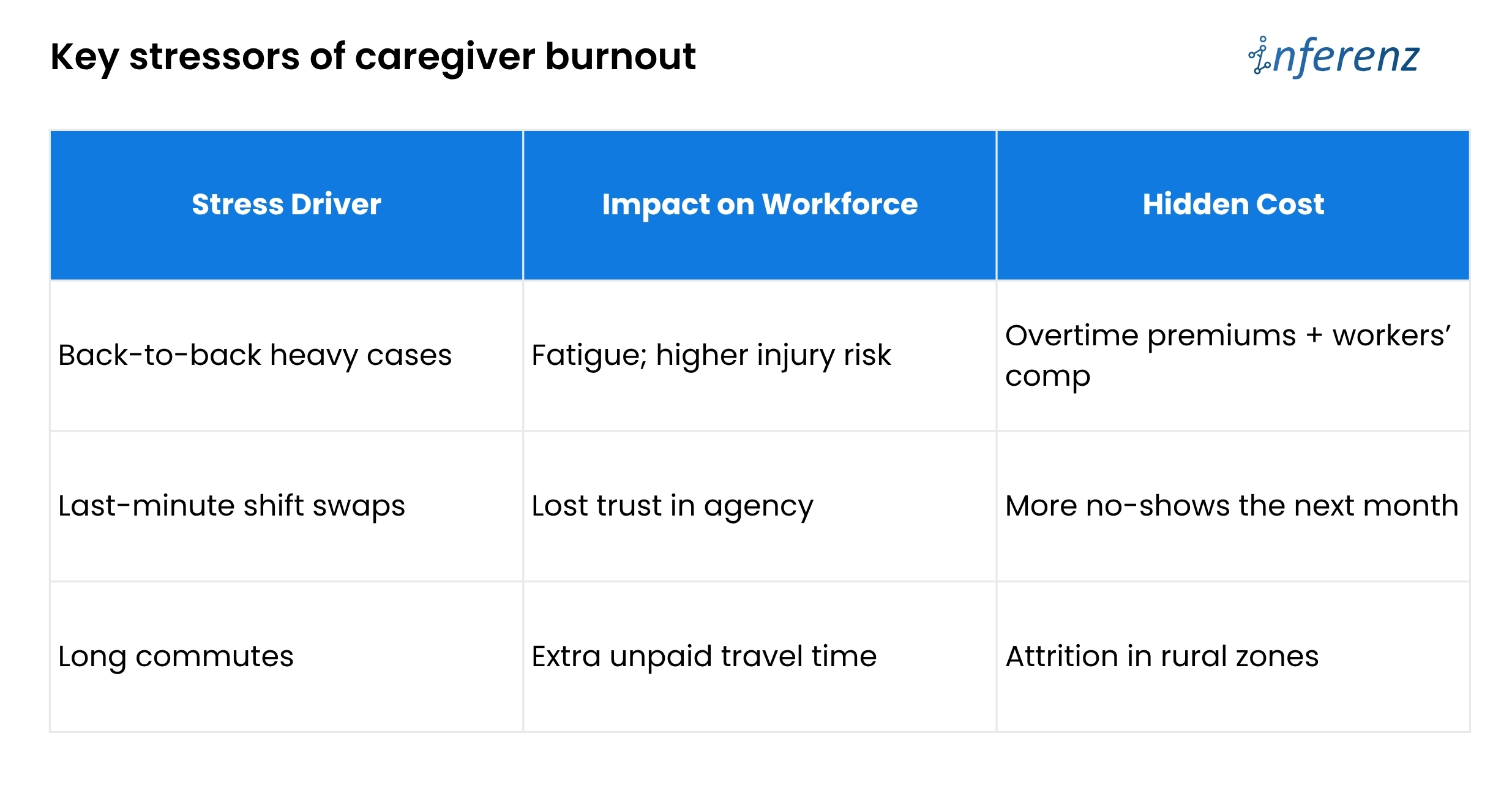
Home-care aides, nurses, and therapists anchor community health, yet their jobs are physically taxing and poorly paid. Heavy caseloads, unpredictable schedules, and emotional labor drive many to exit the field. Agencies then scramble to recruit replacements, often at higher cost, instead of looking for effective caregiver burnout solutions. 

Industry tracking shows caregiver turnover in home care reached 79.2 percent last year. Nearly four in five workers left within twelve months, erasing institutional knowledge and breaking continuity for vulnerable clients. High churn forces agencies to reject new referrals or rely on overtime, compounding stress for those who remain. 

8. Operations and Compliance Overhead

Regulatory safeguards protect patients but can swamp providers in forms. Prior authorization, eligibility checks, and electronic visit verification (EVV) each add data steps between care and payment. Staff must phone insurers, upload documents, and wait for green lights before proceeding. 

An American Medical Association survey reports that 94 percent of physicians say prior authorization delays access to needed care. These holdups lead to cancelled procedures, rehospitalizations, and frustrated families. Organizations also pay for the privilege: teams spend hours per week on approvals that rarely change clinical decisions, yet every stalled claim inflates days-cash-on-hand risk. 


Why AI Sits at the Pivot Point 

Taken together, the pressure points above form a single pattern: vital clinical minutes vanish into data hunts, billing loops, and staffing scrambles. Every home care agency especially need to take note that 

  •  When intake stalls, a patient’s first touch runs late.  
  • When documentation drags, the visit itself shrinks.  
  • When claims wait in limbo, funds for follow-up dry up.  

The system feels these shocks end to end. 

Agentic AI in Healthcare

Agentic AI offers a direct counterweight because it slots into each phase of care: 

  • Start of care: Conversational intake tools collect histories, verify coverage, and label high-risk cases before the first appointment. Clean data flows forward instead of fragmenting at the gate. 
  • Point of care: Ambient notetaking, real-time risk scores, and predictive staffing engines give clinicians more face time and safer shift patterns. The visit becomes richer while administrative drag drops. 
  • Post care: Automated coding, denial prediction, and longitudinal analytics speed payment and flag avoidable readmissions through AI-based patient engagement software. Dollars return sooner, lessons cycle back into quality plans, and staff energy stays on patients rather than portals. 


Advanced analytics, ambient clinical documentation, predictive scheduling, and automated claims triage each target the pain points above. Early results such as Agentic AI scribes cutting note-taking time and fairness-aware models closing bias gaps, hint at relief.  

The next article will map problem-solution pairs in depth; for now, it is enough to see that AI, applied responsibly, can clear data blockages, shorten queues, and free human attention for care itself. 

Frequently Asked Questions 

Natural Language Analytics: A Simple Doorway to Deeper Home-Care Insight

Summary

Home-care leaders need answers in real time. Our stack joins Snowflake, CrewAI, Neo4j, and GraphRAG; Grok3 writes the SQL, while Azure OpenAI crafts the insights and formats the results for the best-fit chart— all in seconds. A six-step flow rewrites the query, tags intent, adds knowledge-graph context, writes Snowflake-ready SQL, and shapes the result while keeping HIPAA data safe.  

Early runs cut report queues by 90 percent, surfaced overtime risk days sooner, and set the scene for smarter patient-caregiver matching.  Care teams swim in data. Payroll records, visit logs, EMR notes, and staffing rosters sit in different tools and formats.  

Now, when a manager wants a quick view — “Which aides carried more than ten active cases last month?”— they often wait on analysts or write fragile SQL by hand.  

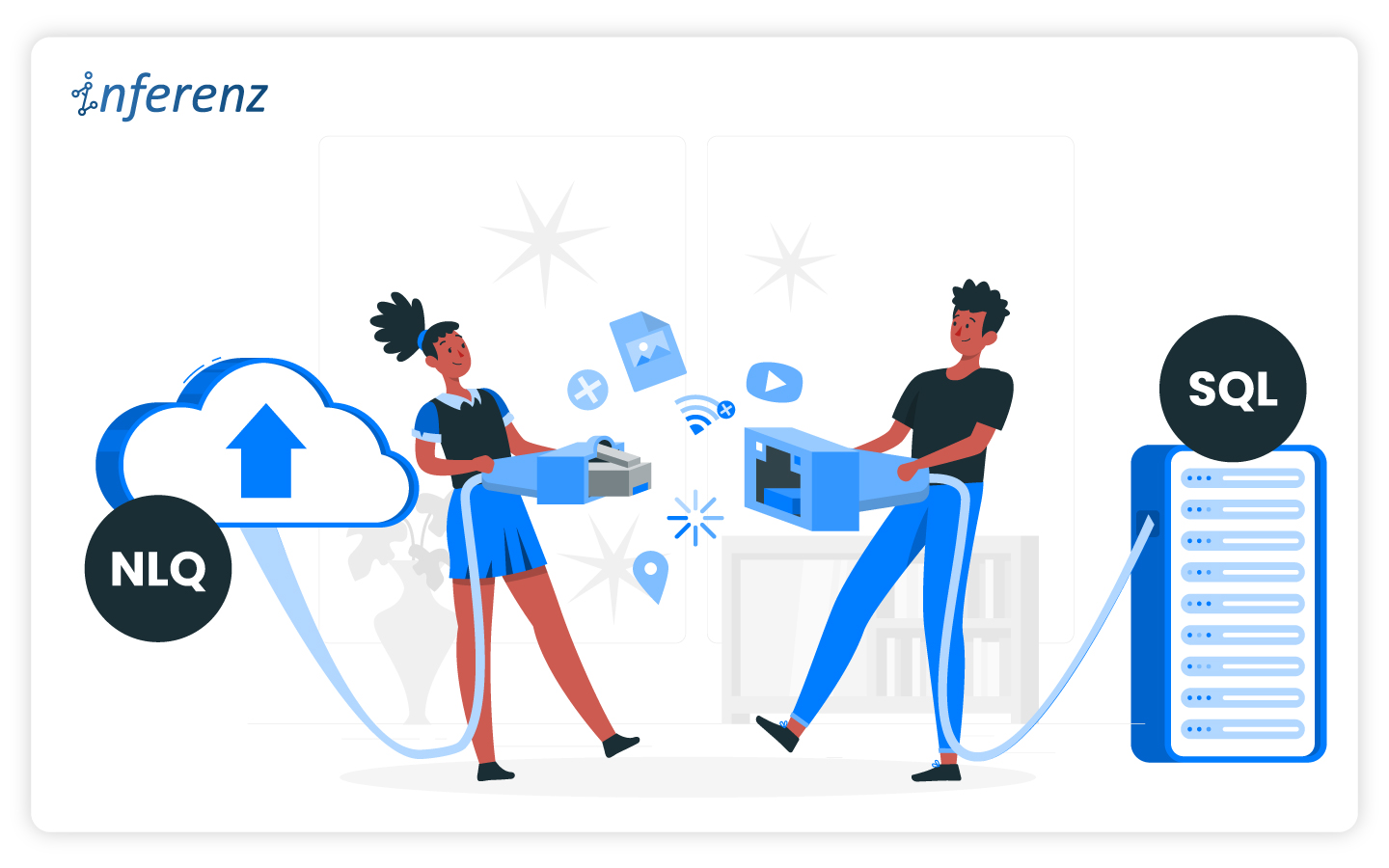
A natural-language-to-SQL (NLQ-to-SQL) layer fixes that gap. It lets any leader ask plain-English questions and see answers powered by natural language analytics.  

Large health systems have already shown the impact of agentic AI in research; now the same model can drive natural language processing for sharper caregiver workload insight and smarter staffing balance. 

What We Built? And Why? 

Our home-care clients kept raising the same pain point: “We have mountains of data, yet simple staffing questions still take a day.” We wanted a proof of concept that showed how NL2SQL, natural language analytics, and agentic AI could shorten that wait to seconds. The goal was not a lab toy but a tool busy branch managers could trust before the next shift roster went live. 

We began with five key parts working as one: 

  • CrewAI agents + FastAPI served the front door. FastAPI gave us a light web layer, while CrewAI split each task—rewrite, intent check, SQL build, chart—for cleaner tests and quick swaps. 
  • Snowflake handled storage and compute. Its near-instant clones let us demo new data models without copying terabytes. 
  • Neo4j plus a GraphRAG step kept the schema map tight. Each user question only pulled tables that mattered, so the large language model stayed on track. 
  • Grok3 on Azure OpenAI acted as the fallback. When Snowflake flagged a syntax error, the agent sent the message back to Grok3, got a cleaned query, and reran it.  
  • Smart Visualizer Service then scanned the result set, picked the best chart type, and shaped the data for instant display—raising successful answers by about 20 percent. 

Security was non-negotiable. Every call ran inside HIPAA guardrails. Role-based views made sure a branch supervisor could see staffing tables but never payroll for another region. We leaned on CrewAI’s Snowflake connector. Although CrewAI does not yet call Snowflake’s new data-agent hooks first unveiled at Snowflake Summit 2025, the built-in link let our agents run inside the warehouse instead of in a sidecar, trimming weeks from our schedule. 

The result is terrific. This living pilot answers real staffing load, overtime, and visit-gap questions in seconds. It proves that a small, well-planned stack can turn scattered caregiver data into clear action—exactly the clarity home-care CIOs ask for every quarter.

Meet the Five Agents that Own their Tasks

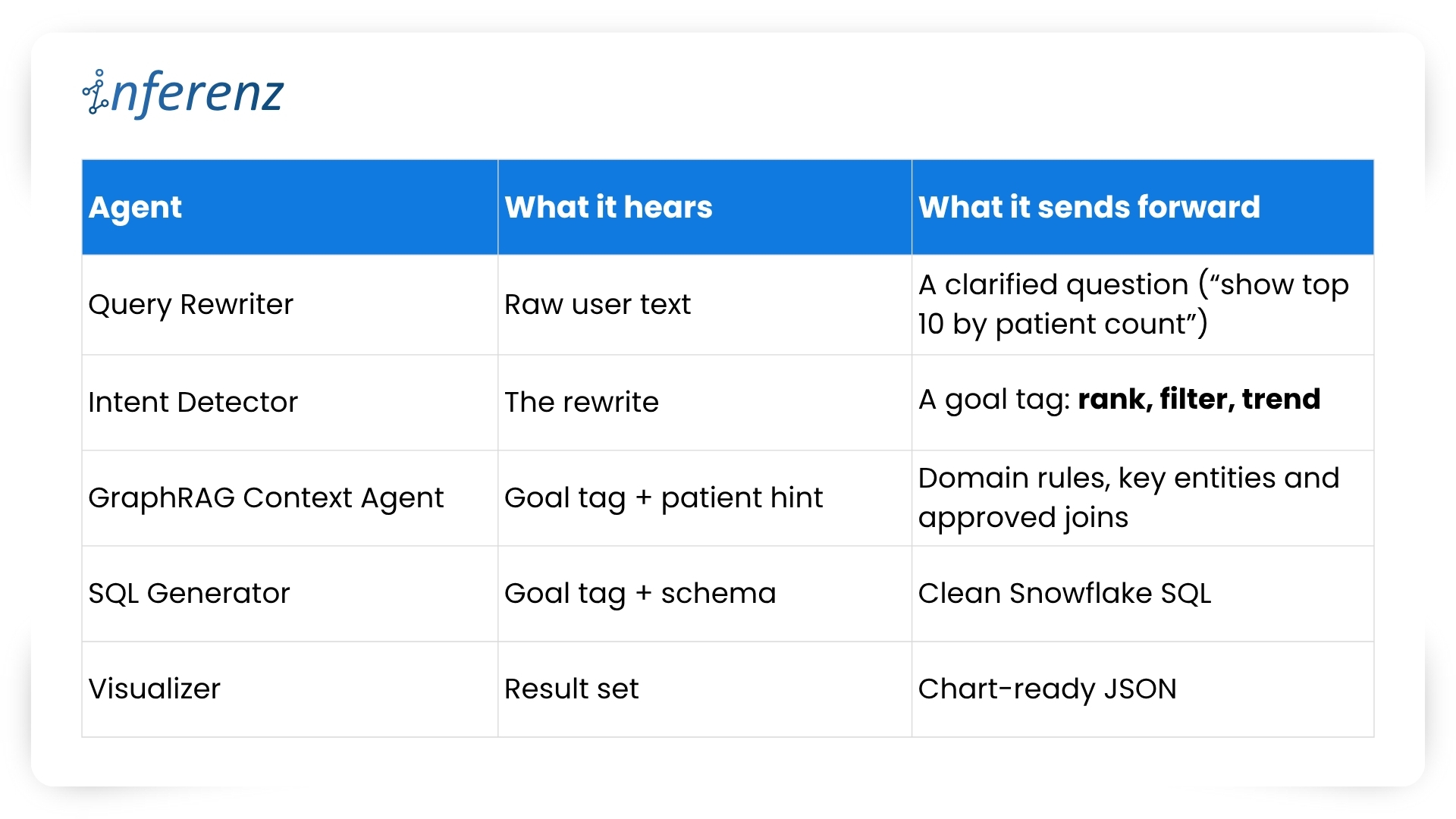
We wanted a flow that felt like a relay race rather than a black box. So, we broke the NLQ-to-SQL path into five lean agents, each with a single duty.  

  • Query Rewriter cleans the user question. 
  • Intent Detector tags the goal. 
  • GraphRAG Context Agent calls the knowledge graph to fetch domain terms, KPI rules, and approved joins. 
  • SQL Generator writes Snowflake code. 
  • Visualizer shapes the chart. 

By giving every agent one clear task, we keep bugs local and upgrades quick. Here’s the lineup that powers our natural language analytics for home-care data: 

Each agent owns one step. That keeps fixes small and testable. 
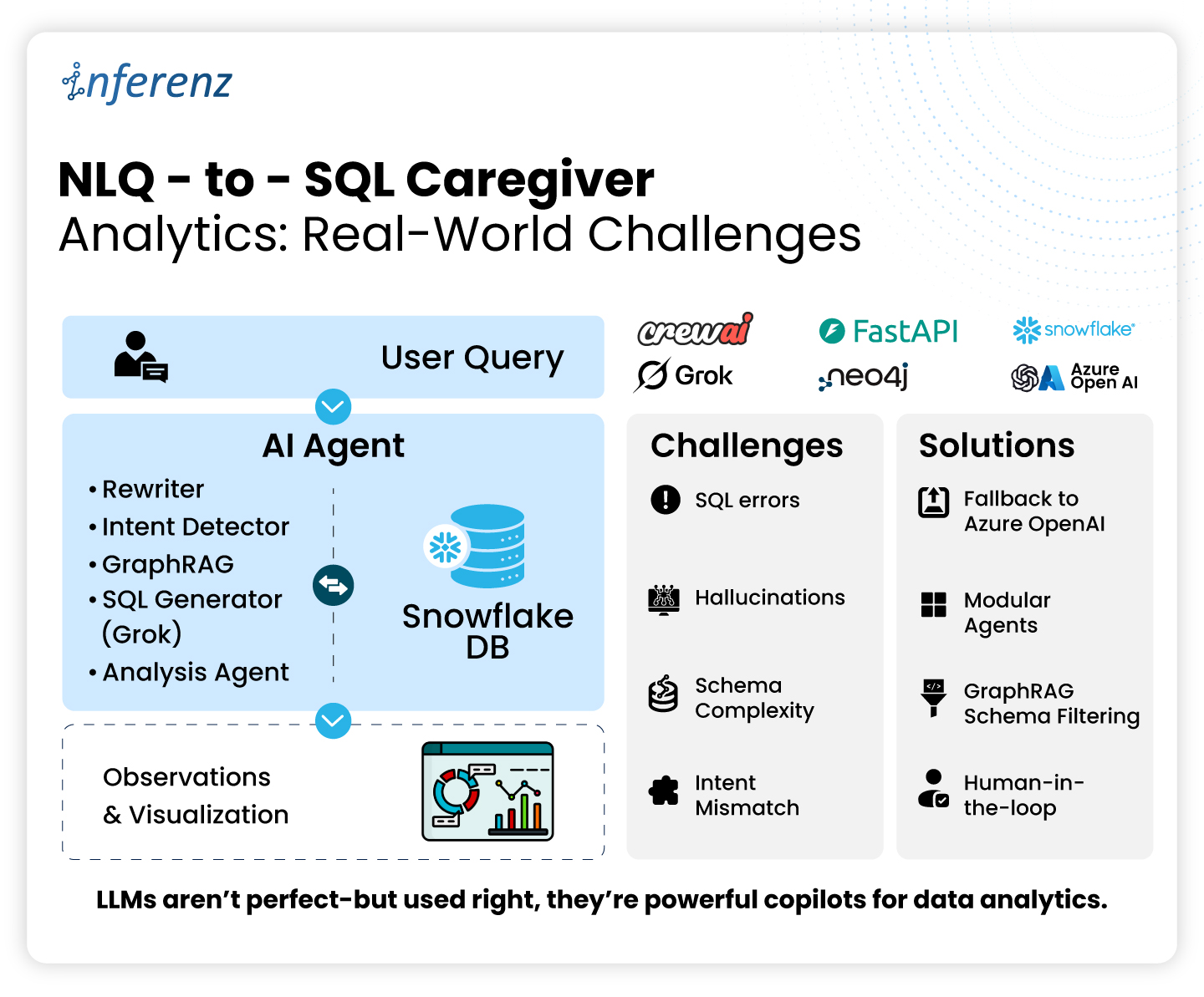
The Challenges We Faced 

  1. Wrong columns, wrong joins
    Agents guessed table names that looked right but were not in the model. 
  2. Generic SQL
    Public training sets leaned the model toward Postgres-style syntax, which Snowflake then rejected. 
  3. Loose questions
    A user typed “caregiver workload Q1” with no metric or slice. 
  4. Bigger schema, louder noise
    The healthcare data warehouse stored 300+ tables. Many of them were redundant and confusing for the model. 
  5. Context drop in follow-ups
    “Now show only California” lost the link to the prior result. 

How We Fixed Them

  • Error-aware fallback
    When Snowflake raised an error, we fed the message to Fallback agent powered by Grok3. Success jumped by 18%. 
  • GraphRAG pruning
    Neo4j stored a knowledge graph representing tables, columns, KPI definitions, dashboards and their relationships. The SQL agent looked up only what matched the question. Speed and accuracy both rose, considerably. 
  • Prompt tuning
    We shifted prompts from “write SQL” to “return a list of steps you will take, then SQL.” Planning before code cut hallucinations. 
  • Modular tests
    Because each agent is a micro-service, we swapped versions without hitting the front end. 

A Week in Production: Real Questions We Saw

During the first week of our pilot, the natural language analytics layer fielded real-world questions such as: 

  1. “Show caregivers with missed-visit rates over five percent for June.” 
  2. “Chart overtime hours by branch for this year.” 
  3. “Rank each RN by the number of first-time patients they onboarded last quarter.” 

Powered by our stack of AI agents in healthcare and agentic AI, every request returned in seconds and fed an instant bar or line chart. Supervisors used the answers in daily huddles to fine-tune rosters with our AI-based home healthcare scheduling software, easing overload and lowering caregiver burnout risk.  

Recruiting and retention of homecare workers top the 2024 agenda across home health care agencies, while steady insight keeps patient visits—and morale—on track. 

Why It Matters for CIOs in Home Care 

Here’s what real-time home care analytics powered by natural language analytics and agentic AI delivers where it counts. The gains below hit staffing, compliance, cost, and morale—core metrics every CIO tracks. 

  • Faster staffing calls: Natural language analytics turns every staffing query into a quick, voice-style search. Supervisors spot overload, drill down to branch or shift, and move aides before a gap harms patient visits. CIOs gain a real-time safety net that guards service levels without waiting on nightly jobs or manual exports. 
  • Cleaner audits: Each query flows through a governed, repeatable path from question to Snowflake SQL to result. Auditors see one chain of truth instead of scattered sheets. This traceability meets HIPAA demands and slashes review time when payers or state boards knock on the door. 
  • Lower spend: Self-serve insight trims the ticket queue for report writers. Analysts focus on high-value models like readmission risk forecasting, not ad-hoc counts. Contractor hours go down, and the IT budget moves toward strategic AI pilots rather than rote data pulls. 
  • Better morale: When aides view fair caseload dashboards, they feel heard. Balanced rosters cut overtime spikes and shrink the 65 percent churn rate that plagues the field. Stable teams mean steadier care quality, fewer rehiring costs, and higher patient trust. 

Inferenz’ Home Care Analytics Approach with Natural Language

Within our home care analytics solution, we aim to tailor every NLQ layer to healthcare rules and home-care realities: 

  • HIPAA-grade security – Row-level filters and least-privilege roles baked in. 
  • Domain vocab – Knowledge graph included CPT codes, visit types, and state billing terms. 
  • Human-in-loop – Flagged queries route to analysts, not silence. 
  • Agentic AI roadmap – The same CrewAI spine can host new agents for RCM, readmission risk, and staffing forecasts, all within one interface. Snowflake’s agent scaffold announced in June lets us add skills without moving data. 

We are now planning A/B trials where one branch uses NLQ daily and a control branch stays on canned reports. We will track time-to-answer, overtime spend and missed-visit fines.  

Early signs point to double-digit gains, but real proof will close the loop. Stay tuned to this space for more updates. 

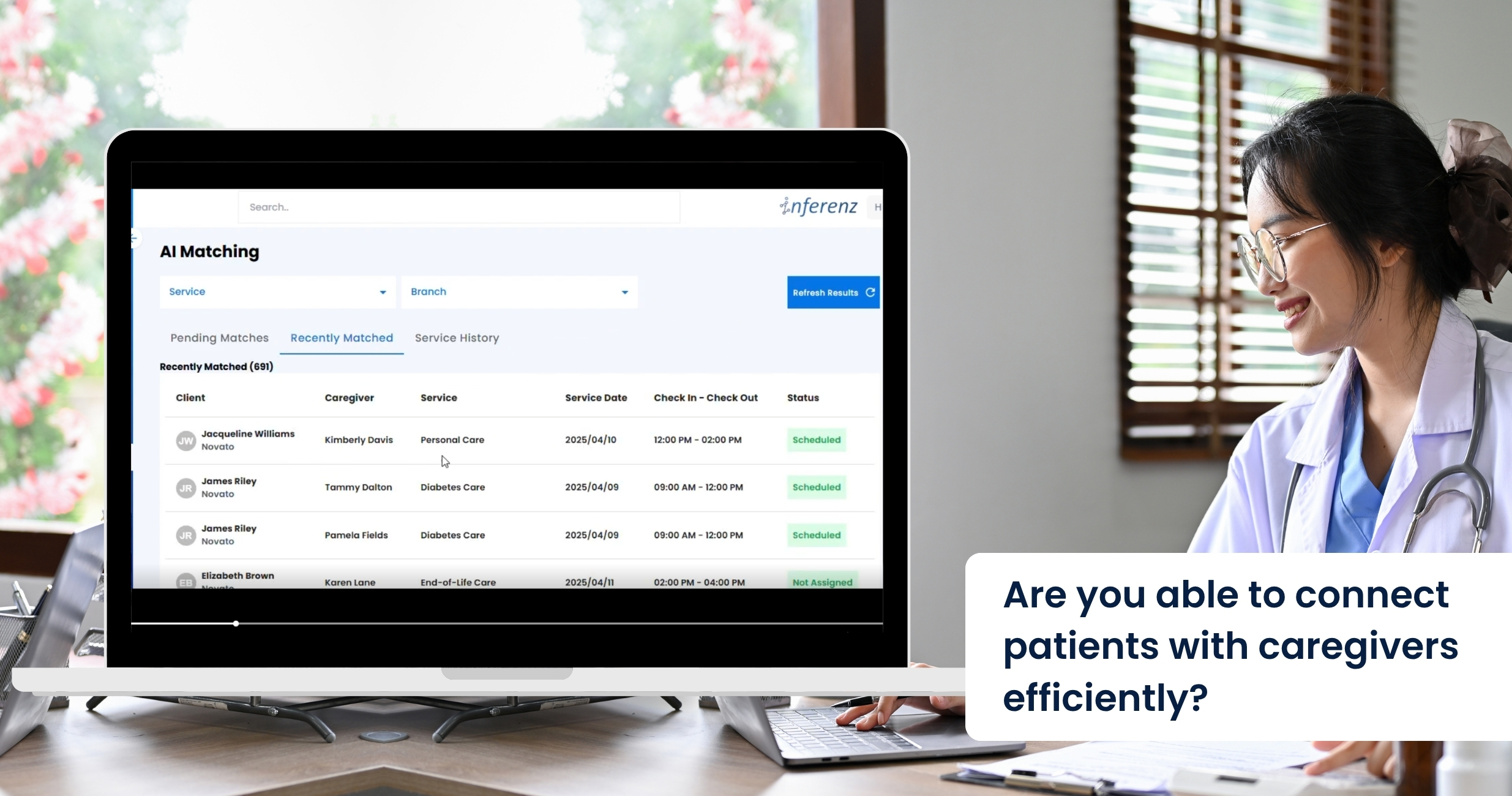
Till  then, you can check our ingenious patient-caregiver matching solution that is already making waves in  the home care industry. 

Frequently Asked Questions 

Patient Caregiver Matching: The AI-Powered Caregiver Connect Solution is Transforming Home Care

Overtime overruns alone threaten to siphon $1.05 billion from U.S. home- and community-care budgets this year, says Avalere Health—proof that shaky patient-caregiver matching is no longer just an operational headache but a bottom-line crisis. 

Schedulers still juggle phone calls, spreadsheets, and rule-based software that crumbles when a caregiver calls in sick. A comprehensive caregiver connect solution powered by agentic AI can flip that script. It watches every shift, learns from each match, and plugs gaps in minutes. No frantic dial-around, no client left waiting. Expect all efficiency with AI in healthcare. 

Problems Faced by the Homecare Industry in Scheduling Appointments


Modern EMR and AMS platforms capture plenty of data, yet most still fail at turning that data into fast, smart schedules. When we ask schedulers and field staff where things fall apart, three patterns rise to the top. 

Manual firefighting 

A single caregiver call-out often touches four or five tools: phone, text thread, spreadsheet, agency software, and finally an “all-staff” blast message. In practice, the rescue takes two to four hours, during which the client risks a missed visit. Home care organizations call this weekend scramble “unsustainable” and link it to high office burnout. 

Every unfilled hour can cost $25–$40 in lost billing. Late or missed wound-care checks raise hospital readmit odds by up to 15% (Loving Home Care study). Schedulers report after-hours stress as a top quit trigger; when one quits, five caregivers follow. 

Data silos 

Most schedulers never see real-time clinical flags. A recent report mentions that only about one in three U.S. home-care agencies have a point-of-care EHR that talks to their patient scheduling tool. The rest rely on notes or phone calls.  

Result

  • A wound-care alert sits in the EHR while the AMS assigns a basic aide. 
  • Medication-change notices arrive hours after the caregiver has left. 
  • Coordinators must cross-check two or three systems before offering a shift, slowing coverage. And there is the issue of duplicate patient records that create more chaos and confusion in scheduling. Check out our AI data duplication solution here. 

Without unified data, matches ignore skills that matter most—like current wound-vac certs, language fit, or post-surgery protocols. 

Burnout churn 

Shift imbalance drives turnover faster than pay issues. The 2024 Activated Insights Benchmarking Report put caregiver turnover at 79%—the highest in six years. Schedulers themselves are leaving too; agencies that lose a scheduler often see a linked caregiver exodus.  

Poor balance means good aides get overbooked, newer aides sit idle, and both groups start scanning job boards. Until schedules pull live clinical data, automate call-out recovery, and watch workload signals, agencies will keep paying for empty visits and exit interviews.  
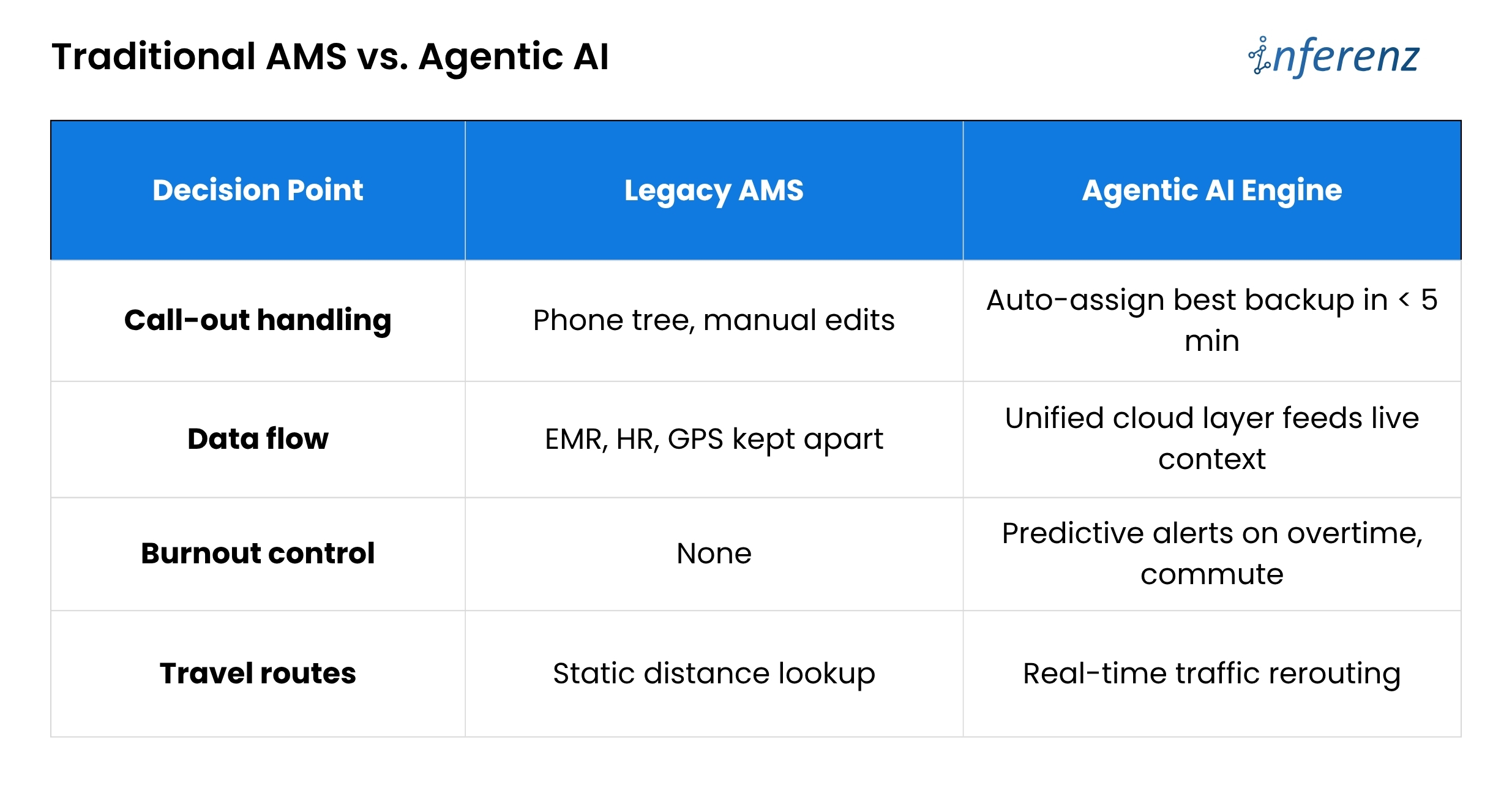
The article now chalks out how predictive care in Patient Caregiver Matching solution fixes those three weak spots. 

What Is Agentic AI? 

Think of it as a digital care coordinator that can perceive, decide, and act without waiting for humans. Unlike first-gen AI healthcare companies that graft models onto old software, a true agentic layer: 

  1. Learns from every shift – Outcome scores, travel times, and client feedback loop back into the model. 
  2. Optimises on many goals at once – It balances continuity, cost, and worker well-being instead of chasing only fill rate. 
  3. Acts in real time – If traffic halts Nurse Maya, the agent reroutes someone closer and messages all parties automatically. 

The result is a living schedule that keeps adapting—no stale rule set, no bias from tired staff. 

Traditional AMS vs. Agentic AI 

Bottom line: Outdated tools act like a notebook. An AI engine acts like a live dispatcher. 

PCM: the heart of smart scheduling

Patient Caregiver Matching (PCM) sits at the core of the agentic engine. It blends hard data that includes skills, licenses, and shift history with soft cues like language, pet comfort, and even commute stress.  

Each visit logged, each survey filled, feeds a feedback loop that sharpens the next match. 

AI extracts relevant details and binds them in a single narrative. This narrative helps caregivers walk in fully prepared and better informed about their assigned patients.  

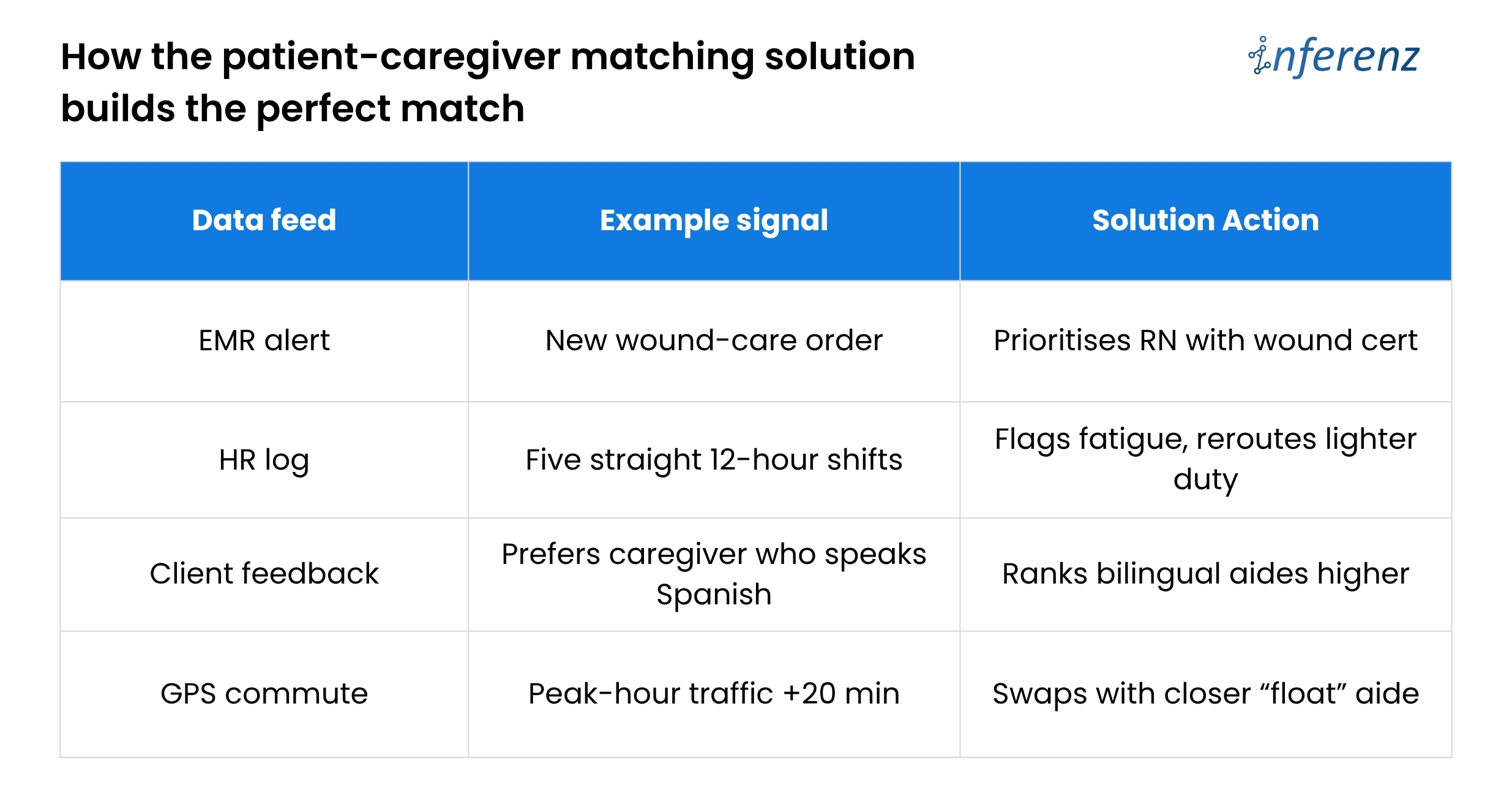
How the patient-caregiver matching solution builds the perfect match 

PCM makes thousands of micro-decisions that a human scheduler simply cannot track in real time.  

Caregiver Connect and Smart Scheduling in Homecare – Three Phases 

Phase 1 – Assist 

  • Role of AI:
    The system watches current openings, checks skill, location, and past ratings, then lists the best caregiver for each visit. It also sends and tracks shift texts for you. 
  • Why it matters:
    Speed is life in home care. By moving the “who is free and right for this client” search to an AI engine, booking time drops by half. A spot that once took twenty calls now locks in minutes. 
  • Effort change:
    Coordinators still approve picks, yet their keyboard time falls about 50%. That freed hour can go to client follow-ups or staff coaching. 

Phase 2 – Co-pilot 

  • Role of AI:
    The tool no longer waits for you to act when a callout hits. It finds the next best caregiver, confirms the shift, and pushes a note into the EMR so nurses see the new name. 
  • Why it matters:
    Missed visits tumble toward zero. Clients stay safe, and the agency avoids fines or angry phone calls on Friday night. 
  • Effort change:
    Because the AI covers most last-minute gaps, schedulers work on harder tasks and see about 70% less day-to-day scramble. 

Phase 3 – Autonomous 

  • Role of AI:
    The agent drafts the full weekly rota, juggles swaps, and even alerts HR when future demand will outrun supply. It chats with caregivers to shift times if traffic or family issues pop up. 
  • Why it matters:
    Fill rate climbs to 98% and holds steady. Fewer gaps mean higher revenue, better reviews, and calmer staff. 
  • Effort change:
    Coordinators shift to oversight. They scan dashboards, spot edge cases, and mentor teams. Routine scheduling work is now background noise handled by the system. 

During Phase 1, a coordinator still approves matches, building trust. By Phase 3, the agent posts a full weekly roster, flags any legal or pay exceptions for quick sign-off, and frees leaders to focus on quality and growth. 

A CXO-level Path to Patient–Caregiver Matching that Actually Works

Home-care agencies lose time and money because scheduling lives in silos. Skills sit in one system, vitals in another, PTO in a third.  

When a caregiver calls out, coordinators must sift through them all. The fix is a Patient Caregiver Matching (PCM) engine that learns and acts in real time—but only if leaders roll it out with equal focus on data, change control, and trust.  

Here is how to move from today’s chaos to tomorrow’s self-tuning roster, without hiring a small army of project managers. 

Start with clean data, not clever code. 

Feed every AMS, EMR, and HR stream into one secure lake through FHIR or other HIPAA-ready APIs. A single source of truth stops double entry and lets the AI see the full picture: licenses, wound alerts, commute times, even overtime risk. Until that lake is live, smart matching cannot begin. 

Prove value in a 90-day branch pilot. 

Switch PCM on for one location and track three simple numbers: shift fill rate, overtime hours, and coordinator minutes per booking. A branch-level test gives hard evidence, keeps risk low, and shows frontline staff that the tool helps rather than replaces them. 

Move to “co-pilot” across the agency. 

Once the pilot hits its marks, let PCM auto-cover call-outs everywhere. Keep one senior scheduler in an “air-traffic control” role to handle edge cases and to reassure teams that humans still guide policy. The daily scramble fades; missed visits trend toward zero. 

Let the AI look three months ahead. 

With real-time cover in place, turn on the forecasting lens. PCM scans referral trends, PTO calendars, and skill gaps, then warns HR before shortages hit. Growth continues without surprise overtime or rushed hiring. 

Build trust into every decision. 

A live roster run by AI only sticks if people believe it is fair and safe.  

Each match stores a plain-language reason such as “Carla assigned for dementia skill, four-mile commute.” Hard caps on weekly hours, license scope, and labor law live inside the rule set, so the engine cannot overstep. Monthly bias scans compare assignments across age, gender, and minority status while retraining drift triggers. The cloud zones keep scheduling live even if one data center fails. 

The payoff 

Weekend duty spreads evenly, time-off requests stick, and early fatigue signs rise to the surface before they become burnout. CXOs gain tighter control over cost and care quality without adding layers of back-office staff. Coordinators finally go home on time. 

“Caregivers who gain more autonomy over their schedule report lower stress.” — Cleveland Clinic flexible scheduling study 

Future-ready edge tapping the private caregiver pool 

Growth pressures will not spare preferred home health care brands. The patient-caregiver matching solution can open an on-demand bench of vetted private caregivers when internal staff hit capacity. The agent weighs cost, compliance, and continuity, then fills gaps without overtime blowouts. 

This “elastic staffing” positions agencies as connected care hubs, not just schedule brokers. It also sidesteps the narrow talent funnel that hammers many healthcare AI companies today. 


FAQs about Patient Caregiver Matching solution by Inferenz  

Navigating Healthcare Data Security & Compliance

As AI technology becomes increasingly integrated into healthcare, ensuring strict healthcare data security and regulatory compliance is essential for its seamless adoption. These AI systems allow healthcare providers to make more accurate interventions, improving care efficiency.

The use of AI algorithms to process different types of healthcare data, such as electronic health records and medical images, has become key to predicting health outcomes and refining individualized treatment plans. However, the sensitive nature of healthcare data makes its protection a primary concern.

Multi-layered encryption, real-time anomaly detection, multi-party computation, and access restrictions are vital to ensure the security of patient data. Healthcare providers must adopt comprehensive security measures, including data masking, federated learning, and robust auditing mechanisms.

Inferenz ensures compliance by leveraging automated systems alongside advanced encryption and access control, facilitating seamless integration of these protocols into AI systems, and providing healthcare organizations with a secure and compliant environment.

Key Compliance Regulations in Healthcare AI

Healthcare compliance regulations consist of laws and standards that safeguard patient privacy and ensure the quality of care. To navigate the complexities of healthcare data security, one needs a deep understanding of the regulations listed below:

HIPAA (Health Insurance Portability and Accountability Act) 1996

HIPAA establishes strict standards for the confidentiality and security of individually identifiable health information. Primary healthcare providers and their business collaborators are required to implement safeguards and notify individuals in the event of a breach.

HITECH Act  2009

The act strengthens HIPAA by enhancing penalties for data breaches and promoting the adoption of electronic health records (EHRs). It emphasizes secure electronic health information exchange, further protecting patient data and encouraging healthcare innovation.

21st Century Cures Act 2016

The act aims to foster scientific innovation, reduce administrative burdens, and improve healthcare data sharing and privacy protections. It also enhances the overall healthcare experience for patients while prioritizing healthcare data security.

GDPR (General Data Protection Regulation) 2018

GDPR applies primarily to the European Union and affects U.S. healthcare organizations handling data of EU citizens. It sets stringent rules for data protection, including health data, and mandates informed consent for data processing.

CCPA (California Consumer Privacy Act) 2020

The CCPA grants California residents control over their personal information, including health data. It mandates transparency in data practices and allows individuals to request the deletion of their data.

HITRUST CSF (Health Information Trust Alliance Common Security Framework)

Even though it is not a regulation, HITRUST provides a security framework for medical facilities. This framework helps ensure compliance with various regulations and protects patient data across platforms.

Information Blocking Rule  2021

Enforced by the Office of the National Coordinator for Health IT (ONC), this rule prohibits information-blocking practices and promotes interoperability while safeguarding the privacy and security of patient information.

Interoperability and Patient Access Final Rule 2021

Enforced by the Centers for Medicare & Medicaid Services (CMS), this rule advances patient data access and exchange. Health systems are required to share electronic patient data upon request, giving patients more control over their healthcare data.

According to the NHS, it’s essential to recognize that these regulations do not encompass AI applications such as software for health management, administrative tools, or clinical support systems for healthcare providers.

As these applications are intended to be used by qualified individuals who can make their own rational decisions based on the AI’s recommendations.

The analysis of global regulatory frameworks for AI in healthcare reveals that regulations predominantly include professional guidelines, voluntary standards, and codes of conduct adopted by both governments and industry players. However, these frameworks are not directly enforced by governments.

Addressing Healthcare Data Security Challenges

While AI enhances healthcare outcomes, it also brings forth challenges related to healthcare data security.

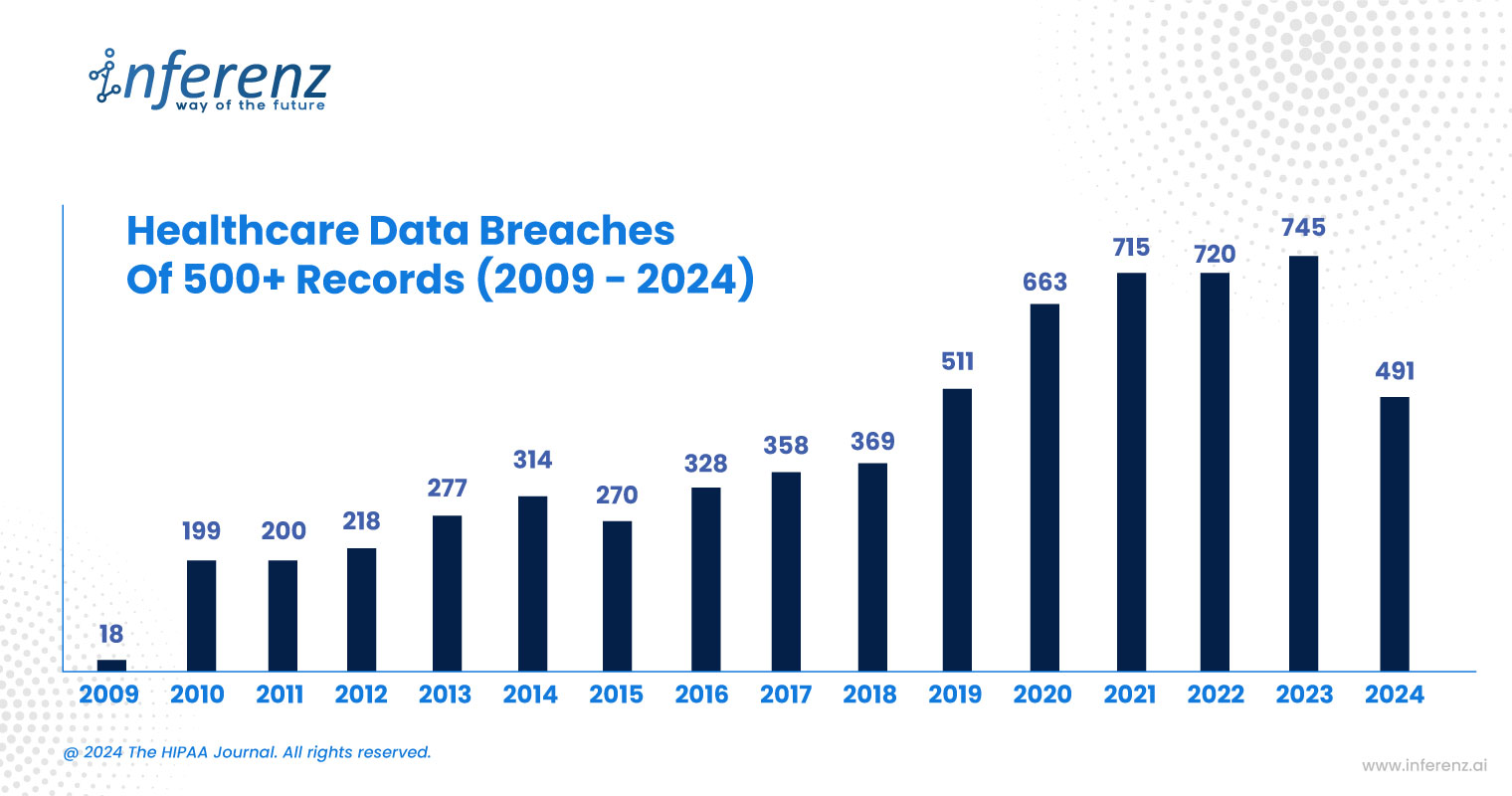
In the most recent period, in line with the Advisory board, the latest updates from California, DC, and Texas suggest that 2023 saw an alarming rise in healthcare data breaches, with 727 reported incidents compromising the data of nearly 133 million individuals.

The HIPAA Journal further reveals that in this year itself, February 2024 witnessed 69.5% of healthcare data breaches attributed to hacking, compromising nearly 5 million records in only one month. Here is a more detailed explanation:

Healthcare Data Security Breaches

The large volumes of sensitive data handled by healthcare organizations, combined with AI systems’ reliance on this data, make them vulnerable to data breaches and cyber-attacks.

Vulnerabilities in Machine Learning Models

ML models are at risk of data leakage, potentially resulting in privacy crises for organizations. As stated by the National Library of Medicine, while machine learning (ML) can significantly enhance physicians’ decision-making, it also introduces vulnerabilities in healthcare systems that are susceptible to attacks.

ML models are particularly vulnerable to various types of attacks, including data poisoning, where the training data is compromised. Evasion attacks, where test data is manipulated to mislead the model invalidation and backdoor exploits.

In response to these concerns, employing techniques like encryption, anonymization, and secure storage is essential for safeguarding sensitive healthcare data. While encryption secures data during both transfer and storage, anonymization minimizes the potential exposure of personal identifiers.

Data engineers and tech leaders are at the forefront of implementing these measures, working to ensure that AI architectures are both secure and scalable.

Inferenz boasts a team of skilled data engineers who specialize in developing AI-driven healthcare solutions that seamlessly integrate top-tier security practices, ensuring data protection and regulatory compliance.

Balancing Compliance and Security in AI Development

As suggested by the Diagnostic and Interventional Radiology Journal, research has shown that AI algorithms may unintentionally absorb biases in their models. Whether intentional or not, such biases could lead to unforeseen challenges in clinical practice.

To prevent bias in AI systems, it is crucial to focus on early-stage strategies in AI development. Here are key principles that are essential to guide AI design and minimize the risk of bias:

  • Transparency: Ensures that data collection and processing methods are clear, fostering trust and accountability in the AI system.
  • Fairness: Promotes equal treatment and considers diversity, preventing discriminatory practices and ensuring that AI systems serve all users impartially.
  • Non-maleficence: Focuses on ensuring AI systems do not cause harm, particularly by avoiding biased, discriminatory, or ineffective decisions that could negatively impact patient outcomes.
  • Privacy: Ensures that data is used responsibly, giving patients control over their information and maintaining the ethical handling of sensitive data.

Thus, by balancing compliance and security at every stage of AI development, from data collection and processing to model deployment, service providers can minimize the risk of breaches and vulnerabilities.

Real-Time Auditing and Cross-Functional Review

For sustained compliance and security, healthcare data security measures should be consistently audited and assessed using real-time monitoring tools for risks such as unauthorized access or breaches in data handling.

Furthermore, robust compliance relies on seamless collaboration between regulatory advisors, data analysts, and healthcare experts. Healthcare law advisors can ensure that the AI systems meet evolving regulatory standards. AI engineers can design and implement security measures, and clinicians can provide insights into clinical requirements.

This cross-functional teamwork will ensure that all aspects of AI system development and deployment are fully compliant with regulations and aligned with best practices for healthcare data security and patient care.

Conclusion

Healthcare data security is critical, and it demands unwavering attention to privacy and regulatory standards. Top executives, Chief Technology Officers (CTOs), and data architects need to work in tandem to ensure that patient data remains protected while pushing the boundaries of AI-driven innovation.

AI in Healthcare: Expert Insights, Use Cases, Future Trends

AI in healthcare is no longer a glimpse into the future but a breakthrough that is happening today. Its role is extremely conspicuous and has brought about a considerable change to many aspects of healthcare.

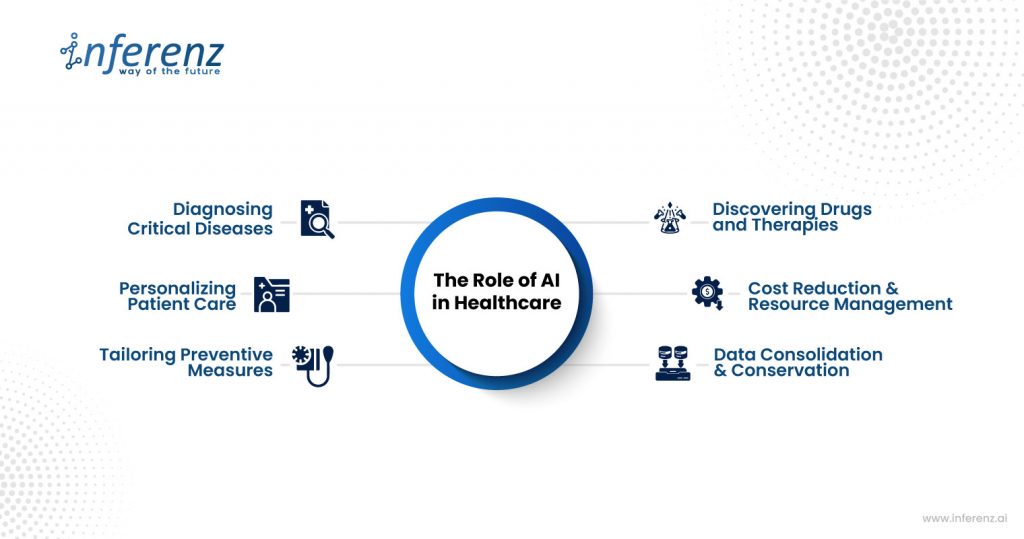
From diagnosing diseases with speed and precision, personalizing patient care, tailoring preventive measures, discovering drugs and therapies, and cost reduction to overseeing administrative workflow, the benefits are far-reaching. By consolidating and conserving data, predicting analytics, and natural language processing, AI has optimized healthcare data.role of ai in healthcare

Considering the upheaval brought by AI technology in healthcare, evaluating its usage is crucial, as unregulated AI can endanger patient safety and compromise trust in healthcare. Through this article, we will explore the critical role of responsible AI technology and how it is attainable.

Ethical Considerations in AI-Driven Healthcare

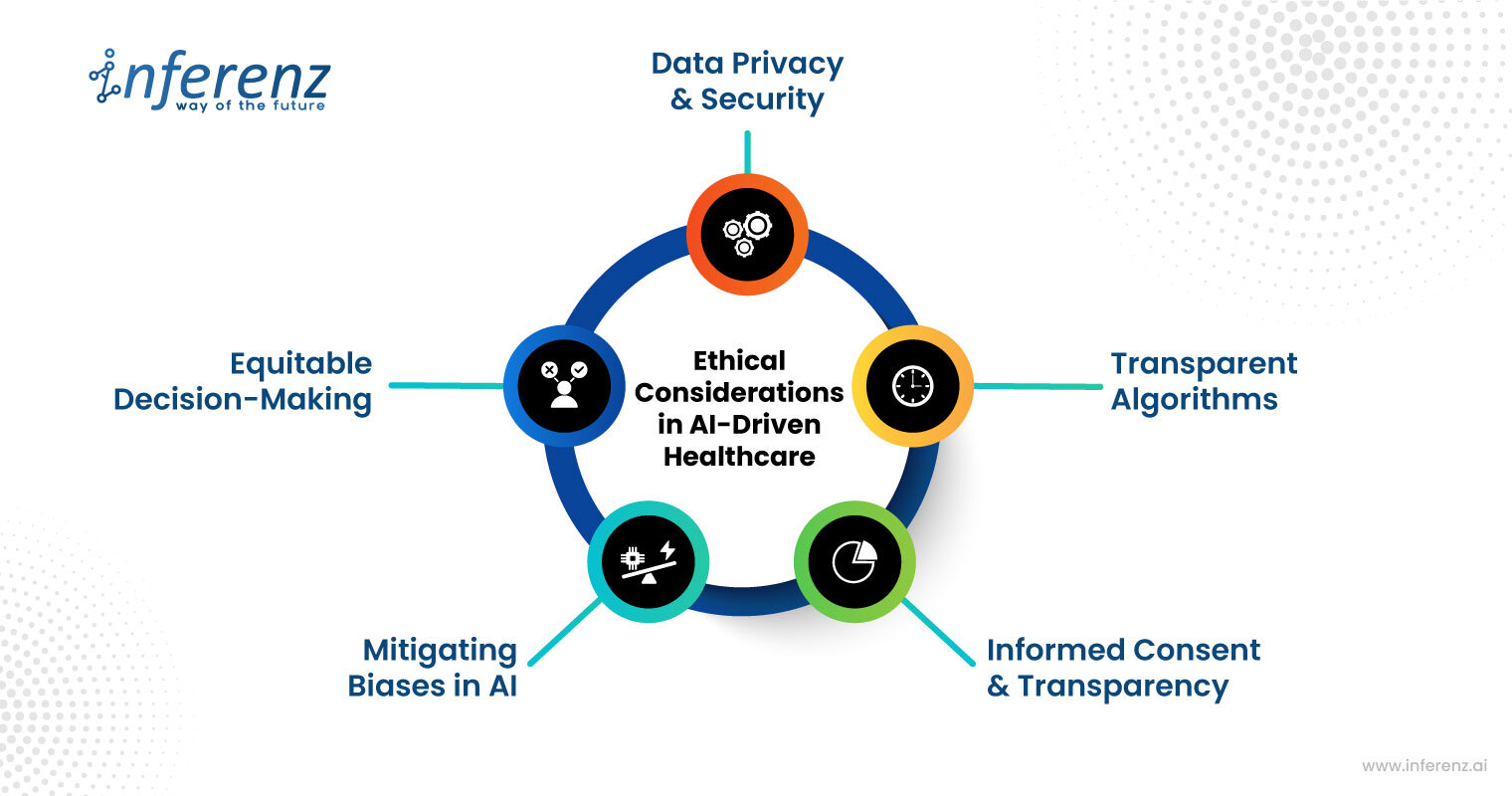
Ethics in AI-driven healthcare is critical as its role in healthcare is one of a silent partner. It impacts the three fundamentals of the industry, which are products, services, and finance. Therefore, rightness in data privacy and security, patient autonomy, roles of stakeholders should be secured. Here are a few examples of ethical considerations in AI-driven healthcare:

Data Privacy & Security

As the volume of healthcare data is growing exponentially, data privacy and security have become primary concerns. Here are a few ways to ensure data privacy and security in healthcare:

Handling Sensitive Patient Data:

As the orientation of the healthcare industry is toward patients, ensuring their data confidentiality is crucial to it. The industry is faced with a wide spectrum of structured, unstructured, and patient-generated health data that necessitates the use of artificial intelligence to process large data sets. 

However, its unmonitored use can anonymize patient information. To mitigate that, healthcare organizations must have stringent compliance with security regulations like HIPAA and GDPR and ensure broadened protection of patients’ sensitive medical data. 

Risk Of Data Breaches and The Need For Robust Security Protocols:

The HIPPA journal’s healthcare data breach statistics have shown an upward trend in data breaches due to hacking incidents and ransomware attacks. In a record stated by OCR, there was a 239% increase in hacking-related data breaches between January 1, 2018, and September 30, 2023, and a 278% increase in ransomware attacks over the same period.

In 2023, 79.7% of data breaches were due to hacking incidents. Such breaches of healthcare data can be averted through widespread data encryption, the use of intrusion and malware detection systems, and strict security audit protocols.

HIPPA report on AI in healthcare

Bias in AI Algorithms

In healthcare generally, biases in AI can emerge from inherent design or learning mechanisms of the algorithm itself. A study published in the Science Journal described how biases in AI algorithms systematically discriminated based on gender, race, and socioeconomic parameters. Here are a few ways to overcome the prejudice in patient care:

Identifying and Mitigating Biases in Healthcare AI

Healthcare has struggled to include women and minorities in research despite knowing they have different risk factors and manifestations of the disease. Also, the algorithm assigned people to high-risk groups based on their socioeconomic status. According to biases, black people had to be sicker than white people before being referred for additional help.

Ethical considerations in AI driven healthcareThe bias in the algorithms that lead to inequities in healthcare can be identified and mitigated by capturing data from varied demography, collaborative research, continuous monitoring, and ensuring accurate and formatted data for use in multiple systems.

Importance of Transparent Algorithms for Equitable Decision-Making:

To ensure transparency in algorithms and support equitable decision-making, the design and implementation of AI algorithms must align with ethical guidelines and industry standards. 

The performance of algorithms must be continuously evaluated to ensure transparency and accountability. There should be mechanisms that regularly audit the AI systems to provide accuracy. 

Patient Consent & Transparency

The role of AI technology in healthcare must complement patient care and not compete with it. The AI decisions must be regularly scrutinized to identify any potential inaccuracy in the judgment. 

The outcomes must be explained to the patients using explainable AI (XAI) to ensure transparency throughout their treatment. Also, healthcare industries must allow insights and data collection from diverse patients to understand the impact of AI on them and mitigate disparities in their care.

Fair Use of AI in Healthcare Analytics and Decision-Making

Fair use of AI in healthcare means the use of unbiased AI that supports patient autonomy and provides accurate diagnoses and treatments for all patients regardless of their differences. Establishing this fairness requires an understanding of the potential causes of misuse of AI and the development of strategies to mitigate them.

AI in Diagnostics and Treatment Planning

The integration of AI in healthcare offers precision in diagnosis and effective treatment plans. With algorithms, AI can identify anomalies in medical data and offer evidence-based recommendations and insights. It can help monitor patient conditions and provide personalized treatment, thus improving overall patient care. 

Ensuring AI Recommendations Align With Human Clinical Judgment

Healthcare is human-centered, making it imperative that AI recommendations harmonize with human intelligence for enhanced clinical judgments. While AI can process large data sets and provide predictive analysis, it lacks the nuanced judgment and ethical reasoning of humans. 

The healthcare industry must have a collaborative human-in-the-loop model where AI is used as a tool to increase diagnostic accuracy, provide remote health monitoring and personalized treatment, and streamline administrative workflow.

Avoiding Over-reliance on AI

AI has the potential for misinformation, algorithmic bias, and lack of accountability that can endanger patient safety. Therefore, it is important to avoid over-reliance on AI, maintain human oversight to mitigate biases, and explore key ethical concerns, including patient data privacy, security, and discrimination.

By avoiding over-reliance on AI and integrating human oversight, we can ensure that AI technologies align with healthcare values and ethical standards, thereby fostering patient’s trust in healthcare systems. 

AI in Predictive Analytics

AI predictive analytics uses machine learning (ML) algorithms to assess how different diseases progress in individual patients and predict how they might respond to various treatments. This leads to more personalized treatment plans, maximizing effectiveness in healthcare management.

Responsible Use Of AI In Predicting Patient Outcomes

In the context of preventative care and personalized medicine, AI can be used responsibly to process broader medical data, including genetic data, medical history, and lifestyle factors, to identify patterns and make predictions about health outcomes. It can forecast public health risks, provide personalized risk assessments, and support decision-making in preventive medicine.

Ethical Implications Of Using Predictive Data In Patient Care Decisions 

Although AI is a potentially promising application, the ethical implications of using patient data raise concerns about patients’ autonomy in decision-making that could impact the doctor-patient relationship.

As over-reliance on predictive analytics grows, aspects like voluntary participation, informed consent, confidentiality, etc., must be necessitated. It’s crucial to strike a balance between taking advantage of the benefits and safeguarding the patient’s confidential data against misuse. 

Regulatory Landscape and Future Outlook

AI technologies are being rapidly deployed, which could either benefit or harm stakeholders, including healthcare professionals and patients. When using health data, AI systems could have access to sensitive personal information, necessitating robust legal and regulatory frameworks for safeguarding privacy, security, and integrity.

Current AI Regulations in Healthcare

The World Health Organization (WHO) has listed key regulatory considerations on the role of AI in healthcare. WHO emphasizes the following aspects in its listing:

  • Ensure accurate data quality through rigorous evaluations and prevent biases and errors in the AI algorithms.
  • Address risk management, issues like ‘intended use,’ ‘continuous learning,‘ human interventions, training models, and cybersecurity threats.
  • Externally validate data and interpret the intended use of AI to assure safety and facilitate regulation.
  • Encourage dialogue and collaboration among stakeholders, including healthcare developers, regulators, manufacturers, health workers, and patients.
  • Foster trust and transparency in documentation by documenting the entire product lifecycle and tracking development processes.

Future Trends in Responsible AI Governance

The future of AI in healthcare is brimming with promises as it is expected to enhance the functionality of healthcare systems further and positively impact patient care. According to the Mayo Clinic, the future of AI in healthcare could create novel methods to diagnose, treat, predict, prevent, and cure disease. It can select and match patients with the most promising clinical trials and develop remote health-monitoring devices and more. Here are a few areas of development:

  • Adaptive Learning & Real-Time Data Analysis: The future of AI in healthcare will be more equipped with advanced learning capabilities and analyzing data in real-time. It will constantly update its knowledge base and algorithms with new data, research, and outcomes.
  • Adaptive Patient Care: Continuous learning will enable AI to assess patient-specific factors over time better, leading to more personalised and effective healthcare solutions.
  • Accuracy Over the Long Run: As AI gains more exposure to diverse patient cases and conditions, its diagnostic and treatment recommendations are expected to become precise and reliable.

FDA has developed SaMD (Software as a Medical Device) that necessitates the steps AI models must follow to be approved for healthcare. AI developers have to seek review and approval from the FDA when significant medication is involved.

Here are a few more ways to ensure that the future of AI in healthcare is made with greater responsibility: 

  • Maintain algorithmic accountability by building a framework that ensures that AI systems are audited and held accountable for their outcomes.
  • Develop a human-in-the-loop (HITL) model where human judgment is blended with AI technical know-how.
  • Mobilize Fast Healthcare Interoperability Resources (FHIR), a health level seven international (HL7) standard for exchanging healthcare information electronically. 
  • Execute a federal learning approach to train AI models using data from healthcare institutions without sharing sensitive data, ensuring patient privacy while still improving the model’s performance.

Inferenz is a team of skilled professionals that offers healthcare professionals cutting-edge solutions and products. We provide tailor-made machine learning and AI chatbots for healthcare to ensure they align with your business needs.

Contact us today, and let us help you build the right solution that seamlessly fits into the existing system. Responsible AI in healthcare

AI in Healthcare FAQs 

Chatbot For Healthcare: Key Use Cases, Benefits, & Risks Of AI

A chatbot for healthcare is a game changer for the medical industry, as it helps professionals serve patients 24*7. The conversational artificial intelligence chatbot reduces caseloads by assisting patients with easy access to healthcare. 

Using technology in healthcare is not a new concept. Healthcare professionals are already using various types of artificial intelligence, like machine learning, predictive analytics, etc., to address multiple issues. 

Thanks to new technology inventions, many healthcare organizations are leveraging the power of medical chatbots. If you are a healthcare provider wanting to integrate AI healthcare chatbots, this guide is for you. 

In this ultimate guide, we will discuss everything you need to know before implementing chatbot technology in healthcare. 

What Are Conversational AI Chatbots? 

There is no denying that chatbots in healthcare are becoming more critical than ever. According to Allied Market Research, the global healthcare chatbot market that accounted for $116.9 million in 2018 will cross $345.3 million by the end of 2026. That said, we can expect more implementation of chatbots in healthcare organizations. 

But before we dig deeper into chatbot technology in healthcare, let’s start with what a chatbot can do. In medical terms, healthcare bots are designed to provide guidance and appropriate help to patients digitally. Instead of searching online and understanding the cause of their symptoms, chatbots offer reliable and accurate information to patients. 

Many professionals believe that chatbots are designed to help patients who aren’t sure about the severity of their diseases. Chatbots work by collecting basic information from patients. Then, based on the input, healthcare AI bots provide patients with more information about their conditions. In addition, the chatbot can suggest the next steps or connect patients with doctors based on their health condition. 

Key Use Cases Of AI Healthcare Chatbot In Healthcare

Let us learn how healthcare providers can use chatbots to improve the patient experience. 

Health Tracking 

Many patients require daily health monitoring and tracking. Healthcare chatbots can be used to create a link between the patient and the doctor. Not only does the chatbot provide a detailed record of a patient’s health condition to the doctor, but it also assesses how well-prescribed medicines work to improve a patient’s health. 

Symptom Checking 

Chatbots can offer symptom checking to patients without them having to leave their homes. The Natural Language Processing (NLP) technology of chatbots helps patients to check their symptoms online and understand their medical condition. 

Patients can input their requests in the conversational AI in healthcare. The bot can access the information and narrow down the cause behind their symptoms. Thus, it will help patients determine whether they need professional treatment. 

Schedule Medical Appointments 

Scheduling doctor appointments has never been an easy feat. Patients have to wait in long queues, making it hard to get quick health information. Chatbots are proven to be a fantastic solution to this problem due to round-the-clock availability. 

Patients can quickly access medical information via chatbot by using its message interface. Plus, a well-designed healthcare chatbot can schedule medical appointments based on the doctor’s availability and the patient’s health. 

AI-powered chatbots can also send follow-up messages or reminders via email, text, or voice messages to remind patients about their appointments. The best part about scheduling appointments via chatbot is that the staff won’t get overwhelmed when inquiries become high. 

Easy Hiring & Employee Training 

Hiring and onboarding new employees can be cumbersome and time-consuming, especially in a large healthcare company. That’s why they implement AI chatbots to make the job of the HR department easy. 

Chatbots, for instance, can help new employees receive information about the company. In addition, new joiners can use the chatbot to automate multiple tasks, including maternity leave, requests for vacation time, etc. 

Answer Frequently Asked Questions 

One of the primary use cases of medical chatbots is providing timely answers to questions based on patient data. Many healthcare organizations can deploy an interactive chatbot feature on their homepage to answer common questions.

For example, a chatbot can help website visitors understand payment tariffs, insurance information, business hours, etc. This, in turn, lowers the workload on the in-house team and helps patients get quick information without any wait times. 

If you are planning to get started with a project related to machine learning or artificial intelligence system development, contact Inferenz experts. The AI and ML professionals will help you integrate advanced technology into your organization without spending out of your budget. 

Benefits Of Medical Chatbots For Healthcare 

In today’s technology-driven world, every industry is leveraging the power of AI, and the medical industry is no different. Chatbots for healthcare can automate repetitive and mundane tasks, so healthcare experts can focus on complex ones. Below we cover a few common benefits of chatbots for healthcare. 

  • Chatbots help patients get immediate responses, improving patient engagement, providing better care, and reducing wait time. 
  • AI-enabled healthcare chatbot understands patient behavior to deliver personalized recommendations in real-time. 
  • Delegating repetitive tasks to medical chatbots can help organizations reduce the need for human resources. 
  • Patients with minor medical issues can chat with the bot to get simpler medical advice based on their medical history. 

Risks Associated With Using Healthcare Chatbots 

Similar to other technologies, a healthcare chatbot comes with a few disadvantages and shortcomings. Chatbots can work with doctors to provide immediate care, but they can never replace doctors in the healthcare industry. Ultimately, it’s the doctor who will provide physical and mental health assistance. 

User privacy is the main concern when it comes to using AI chatbots to provide medical assistance. That said, medical professionals need to implement data safety measures and ensure their platforms are resistant to cyber-attacks. 

The Future Of Chatbot Technology In The Healthcare Industry 

AI-enabled chatbots can be used to check patients’ symptoms online, book appointments, contact doctors via video call, or answer simple medical questions. 

That said, it is clear that healthcare chatbots are transforming the healthcare sector. We can expect many more organizations to deploy machine learning and artificial intelligence technologies in healthcare to streamline their processes. 

If you want to know how healthcare organizations can use modern technologies to stay ahead, contact Inferenz experts today. Our professionals will help you in your health tech project or answer your questions related to chatbots for healthcare deployment.

Artificial Intelligence In Healthcare: Benefits & Use Cases Of AI

Summary

Artificial intelligence in healthcare is reshaping clinical decision-making, patient engagement, diagnostics, and hospital operations at scale. From AI-powered imaging analysis to conversational AI in healthcare that supports patients around the clock, the technology delivers measurable improvements in accuracy, efficiency, and outcomes. Healthcare organizations that strategically adopt AI gain a clear operational edge, reduce diagnostic errors, and improve patient satisfaction. This blog examines the most impactful AI use cases in healthcare, the core benefits, and what decision-makers need to know before investing.

Introduction: A Sector Under Pressure Needs Smarter Solutions

Healthcare systems worldwide face a compounding set of challenges: aging populations, clinician burnout, rising treatment costs, and an explosion of patient data that no human team can process manually at speed. Misdiagnosis rates remain stubbornly high. Administrative burdens consume up to 30% of a clinician’s working time. Meanwhile, patients expect faster, more personalized care than ever before.

The role of artificial intelligence in modern healthcare is not simply to digitize existing processes. Instead, AI fundamentally transforms how providers identify disease, coordinate care, and interact with patients. Machine learning models surface patterns in data that human review would miss. Natural language processing accelerates documentation and coding. Robotic systems assist surgeons with precision that reduces complication rates.

For healthcare executives, CIOs, and clinical leaders evaluating AI adoption, the central question is no longer whether AI delivers value. The evidence is clear. The question is where to deploy it first, and how to govern it responsibly.

The Importance of Artificial Intelligence in Healthcare

The importance of artificial intelligence in healthcare becomes evident when examining the volume and complexity of data the sector generates. Electronic health records, imaging files, genomic data, wearable sensor outputs, and clinical notes represent a dataset far too large for manual analysis.

AI systems process this data in real time, identify clinically relevant patterns, and support faster, more accurate decisions. According to research from EIT Health and McKinsey, AI-powered systems can improve patient care quality, drive operational efficiency, and help professionals achieve better outcomes consistently.

Furthermore, the global AI in healthcare market continues to grow rapidly, projected to reach over USD 187 billion by 2030. This growth reflects not just technology optimism but demonstrated clinical and financial returns across early adopters.

Why Healthcare Organizations Are Prioritizing AI Investment

Several converging forces drive AI adoption across healthcare systems:

  • Diagnostic complexity: Conditions like cancer, rare diseases, and neurological disorders benefit significantly from AI-assisted pattern recognition in imaging and genomics.
  • Workforce constraints: Clinician shortages in radiology, pathology, and primary care make AI augmentation a practical necessity, not a luxury.
  • Regulatory evolution: Regulators in the US, EU, and other markets now provide clearer frameworks for AI-based clinical decision support, reducing adoption risk.
  • Cost pressure: Hospitals and health systems face margin compression that demands operational efficiency at every level.

Together, these factors make AI adoption a strategic priority rather than an exploratory experiment.

Key Applications of AI in Healthcare

The applications of AI in healthcare span the entire care continuum, from early detection and diagnosis to treatment planning, post-discharge follow-up, and administrative management. Below are the areas delivering the most significant impact.

Medical Imaging and Diagnostic Analysis

Medical imaging represents one of the most mature and validated applications of AI in clinical care. AI algorithms trained on millions of annotated images detect anomalies in CT scans, MRIs, X-rays, and mammograms with accuracy that matches or, in specific conditions, exceeds specialist performance.

For example, AI tools detect early-stage breast cancer in mammography screenings with greater sensitivity than radiologists reviewing the same images independently. This capability reduces false negatives, supports earlier intervention, and improves survival outcomes.

In ophthalmology, AI systems analyze retinal images to detect diabetic retinopathy, macular degeneration, and glaucoma at population scale. This matters particularly in regions where specialist access is limited, as AI enables community-level screening without requiring an ophthalmologist present at every site.

Predictive Analytics and Early Warning Systems

Hospitals increasingly deploy AI models that predict patient deterioration before clinical signs become obvious. These early warning systems analyze vital sign trends, lab results, and nursing observations to flag patients at high risk of sepsis, cardiac events, or respiratory failure.

Because of this early detection capability, clinical teams can intervene hours before a crisis develops, reducing ICU admissions and improving outcomes. Studies in high-volume hospitals show that AI-powered early warning systems reduce sepsis mortality by 20% or more in deployments with proper workflow integration.

Administrative Automation and Workflow Optimization

How AI is used in healthcare extends well beyond clinical care. Administrative functions represent a significant share of healthcare operating costs, and AI automation delivers measurable savings.

Specifically, AI handles the following administrative tasks effectively:

  • Healthcare claims processing and prior authorization review
  • Patient record management and clinical documentation coding
  • Appointment scheduling, rescheduling, and automated reminders
  • Insurance eligibility verification and billing reconciliation

Natural language processing (NLP) tools transcribe physician-patient conversations in real time and populate electronic health record fields automatically. As a result, clinicians spend less time on documentation and more time on direct patient interaction. In practices where AI scribing tools are deployed, physicians report saving 1.5 to 2 hours per shift on average.

Drug Discovery and Pharmaceutical Research

AI use cases in healthcare extend into pharmaceutical R&D, where the cost and time required to bring a new drug to market have long been prohibitive. AI platforms analyze molecular structures, predict protein folding, identify candidate compounds, and model clinical trial designs at speeds no traditional research approach matches.

For instance, Inferenz collaborated with a pharmaceutical company in Germany to deploy AI and ML tools that predict health outcomes from patient data. By analyzing vital health parameters, the AI models helped clinicians diagnose and treat patients with greater precision, reducing time to treatment and supporting better drug-outcome matching.

Moreover, AI reduces the failure rate of clinical trials by improving patient selection, identifying biomarker-based inclusion criteria, and predicting adverse events before they occur in large-scale testing.

Benefits of AI in Healthcare: A Structured View

The benefits of AI in healthcare span clinical quality, operational performance, and patient experience. Each dimension matters when building the business case for AI investment.

More Accurate Diagnosis, Fewer Errors

Misdiagnosis remains one of the most serious patient safety risks in healthcare. AI-powered diagnostic tools reduce error rates in radiology, pathology, dermatology, and cardiology by providing a consistent, data-driven second opinion that does not suffer from cognitive fatigue or confirmation bias.

Specifically, computer vision models analyze MRI reports, CT scans, and mammograms with a level of consistency that human reviewers cannot sustain across an entire shift. The result is a measurable reduction in missed diagnoses and a shorter time to treatment for patients whose conditions are identified earlier.

Improved Patient Engagement and Communication

Poor communication between providers and patients reduces medication adherence, increases no-show rates, and lowers overall care quality. Conversational AI in healthcare addresses this gap directly.

AI-powered virtual assistants and chatbots handle appointment scheduling, send medication reminders, answer common clinical questions, and triage patient concerns before a clinician needs to engage. Patients receive timely responses around the clock, without placing additional demand on front-desk staff or nursing teams.

Furthermore, conversational AI platforms support patients with chronic conditions by checking in regularly, collecting self-reported symptom data, and alerting care teams when a patient’s condition appears to be changing. This continuous engagement model improves chronic disease management at scale.

Safer, More Precise Surgical Procedures

AI-assisted robotic surgery systems give surgeons enhanced precision, real-time visual guidance, and motion stabilization that reduces surgical trauma. Patients who undergo robotic-assisted procedures consistently report shorter recovery times, lower post-operative pain scores, and fewer complications compared to traditional open surgery.

In addition, AI systems can analyze intraoperative data streams to flag potential risks during a procedure, providing the surgical team with decision support in real time rather than retrospectively.

Operational Efficiency and Cost Reduction

Beyond clinical impact, AI delivers material operational value. Automated prior authorization workflows reduce claim denials and accelerate reimbursement cycles. Predictive scheduling tools reduce appointment no-shows and optimize clinic throughput. Supply chain AI models improve inventory management and reduce medication waste.

Consequently, healthcare organizations that deploy AI across both clinical and administrative functions report reductions in operating costs alongside improvements in patient satisfaction scores. These two outcomes, typically in tension, become simultaneously achievable with well-implemented AI.

Conversational AI in Healthcare: A Closer Look

Conversational AI in healthcare deserves particular attention because its adoption has accelerated sharply since 2023. These systems use large language models and NLP to understand and respond to patient queries in natural language, across text and voice interfaces.

Use cases include:

  • Pre-visit triage: Patients describe symptoms through a chat interface; the AI collects structured clinical history and routes the patient to the appropriate care level.
  • Post-discharge follow-up: AI contacts discharged patients by text or voice to check on recovery progress and flag concerns to the care team.
  • Mental health support: AI-powered tools provide evidence-based conversational support for mild anxiety and depression, extending the reach of behavioral health services.
  • Patient education: Conversational AI explains diagnoses, treatment plans, and medication instructions in plain language, improving comprehension and adherence.

However, organizations must govern conversational AI deployments carefully. Clear escalation pathways to human clinicians, transparent AI disclosure to patients, and robust audit logging are non-negotiable requirements for responsible deployment.

Limitations and Responsible Deployment Considerations

No honest assessment of AI in healthcare can overlook its current limitations. AI models perform best on data distributions that closely match their training data. Demographic gaps in training datasets can introduce bias, leading to reduced accuracy for underrepresented patient populations.

Additionally, AI systems require ongoing monitoring after deployment. Model drift, where performance degrades as patient populations or clinical workflows change, is a real operational risk that governance frameworks must address.

Therefore, healthcare organizations should treat AI adoption as a continuous program, not a one-time implementation. Clear ownership of model performance, structured validation protocols, and clinician training on AI tool limitations are essential components of a responsible deployment strategy.

Conclusion: AI as a Strategic Imperative, Not an Optional Add-On

The evidence for AI’s value in healthcare is no longer theoretical. Across diagnostics, surgical assistance, patient engagement, administrative automation, and pharmaceutical research, AI delivers outcomes that improve care quality and reduce costs simultaneously.

The organizations that benefit most are those that approach AI adoption strategically: identifying high-value use cases, investing in data quality, building governance frameworks, and treating clinicians as partners in deployment rather than passive recipients of new tools.

For healthcare leaders evaluating where to begin, the practical advice is straightforward. Start with use cases where AI augments rather than replaces clinical judgment, where data quality is high, and where measurable outcomes allow rapid validation. Build from there.

The role of artificial intelligence in modern healthcare will only expand as models become more capable and data infrastructure matures. The question is not whether your organization will operate in an AI-enabled environment. It is whether you will lead that transition or follow it.

Frequently Asked Questions

Data Science in Healthcare: 8 Use Cases No One Will Tell You

Summary

Data science in healthcare has moved past dashboards and retrospective reporting. Hospitals now use predictive models to flag patient deterioration hours before a crisis, prevent readmissions, and close revenue leaks that quietly drain margins. This guide covers eight practical use cases most vendors don’t discuss, the benefits and challenges of adoption, and how agentic AI is reshaping healthcare data science heading into 2026 and beyond. Whether you run clinical operations or manage the P&L, the goal is the same: turn scattered healthcare data into decisions that protect patients and revenue.

Introduction: The Changing Role of Data Science in Healthcare

A single mid-sized hospital generates more data in a week than most enterprises generate in a year. Vitals, claims, lab results, imaging files, scheduling logs, and clinician notes pile up across disconnected systems. However, most of that data sits idle. Clinical teams still make high-stakes decisions on incomplete information, and finance teams still discover billing errors months after the damage is done.

This is the real problem data science in healthcare exists to solve. It is not about adding another dashboard. It is about converting fragmented, messy healthcare data into predictions and decisions that arrive before the outcome, not after it. Consequently, organizations that treat data science as a reporting exercise get reports. Organizations that treat it as a decision-support system get results.

This article breaks down what data science in healthcare actually means, the eight highest-impact use cases that rarely make it into vendor pitch decks, and how healthcare data science consulting services help organizations move from pilot projects to production systems.

What Is Data Science in Healthcare?

Data science in healthcare is the discipline of applying statistics, machine learning, and structured analytics to clinical, operational, and financial healthcare data to improve outcomes and reduce cost. It sits at the intersection of three domains: clinical knowledge, computer science, and healthcare data analytics.

In practice, healthcare data science does three things:

  • Collects and cleans data from EHRs, claims systems, wearables, and lab feeds
  • Applies statistical models and machine learning to detect patterns humans would miss
  • Delivers predictions in a form clinicians and administrators can act on immediately

Because healthcare data is fragmented across payers, providers, and devices, most organizations need a data science consulting partner to unify these sources before any model can be trusted. Without that foundation, even the most advanced algorithm produces unreliable output.

How This Differs From General Data Science

General data science optimizes for engagement, conversion, or efficiency. Healthcare data science optimizes for something harder to measure and higher stakes: patient safety. A false positive in retail analytics costs a wasted ad. A false negative in patient deterioration prediction can cost a life. This is why data science consulting services built specifically for healthcare emphasize explainability, HIPAA compliance, and clinical validation far more than a generic analytics vendor would.

Key Applications of Data Science in Healthcare

Before diving into the specific use cases, it helps to understand the broad categories where data science and analytics are already active in healthcare organizations:

  • Medical imaging analysis — detecting anomalies in X-rays, CT scans, and MRIs faster and more consistently than manual review alone
  • Genomics and precision medicine — correlating genetic markers with disease risk to personalize treatment
  • Drug discovery — modeling molecular interactions to shorten research cycles
  • Predictive analytics — forecasting patient risk, staffing needs, and resource demand
  • Remote patient monitoring — using IoT devices and continuous data streams to catch problems early
  • Clinical operations optimization — reducing wait times, improving scheduling, and cutting waste

These categories set the stage. The next section gets specific, covering eight use cases that deliver measurable ROI but rarely appear in generic healthcare AI marketing.

8 Data Science Use Cases in Healthcare No One Will Tell You

Most articles on data science in healthcare repeat the same four examples: imaging, genomics, drug discovery, and wearables. Those matter, but they are not where most healthcare organizations are actually losing money or missing early warning signs. The following eight use cases are less discussed, more operationally relevant, and often deliver faster ROI.

Use Case #1: Predicting Patient Deterioration

Early warning scores based on static vitals thresholds miss subtle deterioration patterns. Machine learning models trained on continuous vitals, lab trends, and nursing notes can flag at-risk patients six to twelve hours before a rapid response event. As a result, clinical teams intervene earlier, and ICU transfer rates drop.

This is one of the clearest applications of Healthcare Data Science, because the underlying data (vitals, labs, notes) already exists inside most EHRs. The barrier is rarely data availability. It is almost always data fragmentation and model validation.

Use Case #2: Predicting Hospital Readmissions

Readmission penalties under value-based care models make this a financial as well as clinical priority. Predictive models combine discharge diagnosis, social determinants of health, medication adherence history, and follow-up appointment data to score readmission risk at discharge.

Hospitals that act on these scores, by scheduling earlier follow-ups or adding home health visits for high-risk patients, consistently reduce 30-day readmission rates. This is a textbook case for data science for healthcare teams pairing clinical logic with statistical modeling.

Use Case #3: Predicting Patient No-Shows

No-shows quietly cost outpatient clinics significant revenue every month. Predictive models using appointment history, distance to facility, weather, and communication preferences can flag high no-show-risk appointments in advance. Clinics then double-book strategically or send targeted reminders through the patient’s preferred channel.

Because this use case ties directly to revenue rather than clinical outcomes, it is often the easiest entry point for organizations exploring data science consulting for the first time.

Use Case #4: Detecting Revenue Leakage and Billing Anomalies

Coding errors, missed charges, and denied claims drain millions from healthcare organizations every year. Anomaly detection models flag billing patterns that deviate from historical norms, whether that is an unusual denial spike from a specific payer or a coding pattern that consistently under-bills a procedure.

This is where a healthcare data analytics company delivers immediate, measurable financial impact. Unlike clinical use cases that require long validation cycles, billing anomaly detection can show ROI within the first quarter of deployment.

Use Case #5: Predicting Staffing Needs

Overstaffing wastes budget. Understaffing burns out clinical teams and increases error rates. Predictive staffing models combine historical census data, seasonal illness trends, local event calendars, and even weather forecasts to project patient volume days or weeks in advance.

Organizations using this approach report more stable nurse-to-patient ratios and meaningfully lower agency staffing costs, which are often the single largest controllable expense in a hospital budget.

Use Case #6: Identifying Referral Leakage

Referral leakage happens when patients referred to a specialist within a health system instead go outside the network, taking that revenue with them. Data science models track referral patterns, identify where leakage concentrates by specialty or geography, and surface the drivers, whether that is scheduling delays or network gaps.

This use case sits at the intersection of data science consulting services and network strategy, and it is rarely discussed publicly because health systems consider referral data commercially sensitive.

Use Case #7: Accelerating Clinical Documentation

Clinicians spend a disproportionate share of their day on documentation instead of patient care. Natural language processing models, increasingly powered by Conversational AI in Healthcare, now summarize clinical encounters, auto-populate structured fields, and flag missing documentation required for accurate billing.

This directly improves clinician satisfaction and reduces burnout, while also improving downstream data quality for every other model built on top of that documentation.

Use Case #8: Predicting Hospice and Palliative Care Eligibility

Identifying patients who would benefit from palliative or hospice care earlier improves quality of life and reduces unnecessary aggressive interventions near end of life. Predictive models analyze diagnosis trajectories, functional decline indicators, and utilization patterns to flag eligible patients for care team review.

Because this use case touches sensitive clinical judgment, it is typically deployed as a decision-support flag for physician review rather than an automated trigger, which keeps the human in the loop where it matters most.

Benefits of Data Science in Healthcare

Bringing these use cases together, the benefits of Data Science in Healthcare span three areas:

Clinical benefits

  • Earlier detection of patient deterioration
  • More personalized treatment plans through genomics and predictive modeling
  • Reduced diagnostic error rates

Operational benefits

  • Better staffing predictions and resource allocation
  • Reduced no-show rates and improved scheduling efficiency
  • Faster clinical documentation

Financial benefits

  • Reduced readmission penalties
  • Detection of billing anomalies and revenue leakage
  • Lower agency staffing costs

Together, these benefits explain why data science services in healthcare have moved from innovation-lab pilots to core operational infrastructure at leading health systems.

How Data Science Turns Healthcare Data Into Actionable Intelligence

Raw healthcare data, on its own, has no value. The transformation from raw data to actionable intelligence follows a consistent pipeline.

Step 1: Data Collection and Integration

Healthcare data lives in EHRs, claims systems, lab platforms, imaging archives, and increasingly, wearable devices. A data consulting services partner typically starts here, because fragmented data undermines every model built afterward.

Step 2: Cleaning and Standardization

Healthcare data is notoriously messy. Different providers code the same condition differently, timestamps drift across systems, and manual entry introduces errors. Standardizing this data is unglamorous work, but it determines whether downstream models are trustworthy.

Step 3: Model Development and Validation

Data scientists build models specific to the use case, whether that is a readmission risk score or a billing anomaly detector, and validate them against historical outcomes before any clinical or financial decision relies on them.

Step 4: Deployment Into Clinical or Operational Workflows

A model that lives in a data science notebook delivers zero value. The final step embeds predictions directly into the tools clinicians and administrators already use, so the insight arrives at the point of decision, not buried in a separate report.

Challenges of Implementing Data Science in Healthcare

Despite the clear benefits, healthcare data science projects fail more often than they succeed. The common obstacles include:

  • Data fragmentation across EHRs, payers, and legacy systems that don’t communicate
  • Regulatory complexity, particularly HIPAA compliance and state-level privacy rules
  • Clinician trust, since models without explainability get ignored regardless of accuracy
  • Data quality issues inherited from decades of inconsistent manual entry
  • Change management, because a model is only useful if workflows actually change around it

Overcoming these challenges typically requires more than an internal data team. It requires a partner with both technical depth and healthcare domain experience, which is exactly the gap data science consulting firms with healthcare specialization are built to close.

The Role of AI and Agentic AI in Healthcare Data Science

Traditional predictive models answer narrow questions: will this patient be readmitted, will this claim be denied. Agentic AI extends this further by taking action, not just producing a prediction.

A HIPAA compliant healthcare native agentic AI platform can, for example, flag a deterioration risk, automatically notify the appropriate care team member, and schedule the follow-up, all within a compliant, auditable workflow. This shifts data science in healthcare from passive reporting to active intervention.

Platforms like Meta Muse Spark in Healthcare and GPT-6 Astra in Healthcare represent the direction this space is heading: multimodal systems capable of reasoning across imaging, structured records, and clinical notes simultaneously, rather than analyzing each data type in isolation. Meanwhile, AI in health data science and analytics increasingly blends generative reasoning with the statistical rigor of traditional predictive modeling, giving clinicians both a prediction and a plain-language explanation of why the model reached that conclusion.

Future of Data Science in Healthcare

Looking toward 2026 and beyond, several trends are converging:

  • Agentic AI moving from pilot to production, handling routine clinical and administrative workflows end to end
  • Multimodal models that reason across imaging, genomics, and text simultaneously instead of requiring separate systems for each
  • Real-time monitoring becoming standard rather than a premium feature, as wearable and IoT data volumes grow
  • Stronger regulatory frameworks around AI explainability in clinical decision-making, pushing vendors toward more transparent models

Organizations that wait for these trends to fully mature will find themselves competing against health systems that already built the data infrastructure to support them.

How Healthcare Organizations Can Prepare for the Future

Preparation does not start with buying an AI platform. It starts with the data foundation underneath it.

  1. Audit data infrastructure to identify fragmentation across EHRs, claims, and departmental systems
  2. Prioritize one or two use cases with clear ROI, such as no-show prediction or billing anomaly detection, rather than attempting an enterprise-wide rollout immediately
  3. Build in compliance from day one, since retrofitting HIPAA compliance into an existing system is far more expensive than designing for it upfront
  4. Partner with a specialized team offering Data Science & Predictive Analytics Services built specifically for healthcare workflows, not adapted from generic enterprise analytics

Organizations that follow this sequence typically see faster time to value and fewer stalled AI initiatives than those that jump straight to platform selection.

Conclusion: From Healthcare Data to Better Outcomes

Data science in healthcare has outgrown the era of static dashboards and quarterly reports. The organizations seeing real returns are the ones using predictive models to act before an outcome happens, not after. From predicting patient deterioration to closing revenue leaks in billing, the eight use cases outlined here represent where the practical value is concentrated right now.

The path forward is not complicated, but it does require discipline: fix the data foundation, prioritize high-ROI use cases, and build compliance in from the start. Healthcare organizations that treat data science as core infrastructure, rather than an experimental add-on, will be the ones setting the pace as agentic AI reshapes what is possible in clinical and operational decision-making.

At Inferenz, we help healthcare organizations turn fragmented data into trusted intelligence and actionable AI solutions, connecting data modernization, analytics, and AI to measurable business and patient outcomes. Learn more about how Inferenz approaches data and AI transformation for healthcare organizations.

Frequently Asked Questions