










FHIR Prior Authorization APIs: Build, Buy, or Integrate?

Summary

A practical framework for hospital CIOs deciding whether to build, buy, or integrate a FHIR prior authorization API before the January 2027 CMS-0057-F deadline. Every cost, risk, and governance trade-off below is sourced, not pitched. 

 Ask five vendors how to fix prior authorization and you’ll get five different answers, each one conveniently pointing back to whatever that vendor sells. One recent study found radiologists face a prior authorization request on 91% of the orders they write, the highest rate of any medical specialty. That reality is pushing hospital leaders toward a decision they cannot keep deferring: standing up a FHIR prior authorization API before the CMS-0057-F clock runs out in January 2027. 

Three paths sit on the table right now.  

  1. Build it yourself. 
  2. Buy a point solution. 
  3. Integrate an agentic layer on top of the systems you already run.  

Each one solves a different problem, and each one creates a different risk. 

What a FHIR Prior Authorization API Actually Does

A FHIR prior authorization API is the technical mechanism CMS-0057-F requires payers to expose so providers can check coverage rules, submit documentation, and get a structured answer back, approved, denied with a specific reason, or flagged for more information, without a phone call or a fax. 

It runs on three of HL7 FHIR’s Da Vinci implementation guides working together. CRD checks whether an order needs authorization before it is even placed. DTR gathers the documentation the payer will actually require. PAS submits the request and tracks its status through to a decision. 

The rule applies to Medicare Advantage organizations, state Medicaid and CHIP programs, and Qualified Health Plan issuers on the federal exchanges. Self-insured employer plans and traditional Medicare fee-for-service are not directly covered, though many commercial payers are aligning voluntarily. 

CMS projects the shift will save the healthcare system roughly $15 billion over ten years, mostly by cutting the manual back-and-forth between provider and payer staff. There is a compliance layer for hospitals too: eligible clinicians must attest to submitting at least one electronic prior authorization through a FHIR API to remain MIPS compliant, starting with the 2027 performance period.

The Three Paths on the Table
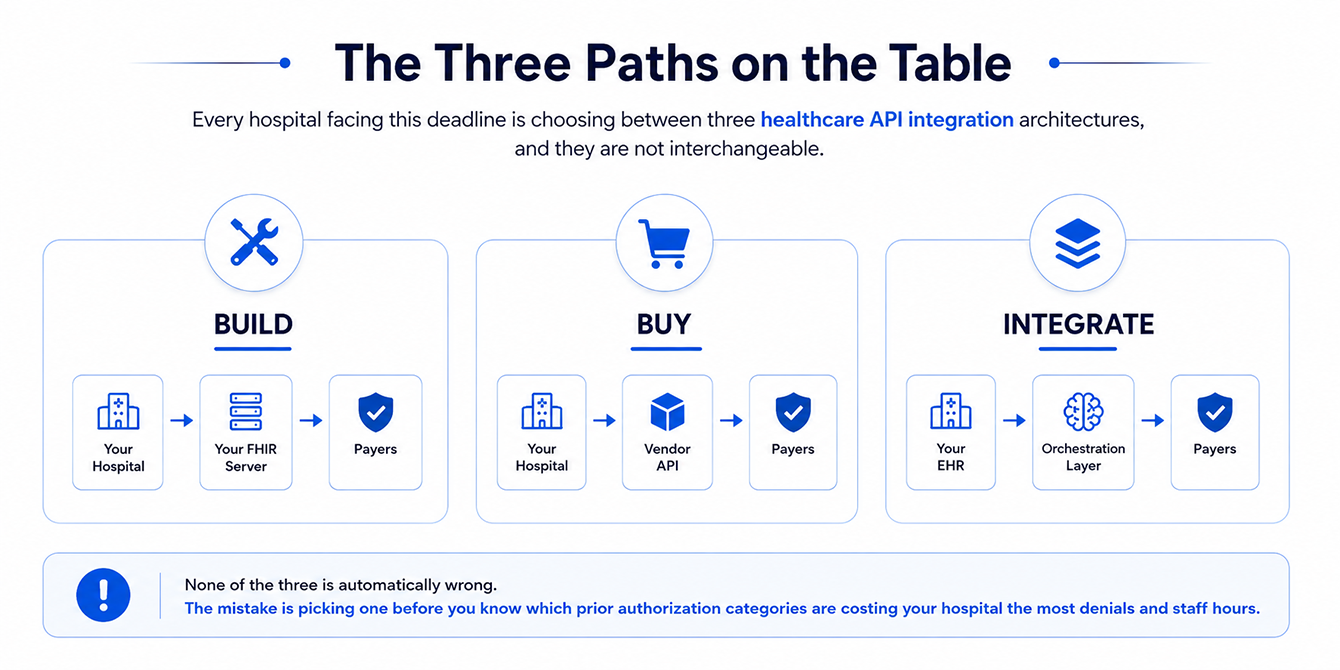
The Three Paths on the Table 

Here are the three healthcare API integration architectures: build, buy and integrate. 

  • Build means standing up your own FHIR server, mapping every payer’s rules by hand, and maintaining the integration with your own team indefinitely. 
  • Buy means licensing a vendor’s packaged prior authorization API, usually scoped to one function like imaging or specialty pharmacy. It is fast to turn on, but it is one more system your IT team now has to babysit. 
  • Integrate means placing an orchestration layer, often an agentic one, on top of the EHR and payer connections you already have. It reads clinical data, checks the CRD, DTR, and PAS rules, and routes anything ambiguous to a human instead of guessing. 

None of the three is automatically wrong. The mistake is picking one before you know which prior authorization categories are costing your hospital the most denials and staff hours. 

Why building in-House Rarely Pays Off for Hospitals

The cost of building a FHIR prior authorization API in-house in hospitals and ambulatory organizations sounds manageable on a slide, until you count the bill. Building an AI-Ready Infrastructure for Hospitals & Ambulatory care requires a data foundation that can support FHIR integration alongside broader analytics and AI initiatives. Enterprise-scale FHIR integration connecting multiple payer and EHR systems runs into six figures before a single payer contract is fully mapped, and the assessment and mapping phase alone often takes six to twelve months before any code ships.

A study of ten health systems that had already deployed patient-facing APIs found the same barriers kept resurfacing across every one of them: security concerns, an immature app ecosystem, EHR vendor hesitation around data sharing, and standards still settling underneath them. 

None of that goes away because your own engineers wrote the code. It just moves in-house, permanently. Unless there is budget for a standing team whose only job is chasing payer rule changes, build tends to consume exactly the three to nine months of executive runway that gets burned when a pilot stalls halfway through integration. 

Why Buying a Point Solution Solves One Problem and Creates Another

Buying a packaged prior authorization API gets one workflow moving fast, usually imaging or specialty medication, since those categories carry the heaviest authorization load. But an AI-ready hospital rarely stops at one use case. 

Five different point tools for five different departments means five vendor contracts, five data models, and five places where a denial can quietly fall through the gap. Published research on agentic prior authorization architecture makes the same point from the engineering side: the real gains come from systems that integrate FHIR, EDI, and legacy interfaces under one governance layer, not from bolting another single-purpose tool onto an already fragmented stack. 

Why an Agentic Integration Layer Is Winning Out

The path gaining the most traction right now is the third one: prior authorization automation built as an agentic AI layer that sits on top of the EHR and payer systems a hospital already runs, instead of replacing them. 

One 2026 study of a multi-payer radiology deployment reported a 65.4% reduction in denials, a 33.9% improvement in authorization cycle time, and 97.4% alignment between payer and practitioner decisions, all without a system replacement. That figure comes from a single early-stage publication rather than a peer-reviewed multi-site trial, so treat it as directional, and ask any vendor citing similar numbers for their own validation data. 

The architectural pattern behind those results shows up across other published research too: an agent extracts the clinical data, validates it against payer rules, assembles the required documentation, and escalates anything ambiguous to a human reviewer instead of guessing on its own.

How to integrate FHIR prior authorization API with existing EHR? 

Integrate means learning how to integrate a FHIR prior authorization API with your existing EHR, rather than replacing it: an orchestration layer, often an agentic one, sits on top of the EHR and payer connections you already have. It reads clinical data, checks the CRD, DTR, and PAS rules, and routes anything ambiguous to a human instead of guessing. 

This is the model behind platforms like Caregence, Inferenz’s HIPAA Compliant Agentic AI Platform for Healthcare. It connects directly to EHR, payer, claims, and RCM systems already in place. The prior authorization agent and the clinical AI documentation agent are both governed and auditable by design. For a CIO who has already lived through one AI pilot that could not explain its own decisions, that auditability tends to matter more than the automation itself. 
Prior Authorization AI Agent for Healthcare

Comparison tables based on cost, risk, governance, and best fit

 Check out the individual tables to assess the best approach to take for your needs, whether you need to build the solution inhouse, buy one outright or integrate with your present systems.  

 Cost & Timeline

 Build Buy Integrate 
Cost profile Runs into six figures before a single payer contract is even fully mapped Lower upfront cost per tool, but cost compounds as departments add more point tools Mid-range; reuses EHR and payer connections you already have instead of building or licensing from zero 
Timeline to value Assessment and mapping alone often takes 6-12 months before any code ships Fastest to turn on for one workflow, weeks not months Faster than build since it layers on existing infrastructure, proven use-case by use-case 
Executive runway risk Consumes 3-9 months of runway when a pilot stalls mid-integration Low risk per tool, but risk compounds across contracts Lower, since it’s validated on one high-volume category before expanding 

Risk Profile 

 Build Buy Integrate 
Primary risk Security concerns, immature app ecosystem, EHR vendor hesitation on data sharing, standards still settling Point-solution sprawl: five tools means five contracts, five data models, five places a denial can fall through the cracks Vendor-trust risk replaces technical risk; depends on how governed the agent layer actually is 
Maintenance burden Stays in-house permanently, team must chase every payer rule change indefinitely Distributed across vendors; IT still has to babysit each one separately Centralized under one orchestration layer 
Failure pattern Pilot stalls halfway through integration Solves one department, doesn’t scale hospital-wide Requires proof of auditability before scaling past the first use case 

 Governance & Control

 Build Buy Integrate 
Audit trail Fully owned and controlled, but resource-intensive to maintain Vendor-defined, varies contract to contract Governed and auditable by design, not retrofitted after deployment 
Decision transparency High, but the burden sits entirely on your team Depends on whether the vendor’s decisioning is black-box or transparent Agent extracts data, validates against payer rules, assembles documentation, and escalates anything ambiguous to a human 
Data scope One system, fully controlled Siloed per point tool FHIR, EDI, and legacy interfaces unified under one governance layer 

Best Fit & Evidence

 Build Buy Integrate 
Best fit when You have budget for a standing team whose only job is chasing payer rule changes One workflow (imaging, specialty pharmacy) needs a fast, single-department fix Multiple departments need orchestration and you want proof before committing further 
Supporting evidence Barriers documented across ten health systems that had already deployed patient-facing APIs Sprawl risk described in published agentic prior authorization architecture research One 2026 multi-payer radiology deployment reported 65.4% fewer denials, 33.9% faster cycle time, 97.4% payer-practitioner alignment (single study, treat as directional) 
Example in market Your own IT team Point-solution vendors scoped to one function Caregence (Inferenz), an agentic layer connecting EHR, payer, claims, and RCM systems 

A Quick 6-Point Checklist Before You Choose
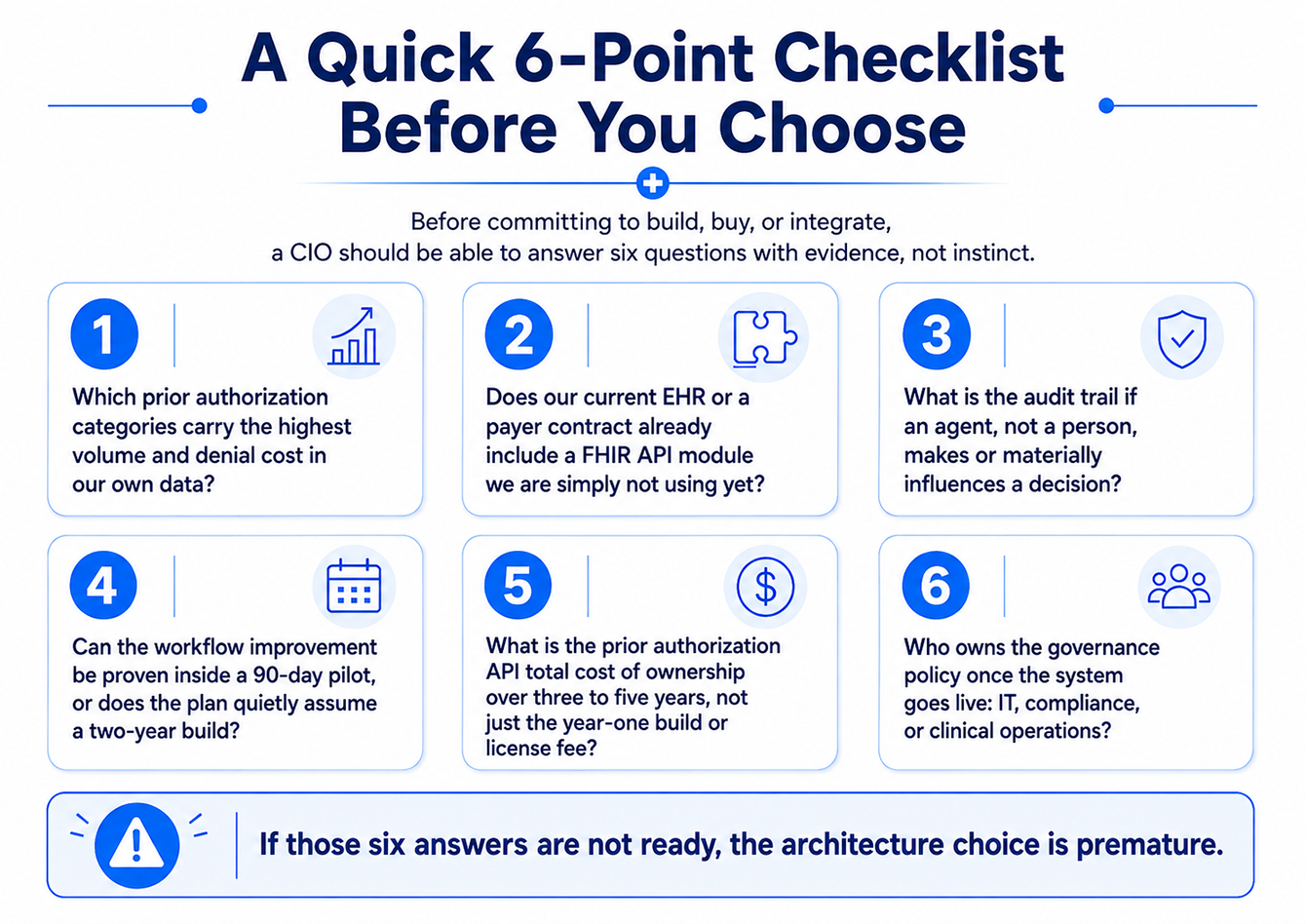
A Quick 6-Point Checklist Before You Choose Before committing to build, buy, or integrate, a CIO should be able to answer five questions with evidence, not instinct. 

  1. Which prior authorization categories carry the highest volume and denial cost in our own data?
  2. Does our current EHR or a payer contract already include a FHIR API module we are simply not using yet?
  3. What is the audit trail if an agent, not a person, makes or materially influences a decision?
  4. Can the workflow improvement be proven inside a 90-day pilot, or does the plan quietly assume a two-year build?
  5. What is the prior authorization API total cost of ownership over three to five years, not just the year-one build or license fee?
  6. Who owns the governance policy once the system goes live: IT, compliance, or clinical operations? 

If those six answers are not ready, the architecture choice is premature.
Contact Inferenz for Data & AI Solution-Led Services

Should we build our own prior authorization API or buy one? 

Neither by default. Run the checklist given above first, on your own denial data, before committing. Building suits hospitals with a standing FHIR team and budget for ongoing payer-rule maintenance. Buying suits a single high-volume use case. Most mid-size hospitals land on integrating an agentic layer over what they already have. 

The Bottom Line 

 CMS-0057-F does not leave room to wait for certainty. The hospitals moving fastest are not building everything from scratch, and they are not buying five disconnected tools either. They are the ones layering a governed agentic system over what they already own, proving it on their highest-volume denial category first, then expanding. 

Get the workflow and data readiness questions answered before the architecture conversation starts, and the vendor pitch stops being the thing driving the decision. 

Know how selecting the right path can prove crucial to align with CMS-0057-F for an AI-ready hospital. 

Frequently Asked Questions

Conversational AI in Healthcare: The Fragmentation Problem Hiding Behind Every Healthcare Chatbot

Summary 

Patient-facing agents fix long hold times, clinician-facing agents fix manual charting, and care-coordination agents fix the five-system scramble behind both. Each only works once the data underneath it is clean. 

 A care coordinator needs about ninety seconds to answer one question about one patient. Log into the EHR. Pull up a telehealth dashboard. Scan a wound-care note. Now multiply that by every patient on a caseload, every shift, every day. The real cost of a fragmented tech stack shows up in burnout numbers long before it shows up on a balance sheet.  

Where the friction lives What breaks today What a real agent should do Who owns the fix 
Patient-facing Long hold times, generic bots Book, verify, and answer in one pass COO, CEO 
Clinician-facing Manual charting, alert fatigue Draft notes, surface risk, cite the source CMIO, CNO 
Care coordination Five systems, one question One conversational answer, grounded in real data CIO, COO 

 Conversational AI in healthcare promises to collapse that search into one plain-language question, answered in seconds. Most healthcare firms aren’t there yet. The reason has less to do with the chatbot on the website than with everything sitting behind it.

What is Conversational AI in healthcare, and why “agent” doesn’t mean “chatbot” 

A chatbot answers a question. An agent does something about it. It books the appointment, pulls the chart, or escalates to a nurse when the answer isn’t safe to give on its own.  

Conversational AI in healthcare covers both ends of that spectrum, and the industry has spent a decade treating them as the same thing. They aren’t.  

A scripted bot that can’t see a patient’s real chart is a phone tree with better manners. An agent wired into the EHR and the care team’s actual workflow works more like a colleague who never sleeps and never forgets to check the chart first. 

There’s a third term worth separating out here too: ambient AI. Where conversational AI is interactive, someone asks and it answers, ambient AI listens passively in the background, capturing a visit without anyone prompting it. Healthcare organizations increasingly need both, and the two work best when they feed the same underlying record instead of running as separate tools with separate logins. 

Inside a Conversational AI agent: how it actually works 

A useful mental model treats the agent as three layers stacked on top of each other, not one black box.

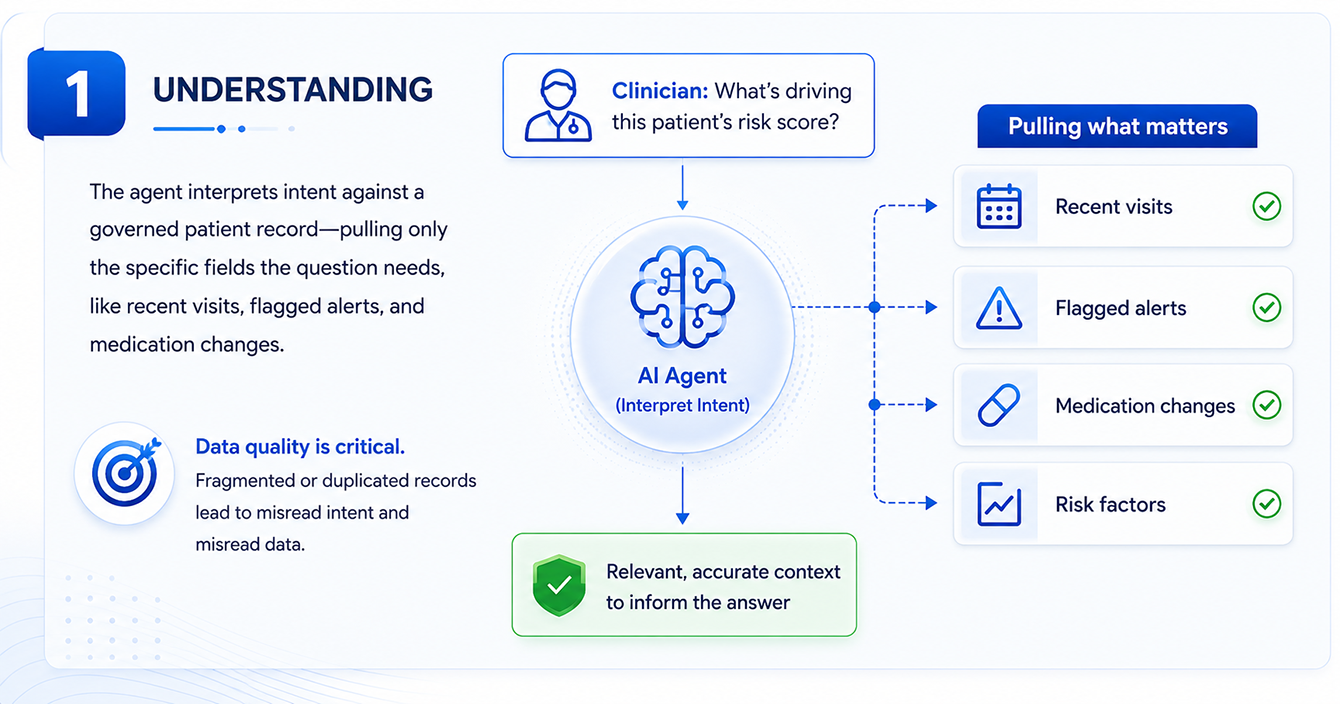
The first layer is understanding. When a clinician asks what’s impacting a patient’s vitals, the agent isn’t matching keywords or walking a decision tree. It’s interpreting intent against a governed patient record, pulling the specific fields the question needs, recent visits, flagged alerts, medication changes, rather than dumping everything based on what is accessible.  

This is also why data quality matters so much. An agent grounded in a fragmented, duplicated record misreads intent almost as often as it misreads the data itself. 

AI agent understanding layer interpreting user intent in a conversational AI system

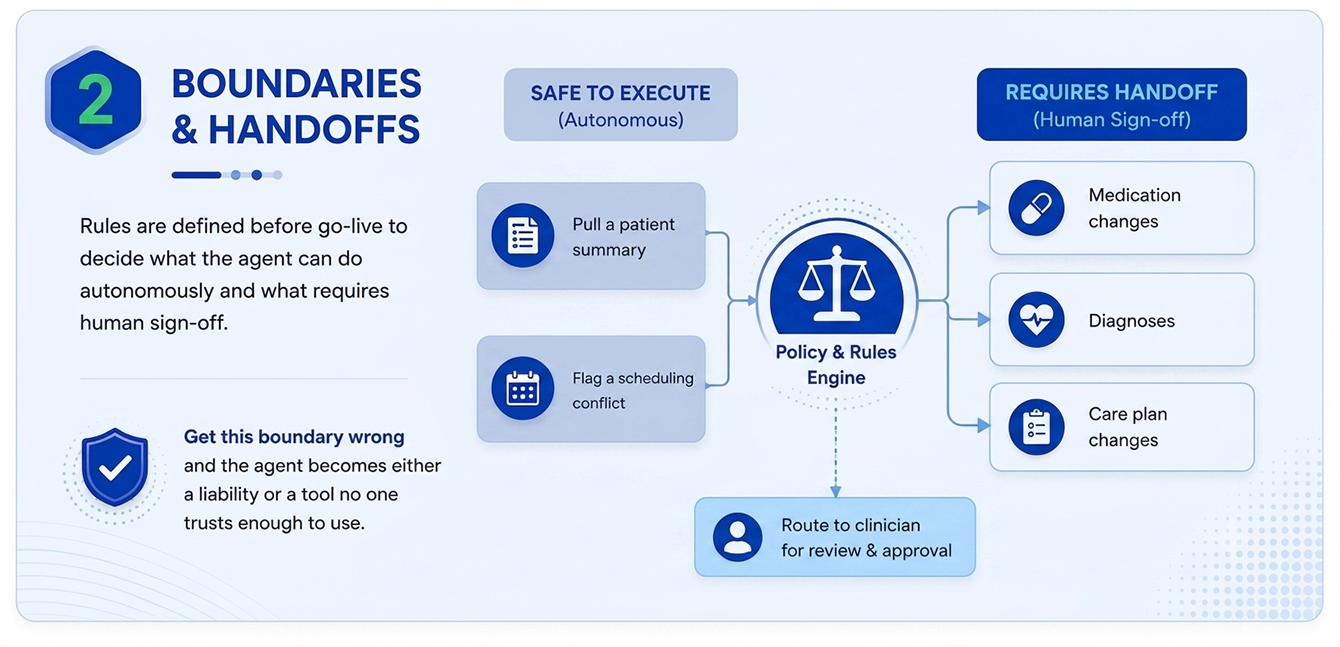
The second layer is the boundary between what the agent can do on its own and what it has to hand off. These rules get defined before the agent ever goes live. Some actions are safe to execute autonomously: pulling a summary or checking on patient record updates. Others always route to a clinician for sign-off: anything touching a medication, a diagnosis, or a care plan change. Get this boundary wrong, either too loose or too conservative, and the agent becomes a liability on one side or a tool that nobody trusts enough to use, on the other. 

Conversational AI agent boundary layer for autonomous actions and human handoffs

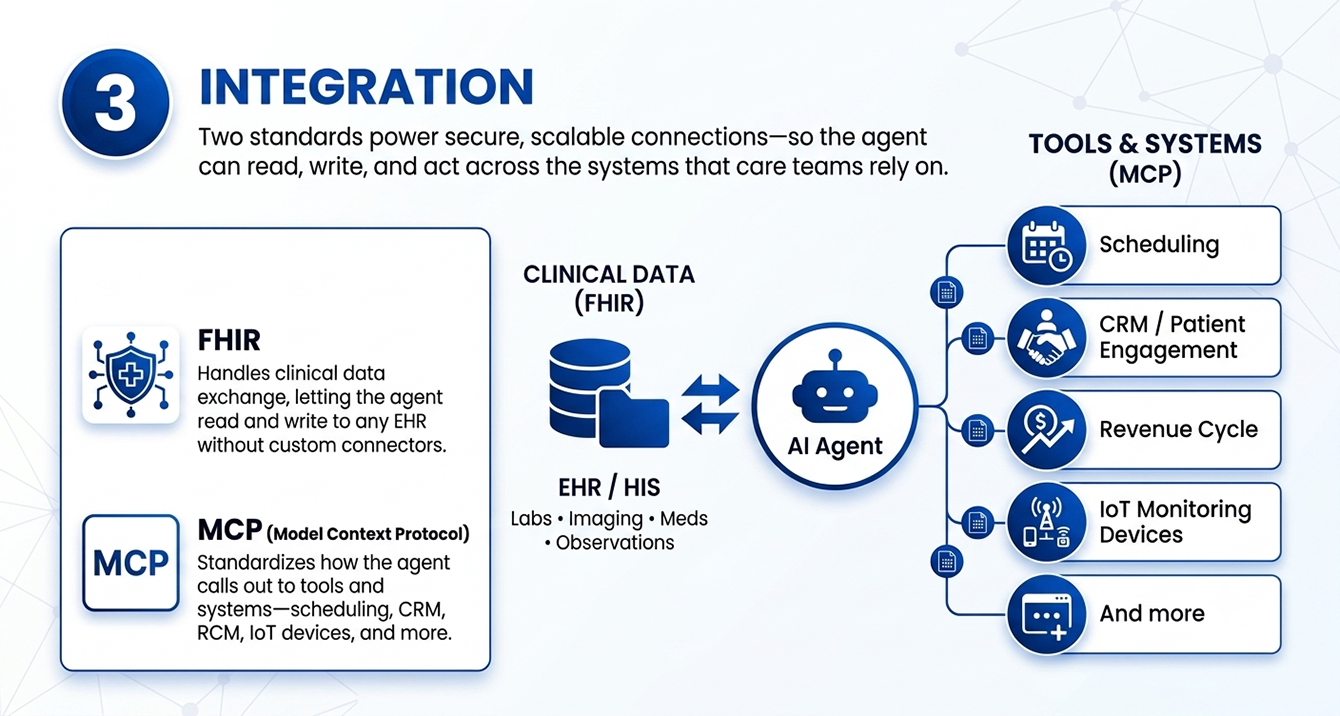
The third layer is integration, and it’s the one most vendors gloss over. Two standards do the real work here. FHIR handles clinical data exchange, letting an agent read and write to an EHR without a custom-built connector for organization’s specific system. The newer piece is MCP, the Model Context Protocol, which standardizes how an AI agent calls out to tools and systems generally: scheduling platforms, CRM, revenue-cycle software, IoT monitoring devices.  

Conversational AI agent integration layer connecting systems, tools, and workflows

Caregence conversational AI agent is built directly on this pattern: an orchestrator-led, multi-agent architecture with several pre-built MCP tool connectors, so adding a new data source becomes a configuration step instead of a months-long integration project. That’s the difference between a pilot that stays a pilot and one that actually scales past a single department.

Why healthcare organizations are adopting Conversational AI agents now 

The math is hard to ignore. One widely cited 2026 market report puts the global conversational AI in healthcare market at $18.8 billion in 2025, growing to roughly $59 billion by 2030, a rate north of 25% a year. Provider organizations are buying because the staffing math ain’t mathing otherwise. 

 The outcomes data is what makes the case to a CFO, not the market-size number. A 2025 systematic review of hybrid chatbot deployments, published in Frontiers in Public Health, found reductions in hospital readmissions of up to 25%, a 30% lift in patient engagement, and consultation wait times cut by 15%.  

 Readmission reduction alone is the number worth sitting with, for CXOs. It’s tied directly to reimbursement penalties, which makes it one of the few AI metrics that shows up on the same spreadsheet a CFO already reads every quarter. 

The real problem is the lack of a common patient identity 

Now conversational AI pitches seem laidback nowadays but some primary points of note before going further on the subject need to be considered.  

A healthcare organization’s clinical documentation, analytics platform, its telehealth monitoring tool, its wound-care software, and its population-health dashboard almost never share one common patient identity.  

 Here is the typical process: 

  1. A care coordinator asking how a patient is doing is really asking five separate systems five separate questions.  
  2. Then it stitches the answer together manually.  
  3. An agent layered on top of that mess doesn’t fix any of it. It just answers faster and sounds more confident, and a fluent wrong answer does more damage than a slow one ever could. 

 When a core piece of data, a patient, a customer, a claim, gets defined differently across systems, no agent built on top of it can be trusted. That holds no matter how good the underlying model is. The agent is only as trustworthy as the identity layer and the governed data sitting beneath it: the same golden record and clean BI foundation that must exist before any of this works. 

Where the value shows up 

Patient-facing agents, the healthcare virtual assistant layer most patients actually see, run the digital front door: scheduling, insurance verification, and prescription refill requests, handled in one conversation instead of a phone tree. A patient asks when their next appointment is and gets a direct answer, not a menu of numbers to press. 

Clinician-facing agents, often named as AI medical scribes, listen to a visit and draft the note. Physicians want their evenings back. Ambient documentation is the fastest path there, modest-savings caveat included. 

Care coordination agents are the newest lane, and the one closest to the fragmentation problem above. Instead of checking a documentation system, a management tool, and a monitoring platform one at a time, a coordinator asks a single question and gets a summary grounded in all three. The source of every fact stays attached, so nobody must take the answer on faith.  

A question that used to mean five browser tabs and a phone call to a colleague now takes one sentence and a few seconds. 

See-what-one-conversational-layer-over-your-existing-data-actually-looks-like

Who should own this in your organization? 

The CFO wants provable call deflection and a real staffing offset. The CIO wants one orchestration layer instead of another integration project. The CMIO needs an answer grounded in the actual chart, because a fluent guess is worse than no answer at all. The CISO wants a full audit trail on anything that touches PHI, no exceptions. The interface changed from a dashboard to a conversation. The underlying demands got sharper now. 

Every agent that touches a clinical decision needs a human in the loop before it acts, not after. That means HIPAA-grade handling by design, a full audit trail, and a clear override path for anything a clinician needs to correct in real time. Once you skip that step, then even the fastest conversational agent on the market would turn into a liability the first time it’s confidently wrong about a medication. 

Where healthcare firms consistently get this wrong 

Across deployments, the same handful of mistakes show up again, regardless of size or which vendor is involved. 

Buying the interface before the foundation 

A polished chat window is the easy part. Teams get excited about the demo, sign the contract, and only discover mid-implementation that the patient record underneath it is fragmented across five systems with no shared identity. The agent launches anyway, and it’s confidently wrong from day one. 

Leaving the human-in-the-loop boundary undefined until something breaks 

Nobody sits down before launch and writes out exactly which actions the agent can take on its own versus which always need a clinician’s sign-off. That conversation tends to happen reactively, right after the first bad answer, which is the most expensive time to have it. 

Measuring success in numbers that don’t mean anything to a CFO.  

Conversations handled and queries answered are activity metrics, not outcomes. They look good in a vendor’s quarterly business review and mean nothing in a budget meeting. The deployments that survive past year one measure call deflection, readmission rate, or documentation hours, numbers that already live on someone’s spreadsheet. 

Rolling out to the whole organization at once.  

Enthusiasm after a good pilot is real, and it’s also how a working solution turns into an unmanageable one. Every department has different questions, different systems, and different risk tolerance. Scaling everywhere at once multiplies every unresolved problem from the pilot instead of fixing it first. 

These are majorly sequencing failures and every one of them is avoidable with the roadmap below. 

A practical roadmap for Conversational AI rollouts 

Most conversational AI agents for businesses fail for the same reason enterprise AI projects fail everywhere else: teams buy the interface before they’ve built the foundation underneath it. A workable sequence for healthcare rollout looks like this: 

  1. Unify the data first. Establish one governed definition of “patient” across every system that touches care. An agent can’t reason well from a fragmented record, no matter how good the language model behind it is.
  2. Pick one high-impact use case, not an enterprise rollout. Find the single question your care teams ask most often and the workflow where the current process visibly wastes the most time. Prove the value there before expanding.
  3. Design human-in-the-loop from day one. Decide up front which actions an agent can take on its own and which ones always route to a clinician for sign-off. Retrofitting oversight after a bad answer ships is the wrong order.
  4. Measure the win in numbers a CFO already tracks. Call deflection, readmission rate, documentation hours, time-to-answer. Skip vanity metrics that don’t map to something already on a budget line.
  5. Expand department by department, using what the first deployment taught you rather than repeating the same assumptions somewhere new. 

Where this leads: Caregence’ conversational AI agent  

This is exactly the direction Caregence’ conversational AI agent for healthcare takes, and it’s aimed squarely at leadership. Any CXO can ask it a plain-language question, which risk drivers are trending across a population, what’s on this week’s visit schedule, whether a medication discrepancy has been flagged, and the answer comes back pulled straight from the EHR, the scheduling system, and the clinical notes sitting underneath it.  

No dashboard to interpret first. Access follows the same care-team assignments already governing the rest of the platform, so a leader never sees data outside what they’re cleared to see, and nobody has to police that separately.  

The agent lives inside a dashboard that pairs a business-KPI view: active patients, high-risk counts, referrals by source, with the full patient and operational picture behind each number, so a metric moving isn’t the end of the question. It’s the start of one a CXO can actually ask.  

And the shape of the answer matches the shape of the question: a summary comes back as a summary, a comparison comes back as a table, a trend comes back as a chart with two lines of context with clarity and precision.

Conclusion 

This article series started with the case for an AI-ready hospital. The next one showed why a golden patient record must exist before any of it works. The one after that turned clean data into dashboards leadership could actually use.  
Conversational AI agents in healthcare are where all three pay off in a form care teams touch every day. A single, plain-language question gets a trustworthy answer, whether that’s a patient checking an appointment, a nurse asking about a risk driver, or a coordinator finding out what to do next. 

Where this goes next matters too. The current generation of healthcare ready AI agents mostly work alone: one bot for scheduling, one scribe for documentation, one risk tool bolted on separately. That’s already starting to change. The more useful pattern is agents that call on each other, a care-coordination agent that pulls in a Next Best Action recommendation mid-conversation instead of sending the coordinator somewhere else to get it.  

That kind of multi-agent orchestration is exactly what standards like MCP were built to support. It’s why Caregence was architected as an orchestration layer from the start instead of a single chatbot with a healthcare skin. The organizations treating conversational AI as a platform decision now are the ones that won’t have to rebuild in two years when a single bot stops being enough. 

What decides whether any of this works in your organization is the same thing it’s been for the entire series: whether the data underneath it is something you’d actually trust a decision to.

Frequently Asked Questions 

AI in Hospice Care: How Agentic AI Is Easing Admissions, Compliance and Documentation

Summary: What Hospice Leaders Need to Know

  • The pressure is real. About 1.72 million Medicare beneficiaries used hospice in 2022, and 49.1% of Medicare decedents were enrolled at death, according to NHPCO Facts and Figures.
  • Compliance got heavier. CMS replaced the Hospice Item Set with the HOPE assessment on October 1, 2025, adding update visits and new data points.
  • AI works best on operations first. Referral intake, eligibility screening, HOPE documentation, IDG prep and billing checks are the highest-return starting points.
  • Clinicians keep the decisions. Agentic AI drafts, flags and routes. People review and sign.
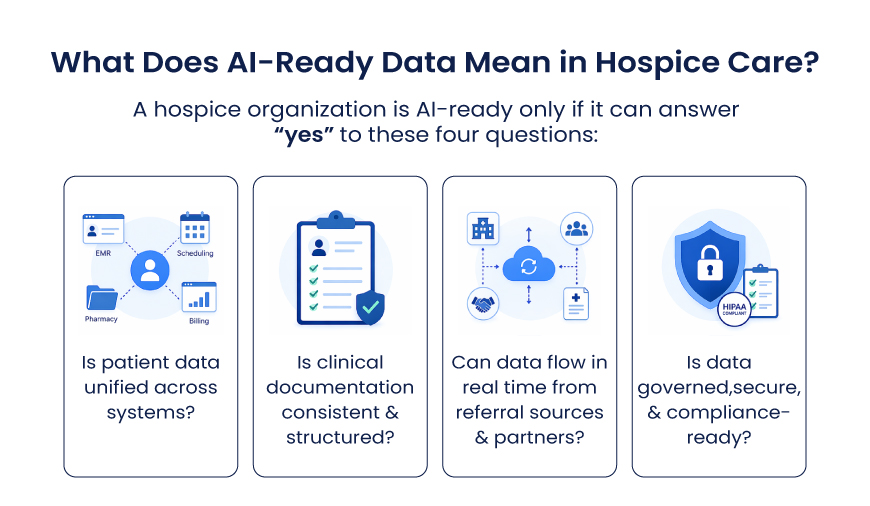
  • Data readiness decides success. Agencies that unify EMR, referral and billing data first see faster results. Our guide on why hospice AI projects fail without data readiness explains why.

Introduction

A referral lands eleven days before a patient dies. The family had been managing symptoms alone for months. Nobody flagged the eligibility signals sooner, because nobody had the hours to look.

That story plays out in hospice agencies every week, and it rarely traces back to clinical skill. It traces back to paperwork, scattered systems and a workforce stretched thin. AI in hospice care is starting to change that, and the agencies moving first are using it on the administrative load, leaving the bedside to people.
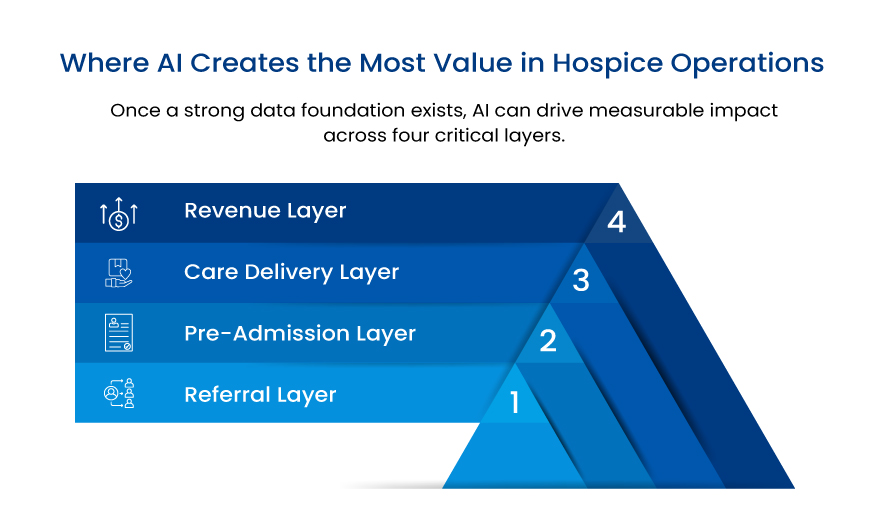
This guide walks through where AI earns its place in hospice and palliative care, which workflows to automate first, how HOPE reporting changes the compliance picture, and what to ask before you buy anything. It closes with answers to the questions families and administrators ask most.

Did you know?

What Is AI in Hospice Care?

AI in hospice care means using machine learning, intelligent automation and data analytics to support the work around end-of-life care. Think intake forms read automatically, eligibility signals surfaced early, visit notes turned into audit-ready drafts, and denials caught before they happen.

It does not diagnose, and it does not decide who receives comfort care. It handles the repetitive tasks that eat clinician hours, so nurses, social workers and chaplains spend those hours with patients and families.

A newer wave, agentic AI, goes a step further. An agent plans and carries out a multi-step task, such as collecting referral documents, checking coverage and scheduling the first visit, and escalates to a person when judgment is needed. Our generative and agentic AI services are built around exactly that model, with human oversight designed in from day one.

Why hospice agencies feel the strain first

Ask a program leader what keeps them up at night and clinical care rarely tops the list. The list looks more like this:

  • Late referrals that shrink a patient’s time on service to a handful of days
  • Eligibility documentation that has to hold up under a targeted-probe audit
  • HOPE assessments that raised the compliance bar in October 2025
  • Interdisciplinary group (IDG) meetings prepared by hand, hours before they start
  • Cap exposure and live-discharge risk tracked in spreadsheets

Every one of these is a data and workflow problem. That makes them solvable.

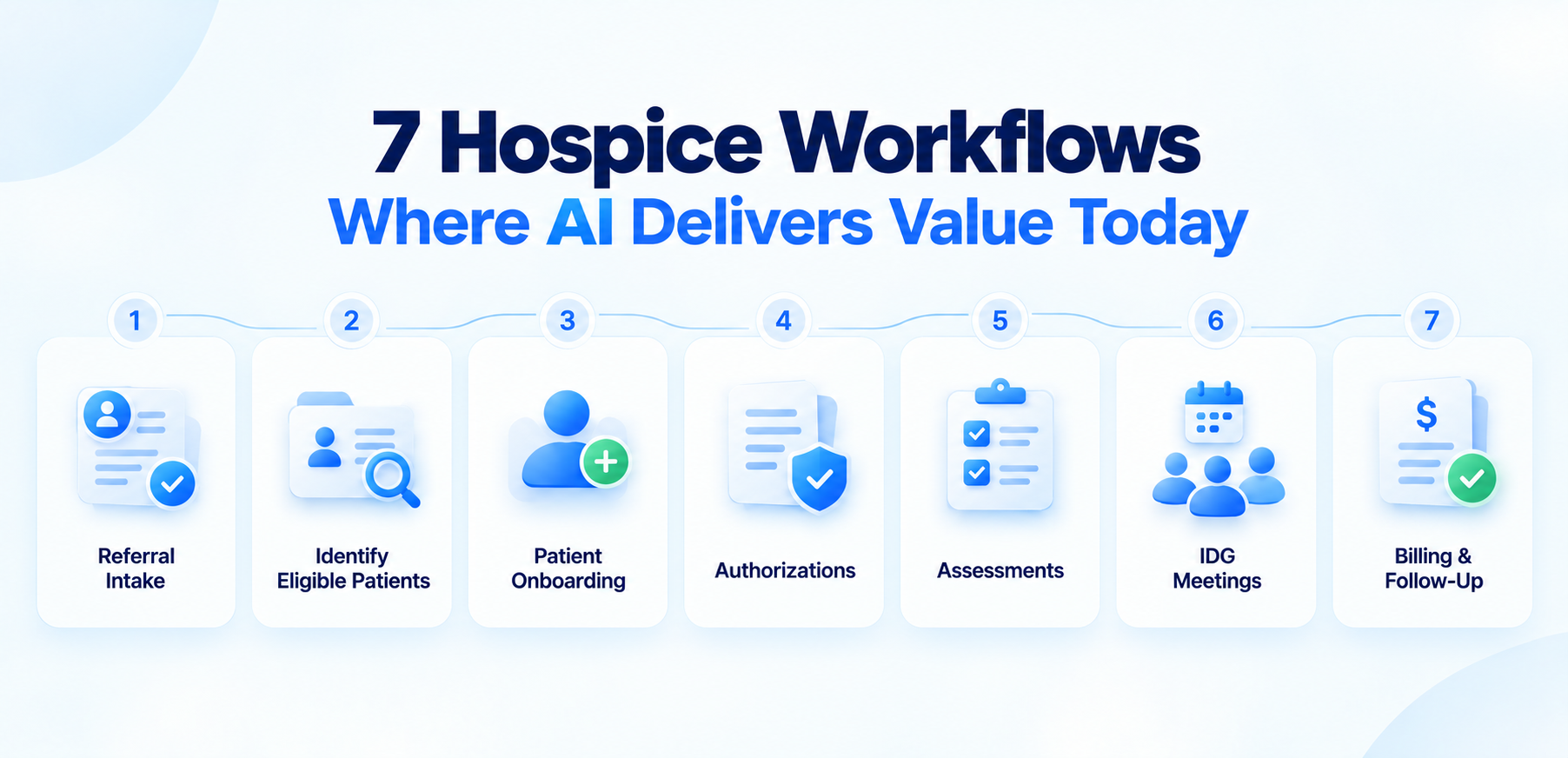
7 Hospice Workflows Where AI Delivers Value Today

7 Hospice Workflows Where AI Delivers Value Today

Start with the workflows that sit closest to revenue and compliance. The order below mirrors how a patient moves through an agency, from first referral to family follow-up.

1. Referral Intake and Eligibility Verification

Referrals still arrive by fax, portal, phone and hospital discharge feeds. Staff re-key details into the EMR, then log in to payer portals to confirm coverage. Hours disappear before a nurse ever visits.

What AI changes

  • Reads referral packets and insurance cards with OCR and machine learning
  • Checks Medicare and Medicare Advantage eligibility automatically
  • Writes verified details back to the EMR and alerts the intake team

Where Caregence fits

The Front Door Agent in Caregence™ Agents automates referral intake, eligibility screening and family outreach, and escalates to a person only when it has to. For a deeper look at the plumbing underneath, read our piece on hospice EMR and referral data integration.

2. Earlier Identification of Hospice-Eligible Patients

Medicare hospice coverage starts when a physician certifies a prognosis of six months or less if the illness runs its normal course. Many eligible patients are identified too late. Predictive models can scan clinical and claims data for hospice-eligible signals around the clock, so the first flag no longer depends on someone noticing.

The Start of Care and Intake Prediction model in Caregence™ Predictive Models flags eligibility complexity and referral urgency so patients enter hospice while there is still time to benefit. It also ties into the wider challenge of referral leakage in post-acute care.

3. Patient Onboarding and Admission

Admission touches scheduling, charting, consents, coding and care-team assignment. Each handoff is a chance for a delay or a data-entry error, and in hospice every day counts.

With AI, the intake team enters diagnoses, demographics and insurance details once. The system then identifies follow-up admission tasks, assigns the right care team by location and acuity, prepares the record and drafts initial notes for clinician review. Inferenz has written about the same pattern in AI-powered patient onboarding, and the Matching and Scheduling Agent applies it to interdisciplinary team assignment.

4. Authorizations and Election Documentation

Notices of election, level-of-care changes and related authorizations all depend on clean clinical and eligibility data. An Authorization Agent retrieves that data, completes the paperwork and tracks status end to end, so nothing sits in a queue unnoticed.

5. HOPE Assessment and Clinical Documentation

HOPE replaced the Hospice Item Set on October 1, 2025. CMS built it to capture patient and family needs in real time and at additional timepoints, and it introduced HOPE Update Visits during the first 30 days after election. Records now flow through iQIES. The full specifications sit on the CMS HOPE technical information page.

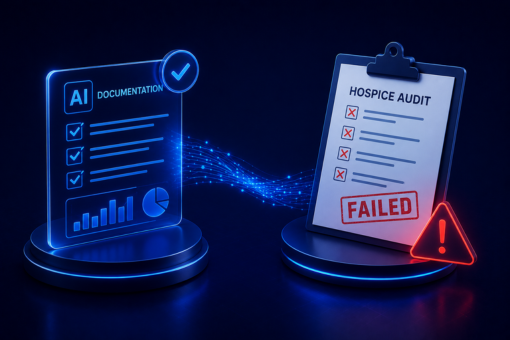
More timepoints mean more documentation, and documentation that looks complete can still fail review. We unpacked that risk in when AI documentation looks perfect and still fails a hospice audit.

What AI changes

  • Drafts HOPE documentation from visit notes for the nurse to confirm
  • Flags coding variance and documentation gaps before submission
  • Keeps every suggestion explainable and traceable for surveyors

6. IDG Meeting Preparation

The IDG meeting is a Conditions of Participation requirement, and preparing a defensible one takes hours. An Operational Summarization Agent turns visit notes, prior IDG discussions and family communications into a structured pre-meeting summary, then flags gaps. Prep time drops, and the meeting itself gets sharper.

7. Billing, Cap Management and Family Follow-Up

On the revenue side, a Billing and Claims Agent submits claims, tracks cap-related exposure and flags denials early. Predictive models forecast cap and reimbursement risk tied to level-of-care changes, so revenue-threatening shifts surface before they hit the books.

After a patient dies, the work continues. Bereavement outreach and family follow-up can be timed and triggered automatically through digital patient engagement, so no family slips through a gap during the hardest weeks of their lives.

See AI Built for Hospice Workflows

Manual vs AI-Driven Hospice Operations

Hospice processManual approachAI-driven approach
Referral intakeFax, re-keying, phone follow-upsAutomated extraction, routing and family outreach
Eligibility checksMultiple portal logins per patientAutomated verification written back to the EMR
Admission and team assignmentManual coordination across departmentsTask orchestration and acuity-based matching
HOPE documentationRetrospective chart reviewDrafted from visit notes, gaps flagged early
IDG preparationHours of live chart reviewAuto-generated summaries and gap alerts
Billing and cap trackingSpreadsheets and denial reworkPredictive exposure alerts and proactive claim checks

Benefits of AI in Hospice and In-Home Hospice Care

For patients and families

  • Faster access to hospice services, at home or in a facility
  • Symptom concerns reach the care team sooner
  • More consistent support, including bereavement follow-up

For hospice care teams

  • Less documentation and re-keying
  • Sharper IDG meetings with less prep
  • More hours for direct patient and family time

For hospice organizations

  • Fewer claim errors and avoidable denials
  • Earlier warning on cap exposure and audit risk
  • Room to grow census without adding administrative headcount

Across healthcare deployments, Inferenz reports 45% less administrative load, 5x faster onboarding and 30% better caregiver allocation on Caregence™. Results vary by organization and starting data quality.

The Future of AI in Hospice and End-of-Life Care

Automation is the opening chapter. Over the next few years, expect four shifts.

Predictive care planning

Models that read symptom progression and visit patterns will help teams anticipate pain escalation and level-of-care changes days earlier. Our take on predicting readmission risk before it happens shows the same closed-loop thinking in action.

Agentic workflows with human oversight

Agents will run onboarding, authorization and follow-up sequences end to end. Clinicians stay in control of every clinical decision, and every agent action leaves an audit trail.

Outcome-based measurement

Agencies will judge AI by admission speed, comfort outcomes and clinician time reclaimed. Adoption for its own sake loses appeal.

Governed, human-centered design

Transparency, consent and alignment with patient values will decide which tools earn trust. See how we approach this in building trusted agentic AI beyond HIPAA compliance.

How to Start: A Practical Path for Hospice Agencies

Step 1: Fix the data foundation

AI can only work with what it can see. Agencies running separate EMR, pharmacy, referral and billing systems need a unified layer first. Our data engineering and integration services and MPI and Patient 360 solution connect those sources without forcing a migration.

Step 2: Pick one high-friction workflow

Referral intake or HOPE documentation makes a strong pilot. Both are measurable, and both touch revenue and compliance. A 90-day pilot beats a twelve-month roadmap nobody finishes.

Step 3: Build governance in from day one

Role-based access, encryption and audit trails are baseline requirements for PHI. Review our data quality, governance and compliance services and the guide to PII and PHI protection in healthcare before any agent touches patient data.

Step 4: Measure and expand

Track days from referral to admission, HOPE completion rates, IDG prep time and denial rates. Once the first workflow proves out, extend to the next. Our AI strategy team can help sequence the roadmap.

Our Perspective: Where Caregence™ Fits

Caregence™ is Inferenz’s healthcare-native agentic AI platform. It connects to the EMR, hospice pharmacy, referral network and analytics tools an agency already runs, and turns them into one data layer. On top of that layer sit ready-to-use agents, predictive models and a no-code workflow builder that clinical and compliance leaders can adjust without waiting on a developer.

  • Works with your stack: integrates with platforms such as HCHB, WellSky and MatrixCare, with no forced migration
  • Governed by design: HIPAA-aligned pipelines, explainable outputs and full traceability
  • Purpose-built: designed around hospice and palliative workflows, then extended across home health, home care and hospitals

Explore the full set of Caregence™ use cases or browse all healthcare solutions from Inferenz.

Final Thoughts

Hospice teams already give everything they have. The agencies pulling ahead are the ones giving that effort back its time: fewer forms, earlier referrals, cleaner audits, calmer IDG meetings.

If you are weighing where to begin, start with the data, pick one workflow, and keep a clinician in the loop. Then talk to people who have built it. Our team is ready when you are, and you can browse our case studies or contact us to plan a first step.

Let's Connect Hospice to the Moment It Matters Most

Frequently Asked Questions

Record, Foundation, Action: Building the AI-Ready Hospital on the Systems You Already Own

Summary   

Hospitals have a complete electronic health record, but two gaps remain: data scattered across multiple source systems, and work that nothing acts on. This piece lays out a two-layer fix: a governed healthcare data platform and a no-code agentic AI layer, joined by one conversational interface, built on the systems a hospital already owns.

A decade of investment made the electronic health record the undisputed system of record. Whether the platform is Epic, Oracle Health, MEDITECH, or another major EHR, the chart is complete.  

That was the achievement of the last era. It is also its ceiling; for two reasons every CIO, CMIO, and informatics leader feels daily. 

First, the EHR was never the whole picture.  

The record sits alongside laboratory, imaging, pharmacy, revenue cycle, coding, bed management, an ERP, a patient portal, health-information exchange, and a stream of device data – and, across a real health system, post-acute and community systems too. Some are modules of the EHR; many are separate, and true healthcare interoperability across them is rare. None, alone, tells the full story of a patient or a service line, and manual healthcare data integration, stitching records together by hand, is where reliable insight goes to die. 

Second, the EHR records work but rarely does it.  

Between the records sits an enormous layer of human effort: reading a referral and keying it in, chasing a prior authorization, reconciling a document, following up on an order, moving a patient through the building and out to the next setting of care.  

The chart captures the result. But it performs almost none of the labor. 

So, the modern hospital carries two structural gaps: data it cannot see whole, and work nothing acts on. The AI-ready hospital closes both, in order, without touching the EHR it depends on.

Layer One Source Systems Fragmented Across the Enterprise

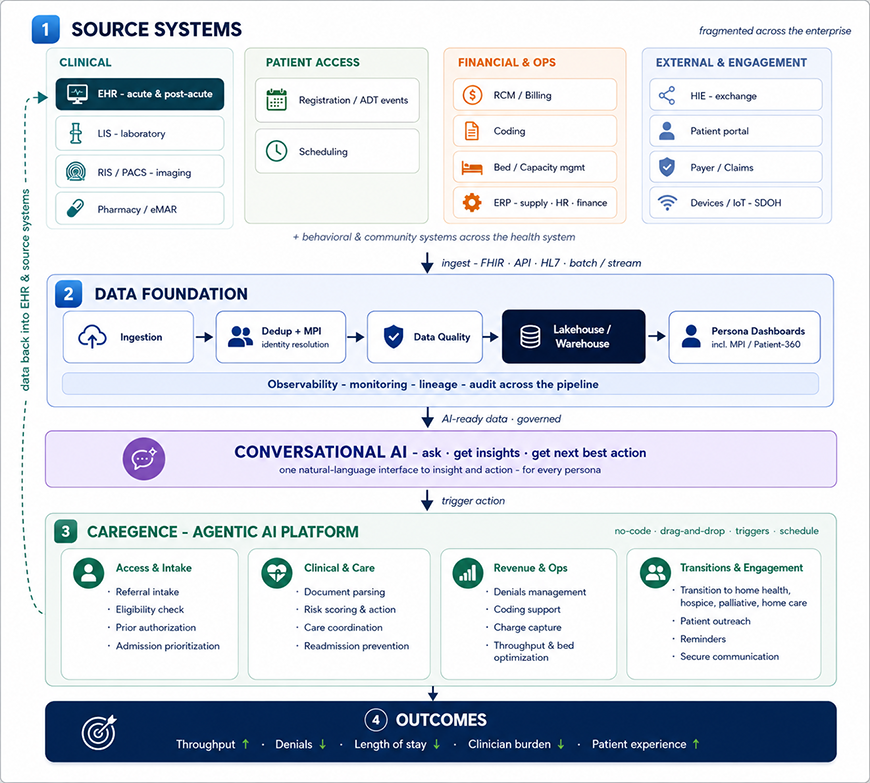
Three layers over the systems you already own, joined by one conversational interface. Data flows up into the foundation; a natural-language assistant turns it into insight and next best actions; the agentic AI layer executes and writes back into the EHR and source systems for continuous EHR data integration, signifying a closed, observable loop. 

Layer one: a healthcare data platform that makes data whole 

Before any AI is trustworthy, the data must be. The foundation ingests from every source: clinical, financial, operational, external, and the post-acute and community systems in the health system. It uses FHIR where it exists, native APIs where it does not, and HL7 where it must.  

It resolves duplicate identities into a single master patient index, the foundation of a true Patient 360 view, enforces data quality and healthcare data governance, and lands everything in a governed lakehouse-warehouse, with observability across the whole pipeline. What leaders see is not raw plumbing but persona-specific dashboards, an operations view for the CIO, a clinical view for the CMIO, a service-line view for the leader who owns the P&L, including a unified Master Patient Index / Patient-360 view that finally shows one patient as one record. 

The way in with conversational AI 

Dashboards answer the questions you already know to ask. A hospital needs more than that. So, the foundation and the agentic layer share one conversational AI interface built for healthcare teams: ask a question in plain language, get an insight drawn from your own data, and get the next best action – which the platform can then carry out. A service-line leader can ask why to length-of-stay drifted last month; a case manager can ask which discharges are highest-risk today and set the follow-up in motion. One way in, for every persona. 

Layer two: agentic AI that acts 

On that foundation, a no-code orchestration platform for agentic AI in healthcare turns the record into action across the care continuum and the back office alike: automating access and intake – including prior authorization automation, supporting clinical work and care coordination, tightening revenue and operations with denials management software and coding support, and engaging patients directly. Workflows are built by drag-and-drop, run on schedules or event triggers, and every action is logged, observable, and written back into the EHR and source systems, so the system of record stays current while the work finally gets done. 

The step most hospitals still do manually; the transition out 

One use case deserves singling out, because it sits at the boundary of the hospital’s control and its accountability: the transition of care at discharge. Referrals to home health, hospice, palliative care, and home care are still largely faxed, keyed, and sent into the dark, even as readmissions and value-based contracts make what happens next the hospital’s problem. Automating that hand-off, and monitoring risk after it closes the seam between the hospital and the next setting of care. 

Keep your EHR. Add the three things it was never built to be: whole, conversational, and active.

Why AI stalls without these layers 

  • Fragmented data, unreliable AI. Models built on scattered, duplicated, uneven data cannot be trusted, and leaders know it, so nothing ships. 
  • A high safety bar, rightly. HIPAA, clinical risk, and audit obligations make automation without governance and observability a non-starter. 

Every layer here is additive. None disrupts the EHR. That is what makes the path realistic for a live health system rather than a slide. 

Contact us

Where Inferenz stands 

We are a healthcare-native Data & AI company driving healthcare workflow automation, building these layers is what we do. Three things let us do it quickly and safely: 

  • Proven delivery for healthcare. We design, build, and run production data platforms and AI for healthcare organizations unifying dozens of source systems into a single source of truth, master data and patient indexing, predictive risk models, conversational AI assistants, and agentic workflows. 
  • Partnerships that de-risk the platform. Deep partnerships and alliances with Databricks, Snowflake, Azure, and AWS mean the foundation runs on the cloud and data platforms your teams already trust – no exotic stack to maintain, and a clear path to scale. 
  • Accelerators and frameworks that compress time-to-value. A library of 30+ production accelerators: ingestion, deduplication, data quality, observability; a lakehouse-warehouse blueprint; a Master Patient Index; and pre-built Caregence tools, turns months of build into weeks of configuration. 

Caregence brings it together in one no-code, MCP-based agentic platform. Pre-built healthcare AI agents span access, clinical care, revenue cycle management, operations, care transitions, and engagement.  

Connectors reach FHIR-native EHRs across acute and post-acute settings, plus API-based and custom integrations for systems without full FHIR and healthcare interoperability solutions for every environment. Secure communication; a conversational assistant; and full observability round it out, HIPAA-compliant by design.  

The result: the AI-ready hospital is not a research project. It is an engagement with a partner who has built the hard parts before. 

See how the department-by-department rollout plan looks for a hospital CIO piloting this today. 

Contact our Healthcare AI Expert

Frequently Asked Questions 

When AI Documentation Looks Perfect and Still Fails a Hospice Audit

Summary  

Most AI clinical documentation tools produce hospice notes that read well and fail audits. Generic AI was never built to reason through jurisdiction-specific Local Coverage Determinations or the clinical-regulatory logic Medicare Administrative Contractors actually use.  

This article breaks down why that gap exists and what compliance-first documentation actually needs. 

documentation-still-open

Introduction 

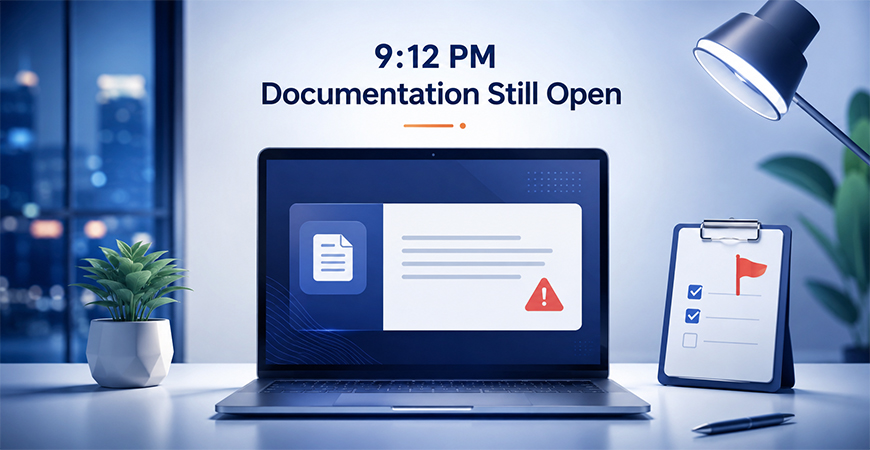
A hospice nurse wraps up a home visit at 9pm. She is exhausted, the family is anxious, and she still has to finish tonight’s note before tomorrow’s IDT meeting. She opens the AI-generated draft. Clean sentences, professional tone, not a typo in sight. She signs off and moves on. 

Six months later, that exact note comes back flagged in a Targeted Probe and Educate (TPE) audit. 

The prose was fine. The compliance case was not there. 

The note never established, in language a Medicare Administrative Contractor (MAC) could point to, why this specific patient is expected to have six months or less to live. That is not a formatting problem. That is a fundamental misunderstanding of what AI clinical documentation for hospice requires to be defensible. 

This is not an isolated case. It is the pattern. 

Why general AI clinical documentation tools cannot handle hospice compliance 

Why general AI clinical documentation tools cannot handle hospice compliance

Hospice News recently reported that hospice leaders across the country are converging on the same finding: most AI documentation tools were built for home health broadly, not hospice specifically. 

They do not understand: 

  • Local Coverage Determination (LCD) criteria and how they vary by jurisdiction 
  • The clinical logic separating a hospice recertification narrative that is well-written from one that is genuinely audit-ready 
  • The comparative decline language CMS reviewers are trained to look for 
  • What the new HOPE quality-reporting framework expects in terms of person-centred nuance 

One of the hospice CEOs summarized it directly: general AI models can produce narratives that are clinically polished and still fail an audit, because polish and compliance are not the same thing. 

More than half of hospices nationwide are already managing multiple simultaneous audits. TPE audit rates keep climbing. This is not a hypothetical risk for future planning. It is an operational reality for most hospice organizations today. 

The LCD problem no one is talking about 

Here is what makes AI clinical documentation for hospice harder than it looks on the surface level. 

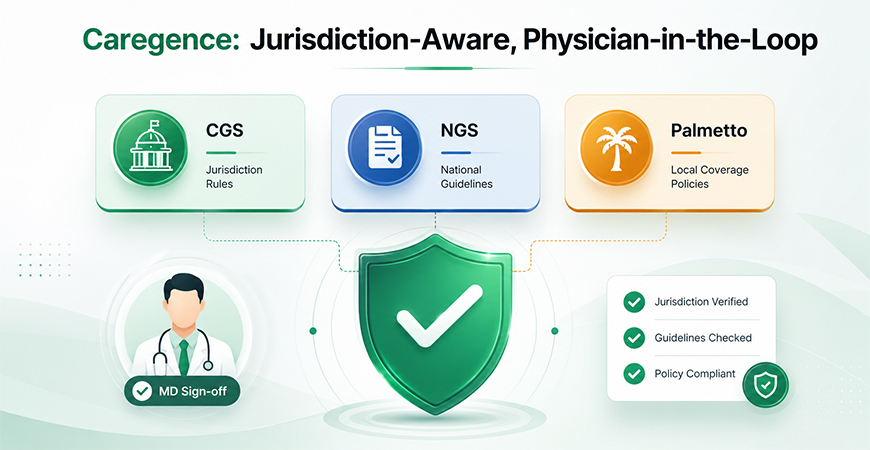
Medicare hospice eligibility is not governed by a single national standard. Despite being a federal benefit, terminal-status criteria are published as jurisdiction-specific LCDs, written separately by three different Medicare Administrative Contractors: 

  • CGS 
  • NGS 
  • Palmetto GBA 

These three MACs use different logic: 

  • CGS and NGS diverge substantively on ALS and renal disease, applying different lab thresholds and different qualifying criteria other than terminology. 
  • Palmetto GBA abandons the itemized-checklist approach entirely for five of its seven disease categories, replacing it with a narrative “structural and functional impairment” standard that carries no numeric thresholds at all 

A generic AI model trained on general clinical notes has no mechanism for knowing which of these three regulatory regimes governs the patient in front of it, let alone applying the right one correctly. 

The result is documentation that may satisfy one MAC’s expectations while failing another’s entirely, with no warning to the clinician who signed off on it.

What compliance-first hospice AI needs? 

The fix for a compliance-first hospice AI is not a larger language model. It is a system built from the regulation outward, not from the sentence inward. 

A documentation tool built for hospice compliance needs to do four things that most general AI tools currently do not: 

  • Resolve jurisdiction before screening begins. The system must identify the patient’s state, MAC assignment, and governing LCD before it touches a single eligibility criterion. 
  • Walk through disease-specific pathways item by item. Required criteria and supporting criteria must be kept distinct and evaluated separately, not summarized into a generic “probably eligible” assessment. 
  • Distinguish between a criterion that is not met and one that is simply not yet documented. Real gaps need to surface for clinical follow-up. They should never be quietly absorbed into a narrative that reads as complete when it is not. 
  • Know its role in the clinical workflow. The tool screens eligibility. It does not diagnose. The physician certifies. That boundary is not optional, and it cannot be designed around. 

These are not feature requests. They are the minimum viable architecture for AI clinical documentation in hospice that can withstand a TPE audit or a Comprehensive Error Rate Testing (CERT) review. 

Is-your-AI-clinical-documentation-built-for-a-hospice-audit-or-just-pretending

How Caregence approaches AI Clinical Documentation for hospice 

 The Caregence clinical documentation AI engine was designed around the compliance logic described above. It is not a general documentation tool adapted for hospice. It is built from the regulatory structure outward. 

How Caregence approaches AI Clinical Documentation for hospice 

Here is how it works in practice: 

  • Jurisdiction resolution first. Before screening begins, Caregence identifies the patient’s state, MAC assignment, and the specific LCD that governs their diagnosis. An ALS or renal patient in an NGS jurisdiction is measured against NGS thresholds, not CGS’s or Palmetto’s. 
  • Disease-specific pathway screening. The system works through each diagnosis pathway the way a compliance-minded clinician would: required criteria evaluated separately from supporting criteria, documentation gaps flagged explicitly rather than inferred around. 
  • Certification-ready narrative output. A completed screen translates directly into narrative language built around the “paint a picture with evidence” standard that CMS reviewers and MACs are trained to apply. The documentation is defensible, not just readable. 
  • Physician certification remains the physician’s call. The system supports the clinical and compliance case. It does not make the determination. That boundary is architectural, not a disclaimer. 

If your current AI clinical documentation tool can produce a well-structured note but cannot tell you which LCD it screened against, it is not a compliance tool. It is a drafting tool. In a benefit this audit-heavy, that distinction carries real financial and regulatory risk.

What this means for hospice organizations right now 

The hospice sector is operating in an environment where audit pressure is structural, not cyclical. 

TPE rates are climbing. The HOPE framework is adding new quality-reporting requirements. Payers are scrutinizing hospice recertification narratives more carefully than at any prior point. And the cost of a failed audit is not just the recoupment. It is the retrospective review that follows, the staff hours consumed by response documentation, and the referral relationships that erode when a provider’s compliance record comes into question. 

The organizations that will navigate this environment most effectively are not the ones with the most advanced general AI tools. They are the ones whose AI understands: 

  • Which MAC governs each patient 
  • Which hospice LCD applies to each diagnosis 
  • What the difference is between a well-written note and an audit-ready one 
  • Where the documentation gaps are before the auditor finds them 

That is bar you need to set for AI implementations.

Hospice-Audits-Are-Not-Slowing-Down.-Your-Documentation-Needs-to-Be-Ready

Frequently Asked Questions 

Beyond HIPAA Compliance: Building Trusted Agentic AI for Modern Healthcare with Caregence

Summary

Caregence is a HIPAA compliant healthcare native agentic AI platform from built by Inferenz that treats HIPAA compliant AI as an architectural principle, not a final checklist. Every AI agent operates on minimum-necessary access, every action is logged, and the infrastructure is isolated and governed by design, so healthcare organizations can adopt agentic AI healthcare workflows without trading away patient privacy or security. 

Introduction 

Healthcare is entering a new era where artificial intelligence goes beyond answering questions and generating summaries. Modern AI systems can reason, coordinate workflows, retrieve information from multiple systems, and execute tasks autonomously. As a result, this new paradigm, agentic AI, has the potential to transform healthcare operations by freeing providers to focus on patient care while intelligent agents handle repetitive administrative and clinical work.

 Yet this transformation raises an important question: how do healthcare organizations embrace autonomous AI without compromising patient privacy, regulatory compliance, or security? 

The Caregence platform, by Inferenz, revolves around trust. Innovation alone is not enough in healthcare. Every AI interaction must be built on a foundation of security, accountability, and responsible data governance. HIPAA compliance is woven into the architecture of our agentic AI platform from the very beginning. 

Why security must evolve alongside AI 

 Healthcare organizations manage some of the world’s most sensitive information. Medical histories, diagnostic reports, insurance details, prescriptions, and laboratory results aren’t just data points they represent deeply personal aspects of an individual’s life. 

 Traditional software applications typically process information in predictable ways. Agentic AI introduces dynamic decision-making instead. Within a healthcare workflow automation environment, AI agents: 

  • Retrieve data from connected systems EHR/EMR, payer platforms, claims, CRM, HR/payroll, and RCM 
  • Reason across multiple sources to determine the right next step in a workflow 
  • Interact with healthcare systems to complete tasks like intake, authorization, or documentation 
  • Collaborate with other agents, coordinated through an orchestration layer, to complete complex, multi-step workflows 

 This expanded capability raises the bar for governance. Healthcare providers need assurance that AI agents access only the information necessary for a specific task, that every interaction is recorded, and that patient information stays protected throughout the process. Security, therefore, must evolve alongside intelligence. 

HIPAA as an architectural principle 

 Many organizations treat HIPAA as a compliance checklist completed near the end of software development. Caregence takes a different approach. 

 HIPAA principles influence architectural decisions from day one. Our approach begins with secure design principles, ensuring every feature – from the core platform to individual pre-built agents – is built with privacy, governance, and regulatory requirements in mind from the outset. That philosophy embeds security into every layer of the platform: infrastructure, application design, AI orchestration, and operational monitoring. 

Designing agentic AI with privacy in mind 

 An autonomous healthcare agent should never have unrestricted access to patient information simply because it ‘can’ perform a task. Each AI agent operates with carefully defined responsibilities instead. 

 Consider an AI agent assisting a clinician with discharge documentation. It doesn’t require unrestricted access to every record in the Electronic Health Record (EHR). It retrieves only the information relevant to that patient’s discharge, processes it within a secure environment, records its activity for auditing, and completes the workflow without retaining unnecessary data. 

 This principle of minimum necessary access sits at the center of responsible healthcare AI, and it aligns directly with HIPAA’s privacy expectations. 

How Caregence protects healthcare data 

 Protecting healthcare information takes more than encryption or authentication alone – it takes multiple layers of defense working together across the entire AI lifecycle. Within Caregence, sensitive healthcare information is protected through a security-first architecture built around confidentiality, integrity, and availability. 

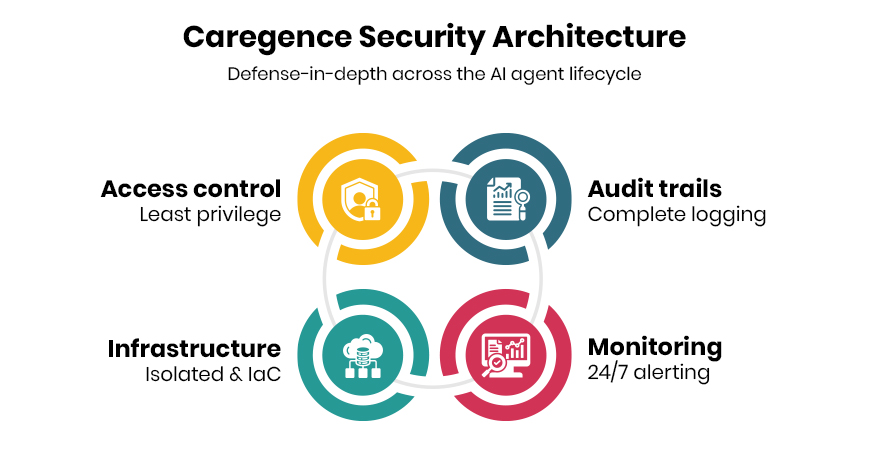
Caregence security architecture

The platform’s four protective layers, at a glance: 

  • Secure identity and controlled access: every request from an AI agent or authorized user is validated before access is granted. Role-based permissions ensure clinicians, administrators, and support staff interact only with the information their role requires, using secure identity management rather than shared credentials. 
  • Secure infrastructure by design: Caregence operates within enterprise cloud environments using isolated networking, secure storage, managed databases, secret management, and Infrastructure as Code (IaC), minimizing public exposure and enforcing controlled communication between services. 
  • Comprehensive audit trails: every meaningful interaction is traceable. Authentication events, AI agent activity, administrative actions, and system operations are all logged to support monitoring, incident investigation, and compliance reporting. 
  • Continuous monitoring: observability practices give visibility into application health, infrastructure performance, and AI workload behavior, with automated alerting so technical teams can respond before an issue touches a clinical workflow. 

 Trust cannot exist without transparency, and uptime alone isn’t the goal, the goal is patient services that stay reliable and secure.

Explore Caregence Platform

Responsible AI beyond compliance 

 Regulatory compliance sets the minimum standard. Responsible AI demands more. 

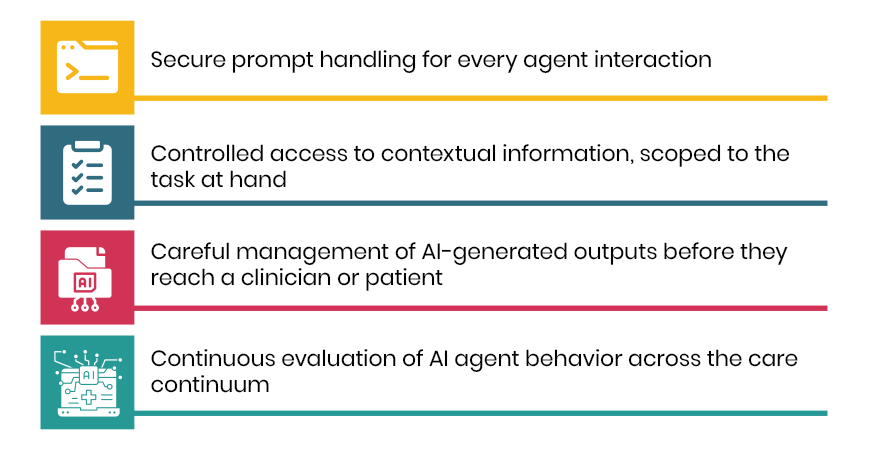
 At Caregence, we believe healthcare AI should be transparent, accountable, and explainable wherever possible. Our platform supports AI governance healthcare practices that include: 

Responsible AI beyond compliance

These practices help healthcare organizations deploy AI confidently while keeping oversight of every automated decision. 

Enabling healthcare innovation without increasing risk 

 Healthcare organizations often face a difficult choice between adopting innovative technologies and maintaining strict regulatory compliance. Agentic AI changes that conversation. 

 When security and governance are embedded into the platform itself, organizations can accelerate digital transformation without adding operational risk. Administrative workflows become more efficient, clinicians spend less time on repetitive documentation, and healthcare teams gain intelligent assistance while maintaining confidence that patient information stays protected. 

 Innovation and compliance no longer compete. They reinforce each other. 

The Caregence Vision 

 The future of healthcare will be defined not simply by smarter AI, but by trustworthy AI. As autonomous systems grow more capable, patients and providers will expect healthcare AI platforms to demonstrate accountability, transparency, and security by design. 

 At Caregence, our mission is to build agentic AI that healthcare organizations can trust. Every architectural decision reflects our commitment to protecting sensitive healthcare information while empowering providers to deliver faster, more efficient, and more personalized care. 

 HIPAA compliance is an important milestone, but our vision extends beyond meeting regulatory requirements. We strive to build an AI platform where security enables innovation, governance strengthens automation, and trust becomes the foundation for every intelligent healthcare interaction. 

 Because in healthcare, the most valuable outcome isn’t just smarter technology, it’s the confidence that every patient interaction is handled with the care, privacy, and responsibility it deserves. 

Ready-to-deploy-Agentic-AI-your-compliance-team-will-actually-approve

Frequently Asked Questions 

The Intelligent Care Partner: A Strategic Framework for Agentic AI in Home Care Operations

Summary 

Agentic AI is no longer a future consideration for home care. It is an operational necessity. This framework covers the highest-impact use cases, governance requirements, and deployment principles that separate AI initiatives that deliver from ones that stall.

Introduction 

Home care is entering a period of structural pressure. Aging populations, workforce shortages, rising cost of care delivery, payer complexity, and documentation overload are all converging at once. At the same time, expectations from hospitals, families, and payers continue to rise. 

This is not a short-term cycle. It is a permanent shift in how care must be delivered, measured, and proven. 

Artificial Intelligence is now moving from automation support to operational backbone. The focus is shifting from isolated AI tools to a comprehensive HIPAA-Compliant Agentic AI Platform for Healthcare that integrates and coordinates workflows, removes friction, and supports real-time decision making across the care continuum. 

As one home care executive recently noted:
“The future of care delivery depends on how well we can scale limited human resources without reducing care quality.” 

For home care leaders, the question is no longer if AI should be adopted. The real question is how to deploy it safely, measurably, and in ways that strengthen care delivery outcomes.

The Strategic Shift: From Task Automation to Care Operations Intelligence 

Home care success now depends on how efficiently organizations can convert referrals into care delivery, manage staff capacity, and demonstrate measurable performance to payers and partners. 

Agentic AI supports this shift by acting as an operational co-pilot, not a replacement for clinical teams. 

The core philosophy is simple:

The Strategic Shift: From Task Automation to Care Operations Intelligence

This is especially important as workforce shortages become structural. 

AI is not replacing human care. It is protecting it. 

High-Impact Agentic AI Use Cases in Home Care 

Home care presents some of the most operationally complex and high-stakes opportunities for agentic AI. The following AI Use Case in Healthcare represent where the impact is clearest and the ROI most measurable. 

Documentation Intelligence and Clinical Time Recovery 

Documentation remains one of the biggest drivers of caregiver fatigue and operational delay. 

Agentic AI can: 

  • Capture visit conversations through ambient listening 
  • Auto-generate structured visit notes 
  • Support coding and compliance checks 
  • Flag missing documentation in real time 

The result is simple but powerful:
More time with patients. Less time finishing paperwork after shifts. 

As one care leader summarized:
“Technology should remove friction, not add another system to manage.” 

Intake, Referral, and Start-of-Care Acceleration 

Start-of-care delays directly impact revenue cycle timing, patient outcomes, and referral relationships. 

Agentic AI can: 

  • Validate insurance eligibility automatically 
  • Initiate prior authorizations 
  • Clean and normalize referral data 
  • Route cases to the right teams instantly 

This reduces: 

  • Manual follow-ups 
  • Lost referrals 
  • Intake backlog risk 

For agencies operating under value-based contracts, faster start-of-care directly improves performance metrics. 

Workforce Optimization and Caregiver Matching 

Workforce strain is no longer episodic. It is structural. 

Agentic AI can support: 

  • Patient-caregiver matching based on skill, location, acuity, and preferences 
  • Smart schedule balancing 
  • Travel optimization 
  • Burnout risk signals based on workload patterns 

This directly impacts: 

  • Staff retention 
  • Care continuity 
  • Visit reliability 
  • Patient satisfaction 

Care Coordination and Medication Safety 

Home care often operates across fragmented systems. 

Agentic AI can unify: 

  • Clinical data 
  • Medication lists 
  • Risk alerts 
  • Care plan updates 

AI-supported medication reconciliation alone can reduce safety risk and save hours of manual reconciliation work weekly.

Governance: Making AI Safe, Trusted, and Clinically Aligned 

AI adoption in home care requires strict governance and clinical control. 

Key principles include: 

Cross-Functional AI Governance 

  • Clinical leadership 
  • Compliance and legal leadership 
  • Technology leadership 
  • Operations leadership 

Human-in-the-Loop Oversight 

AI supports decisions. Clinicians always make final care decisions. 

Data Security and Private AI Environments 

Healthcare AI must operate in protected environments where patient data is never exposed to public model training.

CTA - Is Your AI Deployment Built to Be Trusted?

Partnership Models That Deliver Measurable Outcomes 

The strongest AI partnerships in home care follow shared outcome accountability. 

Best practice includes: 

  • KPI-linked vendor accountability 
  • Measurable operational improvements 
  • Pilot-first validation 
  • Phased deployment 

If a vendor cannot align to measurable outcomes, long-term value risk increases. 

The Next Phase: Predictive and Experience-Led Home Care 

Home care has always been about what happens between visits. The check-ins that didn’t happen. The risk that wasn’t caught. The family that didn’t know what to ask.  

The next phase of intelligent home care is not about doing more. It is about seeing more, earlier, and acting before the moment passes. 

Family Experience Intelligence 

Families don’t read care plans. They read worry into every unanswered question, every missed call, every term they don’t understand. AI changes that equation. 

AI can: 

  • Translate care plans into plain language 
  • Support family education 
  • Provide non-clinical support and reminders 
  • Identify caregiver or family stress signals 

Predictive Risk Intelligence 

By the time a home care patient is hospitalized, the signals were already there. Agentic AI finds them before they become crises. 

Agentic AI can identify: 

  • Hospitalization risk 
  • Fall risk 
  • Care gap patterns 
  • Staffing mismatch signals 

Predictive Modeling in Healthcare shifts home care from reactive response to proactive intervention in care workflows. 

The Inferenz + Agentic AI Model for Home Care 

At Inferenz, the focus is not on deploying AI tools.
It is on building Agentic AI operating layers across home care workflows. 

Through platforms like Caregence, organizations can deploy agents across: 

Agentic AI operating layers across home care workflows

The goal is consistent:
Reduce operational noise so care teams can focus on care delivery. 

Conclusion: The Invisible AI Standard in Home Care 

The highest performing AI in home care should feel invisible. 

When it works well: 

  • Caregivers feel supported 
  • Operations feel smoother 
  • Compliance feels easier 
  • Patients experience consistent care 

Agentic AI should work quietly in the background, coordinating care operations while humans focus on compassion, connection, and clinical excellence.

Case Study - Replacing Manual Portal Entry with RPA Automation for a National Home Care Workforce

FAQs

The Home Health Data Visibility Problem and the AI Agents that you Need

Summary

Home health generates more clinical data per patient than almost any other care setting, yet readmissions that remain preventable, keep happening and caregiver turnover sits at 75%. The problem has never been data shortage but data visibility to see patient data as a whole.

The Master Patient Index & Patient 360 solution from Inferenz fixes this by resolving fragmented patient identities into one governed record, then builds a chronological Patient 360 timeline on top of it.

The Real Problem Is Not Data. It Is the Architecture.

I have sat across from enough home health executives to know that “we don’t have the data” is rarely the actual complaint. What they say, when you press them, is closer to: “We have all this data, and I still can’t tell you which patients are trending toward hospitalization this week.”

That is a data architecture problem, not an absence of some clinical system or tool.

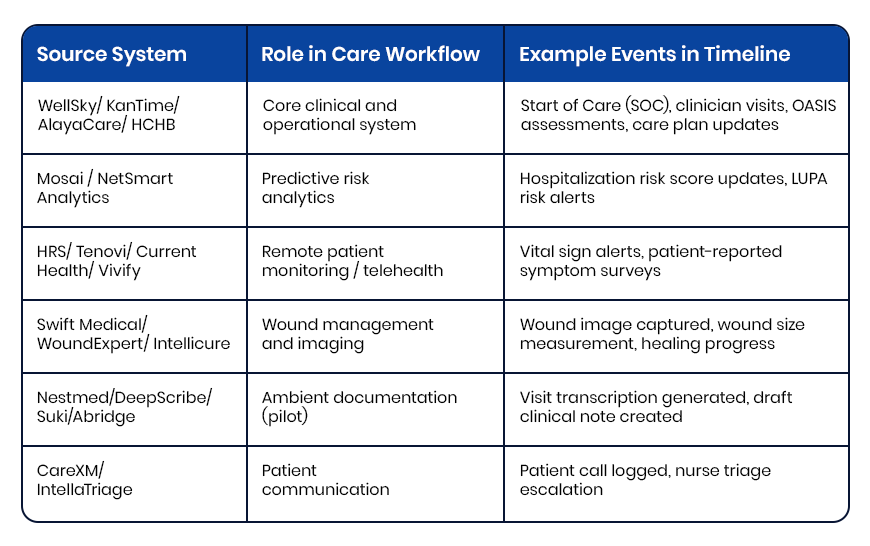
The average home health patient generates events across multiple, separate platforms in a single week.

  • The EMR records visits and OASIS assessments.
  • A remote monitoring platform logs vitals between visits.
  • A predictive analytics tool recalculates hospitalization risk scores.
  • A wound care system captures healing progression with images.
  • An ambient documentation tool transcribes clinical conversations.
  • An after-hours triage platform logs patient calls.

Every platform does its individual job well. Not one of them shows you the others.

The supervising care team managing 20-40 patients has no realistic way to correlate a vital spike on the remote monitoring platform with a risk score jump on the analytics tool and a missed visit in the EMR, because those three events exist in three separate systems, behind three separate logins, reviewed by three different people on three different timelines!

Check out how individual systems perform their individual roles in the care workflow:

how individual systems perform their individual roles in the care workflow

The clinical pattern that would predict the next hospitalization is fully present in the data. It just cannot be read simultaneously.

What Clinical Fragmentation Actually Costs Home Health Agencies

This is where the stakes become concrete.

On patient outcomes

Hospital readmissions remain a major Medicare quality and cost concern, with CMS continuing to tie reimbursement penalties directly to excess 30-day readmission performance. In home health specifically, the deterioration signals that precede those hospitalizations: weight gain trends, rising vital thresholds, declining ADL scores, missed visits, are almost always present in clinical systems days before the ER visit.

On Medicare revenue

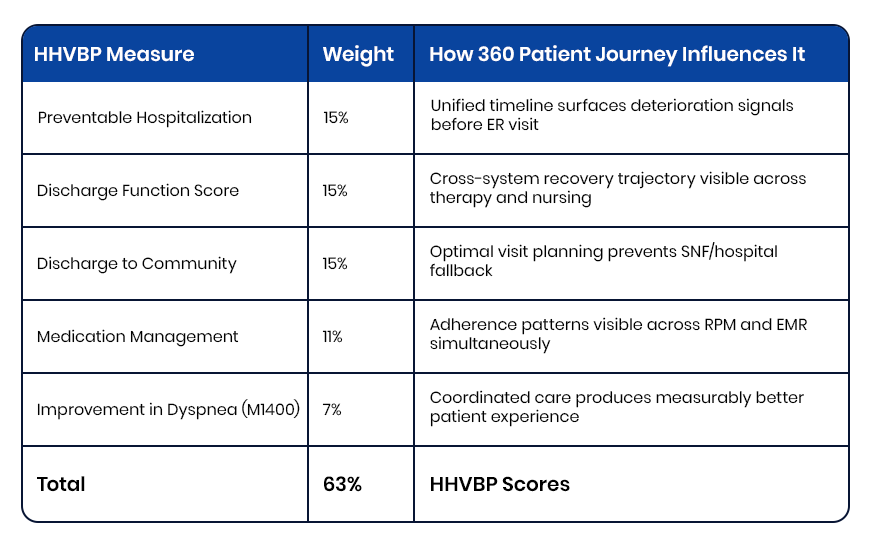
A 5% HHVBP payment swing equals $250,000 in annual revenue impact for a $5 million agency. That score is determined by 2024 performance data being calculated right now, as per expanded model. For most agencies, that performance data has never existed in a single unified view. The quality measures driving the score, including Preventable Hospitalization, Discharge Function Score, Discharge to Community, and Medication Management, are each shaped by whether care teams can see patient trajectory across systems in real time.

On workforce retention

Caregiver turnover sits at 75% annually,a staggering number! Nurses report spending up to two hours per shift navigating disconnected systems to assemble clinical context that should take two minutes. Documentation burden is a structural driver of attrition, not a cultural one. Reducing the time a clinician spends chasing information across platforms is a retention investment, not a workflow convenience.

What a Unified Patient Timeline Looks Like in Practice

Before describing how the Patient 360 Journey works technically, it helps to see what changes on a clinical level.

A supervising RN opens a single patient record. Without logging into anything else, she sees:

  • Tuesday: Blood pressure 158/94, threshold exceeded, flagged moderate severity
  • Tuesday: Patient survey reports increased fatigue and mild ankle swelling
  • Three days prior: Hospitalization risk score elevated from 38 to 59, contributing factors flagged
  • Four days prior: Diuretic dose increased per physician order
  • Five days prior: RN visit completed, weight 3.2 lbs above baseline, physician notified
  • Seven days prior: Start of Care, primary diagnosis CHF exacerbation

That sequence tells a complete clinical story. Rising weight. Medication adjustment. Risk score climbing. Fatigue worsening. Blood pressure spiking. The pattern is unmistakable when all events appear in order on one screen. Without a unified timeline, those same events sit across three platforms, reviewed by different people, connected by nobody.

This is what the Patient 360 Journey makes possible, and it is built entirely from data the organization was already generating. And then the Next Best Action Agent takes it further. It uses the visibility with a recommended next step attached. The right action, for the right patient, delivered to the right person before the pattern becomes a crisis. And it is built entirely from data the organization was already generating.

Book a demo CTA

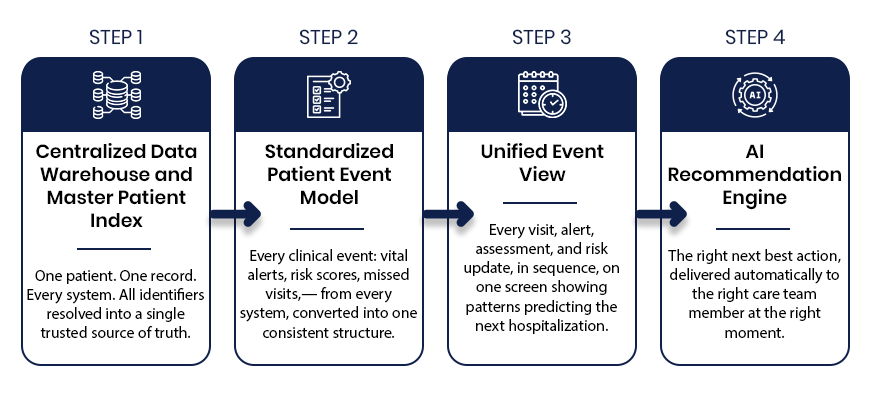
The Patient 360 Journey and the Next Best Action Agent: How They Work in Four Steps

The 360 Patient Journey and the Next Best Action Agent: How They Work in Four Steps

Step 1: Centralized Data Warehouse and Master Patient Index

What it solves: The same patient carries a different identifier in every system. A medical record number in the EMR. A device ID in remote monitoring. A Medicare beneficiary number in the analytics platform.

How it works: The Master Patient Index resolves every identifier, including name, date of birth, Medicare ID, and address, into one canonical patient record using probabilistic matching. One patient. One record. Across every system the organization runs.

Why it matters: Without identity resolution at this level, any downstream unification of clinical data is built on an unreliable foundation. Events get misassigned. Timelines become partial. Clinical decisions get made on incomplete records. The MPI is what makes everything that follows trustworthy.

Step 2: Standardized Patient Event Model

What it solves: Every clinical platform stores data in its own schema, its own timestamp format, its own taxonomy. A vital alert from a remote monitoring platform looks nothing like an OASIS completion from an EMR or a risk score update from a predictive analytics tool.

How it works: Every clinical event from every connected system gets converted into a single standardized structure: event type, timestamp, source system, clinical status, payload summary, and linked events. The care team does not log into six systems to understand one patient. The data arrives already translated into a common language.

Why it matters:For example, six systems with six formats produce six incomplete pictures. One standardized event model produces a complete one.

Step 3: Unified Event Timeline

What it solves: Even with data normalized, clinical teams need a way to see the full patient story in sequence, not as a database export.

How it works: Every normalized event displays in reverse chronological order on a single interface, flagged by severity, color-coded by source system, with linked event relationships visible briefly. The care team sees the complete longitudinal patient journey, from vital spikes and risk score changes to missed visits, wound progression, and after-hours calls, together and in the order they happened.

Why it matters: Patterns are only visible in sequence. The CHF patient whose weight gain, diuretic adjustment, risk score elevation, and vital spike appear as individual data points across three systems looks like four separate mild concerns. On a single unified timeline, they look like what they are: a hospitalization building over five days.

Step 4: AI Recommendation Engine and Next Best Action Agent

What it solves: A unified timeline shows what happened. The Next Best Action Agent tells care teams what to do about it.

How it works: The AI Recommendation Engine reads the complete patient timeline and delivers a specific, prioritized recommended action to the right care team member at the right moment. It surfaces patient summaries, risk drivers, and recommended action plans across every risk level, not just critical cases. The right nurse gets the right instruction automatically: schedule a visit today, escalate to the supervisory RN, request reauthorization before the unit gap widens.

Why it matters: Most clinical AI tools produce dashboards that require interpretation. The Next Best Action Agent produces decisions. There is a meaningful operational difference between a platform that shows a rising risk score and one that tells a specific person to make a specific call within the next four hours.

How Caregence Connects the Intelligence Layer to Clinical Workflows

The Next Best Action Agent runs on Caregence, Inferenz’s agentic AI platform built specifically for home health and hospice organizations. Caregence connects to existing EMR, payer, scheduling, EVV, and RCM systems without requiring agencies to replace a single platform they already use.

It provides the workflow infrastructure for deploying custom AI agents on top of unified patient data, including the Next Best Action Agent, with built-in governance, role-based access, and audit-ready communication tracking.

Think of Caregence as the operating system for proactive care. The Patient 360 Journey provides the unified data foundation for visibility. It is based on Caregence that provides the AI agents that act on it, including the Next Best Action Agent.

The Measurable Impact: From Data Visibility to HHVBP Performance

Inferenz’s internal assessment of the Patient 360 Journey and Next Best Action Agent against the full HHVBP measure set found that this four-step process addresses up to 63% of HHVBP quality metrics directly.

The measures most influenced:

The Measurable Impact: From Data Visibility to HHVBP Performance

The agencies that improve HHVBP scores in 2026 will not do it by changing clinical protocols. They will do it by making existing clinical data visible in sequence, in context, and at the moment when action can still change the outcome.

The Bottom Line

Home health and hospice organizations are not data-poor. They are data-fragmented. Every signal needed to prevent the next hospitalization, protect HHVBP reimbursement, reduce documentation burden, and demonstrate outcomes to payers is already being generated inside the organization.

The Patient 360 Journey makes that data readable. Caregence makes it actionable. The Next Best Action Agent makes sure the right person acts on it before the window for intervention closes.

This is what Data to AI to ROI looks like in home health and hospice, built by Inferenz for organizations that cannot afford to keep losing $250,000 on a visibility problem they already have the data to solve.

Frequently Asked Questions

Why Most Hospice AI Projects Fail Without Data Readiness?

Summary 

  • Most hospice AI initiatives fail due to poor data readiness, not weak algorithms  
  • Fragmented EMR, referral, and payer data limits predictive accuracy  
  • AI readiness requires unified data, governance, and real-time integration  
  • High-impact use cases include referral automation, predictive care, and revenue integrity  
  • A data-first strategy is critical before investing in AI tools  

Introduction

Walk into any hospice boardroom today and one topic dominates the agenda: AI. 

From predictive analytics to workflow automation, hospice leaders are actively exploring how AI can solve staffing shortages, compliance pressure, and shrinking margins. 

Financial pressure is becoming increasingly difficult for hospice providers to absorb. According to the latest reimbursement update from the Centers for Medicare & Medicaid Services, hospices received a 2.6% increase in Medicare base rate payments for 2026, slightly above the initially proposed 2.4% adjustment. While this translates to approximately $750 million in additional federal hospice spending, many providers continue to face rising labor, compliance, and operational costs that outpace reimbursement growth. The hospice aggregate payment cap also increased to $35,361.44 in 2026, reinforcing the need for organizations to improve efficiency, visibility, and financial control across care operations. 

In this environment, hospice organizations are increasingly being asked to deliver better outcomes without proportional increases in reimbursement, making operational intelligence and data-driven efficiency critical priorities. 

But there is a problem, most conversations overlook. 

AI is only as effective as the data it runs on. And in hospice care, that data is often fragmented, inconsistent, and disconnected. 

As leaders prepare for NPHI 2026 Summit, the real question is not which AI vendor to choose. 

The real question is whether your organization is ready for AI at all. 

Why Do Most Hospice AI Projects Fail? 

Most AI failures in hospice do not happen after deployment. They happen before a model is even trained. 

The root cause is data fragmentation. 

Across many hospice organizations: 

  • Patient records exist across multiple EMRs and legacy systems  
  • Referral data remains locked in fax or unstructured formats  
  • Clinical documentation varies across caregivers  
  • Payer, operational, and care data do not connect  

Individually, these issues seem manageable. Together, they create a system where AI models operate on incomplete and duplicated data. 

This leads to a dangerous outcome. 

AI does not simply produce wrong answers. It produces confident wrong answers. 

In hospice care, that risk directly impacts patient outcomes, compliance, and revenue.

What Does AI-Ready Data Mean in Hospice Care? 

What Does AI-Ready Data Mean in Hospice Care

AI readiness is not about buying technology. It is about building the right data foundation. 

A hospice organization is AI-ready only if it can answer “yes” to these four questions: 

  1. Is patient data unified across systems?  
  1. Is clinical documentation consistent and structured?  
  1. Can data flow in real time from referral sources and partners?  
  1. Is data governed, secure, and compliance-ready?  

This is where most organizations struggle. Not because they lack tools, but because they lack a connected data foundation. 

In practice, leading organizations are moving toward a unified approach where clinical, operational, and financial data are brought together into a single layer before any AI is applied. Healthcare workflow automation platforms like Caregence are built around this principle, ensuring that AI operates on a consistent and reliable view of patients, workflows, and outcomes. 

If any of these conditions are missing, AI investments will underperform regardless of the vendor or model quality.

What Data Challenges Prevent AI Adoption in Hospice? 

Most hospice organizations do not lack data. They are lacking usable data. 

Common challenges include: 

  • Duplicate patient records across systems  
  • Unstructured referral intake processes  
  • Siloed clinical, financial, and staffing data  
  • No real-time integration with hospital partners  
  • Manual compliance and audit workflows  

These are operational bottlenecks that directly limit AI effectiveness.

Where AI Creates the Most Value in Hospice Operations 

Where AI Creates the Most Value in Hospice Operations

Once a strong data foundation exists, AI can drive measurable impact across four critical layers. 

1. Referral Layer: Where Revenue Is Won or Lost 

Hospitals are now a primary referral source. Speed is everything. 

AI can: 

  • Convert referrals into structured data 
  • Score eligibility in real time 
  • Flag conversion risks early 

Even small improvements here create significant impact at scale. 

2. Pre-Admission Layer: Predict Before You Commit 

AI enables better decision-making before admitting patients. 

With clean data, models can predict: 

  • Length of stay  
  • Patient risk  
  • Cost alignment  

This allows organizations to plan proactively instead of reacting later. 

3. Care Delivery Layer: Proactive, Not Reactive Care 

This is where AI begins to influence clinical outcomes. 

Predictive models can: 

  • Detect deterioration signals  
  • Trigger timely interventions  
  • Support compliance with frameworks like HOPE  

Care shifts from reactive to proactive. 

4. Revenue Layer: Compliance and Financial Protection 

Audit pressure is increasing across hospice organizations. 

AI can: 

  • Align clinical and billing data  
  • Flag inconsistencies  
  • Generate audit-ready documentation  

This reduces financial risk and strengthens compliance.

The Caregiver Equation: Why This Is Also a Workforce Problem 

Most caregiver burnout is driven by friction, not compensation. 

Scheduling inefficiencies, repetitive documentation, and disconnected tools reduce time spent on patient care. 

A connected, data-driven environment can: 

  • Reduce administrative burden  
  • Improve onboarding  
  • Enable better caregiver-patient matching  

Even a small improvement in retention creates significant financial and operational impact. 

Case in point: Inferenz modernized a fragmented enterprise data ecosystem for a large healthcare organization, creating a unified digital front door that improved data accessibility, streamlined patient engagement workflows, and enabled faster, more coordinated care operations across systems through an enterprise data platform modernization initiative. 

How Can Hospice Organizations Become AI-Ready? 

How Can Hospice Organizations Become AI-Ready?

AI readiness requires a structured approach: 

  • Assess current data maturity  
  • Build a unified data foundation  
  • Implement governance frameworks  
  • Enable real-time data pipelines  
  • Deploy AI use cases strategically  

This shift is already operationalized through healthcare-native platforms that unify data, workflows, and AI into a single ecosystem. AI-based workflow automation solutions like Caregence reflect this approach, helping organizations move from fragmented systems to connected, AI-ready operations. 

Key Takeaways 

  • AI success depends on data quality, not algorithms  
  • Fragmented data is the biggest barrier to adoption  
  • Unified data enables predictive intelligence  
  • Compliance and governance are essential  
  • A data-first approach drives ROI  

Conclusion: The Real Decision Hospice Leaders Must Make 

Every AI investment will perform exactly as well as the data behind it. 

Hospice leaders today face pressure across margins, compliance, workforce, and referrals. These are not separate challenges. They all stem from the same issue: fragmented data. 

The decision is not which AI tool to implement. 

The decision is whether to build the data foundation that makes agentic AI work. 

Organizations that move toward a connected, data-first model will lead to the next phase of hospice transformation. Increasingly, this is being enabled through platforms that unify data, workflows, and intelligence into a single layer. Enterprise workflow automation solutions like Caregence represent what this future looks like in practice. 

Ready to Make Your Data AI-Read

FAQs 

The Importance of PII/PHI Protection in Healthcare

Background summary

This article explains how a healthcare data team secured PII/PHI in an Azure Databricks Lakehouse using Medallion Architecture. It covers encryption at rest and in transit, column-level encryption, data masking, Unity Catalog policies, 3NF normalization for RTBF, and compliance anchors for HIPAA and CCPA.

Introduction

In healthcare, trust starts with how you protect patient data. Every lab result, claim, and encounter add to a record that links back to a person. If that link leaks, the cost is more than penalties. It affects patient confidence and care coordination.

In 2024, U.S. healthcare reported 725 large breaches, and PHI for more than 276 million people was exposed. That is an average of over 758,000 healthcare records breached per day, which shows how urgent this problem has become.

With cloud analytics and healthcare data lakes now standard, teams must protect Personally Identifiable Information (PII) and Protected Health Information (PHI) through the entire pipeline while meeting HIPAA, CCPA, and other rules.

This article shows how we secured PII/PHI on Azure Databricks using column-level encryption, data masking, Fernet with Azure Key Vault, and Medallion Architecture across Bronze, Silver, and Gold layers. The goal is simple. Keep data useful for analytics, but safe for patients and compliant for auditors. Microsoft and Databricks outline the technical controls for HIPAA workloads, including encryption at rest, in transit, and governance.

The challenge: securing PII/PHI in a cloud data lake

Healthcare data draws attackers because it contains identity and clinical context. The largest U.S. healthcare breach to date affected about 192.7 million people through a single vendor incident, and it disrupted claims at a national scale. The lesson for data leaders is clear. You must plan for data loss, lateral movement, and recovery, not only for perimeter events.

Our needs were twofold:

  • Data security
    Protect PII/PHI as it moves from ingestion to analytics and machine learning.
  • Compliance
    Meet HIPAA, CCPA, and internal standards without slowing down reporting.

We adopted end-to-end encryption and column-level security and enforced them per layer using Medallion Architecture:

Bronze

Raw, encrypted data with rich lineage and tags.

Silver

Cleaned, standardized, 3NF-normalized data with PII columns clearly marked.

Gold

Aggregated, masked datasets for BI and data science, with policy-driven access and role-based access control.

For scale, we added Unity Catalog controls and policy objects that apply at schema, table, column, and function levels. This helps enforce row filters and column masks without custom code in every job.

Protecting PII/PHI: encryption at every stage

We used three layers of protection so PII/PHI stays safe and still usable.

Encryption in transit

Data travels over TLS from sources to Azure Databricks. For cluster internode traffic, Databricks supports encryption using AES-256 over TLS 1.3 through init scripts when needed. This reduces exposure during shuffle or broadcast.

Encryption at rest

Raw data in Bronze and refined data in Silver/Gold stay encrypted at rest with AES-256 using Azure storage service encryption. Azure’s model follows envelope encryption and supports FIPS 140-2 validated algorithms. This satisfies common control requirements for HIPAA encryption standards and workloads.

Column-level encryption

This is the last mile. We encrypted specific fields that contain PII/PHI.

  • Identify sensitive columns. With data owners and compliance teams, we tagged names, contact details, SSNs, MRNs, and any content that can re-identify a person.
  • Fernet UDFs on Azure Databricks. We used Fernet in a User-Defined Function so encryption is non-deterministic. The same input encrypts to different outputs, which reduces linking risk across tables.
  • Azure Key Vault for key management. We stored encryption keys in Azure Key Vault and used Databricks secrets for retrieval. We set rotation, separation of duties, and least privilege to keep access tight. Microsoft documents customer-managed key options for the control plane and data plane.

Together, these patterns form our Azure Databricks PII encryption approach and support HIPAA control mapping.

Identifying PII in healthcare data: a collaborative and automated approach

PII storage

  • Collaboration with business teams
    Subject-matter experts show which fields matter most for care and billing. They confirm what counts as PII/PHI by dataset and by jurisdiction, since a payer file and an EHR table carry different fields and retention rules. We document these rules in a data catalog entry and bind them to  Unity Catalog policies.
  • Automated Python scripts for data profiling
    Our scripts look for regex patterns, outliers, and value density that point to contact info or identifiers. We score each column for PII likelihood and tag it at ingestion. We also write the score and the supporting evidence to the catalog. That way, audits can see when we marked a column and why.
  • Analyzing nested data for sensitive information
    Clinical feeds often arrive as JSON or XML with nested groups. We flatten with stable keys, then scan inner nodes. We also search free-text fields for names or IDs. The same rules apply: detect, tag, then protect.
  • What we do with tags
    Tags flow into policies for masking, access control, and key selection. This reduces manual steps and keeps rules consistent as teams add new feeds.

This practice underpins data governance in healthcare and makes PII/PHI classification repeatable.