











An Overview of GPT-6 Astra in Healthcare

Executive Summary 

For healthcare CXOs weighing generative AI and agentic AI investments, GPT-6 Astra’s real story isn’t its benchmark score. It’s the 1.05-million-token context window, the prompt-caching economics, and the HIPAA compliance gate that decide whether a pilot survives contact with a real patient record. This brief breaks down what changes for clinical documentation, care coordination, and healthcare AI governance, and what still requires a signed Business Associate Agreement before any patient data goes near the model.

Why this release is different for healthcare 

OpenAI shipped GPT-6 Astra on September 3, 2026, in the same week Anthropic, Google, and Meta all pushed out their own frontier updates, a cluster of launches so tight that CNBC coined the term “model fatigue” to describe how hard it has become for buyers to keep the scoreboard straight.  

For a general audience, Astra’s headline numbers are the story: a context window of roughly 1.05 million tokens, near-saturated scores on FrontierMath and ARC-AGI-3, and the first OpenAI model to meet the “Critical” threshold for cybersecurity capability under the company’s Preparedness Framework. 

For healthcare, none of that is the interesting part. The interesting part is what changes operationally when a model this capable is dropped into a hospital’s documentation queue, a home-care agency’s referral pipeline, or a payer’s prior-authorization backlog, and what still, deliberately, doesn’t change. 

That operational lens, not the leaderboard, is what matters for healthcare AI governance and generative AI adoption at the health-system level.
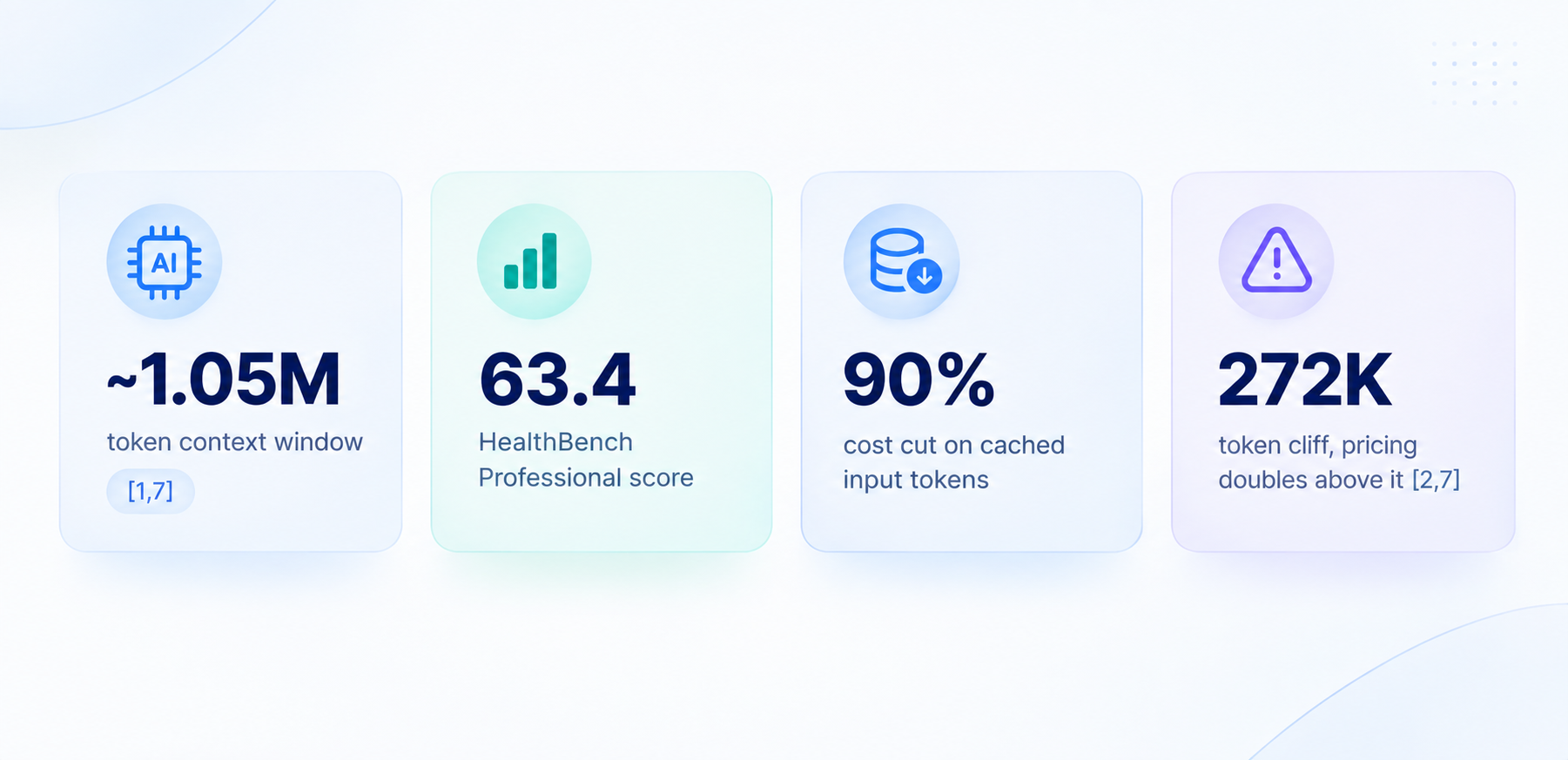
Astra at a glance, healthcare-relevant numbers only. Bracketed numbers reference the Sources list.

The benchmark that actually matters here 

Astra scored 63.4% on the length-adjusted HealthBench Professional evaluation, up from 60.5% for its predecessor, GPT-5.6 Sol, and ahead of Claude Fable 5.1’s 58.1%. That comparison carries an important caveat: OpenAI graded all three models itself, using its own GPT-5.4 grader and an Opus 5 fallback for cases where Fable 5.1 declined to answer, this is not Anthropic’s self-reported figure. A real but incremental gain, and the wrong number to lead with regardless: length-adjusted scoring exists because a longer answer can satisfy more rubric checkboxes without being clearer or more clinically useful, the benchmark itself is warning readers not to over-read it.
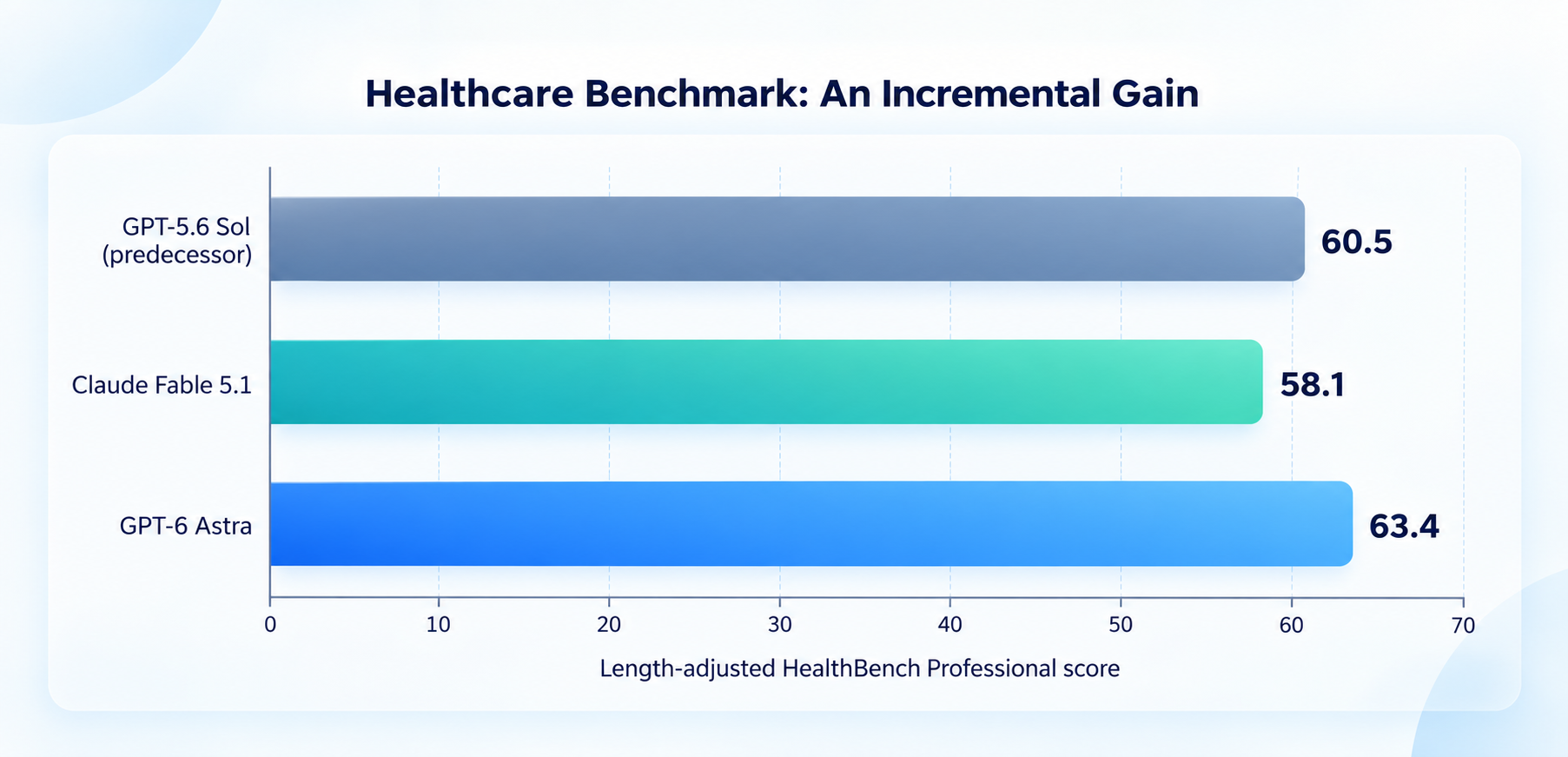
The benchmark that actually matters here

None of this constitutes diagnostic accuracy, prospective clinical validation, or regulatory clearance. Astra is not a medical device, and OpenAI hasn’t positioned it as one; it’s a foundation model that healthcare products get built on top of, and that distinction carries real weight for anyone evaluating it for clinical use.  

For CXOs building a healthcare AI governance framework, that distinction between a foundation model and a regulated clinical device is the first line item in any vendor risk assessment. 

What actually changes: context, not cleverness 

The single most consequential spec for healthcare isn’t a reasoning benchmark, it’s the roughly 1.05-million-token context window. A longitudinal patient record isn’t one document; it’s years of visit notes, lab trends, referral letters, discharge summaries, and imaging reports scattered across systems that don’t talk to each other. Previous-generation context limits forced aggressive summarization before a model could even look at the full picture. 
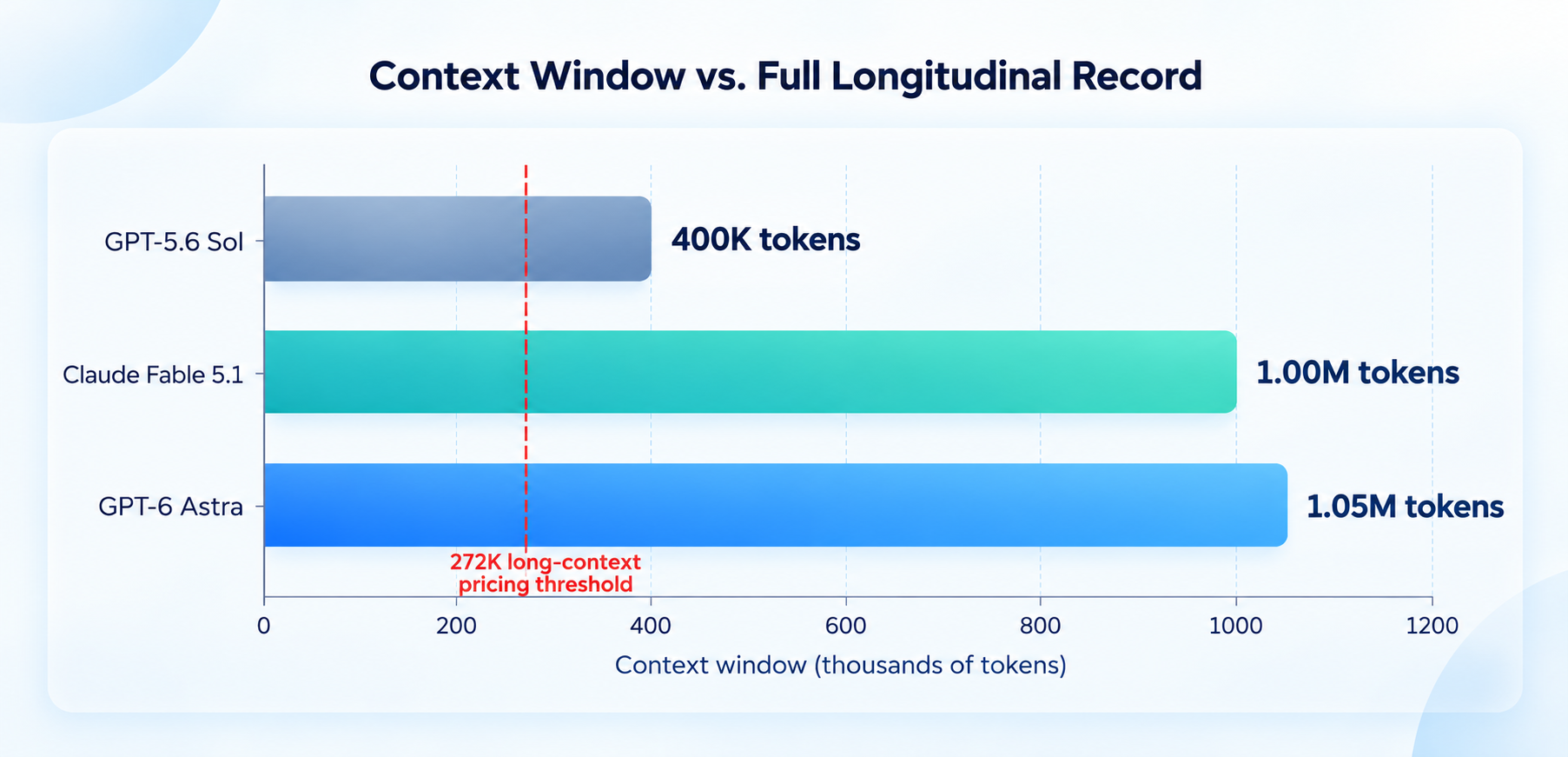
Context window growth, with the long-context pricing threshold marked [1,2,7]

At a million-plus tokens, an application can hand Astra genuinely comprehensive input in a single pass. That doesn’t fix the underlying mess of a real medical record, duplicated entries, inconsistent formatting, contradictory timestamps are still there, but it removes the artificial ceiling that used to force pre-summarization. Paired with native web search, file search, code execution, computer use, and tool-calling (MCP), Astra shifts from answering questions to doing structured, multi-step tasks like application development. That agentic capability is the actual product opportunity, more than any single point of benchmark improvement, per independent healthcare-AI analysis.

Where this shows up in real workflows 

Framed as applications rather than capabilities, here is what realistic healthcare use looks like, per independent clinical-AI analysis:  

Chart Review 

Synthesizes a fragmented, multi-year record into a usable pre-visit summary. 

Evidence Synthesis 

Builds a referenced briefing on a clinical question from literature and structured sources. 

Documentation 

Drafts referrals, discharge summaries, prior-auth requests, and patient letters. 

Care Coordination 

Reconciles referrals, results, and correspondence across disconnected systems. 

Research & Data Analysis 

Runs reproducible code across large structured health datasets. 

Health-Tech Development 

Builds and maintains the software healthcare workflows actually run on. 

Turning GPT-6 Astra's raw capability into a governed, HIPAA-ready healthcare workflow takes more than a system prompt.

What Astra should not be used for 

Keep the clinician in the loop, always. 

  • Autonomous triage: deciding a patient’s urgency or pathway without clinician review. 
  • Prescribing and order entry: generating a prescription or investigation order without a human decision-maker in the loop. 
  • Unreviewed patient communication: sending clinical information to a patient without a clinician checking it first. 
  • Acting beyond authorized scope: as agentic capability grows, what a system is permitted to do matters more than what it’s capable of doing. 

The Compliance Gate: BAA Before PHI 

Protected health information can only touch Astra if OpenAI has executed a Business Associate Agreement specific to that deployment, API, Enterprise account, whichever surface is actually in use, and the environment is confirmed HIPAA-eligible. Verify BAA coverage for the exact product surface before any pilot touches real patient data.  

 A signed BAA and a mapped data-flow diagram are the two artifacts most healthcare compliance software reviews ask for first, and the two most pilots skip. 

Cost and caching: what decides affordability at scale 

This is where the economics diverge sharply from a single chatbot query, and where a workflow orchestrator’s design choices matter as much as model choice. Astra’s OpenAI API standard rate is $10 per million input tokens and $50 per million output tokens. But cross 272,000 input tokens in a single request, trivially easy with a multi-year chart, and the entire request, not just the overage, reprices to OpenAI’s published long-context rate: $20 input, $2 cached input, $25 cache writes, and $75 output per million tokens, roughly double on input and cache, and 1.5x on output. 
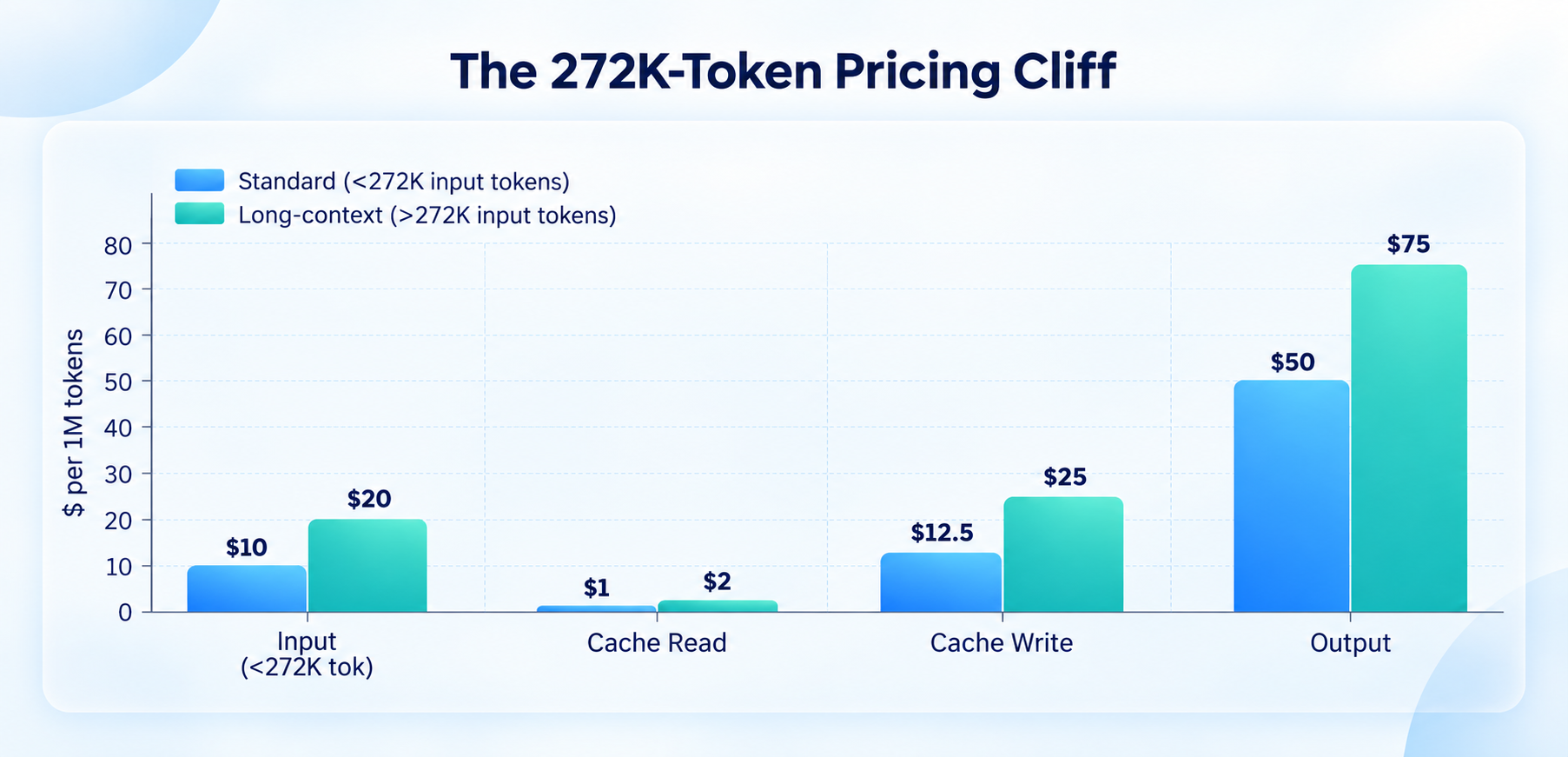
Standard vs. long-context pricing per 1M tokens, from OpenAI's own pricing page 

Prompt caching is what makes repeated, structured workflows economical rather than merely possible. A referral-intake or eligibility-screening pipeline reuses the same scaffolding on every case, the same guideline text, the same extraction schema, the same triage framework, while only the patient-specific data changes. Cached tokens on Astra cost roughly a tenth of the standard input rate, and Astra adds explicit cache breakpoints on top of the automatic implicit caching older models had, so a developer can pin exactly where the reusable guideline block ends and volatile per-patient content begins. 
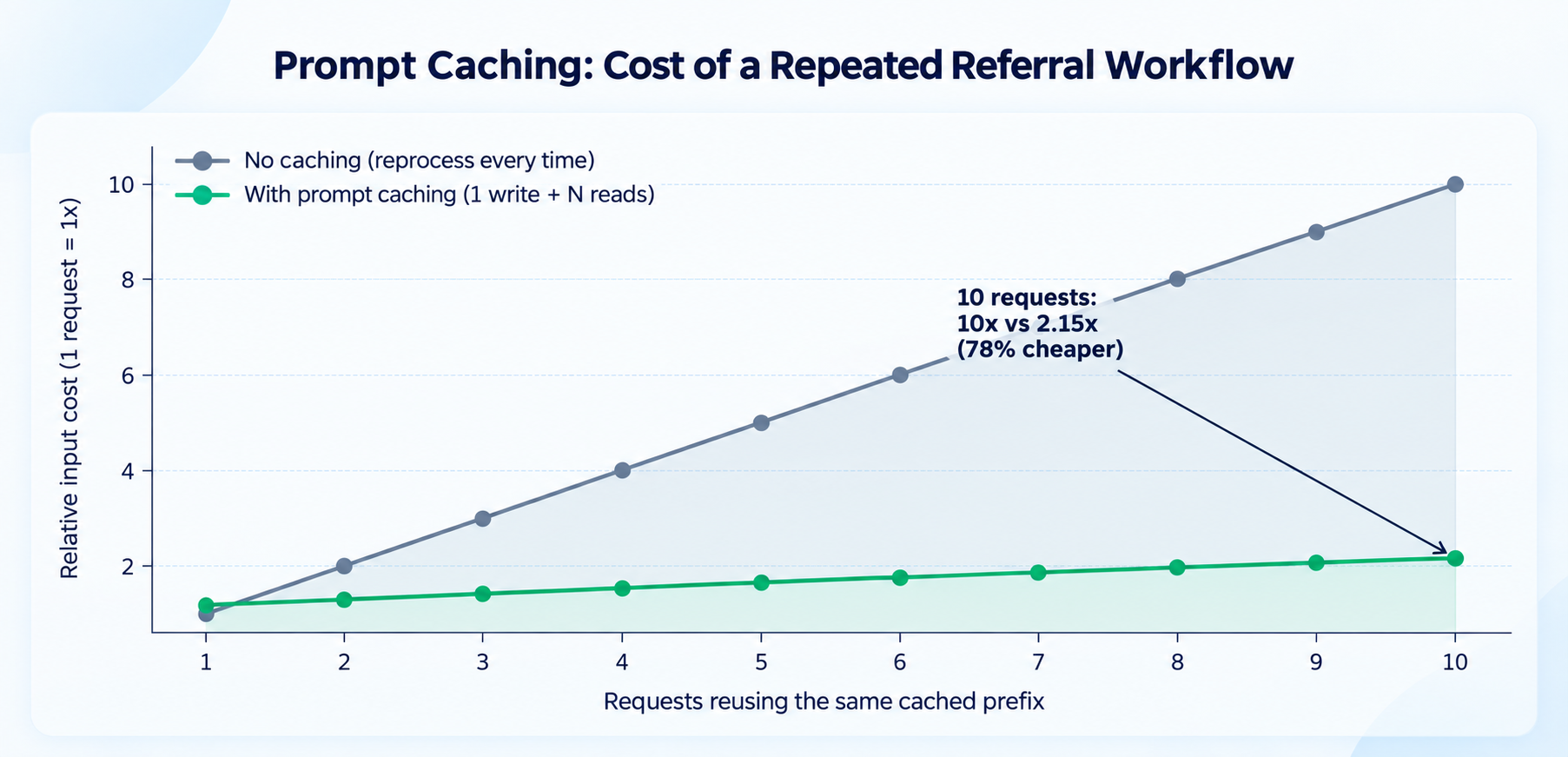
Relative input cost across ten requests reusing the same cached prefix, modeled on OpenAI's published cache-write/cache-read multipliers

For a queue processing hundreds or thousands of referrals a day, that’s the difference between reprocessing an entire rulebook on every case and paying full price once, then a fraction of it forever after. 

That single design choice, caching reusable guideline text instead of resending it, is often what separates a healthcare AI platform or a pilot that scales from one that quietly blows through its budget.

How it stacks up: GPT 6 Astra vs. Claude Fable 5.1 

Against Claude Fable 5.1, Anthropic’s model released in the same launch window, the two are close enough on Artificial Analysis’s live head-to-head comparison that model choice for healthcare workflow automation should probably be decided by solution fit rather than benchmark bragging rights.
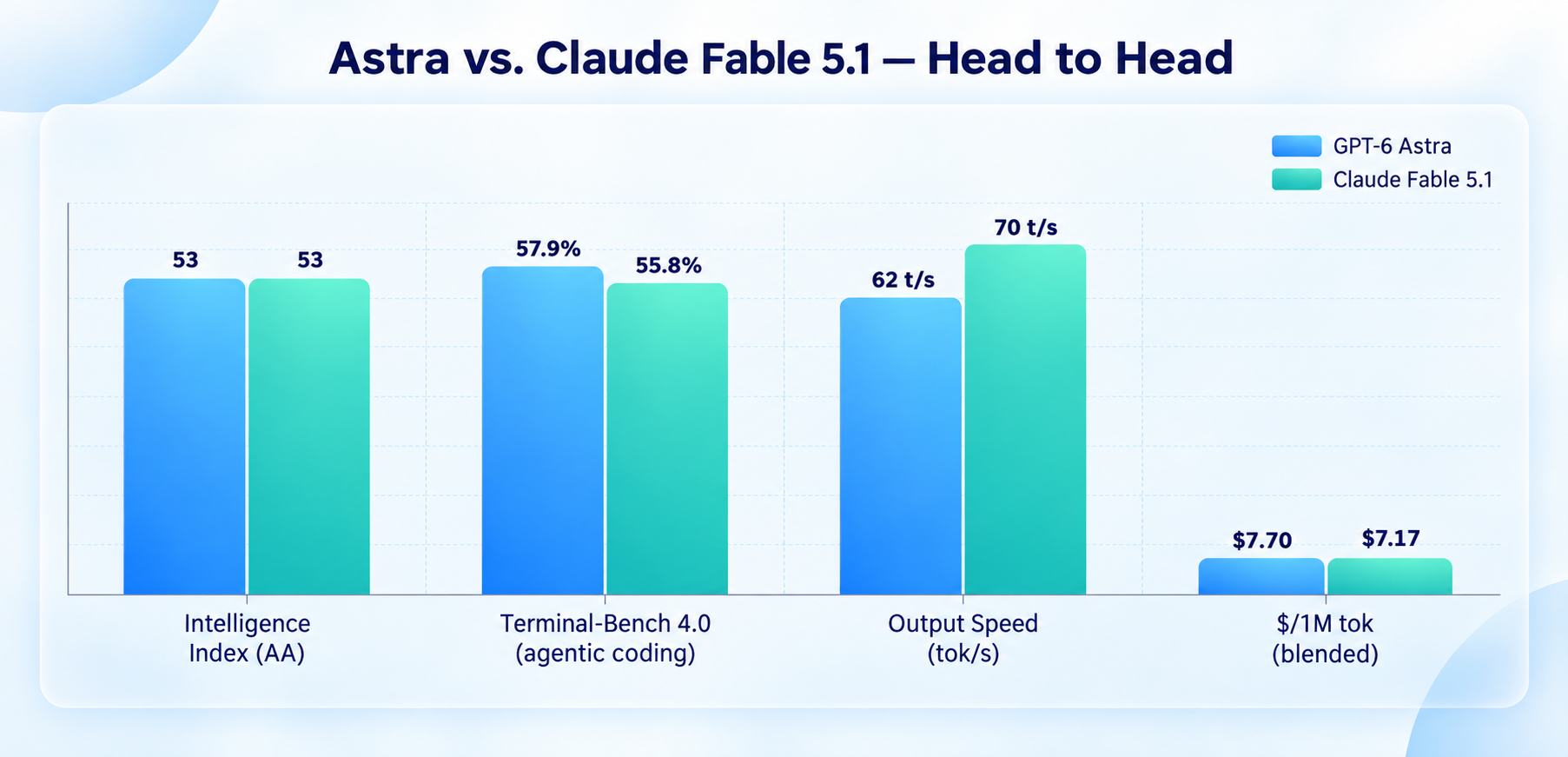
Head-to-head on intelligence, agentic coding, speed, and blended cost (bars normalized for visual comparison; real values labeled)

Metric GPT-6 Astra Claude Fable 5.1 
Intelligence Index (Artificial Analysis, live) 53 53 (tied) 
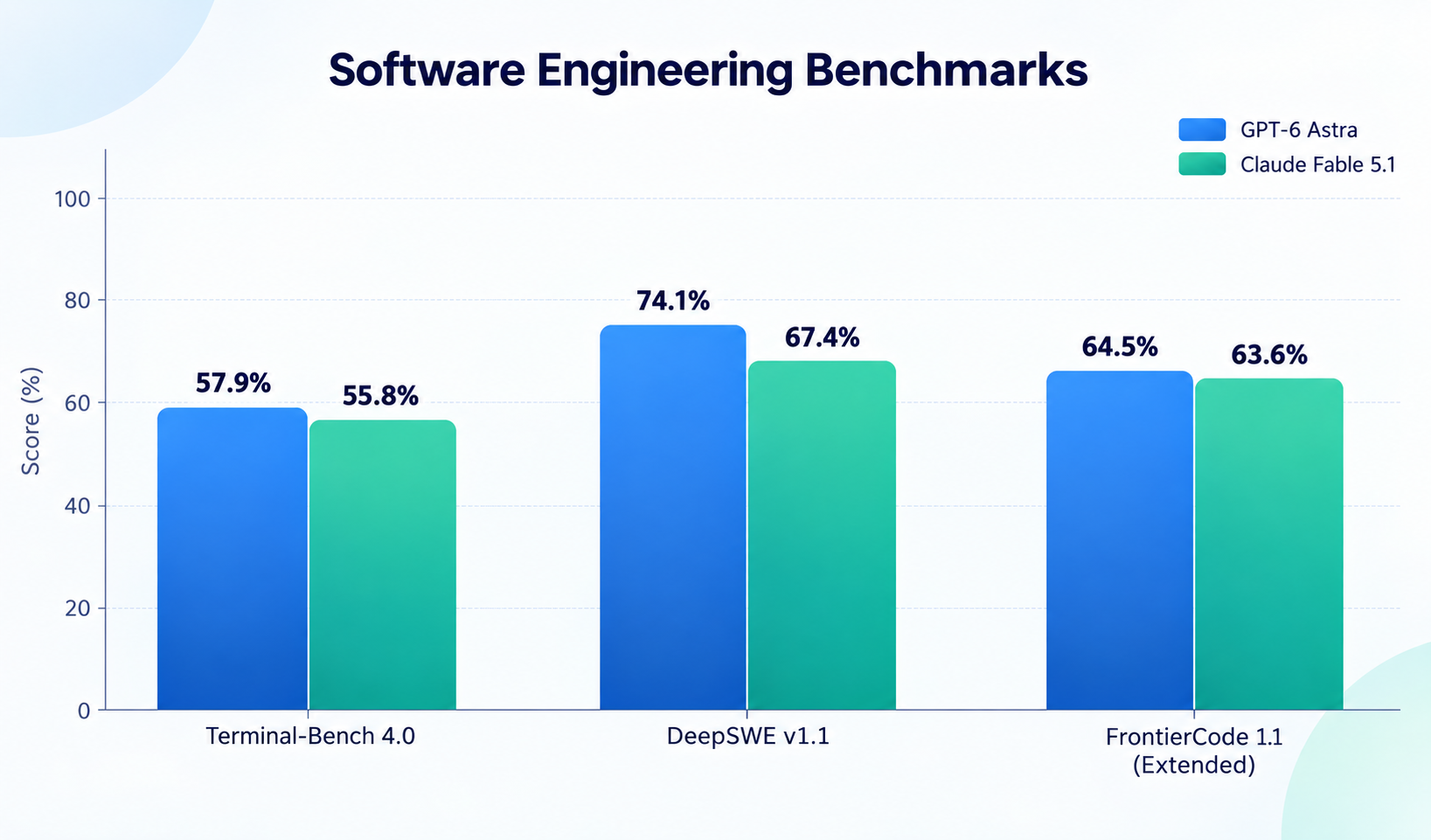
Terminal-Bench 4.0 (agentic coding, OpenAI-reported) 57.9% 55.8% 
Output speed (tokens/sec, Artificial Analysis) 62 70 
Blended cost per 1M tokens (Artificial Analysis) $7.70 $7.17 
HealthBench Professional, length-adjusted (OpenAI-graded) 63.4% 58.1% 
Context window ~1.05M tokens ~1M tokens 
Standout strength Research math, cybersecurity, computer use Multi-hour agentic coding, cache discount up to 45% 
Cloud availability at launch OpenAI API, Azure, AWS Bedrock AWS, Google Cloud, Microsoft Azure 
Enterprise default Off until admin enables 30-day retention required, not on Priority Tier 

Fable 5.1 is faster (70 vs. 62 output tokens/sec) and marginally cheaper on blended cost; Astra edges ahead on Terminal-Bench 4.0 agentic-coding tasks and on the OpenAI-graded HealthBench Professional comparison, and both are effectively tied on Artificial Analysis’s Intelligence Index. Fable 5.1’s own prompt-caching redesign is aggressive in its own right, Anthropic dropped cached-input pricing from $1 to $0.25 per million tokens, cutting typical workloads by roughly 25% and highly agentic workloads by up to 45%, which matters just as much as Astra’s caching story for anyone building a multi-step clinical workflow rather than firing single queries. 

The more relevant enterprise distinction is availability and rollout posture: Astra is off by default in enterprise workspaces until an administrator explicitly enables it, and its cloud footprint at launch, OpenAI API, Microsoft Azure, and AWS Bedrock, is narrower than Fable 5.1’s three-cloud availability. For a healthcare IT team already standardized on a particular cloud and compliance posture, that operational detail may decide the question before a single benchmark is consulted. 

The verdict 

Astra is a more capable clinical co-worker, not a more autonomous one. The context window and agentic tooling meaningfully expand what an application can do around a patient record, comprehensive review instead of forced summarization, drafted documentation instead of blank-page starts, reconciled referrals instead of manually stitched fragments. 

None of that reduces the need for clinical grounding, jurisdiction-specific guidance, human review of anything patient-facing, or a properly executed BAA before real data enters the system. The organizations that get the most out of this release won’t be the ones chasing the benchmark delta, they’ll be the ones that redesign their prompt structure around caching, respect the 272K-token pricing cliff, and keep the clinician firmly in the loop on everything the model drafts. 

For healthcare CXOs, the real decision isn’t GPT-6 Astra versus Claude Fable 5.1. It’s whether your organization has the AI governance, HIPAA-compliant infrastructure, and workflow design in place to capture either model’s agentic upside safely.

Picking a frontier model is the easy part. Building the HIPAA-compliant workflow around it is where most healthcare AI programs stall.Frequently Asked Questions 

Staffing and Demand Forecasting: How Hospitals Are Matching Nurse Capacity to Patient Flow

Summary

Hospital staffing and demand forecasting uses AI predictive staffing models to match nurse capacity to real-time patient flow, forecasting census, acuity, and skill-mix before shifts are built instead of filling gaps after they appear. This approach cuts agency staffing costs and reduces nurse burnout by pairing EHR-integrated staffing analytics with census-based demand forecasting and delivers measurable ROI. Governance guardrails for union rules, fatigue limits, and compliance, presents a clear solution to hospital staffing shortage.

Introduction 

Most nurse staffing shortages are not surprises. They are forecasting failures that surface weeks after the warning signs first appeared, buried in a census trend nobody tracked or a schedule built on instinct instead of evidence. By the time a unit is short two nurses on a Tuesday afternoon, the real failure already happened three weeks earlier. 

The math behind that isn’t going away on its own. The Health Resources and Services Administration’s most recent national workforce projections put the country roughly 8 to 10 percent short of the registered nurses hospitals will need through the back half of this decade, worse in rural areas, worse in behavioral health and long-term care. The Bureau of Labor Statistics still projects steady growth in RN demand, roughly 180,800 openings a year through 2035, largely because an aging population needs more care, not less. Put those two numbers side by side and the conclusion is blunt: hospitals cannot hire their way out of this gap. They have to get sharper about matching the staff they already have to the patients who are actually coming. 

This is the third piece in our series of articles related to the hospital throughput crisis, and it sits closer to the ground than bed capacity and discharge delays. Staffing decides whether a unit can actually absorb the patients those beds are holding. If your census forecast and your staffing plan get built separately, on different timelines, by different teams, you will always be reacting to demand instead of meeting it. 

For a transformation leader trying to prove AI can solve a defined operational problem rather than just look impressive in a demo, staffing and demand forecasting is one of the cleanest use cases in the hospital. The data already exists somewhere in your systems.  

The KPI is obvious:  

  • Fewer shifts filled by agency staff 
  • Fewer forced overtime hours 
  • Fewer nurse-to-patient ratios pushed past safe limits 

The failure mode is visible fast if you get it wrong. Real data is a measurable outcome combined with fast feedback. That combination is exactly what makes this a sound place to spend one of the one or two agentic AI initiatives a board could fund this year. 

How much can hospitals really cut from agency staffing spend with AI forecasting? 

Ask a vendor this question and you’ll get a round number, usually 20 percent, delivered with total confidence. You know it as much as I do that the trail usually goes cold when you try to point out a recent study to back it up. 

Here’s a number worth trusting instead.  

Researchers at Columbia Business School, working with Stanford and clinicians at Hackensack University Medical Center, built and tested a prediction-driven nurse staffing model for a real emergency department.  

The result: hourly nursing labor costs dropped by more than $160, which worked out to roughly $1.4 million in annual savings for a single ED, while wait times, treatment duration, and patient flow held steady.  

No quality trade-off buried in the fine print. A measured cost reduction sitting right next to stable clinical performance. 

That’s the standard to hold any staffing forecasting tool, or any AI initiative, to in a hospital. Whether you choose a vendor offering predictive analytics services or build the capability internally, insist on seeing cost and quality numbers together before you fund a rollout past a single unit.

The data you need before an AI predictive staffing model will work 

This is where most staffing AI pilots quietly die, and it happens before a single algorithm runs. 

An AI predictive staffing model in healthcare needs clean history. Here are some other basic requirements:  

Data Input What It Includes Why It Matters 
ADT data 12–24 months of admission, discharge, and transfer records, by unit Gives the model enough history to learn real patterns, not just recent noise 
Staffing ratios & skill mix Nurse-to-patient ratios and skill mix by shift, not just headcount Headcount alone hides whether the right staff were on the floor 
Patient acuity scores Acuity data tied to the actual staffing decisions made at the time Lets the model learn what drove a decision, instead of guessing from census alone 
Payroll & scheduling history Overtime patterns and agency/travel nurse fill history Shows where reactive staffing has been masking a forecasting gap 
External demand signals Local flu surveillance data, school calendars, elective surgery schedules Captures predictable volume swings the model would otherwise miss 

 Most hospitals have pieces of this scattered across the EHR, a separate scheduling platform, and payroll, with no shared identifier connecting them. That’s a data strategy problem before it’s a modeling problem. Our data strategy consulting services ensure that our experts map what you have, fix the identifiers that don’t match across systems, and build the pipeline before anyone talks about algorithms. Skip any of these steps and you get a model that falls apart the first week it meets real hospital data.

Deploy-predictive-models-that-help-your-hospital-to-anticipate-outcomes-and-make-smarter-decisionsForecasting Patient Volume and Staffing Together, Not in Sequence 

A common mistake: build a patient volume forecast, hand it to workforce planning, and let them build a staffing plan on top of it a week later. By the time the staffing plan is ready, the volume forecast is already stale. 

Census-based staffing models that actually work run both forecasts on the same clock, ideally the same data pipeline. Emergency department demand forecasting, seasonal patient volume prediction, and unit-level staffing recommendations need to update together, on a rolling basis, not as two separate reports reconciled manually every Friday.  

This is closer to what predictive modeling in healthcare should mean in practice: one model, or a tightly linked pair of models, producing a staffing recommendation that already accounts for tomorrow’s expected census, not last month’s average. 

The payoff shows up in surge planning. A hospital forecasting volume and staffing on the same cycle can flex float pools and agency requests days ahead of a predictable surge, flu season being the obvious example, instead of scrambling once volume spikes.

Differences between scheduling software and true predictive demand forecasting 

Both scheduling software and predictive demand forecasting solutions get sold as the same thing. They are not. 

A nurse scheduling optimization software takes a staffing template you already decided on and fills it efficiently. The nurse scheduling solution matches nurse preferences, certifications, and fatigue rules against open shifts. It’s a reactive staffing model wearing a modern interface. It usually answers “who works Tuesday” well. It doesn’t answer “how many nurses does Tuesday actually need” which could be addressed through a predictive nurse scheduling solution. 

Predictive demand forecasting answers that second question first. It reads historical and real-time signals, census trends, ED arrival rates, discharge velocity, seasonal patterns, to estimate the staffing level a unit will need before the shift is built, then hands that number to the scheduling layer. One tool optimizes a plan. The other decides what the plan should be. Hospitals that only buy the first one are still staffing reactively, just with better software. 

To explain this, here is a comparison table  

 Reactive Staffing Predictive Staffing 
Trigger An open shift or a census spike that’s already happened A forecasted census or acuity shift, days to weeks out 
Primary tool Scheduling optimization software Demand forecasting model + scheduling layer 
Typical fix Overtime or last-minute agency nurse Float pool or pre-arranged coverage 
Cost pattern Spikes unpredictably with agency premiums Smooths out, budgeted in advance 
Burnout impact High, driven by last-minute callouts Lower, staff get advance notice 
What it answers “Who works Tuesday?” “How many nurses does Tuesday need?” 

How accurate are AI staffing forecasts compared to a spreadsheet? 

Don’t accept an accuracy claim without asking how it was measured. “95 percent accurate” means very little without knowing the forecast window, the unit type, and what counts as a miss. 

The honest way to evaluate this: backtest the model against 6 to 12 months of your own historical census and staffing data before go-live, then track forecast error on a rolling basis afterward, comparing predicted versus actual need by unit and shift. A model that’s directionally reliable two to three weeks out, and tightens as the shift approaches, is far more useful than one claiming impossible precision a month in advance. 

Spreadsheet-based forecasting, by comparison, is usually built on last month’s average and a scheduler’s memory of what felt busy. It has no error tracking at all, which is exactly why it feels accurate right up until the week it isn’t. 

Why skill-mix and acuity matter more than headcount 

A unit staffed to the right headcount with the wrong skill mix is still understaffed. This is the gap pure census-based models miss. 

Patient acuity-based staffing accounts for the fact that ten stable post-op patients and ten high-acuity step-downs are not the same staffing problem, even at identical census. Skill-mix forecasting for hospitals needs to layer certification level, specialty competency, and acuity trends on top of raw patient counts, or it will recommend the right number of bodies and the wrong capability. A lot of “AI staffing” tools fall short here. They optimize headcount because headcount is the easy number to forecast. Acuity and skill mix are harder, which is exactly why they matter more. 

What it takes to connect a forecasting tool to your EHR and payroll systems 

This is the question that should come before a vendor demo, not after a contract is signed. 

Real-time bed occupancy forecasting and EHR-integrated staffing analytics depend on live or near-live feeds from your EHR’s ADT stream, your scheduling platform, and your payroll or HR system, each very likely built by a different vendor, on a different data model, at a different point in your hospital’s history.  

Integration effort here typically breaks into three buckets: pulling clean, structured data out of each source system; reconciling identifiers so a patient or a shift means the same thing across all three; and building the feedback loop that lets the model learn from what actually happened, not just what was scheduled.

Vendor Evaluation Checklist 

Ask the vendor Why it matters 
What’s your forecast error rate, backtested on our own data? Vendor-claimed accuracy without your data means nothing 
Which of the three integration buckets (data pull, identifier match, feedback loop) do you own? Tells you what becomes your team’s job 
Can you show cost savings and stable quality metrics together? One without the other isn’t proof 
Are union rules, fatigue limits, and audit trails built in or bolted on? Determines whether it survives a labor dispute 

 Evaluate vendors to walk through exactly these questions and what is expected from your team. Get the answers and you’re sorted. 

Building guardrails: union rules, fatigue limits, and compliance in an AI staffing model 

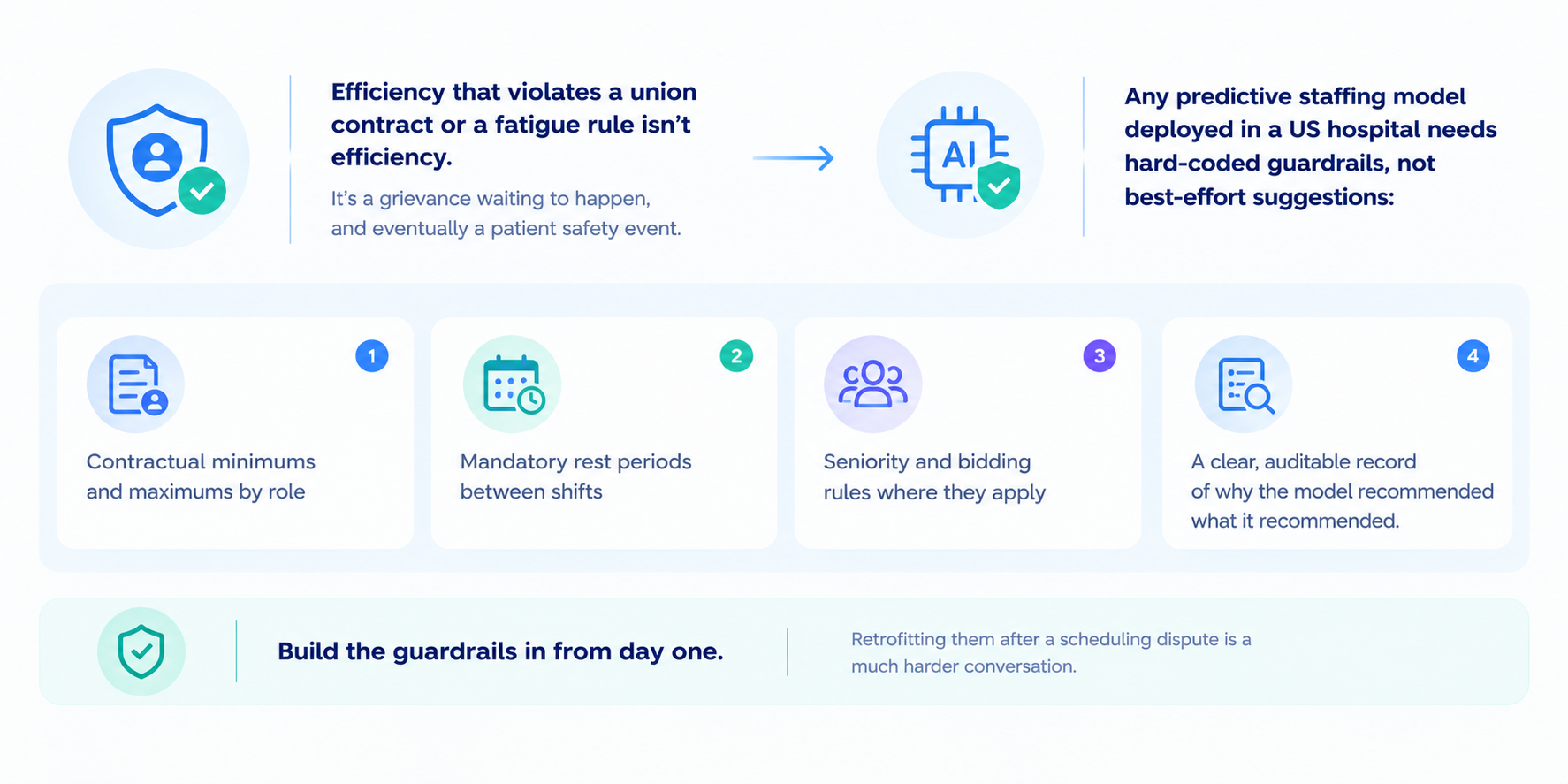
Building guardrails: union rules, fatigue limits, and compliance in an AI staffing modelEfficiency that violates a union contract or a fatigue rule isn’t efficiency. It’s a grievance waiting to happen, and eventually a patient safety event. 

Any predictive staffing model deployed in a US hospital needs hard-coded guardrails, not best-effort suggestions:  

  • Contractual minimums and maximums by role 
  • Mandatory rest periods between shifts 
  • Seniority and bidding rules where they apply, and  
  • A clear, auditable record of why the model recommended what it recommended.  

This is the governance work that turns a staffing forecast from a black box into something you can defend to a labor relations team, a compliance officer, and a board that just finished asking hard questions about your last AI pilot. Build the guardrails in from day one. Retrofitting them after a scheduling dispute is a much harder conversation.

The Bottom Line 

None of this requires betting the budget on a hospital-wide platform. Pick one unit, ideally the one with the worst agency spend or the most unpredictable census, and run the forecast against real data for one quarter before scaling anything. If the numbers hold, and they hold alongside stable quality metrics, that’s exactly what a board wants to see: a defined problem, a measured result, and a repeatable model for what comes next. 

See-what-Inferenz's-predictive-analytics-team-can-build-with-your-own-staffing-and-census-dataFrequently Asked Questions

The Hospital Throughput Crisis: How COOs Are Using AI to Cut LOS and Discharge Delays

Summary

A patient who’s medically cleared to go home but is still lying in a bed isn’t a staffing problem. It’s a coordination failure, and it quietly drains millions of dollars a year in beds that never reopen for the next admission. Hospital throughput AI closes that gap. It turns the moment a physician writes “discharge today” into the moment a bed is actually clean and ready, replacing whiteboards and 3 p.m. huddles with a live, predictive view of the entire patient journey. 

Throughput and Length of Stay are not the same problem 

Every hospital tracks length of stay like a scoreboard. Throughput barely gets a line on the report, and that blind spot is exactly where the money and the beds disappear. 

Length of stay counts the days a patient occupies a bed, admission to discharge.  

Throughput measures something harder to see how efficiently the whole system, beds, staff, transport, pharmacy, environmental services, moves that patient from the front door to the exit.  

Hospital and ambulatory data can often include a perfectly respectable average length of stay and yet bleed capacity in reality, every day. This happens because the real leak is usually what happens after the clinical decision to discharge has already been made. 

Operations teams have a name for that gap: the discharge-to-actual-discharge gap. It’s where most avoidable bed days live, and it’s nearly invisible on a standard length-of-stay report. We map exactly where that last mile breaks down in Why Beds Stay Occupied After the Clinical Decision to Discharge. 

What causes hospital discharge delays 

What causes hospital discharge delaysThe instinct is to blame acuity: sicker patients, more complex cases, an aging population. That’s part of the story, but not the biggest part. According to the American Hospital Association’s 2026 Costs of Caring report, hospital workforce spending rose 5.6% in 2025 alone, and hospitals spent $43 billion in 2025 simply trying to collect payment for care they had already delivered, chasing denials, prior authorization delays, and repeated documentation requests. 

None of those billions buy a single extra day of good clinical care.  

It buys time which patients spend waiting 

  • on insurance sign-offs 
  • for skilled nursing beds to open 
  • on transport 
  • for a family member to pick up the phone.  

Add ongoing workforce shortages at post-acute and behavioral health facilities, and a discharge that should take an afternoon stretches into two or three extra days. None of it shows up on a clinical chart. All of it shows up on the P&L. 

That’s why hospital solutions for discharge delays are worth budgeting for in 2026 starting with care coordination. Adding case managers to a broken handoff process just means more people waiting on the same missing information. 

The real price tag: what counts as an avoidable bed day 

An avoidable bed day is any day a patient stays in an inpatient bed after being clinically cleared to leave, for nonclinical reasons, with no reimbursement attached. Hospitals absorb the full cost, staffing, supplies, overhead, and collect none of the revenue. 

That’s the quiet part of the crisis. It’s rarely one catastrophic failure. It’s dozens of small delays compounding across a 300-bed hospital, every single day, at a cost that seldom reaches a board presentation until someone finally adds it up. This is the core of hospital capacity optimization AI: recovering capacity you already own instead of building or leasing more of it.

Build a hospital command center layer to ensure predictive discharge signals reach the people who can act on them.  From dashboards to decisions: what a hospital command center actually does 

A hospital command center AI platform isn’t a bigger screen on a wall. It’s an operating layer that pulls bed status, staffing, transport, and discharge readiness into one place, then tells someone exactly what to do about it before a backlog forms. 

The results are becoming hard to dismiss. Sutter Health ran a command center pilot across three hospitals through 2025 and, according to the American Hospital Association, cut ED arrival-to-departure time by 8%, grew transfers and direct admissions by 29%, increased discharges by 4%, and reduced net days above geometric mean length of stay by 27%, the equivalent of freeing up 12 beds a day without adding a single physical bed. 

Throughput Lever What It Actually Fixes Explored In 
Last-mile discharge coordination The gap between “cleared to leave” and “bed is open” Why beds stay occupied after the clinical decision to discharge 
Post-acute matching Out-of-network referrals draining revenue and outcomes Referral leakage to post-acute care 
Early risk flagging Patients likely to bounce back within 30 days Predicting readmission risk before it happens 
Census-based staffing Overtime cost and unsafe nurse-to-patient ratios Staffing and demand forecasting 

Baptist Health Arkansas took a comparable approach and, per Becker’s Hospital Review, saw a 32% reduction in discharge processing time, a 25% reduction in opportunity days, and a 34% reduction in geometric-mean-length-of-stay variance after standardizing predictive discharge data estimation (forecasts) and automated escalation inside its command center. 

That’s the difference between visibility and action. A dashboard tells a nurse manager that 11 patients are ready for discharge. A command center built on hospital throughput AI tells her which of them are stuck, why, and who needs to move next. 

A point to note, though. A command center is only as good as the patient view feeding it, which is why hospitals building real hospital throughput AI usually start with a Master Patient Index and Patient 360 view that reconciles bed status, case management notes, and post-acute referrals into one record instead of three. 

How AI Actually reduces Length of Stay 

Strategies that use AI to reduce length of stay rarely start with a new algorithm. They start with visibility into three things most hospitals still track separately: predicted discharge date, current discharge barriers, and who owns each barrier right now. 

Predictive discharge date estimation flags, often 24 to 48 hours out, which patients are trending toward a delay, so case managers can intervene before it happens instead of reacting the morning of. Real-time bed management software replaces the static whiteboard with a live view that updates the moment a bed is marked clean. And care coordination software ties case management, nursing, and physician rounds together, so a barrier surfaced on one unit doesn’t sit unaddressed for six hours because nobody outside that unit knew it existed. 

None of this works as a dashboard nobody owns. The hospitals seeing length of stay reduction strategies pay off are the ones pairing AI patient flow management with an accountable owner and a clock, not the ones that bought software and called it done.

ED boarding starts at the back door, not the front door 

It’s tempting to treat emergency department boarding as an ED problem. It usually isn’t. A patient boards in the ED because there’s no inpatient bed available, and there’s no inpatient bed available because a patient upstairs who’s ready to leave hasn’t left yet. 

Federal regulators have started treating that connection seriously. The Agency for Healthcare Research and Quality convened a national summit specifically because, in its own words, the causes of ED boarding “originate at the hospital or health system level and require solutions beyond the walls of the ED.” CMS has since moved to require hospitals to report ED boarding metrics as part of its quality measurement program, formally tying the two problems together. 

If your hospital is still tracking ED boarding and discharge delays on two separate dashboards, owned by two separate teams, you’re only solving half the equation. 

How to standardize discharge barrier escalation across units 

Discharge barrier escalation is what happens after a case manager identifies exactly why a patient can’t leave yet: pending labs, a family member who hasn’t been reached, an unsigned insurance form, a transport slot that was never booked. The barrier itself is rarely the hard part. The hard part is that in most hospitals, escalating it depends on someone remembering to make a call or send an email, and that someone is usually already covering twenty other patients. 

This is where agentic AI for healthcare earns its keep. Instead of a case manager manually chasing five departments, an agent can flag the barrier, route it to the right owner automatically, escalate it if nobody responds within a set window, and log the resolution, all without anyone having to remember to check a spreadsheet. It’s a meaningful piece of what Caregence, Inferenz’s HIPAA compliant agentic AI platform for healthcare was built to do for hospital operations teams. 

Nonclinical discharge delay causes account for a meaningful share of excess bed days, and they’re also the easiest to automate, because they rarely require clinical judgment. They require consistency. 

Who actually engages the patient during discharge, and why it matters? 

Who actually engages the patient during discharge, and why it matters?“Ask who ‘owns’ a patient’s discharge and most hospitals point to a case manager.  

In practice it’s a relay:  

  1. Nursing confirms readiness

  2. Case management builds the plan 

  3. A discharge navigator or a digital patient engagement platform, has to make sure the patient and family actually understand what happens next.  

That last handoff is where a surprising number of delays start. A patient confused about medication changes, or a family that couldn’t be reached to arrange a ride, turns a same-day discharge into a next-day one. This is why patient engagement matters in throughput conversations now, not just satisfaction scores. Platforms that text discharge instructions, confirm transportation, and flag confusion in real time give the care team a head start instead of a surprise. 

Where referrals, readmissions, and staffing fit into the bigger picture 

Throughput doesn’t end when a patient walks out the door. A discharge that sends a patient to an out-of-network skilled nursing facility, simply because the in-network bed wasn’t matched in time, isn’t just a coordination miss. It’s revenue and outcomes walking out with the patient. We break down exactly what that leakage costs in Referral Leakage to Post-Acute Care: The Silent Revenue and Outcomes Drain. 

Some of those same patients come back. Readmission risk doesn’t appear the day someone is readmitted, it builds during the stay, and the hospitals catching it early give their care coordination teams enough runway to actually intervene rather than react. Check out this article: Predicting Readmission Risk Before It Happens. 

How accurate are AI discharge date predictions, really? 

Case managers have always predicted discharge dates. The question isn’t whether AI guesses better than an experienced nurse, on its own, it usually doesn’t. The value shows up when the prediction runs continuously in the background, flagging patients drifting off-plan before a case manager would otherwise notice, and freeing up human judgment for the cases that actually need it. 

None of this holds together without the right people in the right place on the right day. Matching nurse staffing to predicted census, not last week’s census, is its own discipline, one that also shapes overtime cost and unsafe staffing ratios. We cover this topic in Staffing and Demand Forecasting: Matching Capacity to Patient Flow. 

Across integrated command center deployments, health systems including Baptist Health Arkansas and University Health in San Antonio have reported, per Becker’s Hospital Review, up to a 12-hour reduction in length of stay, a 2% increase in admissions, and a 5% increase in daily discharges, all without adding a single bed. AI discharge planning software doesn’t replace a case manager’s judgment. It gives that judgment a 24-to-48-hour head start.

Every hospital's throughput bottleneck built on the beds, discharges, and staffing data sits different.  Frequently Asked Questions

GPT-6 Astra vs Claude Fable 5.1: A Comparison of the Agentic AI Models

Summary

GPT-6 Astra and Claude Fable 5.1 are the two frontier agentic AI models setting the pace for computer use, agentic coding, and enterprise AI automation heading into 2027. Astra leads on computer-use accuracy, CAD and 3D reconstruction, and cybersecurity benchmarks; Fable 5.1 holds its own on output speed and blended cost. The right fit comes down to which tools, workflows, and governance model your team needs. 

At a Glance 

GPT-6 Astra, OpenAI’s flagship model released on September 3, 2026, and Claude Fable 5.1, Anthropic’s parallel release this quarter, are both built to finish work, not just answer questions. Astra pulls ahead on computer use, design and CAD reconstruction, and cybersecurity benchmarks. Fable 5.1 answers back with faster raw output and a lower blended cost. Here’s what each one does well, tool by tool, before we get into the numbers.  

Where Each Model Actually Wins

Skip the leaderboard for a second. In practice, the two models split along clean lines. 

Astra is the stronger pick for anything that touches a screen: filling out forms, running QA on a live frontend, reconstructing a 3D object from photos, or laying out a circuit board. It’s also the one OpenAI trusts, cautiously, with real offensive security work, since it’s the first model to cross the “Critical” threshold on the company’s Preparedness Framework. 

Claude Fable 5.1 answers with efficiency. Teams already inside the Anthropic ecosystem get comparable agentic coding results, a broader library of MCP Apps, and content-provenance features (a statistical watermark plus signed C2PA credentials) that Astra doesn’t publicly document yet. 

Both ship a genuinely broad toolkit rather than a single chat window. That’s the part most coverage skips, and it’s the part that actually decides whether a model fits your stack. 

What This Launch Is Really About

Most of the public conversation about GPT-6 Astra collapses it into one number: a benchmark score, a context-window size, a price tag. That misses the point. What OpenAI actually built Astra to do sits somewhere else: computer use, software engineering, design and CAD, legal work, business documents, and scientific research. https://openai.com/index/gpt-6-astra This piece covers the features, use cases, and built-in tooling that matter most across those six areas, holding the same head-to-head discipline against Claude Fable 5.1 throughout. 

Four numbers frame the launch outside pure chat benchmarks:  

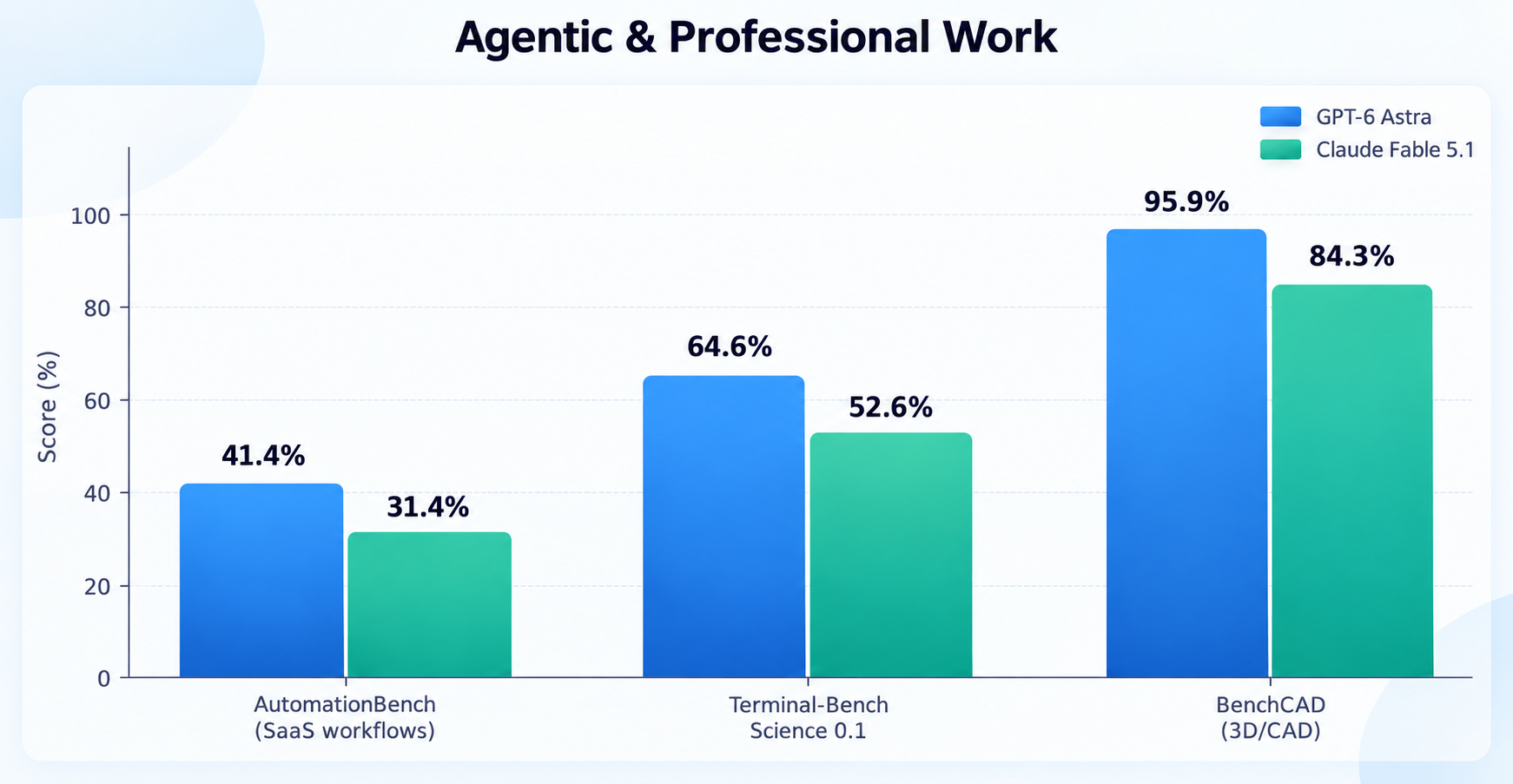
  • 95.9% on BenchCAD (3D reconstruction to CAD code) 
  • 72.6% on OSWorld 2.0 (roughly 47% less time per task) 
  • 100% on ExploitBench (“Critical” cyber tier) 
  • 10+ built-in tool types via the Responses API. 
 GPT-6 Astra Claude Fable 5.1 
Launched September 3, 2026 Same launch window, 2026 
Strongest at Computer use, CAD/3D reconstruction, cybersecurity review Output speed, blended cost efficiency 
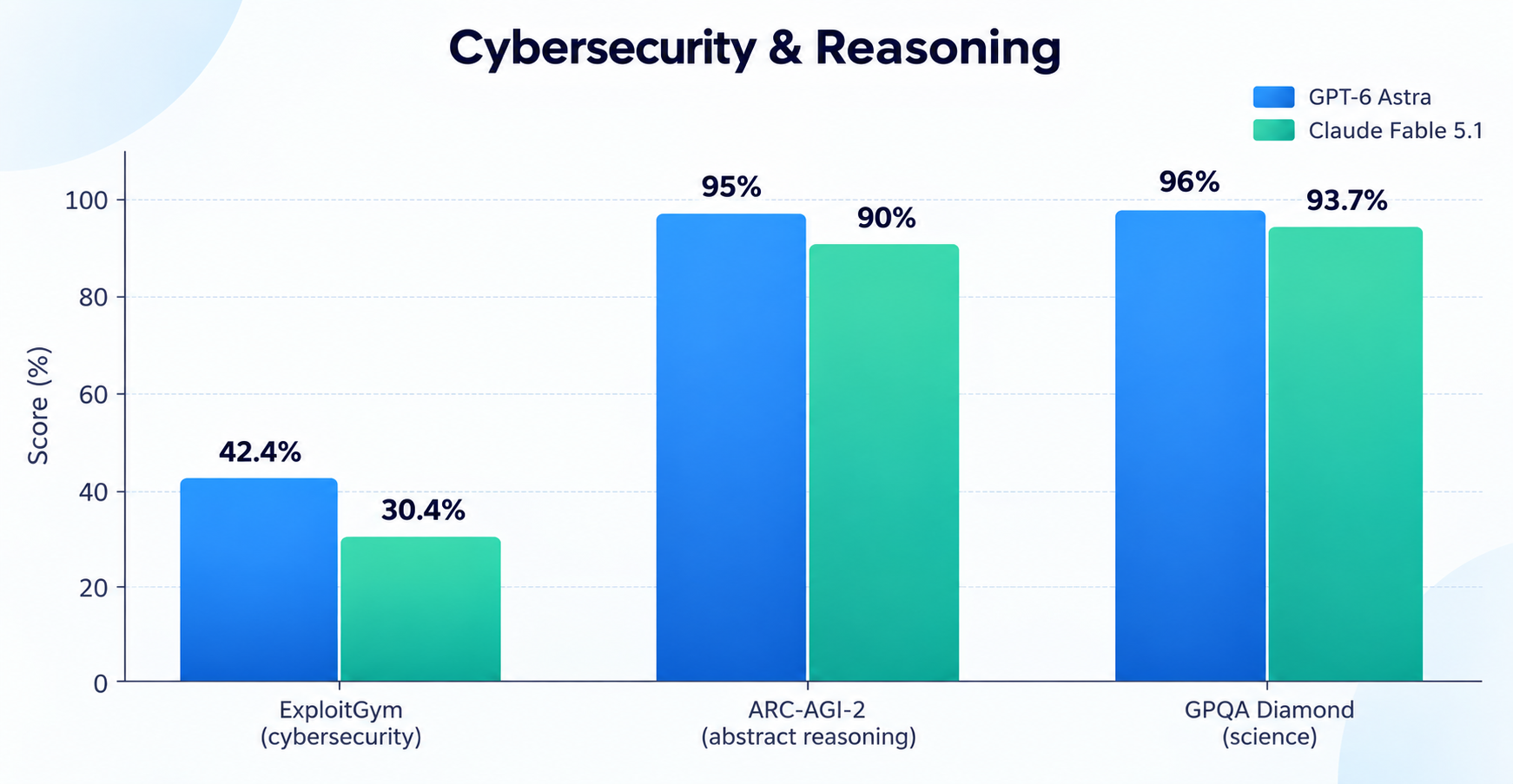
Headline benchmark 95.9% BenchCAD; 100% ExploitBench 84.3% BenchCAD; 30.4% ExploitGym 
Cybersecurity tier “Critical” (OpenAI Preparedness Framework) Not publicly documented at this tier 

Computer Use: The Biggest Single Capability Jump

Computer Use The Biggest Single Capability JumpAstra marks what OpenAI calls a new frontier in the speed, accuracy, and safety of computer use: filling out online forms, updating CRM records, organizing a calendar, drafting research summaries inside an email or document editor, and running frontend QA checks.  

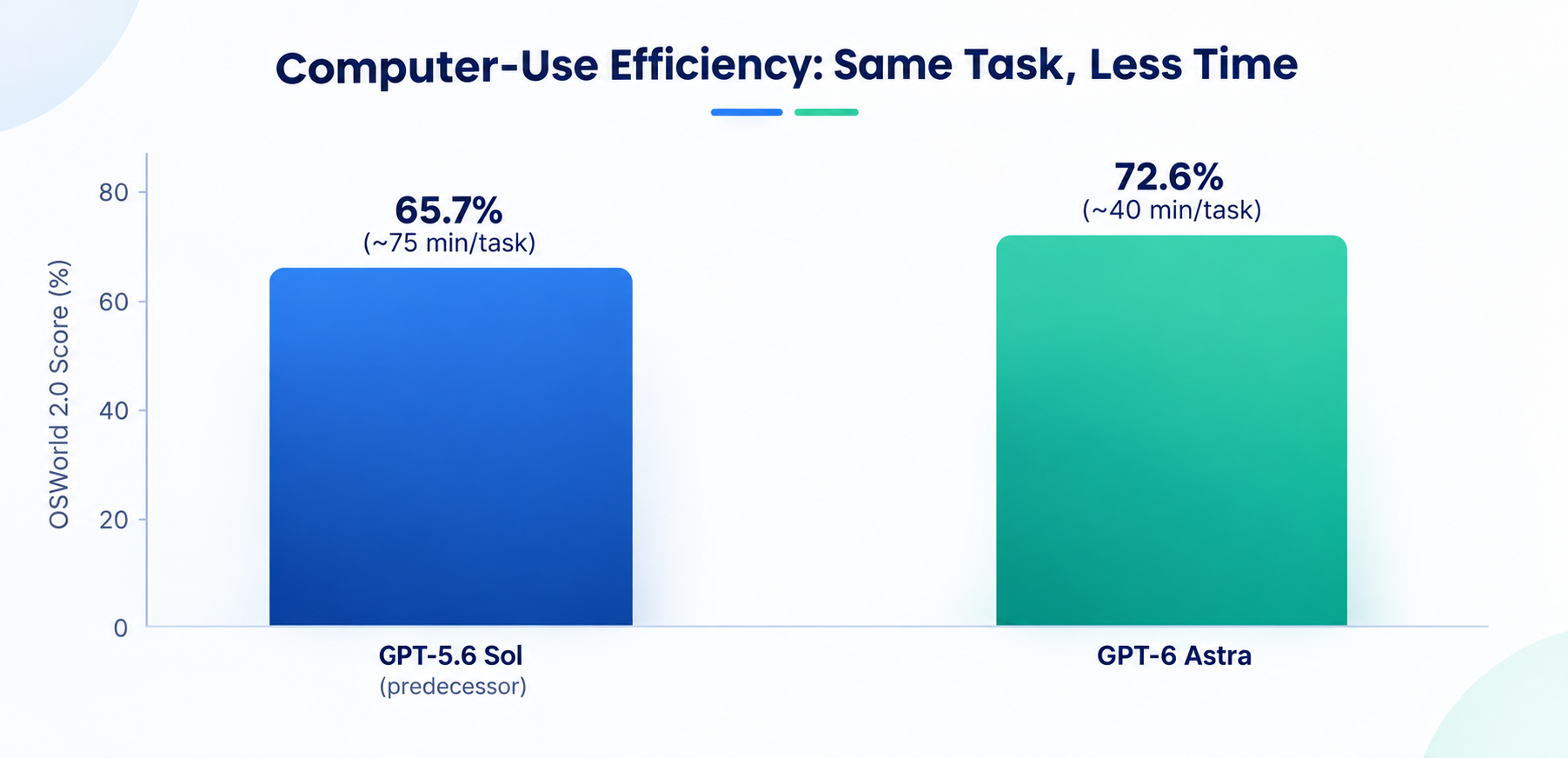
In latency testing on OSWorld 2.0, Astra hit 72.6% in roughly 40 minutes per task, against 65.7% in about 75 minutes for GPT-5.6 Sol, its predecessor, a 47% cut in time for a higher score. 

Paired with an updated Codex harness, OpenAI reports 1.9x faster task completion on Mind2Web versus the prior GPT-5.6 Sol experience. For any business built around repetitive screen work (data entry, back-office operations, QA testing, research summarization), this is the feature with the widest reach across industries. It goes well beyond any single vertical. 

Agentic Coding: Long Sessions, Not Just Better Code 

Agentic Coding Long Sessions, Not Just Better CodeAstra posts real gains on agentic coding benchmarks against Claude Fable 5.1. Terminal-Bench 4.0, DeepSWE, and FrontierCode all favor Astra by several points. 

Two features matter more than the raw scores. 

Persistent notes across context windows. Rather than summarizing away detail every time a long coding session fills its context, Astra can keep searchable notes across windows in Codex. It can find a requirement or test result from an earlier message even if that detail never made it into a compacted summary. This is opt-in today and becomes the default in the coming weeks. 

Async tool calls. Astra can ask a clarifying question and keep working on an independent part of the task while it waits for a reply, instead of blocking entirely. If nobody responds, it proceeds on sensible assumptions for routine gaps but waits on consequential decisions, useful for any long-running automation where blocking on every ambiguity kills throughput.

Design, CAD and 3D: A Genuinely New Application Area 

Design, CAD and 3D A Genuinely New Application AreaBenchCAD tests whether a model can reconstruct 3D objects from multi-view renders by generating CAD code. Astra scores 95.9% with tools, well ahead of Claude Fable 5.1’s 84.3%, though Anthropic’s own system card notes that score reflects three modifications to the evaluation, worth keeping in view. 

OpenAI’s own demonstrations extend this into practical engineering and design work: laying out a printed circuit board in KiCad from a schematic, modeling a house in Blender and turning it into a walkable Unreal Engine 5 scene, and building playable games with accurate motion and graphics. 

Choosing between frontier models before a frontier model ever touches a live workflow? Business Documents, Legal Work and Scientific Research 

Astra is trained to match a business’s existing templates rather than produce generic output: slides, spreadsheets, and analyses that fit an organization’s writing and visual style, pulling only the context that matters into the final artifact. Executing complex creative workflows in videos used up to 20% fewer tokens than other models tested, which translates directly into higher-quality output for end customers. 

In early legal testing, Astra approached legal work “the way a discerning lawyer does”: distinguishing documents from established records, surfacing unsupported assumptions, and converting gaps into concrete drafting positions. On the scientific side, Astra contributed to two new results on prime-number gaps, improving a bound that had stood for more than 80 years, and it pairs scientific reasoning with computer use to inspect sequencing data and genetic variation directly inside specialized research software.

Cybersecurity: A Capability Jump with Guardrails Attached 

Cybersecurity A Capability Jump with Guardrails AttachedAstra is the first OpenAI model to meet the “Critical” threshold for cybersecurity capability under the company’s Preparedness Framework. With the right tooling, it can independently identify and develop exploits for previously unknown vulnerabilities across hardened systems. https://openai.com/index/gpt-6-astra On ExploitBench it scored 100% versus 78.5% for GPT-5.6 Sol; on ExploitGym, a harder benchmark, it scored 42.4% against Claude Fable 5.1’s 30.4%. 

Because of that jump, OpenAI is keeping the most advanced cybersecurity capability restricted to a limited group of testers through its Daybreak program rather than opening it broadly. The model is designed to refuse tasks like generating proof-of-concept exploits under standard deployment. For security teams, the more immediately usable value is defensive: secure code review, patching, and, with expanded access, vulnerability validation and malware analysis.

Built-In Tools, Side by Side 

Neither lab ships a single chat endpoint. Both ship a broad agentic toolkit. The table below lines up what’s documented for each as of this launch window; where a capability isn’t publicly documented for a model, that’s noted rather than assumed absent. 

Built-in tool GPT-6 Astra Claude Fable 5.1 
Web search Yes, native tool Yes, togglable feature 
File search / retrieval Yes, dedicated File search tool Via Files API + code execution 
Code execution / interpreter Yes, Code interpreter tool Yes, code execution tool 
Computer use (GUI control) Yes, native Computer use tool Yes, native computer-use tool 
MCP / external connectors Yes, MCP & Connectors, Secure MCP Tunnel Yes, MCP Apps 
Hosted / local shell Yes, Shell and Local shell tools Bash tool via agentic harness 
Image generation Yes, gpt-image-2 Via code execution tool 
Deep research (specialized mode) Yes, separate Deep research model Yes, Deep research feature 
Persistent output canvas Sites in ChatGPT Artifacts 
Output content provenance Not specifically documented on launch page Statistical watermark + signed C2PA credentials 

Where This Shows Up Across Industries 

  • Engineering & Manufacturing: Reconstructs 3D CAD models from multi-view renders and lays out PCBs in KiCad from a schematic. 
  • Legal: Distinguishes established records from unsupported assumptions and converts gaps into concrete drafting positions. 
  • Finance & Consulting: Produces slides, spreadsheets, and analyses that match a firm’s own templates and visual style. 
  • Web, App & Game Dev: Creates, hosts, and shares a website, web app, or game directly from a prompt. 
  • Scientific Research: Combines scientific reasoning with computer use to inspect data in specialized software; contributed to two new results on prime-number gaps. 

How the Two Models Actually Compare

On general intelligence parameters, the two are close. Astra is genuinely ahead on agentic coding, design and CAD, and cybersecurity benchmarks. Fable 5.1 stays ahead on raw output speed and blended cost. 

Both ship comparably broad tool ecosystems. Astra’s toolkit is more granular and explicitly named (tool search, async tool calling, apply patch as distinct primitives), while Fable 5.1 folds similar capability into fewer, broader features. Which one fits a given team depends far more on existing cloud commitments, tool-by-tool fit, and cost profile than on any single leaderboard position. 

Our data and AI engineering experts can help you know which model serves your needs best. Frequently Asked Questions 

Predicting Readmission Risk Before It Happens: A COO’s Playbook for Closing the Discharge Loop

Summary

A standalone readmission risk score doesn’t move a hospital’s numbers, the 2025 and 2026 evidence both say so. What works is scoring patients at three points around discharge, routing every flagged risk to a named owner with a deadline, and measuring intervention completion alongside the readmission rate itself. The piece closes with a 90-day pilot design and the three-part rule for deciding whether to scale it.

Introduction 

Every hospital COO has sat through the meeting set up for predictive analytics in healthcare. A dashboard lights up red with high-risk discharges, a task force gets formed, and six months later the 30-day readmission rate hasn’t moved. The score wasn’t wrong. Nobody built a workflow around it. 

That’s the gap most readmission-risk programs fall into. The real job isn’t predicting who comes back. It’s identifying which discharges need an intervention, assigning that intervention to a named person, and finishing it before the patient hits the next failure point. Get that right, and readmission risk prediction stops being a compliance exercise and starts closing one of the quietest leaks in hospital capacity: a bed that reopens three days later because a discharge bounced back was never actually freed. If length of stay and discharge delay are the front half of your throughput problem, as we cover in The Hospital Throughput Crisis: How COOs Are Using AI to Cut LOS and Discharge Delays, readmissions are the back half nobody puts on the same whiteboard. 

Predictive modelling in healthcare is not starting from zero here. Somewhere in the building, a predictive model is already scoring patients. What’s usually missing isn’t the math. It’s the workflow, the named owner, and the deadline attached to what the model finds. 

Why readmission risk prediction alone won’t move your numbers

Most vendor demos sell prediction as the finish line. The evidence says otherwise. A randomized evaluation of causal machine learning across 19 hospitals and 9,959 patients tested a sharper idea: instead of targeting patients with the highest predicted risk, target the ones most likely to benefit from outreach. The trial found a 30-day readmission rate of 7.7% for benefit-based targeting against 8.2% for standard care. That gap wasn’t statistically significant. 

The model itself worked fine operationally. What the study actually proved is less comfortable: a high AUC, the number vendors love to put on a slide, doesn’t tell you whether an intervention will land. Readmission risk stratification only pays off when it’s measured against preventability and available outreach capacity, not against how cleanly the model separates high-risk from low-risk patients on paper. Grade your program on discrimination alone, and you’re grading the wrong exam. 

Most hospitals aren’t starting this comparison from scratch, either. The LACE index, built on length of stay, acuity, comorbidities, and emergency-department visits, has been the default readmission screening tool for well over a decade, and it remains a fair baseline to test any newer model against. The honest question was never LACE versus a fancier algorithm. It’s whether either one, on its own, changes what a care team actually does before the patient leaves. A model that beats LACE on a validation set but doesn’t move a single workflow decision hasn’t improved anything a COO can put on a scorecard.

What the 2026 evidence actually shows

A more encouraging picture comes from a nine-hospital study published in 2026. Researchers compared 4,662 discharges supported by virtual nursing against 4,662 traditional discharges with similar baseline risk scores. Emergency-department readmissions within 30 days landed at 3.7% for the virtual-nursing group, versus 13.3% for the control group. 

That’s a real difference, and it’s still a retrospective implementation study, not a randomized trial. It shows what the workflow model can do, not that the algorithm alone caused the drop. The prediction was attached to a full discharge operating system: medication reconciliation, teach-back, follow-up scheduling, barrier resolution, and a structured post-discharge contact plan. A score sitting alone on a dashboard, with no closed-loop task behind it, is unlikely to touch outcomes at all. 

This is where the scoring engine must earn its place inside the workflow, not just inside a model registry. Inferenz’s Caregence™ Predictive Models, built on their data science and predictive analytics services embed this kind of risk model directly into clinical and operational workflows, so a discharge score triggers action instead of sitting in a report nobody opens until the next steering committee. 

Score at three moments, not once 

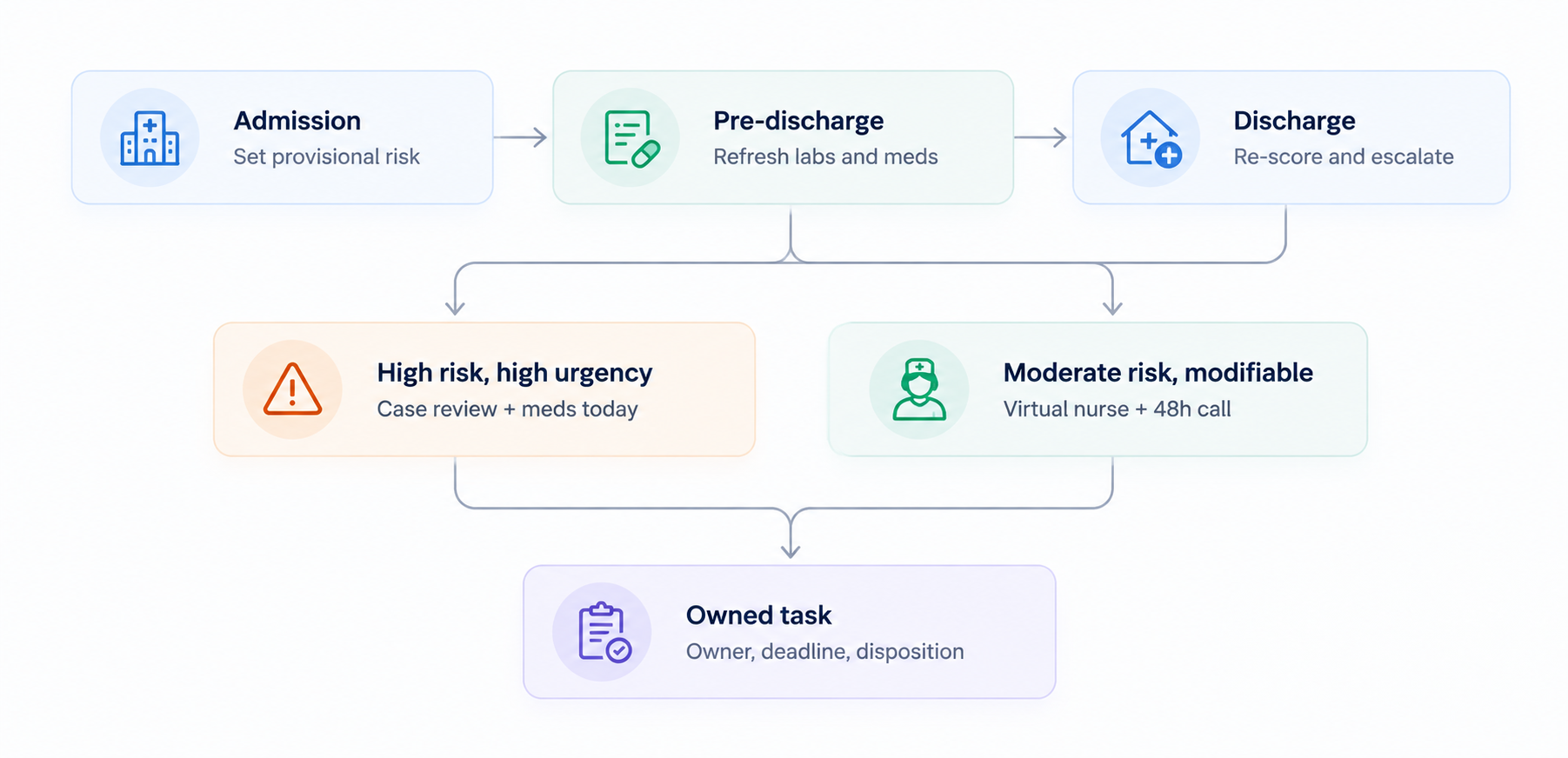
A single admission-time score is a snapshot from before the patient’s condition, medications, and discharge plan took final shape. Three checkpoints work better: 

  • At admission: establish a provisional risk and flag likely barriers. 
  • 24 to 48 hours before discharge: refresh the score using current labs, utilization data, medication changes, functional status, social needs, and discharge destination. 
  • At discharge and again 48 to 72 hours after: re-score or trigger a rules-based escalation the moment a patient misses a prescription fill, a follow-up visit, or a home-service connection. 

The second and third checkpoints carry more operational weight than the first, because they’re the only ones where the team can still change what happens to the patient. None of this works if a case manager has to log into four systems to see current labs, medications, and social-needs data in one place. That’s a real-time readmission risk dashboard problem before it’s a prediction problem, which is why MPI and Patient 360 matters as much here as the model itself. The use of predictive AI in discharge planning could include a risk assessment tool that refreshes on stale or fragmented data will confidently produce the wrong answer.

Three checkpoints and two lanes for responsesTwo lanes, not one risk list 

Treating every elevated score the same way guarantees alert fatigue. Split the response into two lanes instead: 

  1. High risk, high urgency: same-day case-management review, medication reconciliation, a follow-up visit booked before discharge, and resolved transportation, caregiver, food, housing, or equipment barriers.
  2. Moderate risk, high modifiability: a virtual nurse or transition coach, teach-back, a 48-hour call, a pharmacy and primary-care connection, and automated escalation if contact fails. 

The model should optimize for risk times preventability times available intervention capacity, not risk in isolation. That’s the same principle behind the benefit-based targeting study above, applied at the operational level instead of the modeling level. Case managers should keep override authority. They see context a model never will, and a program that strips out clinical judgment for the sake of algorithmic purity tends to lose clinician trust fast, which is its own kind of failure.

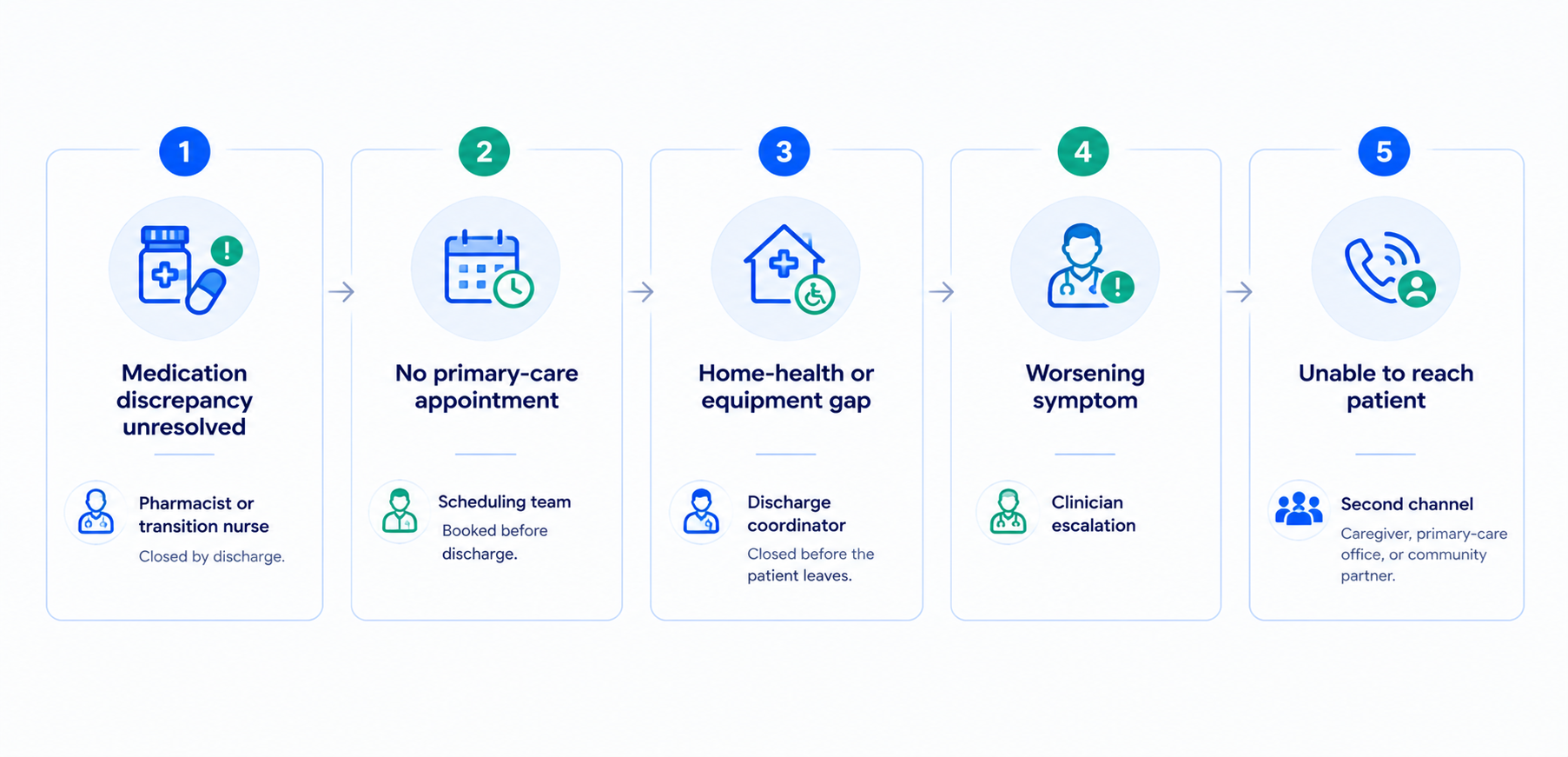
Turn every alert into an owned task 

A risk score without an owner is just anxiety with a percentage attached. Every alert needs three things: an owner, a deadline, and a disposition.

Turn every alert into an owned taskThis is intelligent automation in healthcare doing the unglamorous work it’s actually good at: not diagnosing anyone, just making sure a task doesn’t fall through a shift change. It’s also a clean example of agentic AI applications in healthcare done right, where the agent’s job is routing and follow-through, not clinical judgment. Inferenz’s Risk Analyzer Agent is built around exactly that pattern. It tracks vitals, visit patterns, and clinical events to flag deterioration early, routes the next best action to the right team automatically, and keeps tracking whether that action closed on time.  

Pair that with a structured post-discharge contact channel for the 48-hour call and teach-back steps, and the dashboard finally shows something more useful than a headcount of high-risk patients. It shows open tasks and how long they’ve been sitting there. 

See how a digital patient engagement layer unified post-discharge outreach for a national hospice provider.Read the case study

What COOs and CNOs should actually measure 

Two categories of metrics matter here and mixing them up is a common mistake.  

Leading indicators tell you if the workflow is running: the share of eligible discharges scored before the decision window closes, the share of high-priority patients with a named owner within four hours, medication reconciliation completed before discharge, follow-up appointments booked before discharge, successful patient contact within 48 hours, and alert acceptance, override, and closure rates by unit. 

Leading indicators (is the workflow running?) Outcome & balancing measures (did it work?) 
% of eligible discharges scored before the decision window closes 7-, 30-, and 90-day all-cause readmission 
% of high-priority patients with a named owner within 4 hours ED revisits without admission 
Medication reconciliation completed before discharge Time to first post-discharge contact 
Follow-up appointment booked before discharge Staff workload and after-hours burden 
Successful patient contact within 48 hours Mortality and observation stays 
Alert acceptance, override, and closure rates by unit Calibration by race, language, payer, disability, rurality, discharge destination 

There’s a hard financial backdrop to all this. CMS’s FY 2026 rule continues to publish Hospital Readmissions Reduction Program payment-adjustment factors for discharges beginning October 1, 2025, alongside hospital-level social-risk and behavioral-health diagnosis coding data. That turns readmission and equity monitoring into a standing operating concern for a COO, not a side project the data-science team reports on once a quarter. 

It also connects directly to whatever value-based or bundled-payment contracts your finance team is already tracking. A readmission avoided inside a bundled episode isn’t just a quality win. It’s margin your CFO can point to on the same call where HRRP penalties get discussed, which is usually the fastest way to keep a discharge-workflow program funded past its first budget cycle.

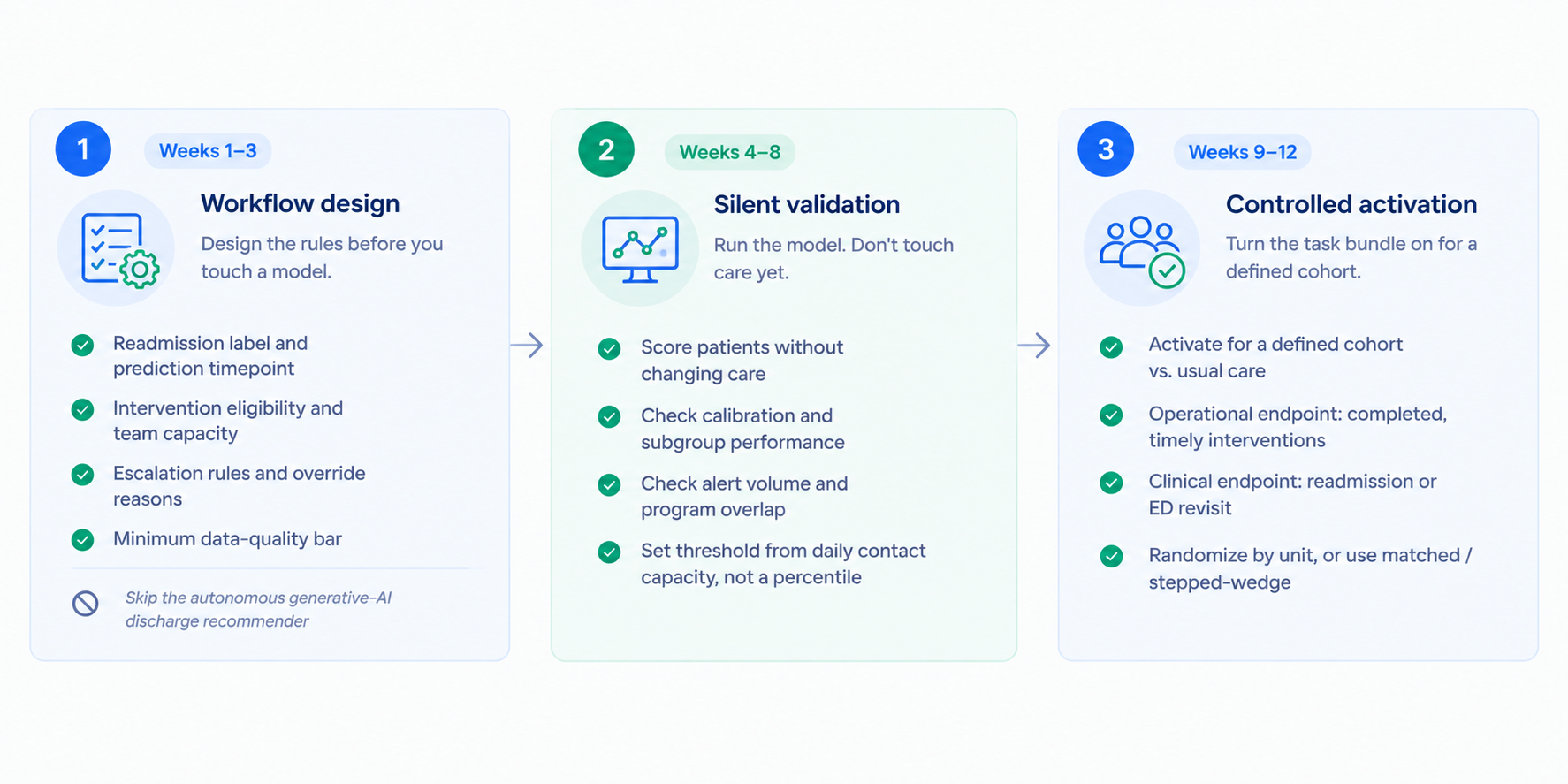
A 90-day pilot you can actually finish 

Pick one service line with real volume and a defined transition team, is what we suggest as part of our data quality, governance, and compliance services. Heart failure, COPD, general medicine, and oncology all work well as a starting point. Ninety days is short enough to keep executive attention and long enough to get past the noisiest weeks of any new workflow. 

A 90-day pilot you can actually finish The decision rule before you scale 

Fund the program past the pilot only if it clears three bars at once: a usable signal that calibrates well in your own population, operational conversion where alerts turn into completed actions inside your real staffing model, and clinical value where the intervention arm improves readmission or revisit outcomes without pushing workload, inequity, or safety risk onto your staff. 

The 2026 virtual-nursing results are encouraging, and they’re still observational, published as an early-access manuscript still working through peer edits. Pilot the workflow. Measure intervention completion, not just the risk score. Scale after your own data backs it, not after a vendor’s. 

None of this is really about the algorithm. A discharge isn’t finished when the patient walks out the door. It’s finished when they don’t come back for a preventable reason, and getting there is a staffing and workflow discipline with a model attached to it, not the other way around. This is where a digital patient engagement platform can extend the workflow beyond the hospital, helping care teams maintain meaningful patient engagement, follow-up, and communication after discharge.  

Treat readmission risk prediction as the entry ticket, not the finish line, and you’ve also closed one of the least visible drains on your throughput math, because every bed a readmission reopens is one your capacity planning already counted as free. 

Ready-to-turn-readmission-risk-into-a-working-discharge-workflow-Talk-to-us-todayFrequently Asked Questions

Referral Leakage to Post-Acute Care: The Silent Revenue and Outcomes Drain

Summary

Post-acute referral leakage quietly costs the average health system millions in margin every year, and CMS’s mandatory bundled payment model (TEAM) just turned that leakage into a direct financial and quality risk. This piece shows hospital COOs and CFOs how to measure referral leakage, build a preferred post-acute network, and close the loop with real-time data and agentic AI before the next board review turns up a number nobody can explain.

Introduction

Your discharge planner just placed a patient at a skilled nursing facility eleven miles outside your network. Nobody flagged it. Nobody will, either, not until your CFO’s quarterly review turns up a margin gap that takes three meetings to trace back to its source.

That gap has a name: referral leakage to post-acute care. It rarely shows up as a clean line item. It shows up as a slow erosion across margin, readmission data, and quality scores, and by the time finance connects the dots, the patient has already been discharged, readmitted, or lost to follow-up for months.

For a hospital COO or CFO in 2026, this stopped being a someday fix the day CMS made bundled payments mandatory. Under the Transforming Episode Accountability Model (TEAM), your organization now owns the cost and quality outcome for 30 days after a covered surgical discharge, regardless of which skilled nursing facility, home health agency, or rehab center the patient actually ends up at. Referral leakage used to be a marketing problem. It’s a balance sheet problem now.

What Referral Leakage Actually Means (and Why It Isn’t the Same as Patient Choice)

Post-acute care is the bridge between hospital discharge and full recovery: skilled nursing, inpatient rehabilitation, home health, and hospice services that pick up where the inpatient stay leaves off. Referral leakage happens when a patient who was a good fit for one of your preferred, high-performing post-acute partners ends up somewhere else instead, at a facility your system has no data-sharing agreement with, no outcomes visibility into, and often no quality track record on at all.

That’s a different problem from patient choice, and the distinction matters for compliance as much as for strategy. Federal discharge planning rules require hospitals to give every Medicare patient a list of certified home health agencies and skilled nursing facilities, along with relevant performance data, and to respect whichever provider the patient or family ultimately picks. You cannot, and should not, try to engineer that choice away.

What you can influence is which option looks easiest, fastest, and clearest on that list. A predictive matching AI agent can help discharge teams identify suitable post-acute providers based on patient needs, provider capabilities, availability, location, and relevant quality indicators. Most leakage isn’t patients actively rejecting your preferred partners. It’s a discharge planner on a Friday afternoon defaulting to whoever picks up the phone first, because nobody built a faster path to the provider who’s actually good.

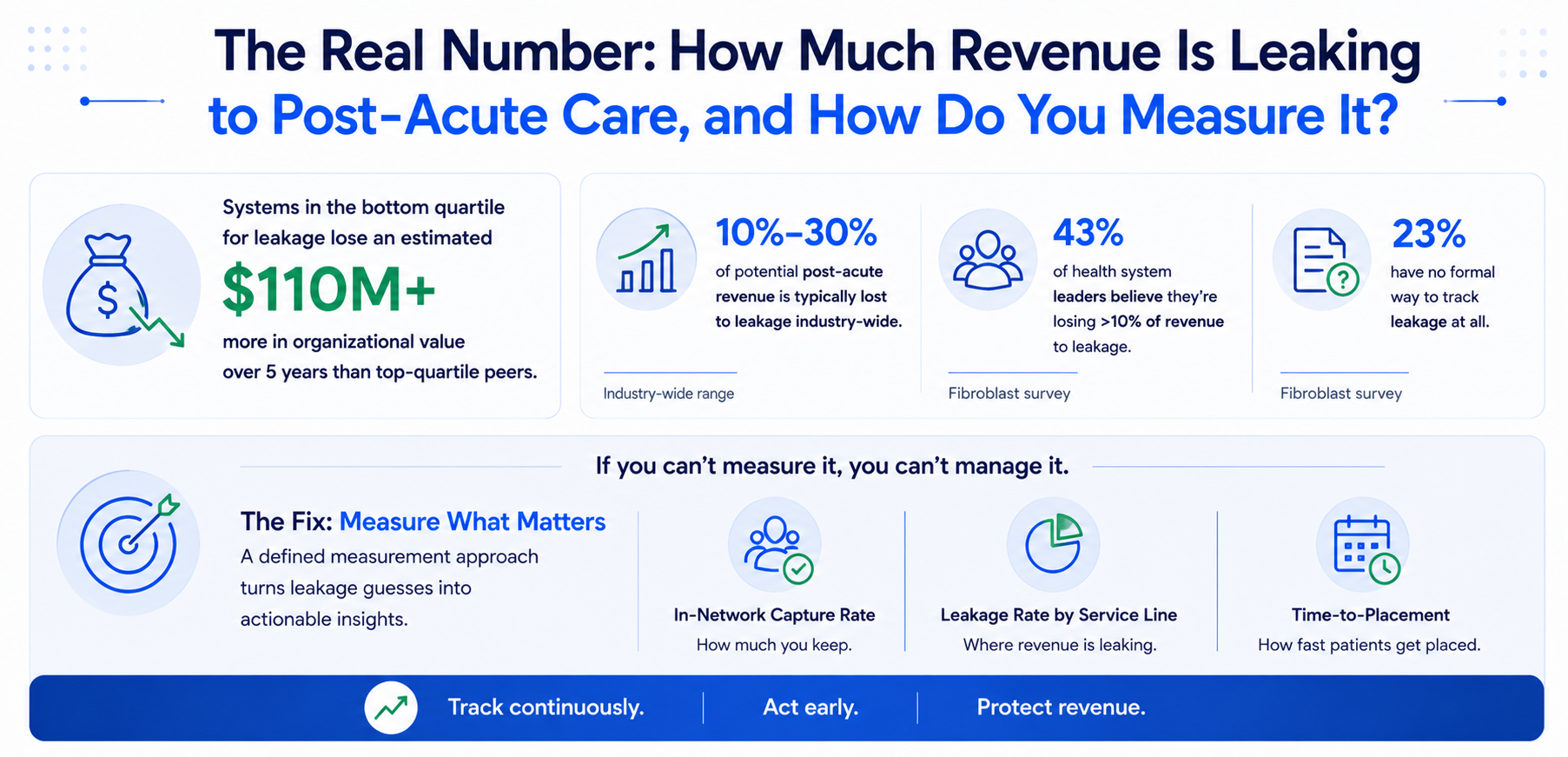
The Real Number: How Much Revenue Is Leaking to Post-Acute Care, and How Do You Measure It

The Real Number: How Much Revenue Is Leaking to Post-Acute Care, and How Do You Measure ItAsk five people on your leadership team how much revenue leaks to out-of-network post-acute providers every year, and you’ll likely get five different guesses. That uncertainty is itself the finding, and it’s showing up at a moment when hospitals can least afford it.  

Fitch Ratings forecasts nonprofit hospital operating margins between just 1% and 2% for 2026, with the sector splitting into three tiers: the top 20% of systems using strong balance sheets to grow, the middle 65% expected to stagnate, and the bottom 15% losing ground.  

Against margins that thin, and that unevenly distributed, recaptured referral volume, care you’re already equipped to deliver, at reimbursement you’re already contracted for, is one of the few growth levers that can move the needle inside the same fiscal year. 

The mismatch shows up in the data wherever researchers have looked for it.  

The Medicare Payment Advisory Commission’s March 2026 report to Congress cites a peer-reviewed study finding that the discharging hospital itself had a measurably large effect on whether stroke patients were referred to an inpatient rehabilitation facility or a skilled nursing facility. The same report notes that industry stakeholders have told the Commission that inpatient rehabilitation facilities admit fewer than 40% of the patients referred to them in the first place, a gap that has little to do with network status and everything to do with a referral process that doesn’t reliably match patients to a setting that will actually take them. 

None of that variation is random, and none of it means the fix requires guessing better. It means the process determining where a patient lands, runs on hospital habits and default behavior. It is not connected to a system built to route patients to the best available fit and confirmed placement.  

If your organization doesn’t have a defined measurement approach in place, in-network capture rate, leakage rate by service line, and time-to-placement, tracked continuously through business intelligence & data visualization services instead of reconstructed after the fact once claims data finally surfaces the problem, you’re not managing referral leakage. You’re guessing at it. 

Building an Enterprise Data Platform from the Ground Up for a Post-Acute Care Organisation

Where the Leakage Actually Happens: The Discharge Planning Breakdown Points

Ask a discharge planner why a patient ended up at Facility B instead of your preferred Facility A, and the honest answer is rarely “the patient chose it.” More often, it’s one of a handful of operational failure points that repeat across nearly every health system, on nearly every shift.

Breakdown PointWhat It Looks Like on the FloorWhy It Drives Leakage
No real-time bed or capacity visibilityPlanner manually calls four or five facilities to check for an open bedWhoever answers first gets the patient, not whoever performs best
Fragmented scheduling workflowsReferral sent by fax, confirmed by phone, tracked in a spreadsheetThe loop closes late, or doesn’t close at all
Insurance and prior-auth frictionPlanner isn’t sure which post-acute partners the plan actually coversDefault becomes convenience, not network fit
No closed-loop confirmationOnce the discharge order is signed, no one confirms the placement happenedLeakage stays invisible until claims data surfaces it months later
Weekend and after-hours coverage gapsDischarge happens Friday afternoon; preferred partners don’t answerPatient goes wherever is reachable, network status aside

Table 1. Five recurring breakdown points across the post-acute referral process.

None of these are exotic problems. They’re the same five or six friction points, repeating on every shift, invisible until someone finally adds up the cost.

The Downstream Hit: Readmissions, Quality Scores, and the Beds You Can’t Turn Over

Once a patient leaves your network for post-acute care, you lose more than the placement. You lose visibility. There’s no shared data feed telling you whether that skilled nursing facility caught a medication issue early, whether the home health agency showed up for the first visit, or whether the patient is trending toward a readmission you could have prevented.

That matters more than it used to. Hospitals nationwide are now watching Medicare Advantage patients wait nearly twice as long to be discharged to post-acute care as traditional Medicare patients, a gap that has doubled since 2019, even as MA reimbursement to hospitals fell 8.8% over the same period. Hospitals are absorbing that mismatch directly: longer stays, no matching payment, and beds tied up by patients who are medically ready to leave but have nowhere confirmed to go.

Referral leakage and bed-turnover delay come from the same root cause: discharge planners without real-time visibility into which post-acute partner has capacity, takes the patient’s plan, and actually performs well on outcomes. Fix the visibility problem and both numbers move together.

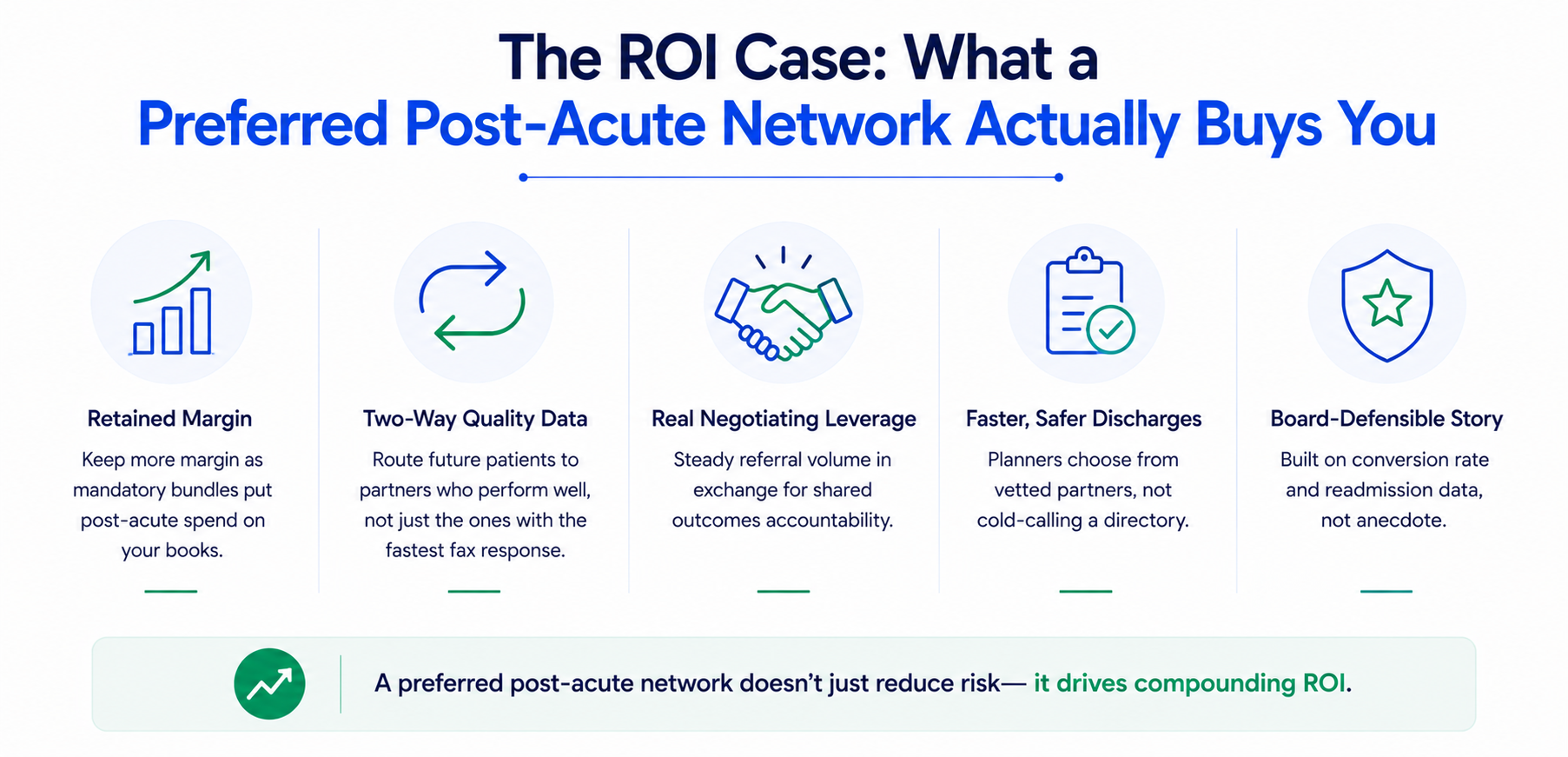
The ROI Case: What a Preferred Post-Acute Network Actually Buys You

The ROI Case What a Preferred Post-Acute Network Actually Buys YouBuilding a genuinely high-performing, in-network post-acute panel, and steering referrals toward it, isn’t just a defensive move. It compounds.

  • Retained margin, at a moment when mandatory bundled payments put post-acute spend directly on your books.
  • Two-way quality data, so you can route future patients to partners who actually perform well, not just the ones with the fastest fax response.
  • Real negotiating leverage with skilled nursing facilities and home health agencies who want steady referral volume in exchange for shared outcomes accountability.
  • Faster, safer discharges, because planners choose from a short list of vetted partners instead of cold-calling down a directory.
  • A board-defensible measurement story, built on conversion rate and readmission data instead of anecdote.

CMS’s Mandatory Bundled Payments Just Raised the Stakes

If you’ve been treating post-acute referral strategy as a someday project, TEAM changed the timeline. The model has been mandatory since January 1, 2026, for more than 700 acute care hospitals across 188 geographic markets, covering five surgical episodes: lower extremity joint replacement, surgical hip and femur fracture treatment, spinal fusion, coronary artery bypass graft, and major bowel procedures. 

Here’s the part that should change how your team thinks about referrals. Each episode includes 30 days of post-acute care bundled under a single target price, covering skilled nursing, home health, and hospice. Come in under that target while hitting quality benchmarks, and the hospital shares in the savings. Let a patient leak to an out-of-network, uncoordinated, or lower-performing post-acute provider during that same window, and the hospital still owns the cost and the outcome, even though it lost control of where the patient went. 

Medicare Advantage plans add another layer of pressure, often steering patients toward their own narrow post-acute networks regardless of clinical fit or your existing partnerships. Between TEAM’s mandatory risk and MA’s narrowing networks, referral leakage has quietly become one of the more direct financial exposures on your books. Addressing that exposure requires data strategy consulting services that bring referral, payer, provider, network, and post-acute data together to give hospital leaders the visibility they need to make better-informed decisions. 

Real-Time Data and Interoperability: What Actually Closes the Loop

Most referral leakage isn’t a strategy failure. It’s a data-timing failure. The discharge planner needs to know, in the moment, which preferred partners have an open bed, accept the patient’s insurance, and have a real track record on readmissions and length of stay. Instead, that information usually lives in three different systems, none of which talk to each other, updated on three different schedules.

Closing the loop takes three things working together:

  1. A live feed of bed and capacity availability from your preferred partners
  2. Care transitions data that flows both directions between your EHR and the post-acute provider
  3. Closed-loop referral tracking that confirms a placement actually happened instead of assuming it did once the discharge order is signed.

Without that third piece, leakage stays invisible until claims data surfaces it, long after the decision that caused it.

Is Agentic AI for Referral Management Ready, or Still Overhyped?

Reasonable question, and worth a direct answer instead of a sales pitch.

Fully autonomous AI making clinical placement decisions on its own: not ready, and not something most compliance or clinical governance teams should sign off on yet. What is ready, and already deployed at scale in some health systems, is much narrower. AI agents that check real-time bed availability across your preferred network, verify insurance and prior-authorization fit, surface the best matching in-network option to the discharge planner within seconds, and automate the caregiver matching and scheduling steps that used to eat an entire afternoon.

The useful test for a COO or CFO evaluating vendors: does the AI make the decision, or does it hand the discharge planner a faster, better-informed decision to make themselves? The second version is mature technology, deployable now. The first version, mostly, is still a demo.

KPIs to Track (and How to Build Accountability Without Adding Headcount)

KPIWhat It Tells YouTarget Direction
In-network capture rateShare of eligible referrals placed with preferred, high-performing partnersHigher
Referral conversion rateShare of referrals that result in a confirmed, completed placementHigher, and faster
Time-to-placementHours from discharge order to confirmed bedLower
Readmission rate by post-acute partnerWhich partners actually perform once the patient leavesTrack continuously, route accordingly
Leakage rate by service lineWhere leakage concentrates, prioritized by TEAM-covered episodesLower, starting with highest-volume episodes

Table 2. Core KPIs for benchmarking post-acute referral performance.

You don’t need a bigger team to close this gap. You need visibility that already exists somewhere in your systems, surfaced at the moment a discharge decision gets made, with the friction stripped out. Automate the checking, the matching, and the confirming. Leave the judgment calls, and the relationships, to your discharge planners.

Where This Fits in Your Throughput Strategy

Referral leakage and bed-turnover delay are two symptoms of the same disease: discharge decisions made without real-time visibility into where a patient can actually go, safely and well. 

  • If your organization is measuring leakage for the first time, start narrow. 
  • Pick your highest-volume TEAM-covered episode and build a preferred panel of three to five post-acute partners with real outcomes data behind them. 
  • Track conversion rate for ninety days before scaling further. 

Your board doesn’t need a hundred-page strategy. It needs a number that moves, and proof of why it moved. Data engineering and integration services can connect referral, partner, placement, and outcomes data across disconnected systems, giving teams the visibility they need to identify leakage and improve throughput. 

Inferenz unifies hospital and ambulatory data into one governed foundation, building an AI-ready infrastructure for hospitals & ambulatory environments.

Frequently Asked Questions 

What CMS-0057-F Actually Requires from Hospitals (Not Just Payers)

Summary

CMS-0057-F regulates payers directly, Medicare Advantage plans, Medicaid and CHIP programs, and marketplace QHP issuers. Hospitals get pulled in through EHR certification, daily API traffic, and a new Promoting Interoperability attestation. That attestation is optional for CY2027 and turns mandatory starting CY2028, per CMS’s FY2027 IPPS Final Rule, one year later than most compliance calendars still assume.

If you ask five professionals working at your hospital who CMS-0057-F applies to and you will probably get five different answers. Compliance says “not us, that is a payer rule.” IT says “sort of, through the EHR.” Finance just wants to know if it shows up in next year’s capital plan. All three are half right, which is exactly the problem. 

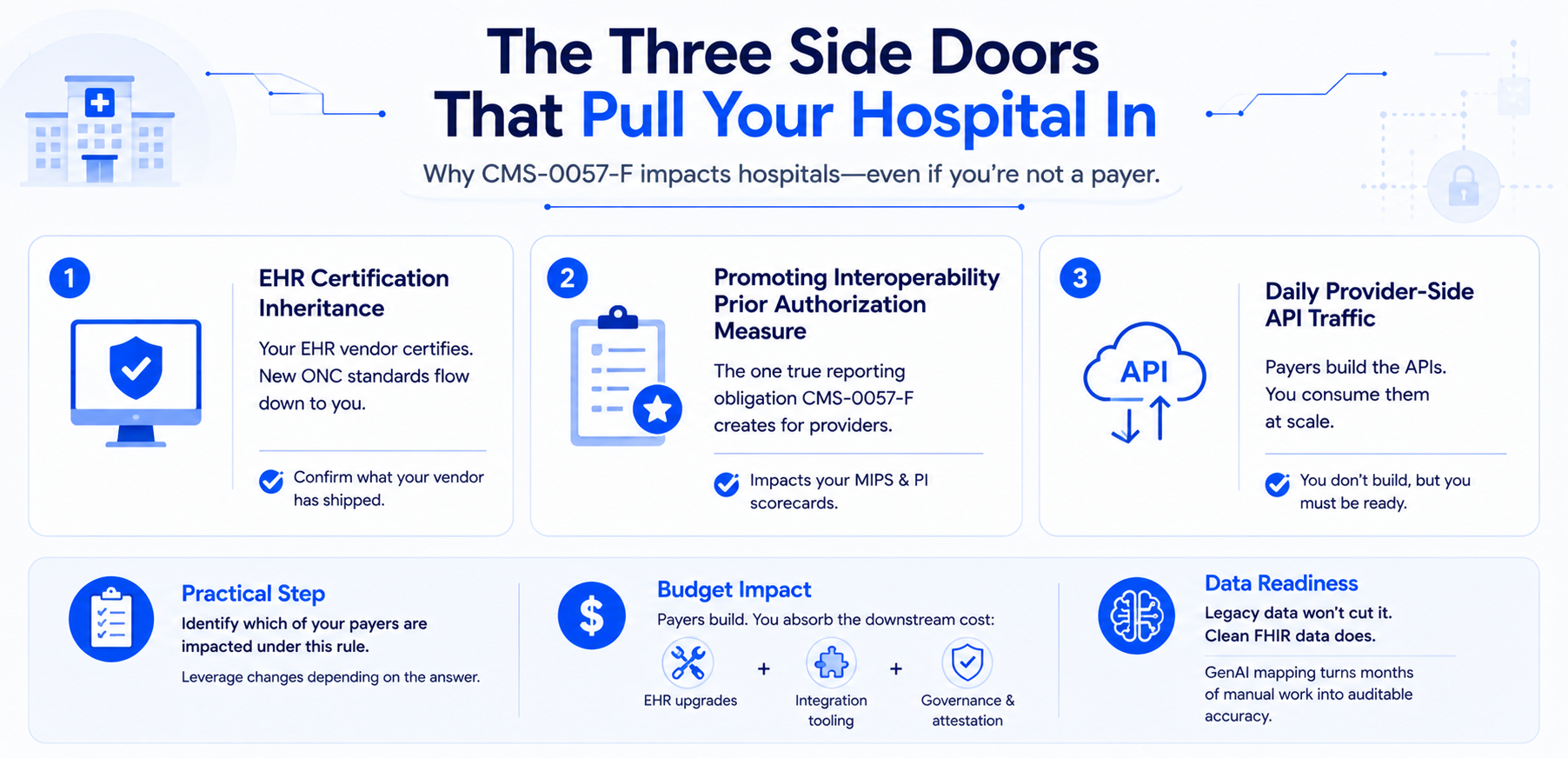
CMS-0057-F, the CMS Interoperability and Prior Authorization Final Rule, technically regulates health plans, not hospitals. But three separate mechanisms pull provider organizations into its compliance perimeter anyway, and one of them carries a real reporting obligation with a deadline that just moved. This piece untangles the payer-versus-provider confusion, walks through what your hospital actually has to do and by when, and flags where the real risk sits if you get it wrong. 

Does CMS-0057-F Apply to Hospitals, or Only to Payers? 

CMS-0057-F hospital requirements exist, but they are a side effect of a rule written for a different audience. The final rule regulates what CMS calls “impacted payers,” and that is a defined, closed list, not a general statement about the health system. 

Directly Regulated (“Impacted Payers”) Explicitly Outside the Rule 
Medicare Advantage (MA) organizations Traditional Medicare Fee-for-Service (Original Medicare) 
State Medicaid & CHIP fee-for-service programs Employer-sponsored / self-funded commercial plans 
Medicaid managed care plans (MCOs, PIHPs, PAHPs) Stand-alone dental plan (SADP) issuers 
CHIP managed care entities FF-SHOP-only issuers 
QHP issuers on the Federally Facilitated Exchanges State-Based Exchange (SBE) issuers 

 That second column answers two questions we hear constantly. Is traditional Medicare FFS subject to CMS-0057-F? No, though CMS has said it wants Original Medicare to be a “market leader” on data exchange voluntarily, which is an intention, not a mandate. Are commercial employer plans exempt? Yes, almost entirely, since the only commercial coverage the rule touches is QHPs sold on the federal exchange.  

The full CMS-0057-F Requirements for Payers run through four FHIR APIs, which we break down below.

The Three Side Doors That Pull Your Hospital In 

The Three Side Doors That Pull Your Hospital InIf your hospital is not a regulated payer, why is this rule on your CIO’s roadmap at all? Three mechanisms do it, and none of them require you to build anything CMS-0057-F itself mandates. 

  1. EHR certification inheritance. Your EHR vendor, Epic, Oracle Health, MEDITECH, whichever you run, has to certify against updated ONC standards to keep selling into the market impacted payers depend on. That certification cascade means your environment inherits new data requirements whether or not your compliance team ever reads the Federal Register notice. Confirm what your vendor has actually shipped against the ONC Certified Health IT Product List before it lands on a board slide marked “done.” 
  2. A new Promoting Interoperability Prior Authorization measure. Covered in full in the next section, this is the one true reporting obligation CMS-0057-F creates for providers. It is the reason a “payer rule” now has a line on your MIPS and Promoting Interoperability scorecards. 
  3. Daily provider-side API traffic. Once impacted payers stand up their Provider Access and Payer-to-Payer APIs, your staff will pull and push patient data through them constantly, whether or not your organization formally opted in. Does CMS-0057-F require hospitals to build their own FHIR API? No. The build obligation sits with payers. What you do need is a clean way to consume what they build at scale, and that is a real technical decision even without a mandate attached.  

Keen to know how the new regulation and a AI-ready hospital has in common? Read the comprehensive article here: CMS-0057-F and the AI-Ready Hospital: What CIOs Must Solve Before January 2027 

One practical step worth taking this quarter: pull your top payer contracts and mark which ones are actually impacted payers under this rule. A regional Medicaid MCO and a national Medicare Advantage plan both count. A self-funded employer plan administered by the same carrier does not. Knowing the difference changes your leverage in the next vendor conversation, since an impacted payer is working against a federal deadline you can point to and a non-impacted one is not. 

Budget impact follows the same logic. Payers carry the cost of building the APIs, but your hospital absorbs the downstream cost: EHR upgrade fees folded into your maintenance contract, integration tooling to consume payer endpoints at real volume, and the governance work required to prove your attestation is accurate on request. None of that shows up in CMS’s regulatory impact analysis. All of it shows up in your capital plan. 

For most hospitals that isn’t a connectivity problem. Legacy HL7v2 feeds and free-text notes have to become clean FHIR resources before any API call means anything, and that’s exactly where generative AI data mapping for healthcare interoperability earns its keep, turning months of manual field-mapping into a supervised, auditable process. 

The Promoting Interoperability Attestation, Explained 

This is the part most compliance briefings skip past, and it is the one with an actual reporting requirement attached to your organization’s name. 

CMS-0057-F added a new measure called Electronic Prior Authorization to two separate reporting tracks: the Promoting Interoperability performance category of MIPS, for MIPS eligible clinician prior authorization attestation, and the Medicare Promoting Interoperability Program 2027, for eligible hospitals and critical access hospitals. 

Both tracks work the same way. It is an CMS-0057-F yes/no attestation requirement, not a numerator-over-denominator calculation. You, or your CAH, report a simple yes or claim an applicable exclusion, confirming that you requested at least one prior authorization electronically through a payer’s FHIR-based Prior Authorization API, using certified EHR technology, during the reporting period. 

Reporting Track Who It Covers Status 
MIPS Promoting Interoperability category MIPS eligible clinicians CY2027 performance period / CY2029 payment year, as originally finalized 
Medicare Promoting Interoperability Program Eligible hospitals & Critical Access Hospitals Optional bonus for CY2027, mandatory from CY2028 (FY2027 IPPS Final Rule) 

 Are Critical Access Hospitals affected by CMS-0057-F?  

Yes, explicitly. CAHs sit in the same reporting bucket as eligible hospitals under the Medicare Promoting Interoperability Program, not a separate, lighter-touch category. 

This single line is also how CMS-0057-F interacts with your existing Promoting Interoperability scoring. Electronic Prior Authorization sits inside the Health Information Exchange objective, next to measures you already report. It does not replace your current PI obligations. It adds one more, worth bonus points now and a required line item later. 

If your data foundation is not ready for one clean attestation, it is not ready for AI at scale either. They are the same gap, wearing two different deadlines. Leaders need to align with the regulation objectives by transforming the data foundation for building an AI-Ready infrastructure for hospitals & ambulatory organizations.  

2027 vs. 2028: The Deadline Most CIOs Still Have Wrong 

A lot of hospital compliance calendars are quietly out of date on this exact point. 

When CMS-0057-F was finalized in January 2024, the Electronic Prior Authorization measure was written as effective for eligible hospitals and CAHs starting the CY2027 EHR reporting period, full stop. That is still the number sitting in a lot of 2025-era compliance decks. 

It changed.  

In the CMS FY2027 IPPS rule hospital prior authorization update, CMS finalized a one-year softening specifically for hospitals and CAHs: the measure is now an optional bonus measure for CY2027, attest yes and earn 10 bonus points toward your PI score, no exclusion needed because it is voluntary, becoming a CMS-0057-F provider compliance 2027 non-issue this year and a mandatory measure starting CY2028. 

That is genuinely good news, one more year of runway on this specific line item. It is not, however, a reason to sit still. Here is why. The hard part was never the attestation checkbox. It is the underlying capability: a working connection to a payer’s live Prior Authorization API, patient and encounter data clean enough to generate a real submission, and a workflow that gets a clinician or utilization management team to actually use it. That build takes months. Checking a box takes ten minutes. Treat CY2027 as a free pass and you simply move the scramble to late 2027, competing with every other hospital in your market for the same integration vendors at the same time. That’s the kind of gap an outside AI healthcare consulting engagement tends to catch faster than an internal audit, because it’s looking specifically for the space between what’s on the roadmap and what’s actually in production. 

CMS-0057-F 2028 hospital extension, in short: real, confirmed, and not an excuse to wait.

Contact UsCMS-0057-F vs. CMS-9115-F: What Actually Changed 

CMS-0057-F did not start from a blank page. It builds directly on CMS-9115-F, the 2020 CMS Interoperability and Patient Access Final Rule, which first required impacted payers to stand up a Patient Access API and a Provider Directory API. 

CMS-0057-F keeps that foundation and adds three new FHIR APIs, plus operational teeth the earlier rule never had. 

FHIR API What It Does New or Expanded? 
Patient Access API Lets patients pull claims, clinical, and now prior authorization data into apps of their choice Expanded (originated in CMS-9115-F; PA data added by CMS-0057-F) 
Provider Access API Shares claims, clinical, and PA data with in-network providers for patients they treat New in CMS-0057-F 
Payer-to-Payer API Moves up to five years of claims and clinical history when a patient switches plans New in CMS-0057-F 
Prior Authorization API Automates PA request submission, decision tracking, and specific denial reasons New in CMS-0057-F 

 The practical difference for a hospital: CMS-9115-F never created a provider-side reporting obligation. CMS-0057-F does, through the Promoting Interoperability attestation covered above. That is the line separating “a payer compliance rule we read about once” from “a measure with our organization’s name attached to it.” 

What Happens If You Don’t Attest, or Get It Wrong 

What Happens If You Don't Attest, or Get It WrongTwo separate risk tracks live under this rule, and hospitals routinely conflate them. 

  • Track one: missing the Electronic Prior Authorization measure itself. For CY2027, there is no penalty for skipping it. It is optional, and no exclusion process exists because none is needed, you simply forgo the 10 bonus points. Starting CY2028, that changes. Once it becomes a required measure, failing to attest without a qualifying exclusion counts against your Promoting Interoperability score the same way missing any other required PI measure would, which can affect your standing as a meaningful EHR user and, downstream, your Medicare payment update. 
  • Track two: information blocking. This is the sharper edge, and it does not run through CMS-0057-F directly. It sits under the separate 21st Century Cures Act framework. If your hospital cannot produce a documented, defensible reason for withholding electronic health information from a legitimate Provider Access or Payer-to-Payer request, and OIG investigates and refers a finding to CMS, the consequences are concrete. An eligible hospital loses meaningful EHR user status for that reporting period and forfeits three-quarters of its annual market basket payment increase.  

A CAH gets paid 100% of reasonable costs instead of 101%. HHS’s own estimate put the median financial hit at roughly $394,000, ranging from about $30,000 to $2.4 million depending on the hospital. 

The realistic risk exposure for a hospital that treats CMS-0057-F as someone else’s problem: low on the attestation itself through 2027, real and growing from 2028 forward, and already live today on the information blocking side, which has applied to Medicare-enrolled providers since July 2024.

Should You Voluntarily Attest in 2027 for the Bonus Points? 

Given the compliance risk is genuinely light this year, the more useful question is not a compliance question at all. It is a strategic one.  

Yes, and here is the actual reasoning. The technical build, connecting to a payer’s Prior Authorization API and generating one real submission, is the same work whether you do it as an optional pilot in 2027 or a mandatory rollout in 2028. Doing it now, while the stakes are low and there is no exclusion pressure, means your first real submission happens as a controlled test, instead of scrambling and competing for the same Prior Authorization API bonus points promoting interoperability and the same integration vendors. 

Treat CY2027 as your evidence-generating year. Pick one payer relationship, most likely your highest-volume Medicare Advantage plan, run one clean electronic prior authorization through it, and use that single transaction to validate your workflow, your data quality, and your governance sign-off process before any of it is mandatory. That is a defensible pilot with a real regulatory deadline behind it, which happens to be exactly the kind of proof point a board actually trusts over a vendor demo. 

Frame this correctly and CMS-0057-F stops being a compliance line item. It becomes the budget justification that finally gets digital transformation in healthcare funded as infrastructure.

What Your CIO Should Tell the Board 

Boards do not need the FHIR API taxonomy. They need three things, stated plainly. 

  • This is a data-readiness deadline wearing a compliance disguise. The clean patient identities, governed data lineage, and FHIR-based connectivity CMS-0057-F assumes are the same foundation any serious AI initiative needs. Fund it once, not twice. 
  • The hospital-side deadline moved; the underlying work did not shrink. CY2027 optional, CY2028 mandatory buys a year of runway, not a year of inaction. 
  • Real financial exposure sits in information blocking, not the attestation checkbox. That risk is live now, not in 2028. 

Talk to Our Strategy ConsultantsFrequently Asked Questions 

Data Governance Checklist for Hospital CIOs for Interoperability Compliance

Summary

Interoperability compliance rarely fails at the FHIR endpoint. It fails one layer down, in the governance gaps nobody mapped: unclear data ownership, missing lineage, and access rules built for a paper world. Here is the checklist hospital data teams need in place before the next audit, and before the next AI proposal reaches the board.

Why Data Governance Gaps Are Causing Interoperability Compliance Failures

Your board didn’t ask about your firewall. It asked why the AI pilot stalled.  

Somewhere in that answer sat a governance gap nobody had mapped: who owns the patient identity record, who approved that vendor’s data access, and why nobody could produce a lineage trail when the question came up. 

That pattern is showing up across hospital systems heading into 2026 and 2027. Most compliance conversations start with the wrong question. Teams ask which FHIR APIs they need, when the harder problem sits one layer down: does anyone actually own this data, and can the organization prove it on demand? 

Interoperability in healthcare, the ability to move and use patient data across systems, isn’t new. What’s new is the enforcement. CMS-0057-F pushes payers toward five FHIR-based APIs by January 2027, and starting that performance period, hospitals and clinicians attest under Medicare’s Promoting Interoperability program that they used one electronically. USCDI v3 sets the data classes those exchanges have to carry. Know what CIOs need to know for implementing CMS-0057-F before the deadline with an AI-ready hospital here.

None of it works without governance underneath: a defined steward, a documented access policy, a lineage trail that survives an audit. 

The cost of skipping that layer isn’t theoretical. IBM’s report puts the average healthcare breach at $7.42 million, the highest of any industry it tracks, for the 14th year running, with healthcare organizations taking an average of 279 days to identify and contain an incident. Most of those breaches trace back to access that never should have existed: a role that outlived the employee, a vendor connection nobody reviewed, a system nobody classified as high-risk in the first place. 

Governance itself is fragile right now. 80% of data and analytics governance initiatives will fail by 2027, largely because they launch without a real, or manufactured, crisis forcing the issue. A board demanding an AI comeback plan after a stalled pilot is, uncomfortably, exactly the kind of crisis that tends to get governance funded. Use it while it’s open. 

Data Governance vs. Data Management: The Difference That Decides Whether You Pass an Audit

Auditors and vendors use these terms interchangeably. Don’t. 

Data management refers to the operational layer: pipelines, storage, and integration, the plumbing that moves data from your EHR to your warehouse to your reporting tools. 

Data governance services work on the accountability layer sitting above it: who owns each dataset, who’s allowed to touch it, what quality standard it has to meet, and how you’d prove all of that to a regulator on a Tuesday afternoon with no notice. 

You can run excellent data management and still fail an interoperability audit, because of the lack of data quality, governance, and compliance services rendered by experts. The auditor does not care whether your pipelines run. They’re asking about accountability in every measure. 

Case Study - Building an Enterprise Data Platform from the Ground Up for a Post-Acute Care OrganisationThe Data Governance Checklist for Interoperability Compliance

The Data Governance Checklist for Interoperability Compliance

Here is what a hospital data team needs in place, organized around the seven areas auditors, AI risk committees, and CMS reviewers actually check. 

Master Patient Index and Patient Identity Matching Governance

  • A single, deduplicated patient identity across the EHR, billing, and any third-party app connecting through your Patient Access API. 
  • Documented match and merge rules, with one named owner accountable for identity accuracy under a real data stewardship program, not a shared inbox. 
  • A defined process for resolving duplicate or fragmented records before they reach a FHIR endpoint, not after a mismatch reaches a patient. 

This is usually the first gap an interoperability audit finds. Inferenz’s MPI and Patient 360 solution is built around exactly this problem: resolving identity once, at the source, instead of downstream in every report that touches it. 

Role-Based Access Control for PHI: A Practical Checklist

  • Access mapped to role, not individual, with periodic recertification built into the calendar, not left to memory. 
  • The HIPAA minimum necessary access standard applied by default at the point of provisioning, not discovered during an audit. 
  • Automatic access revocation tied to HR offboarding, not a quarterly manual review that runs two months behind reality. 

Data Lineage Tracking and Data Quality Management Under HIPAA 

  • Lineage tracked from the source system to every downstream consumer, including third-party apps pulling through your APIs. 
  • Quality rules for completeness, accuracy, and timeliness defined per data domain, not applied as one blanket rule across every table. 
  • FHIR API data governance readiness confirmed before go-live: source mapping, terminology bindings, and error handling all documented, not assumed. 

Data lineage tracking under HIPAA isn’t a nice-to-have diagram for a slide. It’s the artifact that turns “we believe our data is accurate” into something you can actually show a regulator. 

PHI De-Identification, Redaction, and Consent Management 

  • De-identification and redaction procedures documented and tested against real records, not assumed to work because a vendor said so. 
  • Consent captured, stored, and enforced at the point of exchange, not just at intake and never revisited. 
  • Opt-out mechanisms, including Provider Access API opt-outs, reflected in near real time as part of ongoing consent management for interoperability, not batch-updated overnight. 

Data Governance Requirements Before Deploying Clinical AI Models 

  • Every clinical or operational AI model has documented lineage back to its training data source. 
  • AI model risk management in healthcare applies the same minimum necessary rules to model access as to human access. A model doesn’t get a pass because it’s software. 
  • A named owner and a defined kill switch for every production AI agent, not a data scientist’s laptop as the unofficial control point. 

BAA and Third-Party Data Oversight 

  • Business Associate Agreements reviewed against actual data flows, not boilerplate language nobody has revisited since signing. 
  • Third-party API consumers, meaning apps pulling through your Patient Access API, vetted before connection, not after an incident. 
  • Annual reassessment of vendor access scope tied to what a vendor actually uses, not what they originally requested three renewals ago. 

Building a Cross-Functional Data Governance Council 

  • Representation from clinical informatics, compliance, security, and IT. Not IT alone, and not compliance alone. 
  • Decision rights defined in writing: who can approve a new data flow, and who can block one. 
  • A standing cadence, monthly at minimum, with documented minutes an auditor can actually review. 

Ensure Trusted Data with Data Quality Governance and Compliance Services

How to Build a Data Governance Framework for USCDI v3 and HIPAA Compliance, Together

Trying to satisfy USCDI v3, HIPAA, and CMS-0057-F as three separate projects is how most governance programs balloon in cost and stall in scope. USCDI v3 defines what data classes must move. HIPAA defines who’s allowed to see them and under what conditions. CMS-0057-F defines how fast, and through which technical standard, they move. 

The fix isn’t three parallel workstreams. It’s one governance framework, built around a single data catalog, with three lenses applied to the same classification pass: check every dataset against USCDI v3 scope, HIPAA sensitivity, and CMS-0057-F exchange requirements at the same time. Hospitals that treat these as separate compliance tracks end up documenting the same dataset three times, in three formats, for three different reviewers, and by year two, none of the three documents agree with each other. 

What Auditors Actually Expect to See

Ask any compliance officer who has been through an interoperability review and the documentation requests repeat almost word for word: 

  • A current data inventory mapped to USCDI v3 classes. 
  • An access control policy with evidence of enforcement, not just a written policy sitting in a shared drive. 
  • Lineage diagrams for any data exposed through a FHIR endpoint. 
  • BAAs matched to actual API consumers, updated within the last twelve months. 
  • Incident response records showing governance controls were tested, not only documented. 
  • Minutes from governance council meetings that show decisions were made, not just discussed. 

If your data team can’t produce these inside a week, that’s the gap worth closing first, before the next AI pilot goes to the board, not after. 

How to Prevent Data Breaches Through Better Data Governance

Breach prevention gets framed as a security problem. Most of the time, it’s a governance problem wearing a security costume. Access that outlived its purpose, a vendor connection nobody reviewed, a dataset nobody classified as sensitive: none of those are firewall failures. They’re governance failures that a firewall was never going to catch. 

Healthcare data breach prevention through governance means closing the gap before an attacker finds it: recertifying access on a schedule, classifying data by sensitivity at ingestion, and reviewing vendor scope annually instead of at renewal time only. It’s slower and less dramatic than incident response. It’s also considerably cheaper. 

Data Governance Maturity and Your Ability to Deploy AI Safely at Scale

This is the part that matters most for a transformation leader trying to move past a stalled pilot. A large number of organizations still report little or no formal data governance framework, even as they keep adding AI use cases on top of that same ungoverned data. That gap is exactly where pilots stall. Not because the model performed badly, but because nobody could answer who owns the training data, who approved the access, or how the decision gets audited six months later. 

A governance program built to the checklist above does double duty. It gets a hospital through the interoperability audit, and it gives every future AI proposal a foundation to stand on: defined ownership, traceable lineage, and access rules that already meet minimum necessary. That’s the difference between a pilot that stalls in month four and one that reaches production with the board’s confidence intact. We’ve written more on why 59% of health systems are still AI immature, and what separates them from the ones scaling AI safely.

Build an audit-ready data governance program before your next review

Who Should Actually Sit on Your Data Governance Council

Skip the instinct to hand this entirely to IT. A council that actually functions usually includes: 

  • A clinical informatics or CMIO representative, who understands what the data means at the bedside, not just in the schema. 
  • Compliance and privacy leadership, who understands HIPAA and state law exposure. 
  • Security, who understands where the real attack surface sits. 
  • A data or platform architect, who understands what’s technically enforceable versus aspirational. 
  • An executive sponsor with the authority to say no to a data flow, not only yes.

The Real Deadline Isn’t the API

CMS-0057-F’s January 2027 deadline is a governance deadline wearing a technical disguise. Building an AI-Ready Infrastructure for Hospitals & Ambulatory care starts with establishing the ownership, access, and lineage layer that makes compliance and future AI initiatives sustainable. Hospitals that build this foundation first will find the FHIR compliance work comparatively straightforward. The ones that skip it will end up explaining the same gap to their board twice: once at the audit, and again at the next AI pilot review.

Frequently Asked Questions

CMS-0057-F and the AI-Ready Hospital: What CIOs Must Solve Before January 2027

Summary

CMS-0057-F rewires how payers move data to hospitals and patients, and the compliance work is landing on CIO desks well before the January 2027 deadline. This guide breaks down what the rule actually requires, what is already in force, and why the data foundation it demands is the same one your AI strategy needs.

Somewhere in the past two years, prior authorization stopped being a back-office irritation and became a board agenda item.

That shift has a name: CMS-0057-F, the CMS Interoperability and Prior Authorization Final Rule, finalized in January 2024. It forces Medicare Advantage organizations, Medicaid and CHIP managed care plans, and Qualified Health Plan issuers to build standardized, FHIR-based APIs and cut authorization turnaround times.

Hospitals are not who this rule technically regulates. That distinction rarely survives contact with a real IT roadmap. Your EHR vendor now has to certify against a new data standard. Your Promoting Interoperability attestation changes starting the 2027 performance period. Your denial patterns, your prior authorization workflows, your patient data exchange, all of it sits directly downstream of a rule written for payers.

Here is the part most compliance briefings leave out.

The exact data work this rule demands, clean patient identities, governed data lineage, standardized FHIR resources, is the same work that separates hospitals running safe, working AI from hospitals still explaining a stalled pilot to their board. Building an AI-Ready Infrastructure for Hospitals & Ambulatory care means creating this foundation once and using it across compliance, interoperability, analytics, and AI initiatives. Treat the two as separate projects and you will fund both twice. Treat them as one, and the compliance budget quietly becomes your AI-readiness budget. This guide walks through what CMS-0057-F actually requires, what is already due, and how to use the deadline as the forcing function your AI roadmap has been missing.

What CMS-0057-F Actually Requires, and Who It Is Really Aimed At 

CMS-0057-F directly regulates Medicare Advantage organizations, Medicaid and CHIP managed care plans, state Medicaid and CHIP fee-for-service programs, and Qualified Health Plan issuers on the federally facilitated exchanges. Not hospitals. That is the technical answer, and it is also the least useful one, because three things pull hospitals into the compliance perimeter anyway. 

  1. EHR vendors have to certify against ONC’s updated standards, which means your Epic, Oracle Health, or MEDITECH environment inherits new data requirements whether your compliance team asked for them or not. 
  2. Starting with the 2027 performance period, MIPS eligible clinicians, eligible hospitals, and critical access hospitals must attest under the Medicare Promoting Interoperability Program that they requested at least one prior authorization electronically through a Prior Authorization API. That single line turns a payer-side API into a provider-side reporting obligation. 
  3. Your providers will be pulling and pushing data through the new Provider Access and Payer-to-Payer APIs every day, whether or not your organization ever reads the final rule. 

None of this means you can sit back and wait for your EHR vendor to sort it out. Certification timelines slip, and “on the roadmap” is not the same as “in production.” A vendor’s compliance promise is worth confirming against the ONC Certified Health IT Product List (CHPL), the federal government’s public, authoritative registry of every health IT product that has actually been tested and certified, before it lands anywhere near a board slide.

The Four FHIR APIs Under CMS-0057-F 

API What It Does Production Deadline 
Patient Access API Extends existing patient data access to include prior authorization decisions, so patients can pull claims, clinical, and PA data through third-party apps. January 1, 2027 
Provider Access API Lets in-network providers pull member claims, clinical, and PA data for treatment and care coordination. January 1, 2027 
Payer-to-Payer API Moves up to five years of claims and clinical history when a patient switches health plans. January 1, 2027 
Prior Authorization API Automates PA request submission, decision tracking, and specific denial reasons. January 1, 2027 for the payer’s API.  (Note: For hospital attestation, CY2027 is an optional bonus measure; it becomes mandatory starting CY2028 (per the FY2027 IPPS Final Rule)) 

FHIR Prior Authorization APIs: Build, Buy, or Integrate?The Deadline Math: What Is Already Due and What Is Coming 

Two clocks are running, and hospitals that only watch one of them get caught out.  

The operational provisions, decision turnaround of 72 hours for urgent requests and 7 calendar days for standard ones, specific denial reasons, and five years of retained authorization history, took effect January 1, 2026 for most impacted payers. The heavier lift, the actual production FHIR APIs, is primarily due January 1, 2027, per CMS’s own guidance.  

Running in parallel, ONC finalized a separate but connected deadline: as of January 1, 2026, USCDI v3 became the only certified baseline data standard, replacing USCDI v1 entirely. Any hospital whose EHR vendor has not confirmed USCDI v3 and FHIR US Core alignment is already behind schedule, regardless of what the calendar says about 2027. 

What Happens If Your Hospital isn’t Ready 

CMS-0057-F itself does have no fixed penalty schedule. Enforcement alerts run through each program’s existing mechanisms:  

  • Medicare Advantage organizations face corrective action plans or monetary penalties through CMS’s standard MA oversight process,  
  • Medicaid and CHIP managed care compliance is monitored by individual states through contract approval and renewal, and  
  • Qualified Health Plan issuers on the federal exchange must apply annually if they need an exception.  

None of that is comfortable, but none of it hits your hospital’s Medicare payment directly. 

The exposure that does hit your hospital sits one level over, in information blocking. If your organization cannot produce a documented, defensible reason for withholding electronic health information from a legitimate Provider Access or Payer-to-Payer request, HHS-OIG can investigate. Certified health IT developers, health information networks, and health information exchanges face civil monetary penalties of up to $1 million per violation.  

Hospitals and clinicians face a separate track of “appropriate disincentives” that have been active since July 31, 2024: denial of Promoting Interoperability program credit, negative MIPS payment adjustments, and exclusion from ACO shared savings programs for Medicare Shared Savings Program participants. In September 2025, HHS-OIG and ASTP/ONC jointly announced this is now an active enforcement priority.

Compliance Is the Floor. AI Readiness Is the Bar. 

Recent peer-reviewed research on hospital AI infrastructure makes a point worth sitting with: AI implementation without a solid data and governance foundation tends to produce the same failure pattern everywhere, poor model performance, data silos, and compliance exposure, regardless of how good the underlying model is. Enterprise architecture, IT governance, and FHIR-based data standardization are not parallel tracks to an AI strategy. They are the prerequisite for one. 

That is the real opportunity hidden inside a compliance deadline. A hospital that treats CMS-0057-F as a checkbox exercise will spend 2026 patching interfaces. A hospital that treats it as the forcing function for a genuine data foundation walks into 2027 with clean identities, governed lineage, and standardized FHIR resources already in place, which happens to be exactly what a safe, board-defensible AI initiative needs on day one. 

The Data Foundation Hospitals Actually Need 

The Data Foundation Hospitals Actually NeedEvery requirement in CMS-0057-F ultimately traces back to one question: can you produce a clean, standardized, well-governed record of who a patient is and what happened to them? A Master Patient Index and a true Patient 360 view answer that question for regulators and for AI agents at the same time. The five-year data retention requirement, the cross-plan history exchange, the USCDI v3 data classes, all of it depends on identity resolution that does not fall apart when the same patient shows up under three slightly different name spellings across two EHRs and a billing system. 

Layer on top of that the governance work regulators actually check: data lineage that shows where a record came from and what touched it, quality rules that catch malformed or missing fields before they reach an API, and consent and access controls that respect information-blocking exceptions instead of triggering them. 

Inferenz’s MPI and Patient 360 solution is built for exactly this layer. Hospitals also increasingly need a TEFCA and QHIN participation strategy, since national network exchange is becoming the default expectation rather than the exception. Joining early through a QHIN can also do double duty, satisfying Payer-to-Payer style exchange expectations through one connection instead of negotiating separate pipes with every plan.

Why 59% of Health Systems Are Still “AI Immature,” and What Closes the Gap

Data Foundation Checklist, Mapped to CMS-0057-F 

Foundation Element Why CMS-0057-F Needs It Why AI Needs It 
Master Patient Index / identity resolution Powers accurate 5-year data retention and cross-plan history exchange. One clean patient record instead of fragmented duplicates feeding every model. 
Data lineage and provenance Required to show where exchanged data originated for audits. Traceability regulators and clinicians can both trust. 
USCDI v3 data class mapping Baseline standard for all certified data exchange from January 2026. Standardized inputs models can actually be validated against. 
Consent and access governance Prevents information-blocking exposure on Provider/Payer-to-Payer requests. Guardrails that keep AI agents inside defined access boundaries. 
Data quality and validation rules Catches malformed records before they reach a production API. Reduces bias and error carried into AI outputs. 

Compliant on Paper vs. Operationally Ready Compliant on Paper vs. Operationally Ready 

There’s a gap almost nobody’s compliance briefing names directly. A hospital can be compliant on paper, EHR vendor certified, USCDI v3 mapped, contract language updated and still fail the moment a real Provider Access request or Payer-to-Payer exchange hits the system. Paper compliance means the boxes are checked. Operational readiness means the request actually resolves correctly under load, with the right patient matched, the right data returned, and an audit trail that survives scrutiny. 

The tell is usually in the exception cases: patients with common names, records split across a merged health system, data that arrived through three different EHR migrations over the last decade. A vendor’s certification says the API works. It doesn’t say your specific data will move through it cleanly. That’s a data quality and identity resolution question, not a certification question, and it’s exactly why the data foundation work above matters more than the API build itself.

Where the FHIR Build Decision Fits 

Once the data foundation question is answered, the next one follows fast: do you build FHIR infrastructure in-house, buy a vendor platform, or integrate an agentic layer on top of what you already run? Most 400-bed hospitals do not have two years and a standing FHIR engineering team to spare, and a full custom build was rarely the right answer even before the deadline moved up. The faster, lower-risk path for most hospitals is an integration layer, one that sits on your existing Epic, Oracle Health, or MEDITECH instance and handles the Prior Authorization API workflow without a rip-and-replace project. 

Information Blocking, TEFCA, and the Governance Layer CIOs Cannot Skip 

Peer-reviewed policy analysis of the rule frames CMS-0057-F as the operational half of a broader prior authorization reform push, one that pairs API-enabled data exchange with real accountability for turnaround time and denial transparency. That framing matters for CIOs because it signals where enforcement attention is heading next: not just whether the APIs exist, but whether hospitals and payers actually use them instead of defaulting to fax and phone workarounds. 

Information blocking rules under the 21st Century Cures Act sit directly underneath this. If your organization cannot produce a defensible, documented reason for withholding electronic health information from a legitimate Provider Access or Payer-to-Payer request, that is an information-blocking exposure, not a data-governance inconvenience. The ONC Certified Health IT Product List remains the reference point for confirming your EHR vendor’s certification status before you take their compliance roadmap at face value. Inferenz’s Data Quality Governance and Compliance practice was built to close exactly this gap. Our data management experts will provide the required support to ensure that your operations are aligned in terms of data governance standards and compliance regulations. 

The Enterprise Master Patient Index Behind Every Patient 360 View

The Comprehensive CMS-0057-F checklist for CIOs 

If you’re starting now, it is recommended to work in this order to meet CMS-0057-F standards: 

  1. Confirm your EHR vendor’s actual certification status against the ONC Certified Health IT Product List, not their roadmap slide. Ask specifically for USCDI v3 and FHIR US Core alignment dates.
  2. Audit your Master Patient Index for duplicate and fragmented identities. Every downstream requirement, data retention, cross-plan history, AI readiness, depends on this being solid first.
  3. Map your current data against USCDI v3 data classes to find where gaps exist before an auditor or a failed API call finds them for you.
  4. Decide your Prior Authorization API path (build, buy, or integrate) with a realistic view of your engineering capacity, not an optimistic one.
  5. Document your information-blocking exception process now, since enforcement is active as of September 2025, not pending.
  6. Use the CY2027 optional bonus window on the Electronic Prior Authorization measure as a low-stakes test run before it becomes mandatory in CY2028. 

CMS-0057-F was written for payers, but it landed on your desk anyway, and the January 2027 deadline is closer than most 2026 budget cycles account for. The hospitals that come out ahead will not be the ones that treat this as a narrow API integration project. They will be the ones that use the deadline to finally fund the data foundation their AI strategy already needed, one Master Patient Index, one governance framework, one standardized FHIR layer at a time. Explore Inferenz’s data and AI solutions for hospitals to see where your hospital stands today.

Frequently Asked Questions

Why 59% of Health Systems Are Still “AI Immature,” and What Closes the Gap

Summary

59% of U.S. health systems are still stuck in early or developing healthcare AI maturity, and it’s rarely the model’s fault. The real gap sits in fragmented patient data, missing governance, and pilots scoped around a tool instead of a measurable outcome. Close those three gaps first, and the technology stops being the risky part of the story. 

Your last AI pilot didn’t fail exactly. It just didn’t finish. Six months in, the sepsis model was still “validating,” and the ambient documentation tool worked in three units and nowhere else. 

That pattern holds up nationally. Only 19% of health systems have started scaling AI across business units, and just 8% run mature programs with measurable returns, according to the State of AI in Healthcare 2026 survey from Emids and ServiceNow. This piece breaks down what separates that 8% from the 59% still stuck, and the sequence that closes the gap through Building an AI-Ready Infrastructure for Hospitals & Ambulatory care organizations specifically.

What “AI maturity” actually means for a hospital 

What "AI maturity" actually means for a hospital Most AI maturity models, including the four-stage framework behind the Emids/Service Now survey cited above, sort organizations into stages: early experimentation, developing capability, active scaling, and full maturity, where AI is embedded in workflows and tied to a tracked outcome. 

Deployment isn’t the same as maturity. A 2025 survey of 43 US health systems, published in JAMIA, found ambient clinical documentation had reached 100% adoption activity among respondents, and imaging AI had hit 90% deployment. Sounds mature, right? 

It isn’t. The same survey found immature AI tools were the top-cited barrier to success, named by 77% of respondents, ahead of financial concerns (47%) and regulatory uncertainty (40%). Deployment means a tool got switched on. AI maturity means it produces a result someone would defend to a board. 

Why Healthcare AI Pilots Stall Before They Touch a Patient

Pilots rarely stall because the model is bad. They stall because the tool got scoped before the problem did, and a model that scores well on retrospective data rarely survives a real EHR, a real nursing workflow, and a real on-call schedule. 

The pattern repeats across health systems: 

  • The use case was never tied to one measurable outcome from day one 
  • Data fragmentation made the model’s inputs unreliable outside the pilot unit 
  • Governance and evaluation criteria got written after the pilot stalled, not before 

That gap between “it worked in the pilot” and “it works Tuesday at 3 am” is exactly where hospital AI initiatives stall after the pilot phase, and it’s rarely a modeling problem. 

The Real Bottleneck: Fragmented Data and Missing Governance 

The Real Bottleneck Fragmented Data and Missing GovernanceFragmented data isn’t just an efficiency problem, it’s a mortality one. A February 2026 propensity-matched study in BMJ Quality & Safety followed 12 US hospitals and found in-hospital mortality of 11% among patients with duplicate medical records, versus 2.5% among those with one resolved record. 

That’s what an unreliable master patient index costs before AI ever enters the picture, and it’s the same identity-fragmentation problem that stalls AI business cases long before a model gets involved. AI governance maturity model decisions made department by department, instead of centrally, are how that fragmentation survives year after year. Inferenz’s MPI and Patient 360 work exists because resolving one patient’s identity across four different records is usually the first unglamorous step, before any AI use case can stand on solid ground. 

AI-Mature vs. AI-Immature: What Separates the Systems That Scale 

The same Emids/ServiceNow survey found the top barriers to maturity are legacy infrastructure and technical debt (38%), data quality and governance issues (35%), and talent shortages (32%). None of those are model problems. 

Compare how AI-mature health systems structure their data pipelines versus ones still in pilot mode: 

 AI-Mature AI-Immature 
Tool count Fewer tools, wired into existing workflows One tool per function (scheduling, coding, denials) 
Governance One process, centrally owned Five departmental processes, no single owner 
Patient data Single source of truth A login per tool, no shared identity 
Where it breaks Rarely At the handoff between tools 

 Digital maturity shows up in clinical outcomes, not just IT scores 

This is the argument that lands hardest with a board, because it reframes AI maturity as a patient-safety question, not a technology preference. Hospitals with stronger digital maturity tend to post better safety and patient-experience outcomes in the peer-reviewed literature, and the mechanism is straightforward: clean, current, structured data at the bedside is what lets predictive modeling in healthcare, sepsis and deterioration risk especially, actually change a clinical outcome instead of just validating well on paper. Inferenz’s Caregence Predictive Models are built around that exact handoff, from clean data to a bedside signal a clinician can act on. 

Inferenz's Caregence platform unifies fragmented hospital data, governance, and AI agents into one HIPAA-compliant layer.

Why CMS-0057-F turns “someday” data fixes into a January 2027 deadline 

Under the CMS Interoperability and Prior Authorization Final Rule (CMS-0057-F), eligible hospitals and critical access hospitals must begin attesting, starting with the CY 2027 performance period, that they requested at least one prior authorization electronically through a payer’s FHIR-based Prior Authorization API.  

That single attestation assumes clean master patient data, working FHIR connectivity, and governance that can prove, on request, that the call actually happened. Every gap described above becomes visible the moment a regulator asks for proof.  

If your data foundation isn’t ready for that attestation, it isn’t ready for AI at scale either. They’re the same problem wearing two different deadlines, which is exactly what the main article within this series unpacks comprehensively: CMS-0057-F and the AI-Ready Hospital.

A Practical Roadmap: Moving From AI-Immature to AI-Ready 

None of this needs a two-year program. It needs sequencing: 

  1. Scope the problem before the tool. Name the outcome, the population, and who owns it.
  2. Run a data foundation audit. Test the master patient index and interoperability readiness against the real use case, not a generic checklist.
  3. Design governance and evaluation criteria before build starts. Set agent behavior boundaries, audit trails, and an ROI metric the board can hold you to.
  4. Pilot with a production mindset, so “it worked” and “it’s ready for the floor” become one milestone. 

That sequence is, in effect, an AI readiness assessment any hospital CIO or Chief Innovation Officer can run before committing budget.  

For the two-layer architecture behind it, a governed data platform plus an agentic layer, see Record, Foundation, Action: Building the AI-Ready Hospital on the Systems You Already Own.

What “AI-Ready” looks like in practice 

AI-ready hospitals look less exciting than the demos suggest: documented data governance, a small number of well-integrated tools, and evaluation criteria locked in before the pilot went live, not negotiated after the board starts asking questions. 

That’s also what an agentic AI maturity model requires. Autonomous healthcare ready AI agents that request prior authorizations or flag deterioration risk need clearer behavioral guardrails than a static prediction model ever did, because they’re taking action, not producing a score for a human to review. 

The honest framing for your next board conversation: the 59% still in early or developing maturity aren’t behind because their people are less capable. They started with the AI instead of the problem, the data, and the proof. To read more about the build-versus-buy trade-offs, check out Buy vs. Build: The AI Strategy Debate Every CIO Is Having Wrong. 

Data foundation isn't ready for CMS-0057-F? Our expert team can help you build the readiness roadmap before you commit budget.

Frequently Asked Questions