











What CMS-0057-F Actually Requires from Hospitals (Not Just Payers)

Summary

CMS-0057-F regulates payers directly, Medicare Advantage plans, Medicaid and CHIP programs, and marketplace QHP issuers. Hospitals get pulled in through EHR certification, daily API traffic, and a new Promoting Interoperability attestation. That attestation is optional for CY2027 and turns mandatory starting CY2028, per CMS’s FY2027 IPPS Final Rule, one year later than most compliance calendars still assume.

If you ask five professionals working at your hospital who CMS-0057-F applies to and you will probably get five different answers. Compliance says “not us, that is a payer rule.” IT says “sort of, through the EHR.” Finance just wants to know if it shows up in next year’s capital plan. All three are half right, which is exactly the problem. 

CMS-0057-F, the CMS Interoperability and Prior Authorization Final Rule, technically regulates health plans, not hospitals. But three separate mechanisms pull provider organizations into its compliance perimeter anyway, and one of them carries a real reporting obligation with a deadline that just moved. This piece untangles the payer-versus-provider confusion, walks through what your hospital actually has to do and by when, and flags where the real risk sits if you get it wrong. 

Does CMS-0057-F Apply to Hospitals, or Only to Payers? 

CMS-0057-F hospital requirements exist, but they are a side effect of a rule written for a different audience. The final rule regulates what CMS calls “impacted payers,” and that is a defined, closed list, not a general statement about the health system. 

Directly Regulated (“Impacted Payers”) Explicitly Outside the Rule 
Medicare Advantage (MA) organizations Traditional Medicare Fee-for-Service (Original Medicare) 
State Medicaid & CHIP fee-for-service programs Employer-sponsored / self-funded commercial plans 
Medicaid managed care plans (MCOs, PIHPs, PAHPs) Stand-alone dental plan (SADP) issuers 
CHIP managed care entities FF-SHOP-only issuers 
QHP issuers on the Federally Facilitated Exchanges State-Based Exchange (SBE) issuers 

 That second column answers two questions we hear constantly. Is traditional Medicare FFS subject to CMS-0057-F? No, though CMS has said it wants Original Medicare to be a “market leader” on data exchange voluntarily, which is an intention, not a mandate. Are commercial employer plans exempt? Yes, almost entirely, since the only commercial coverage the rule touches is QHPs sold on the federal exchange.  

The full CMS-0057-F Requirements for Payers run through four FHIR APIs, which we break down below.

The Three Side Doors That Pull Your Hospital In 
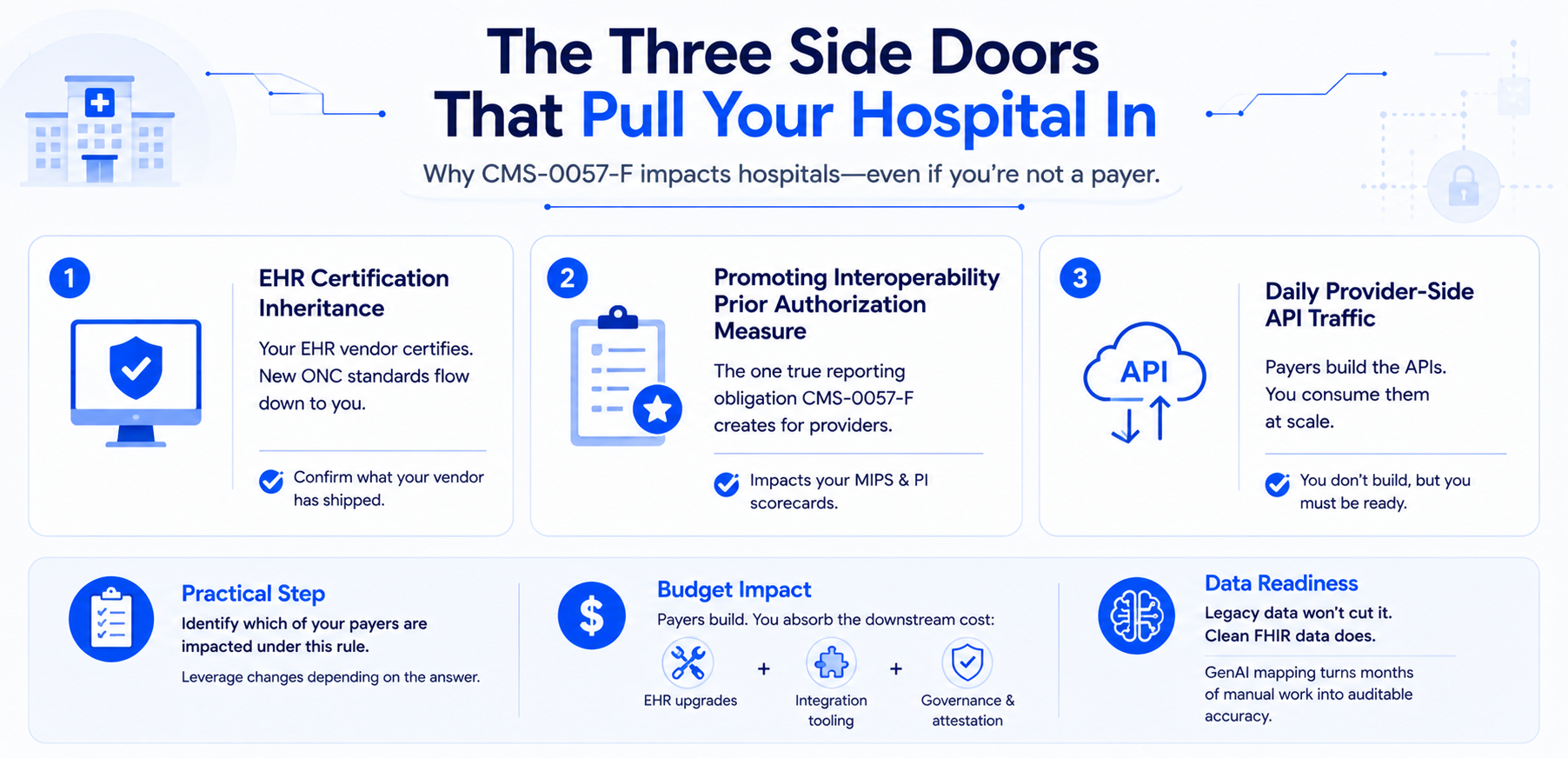
The Three Side Doors That Pull Your Hospital InIf your hospital is not a regulated payer, why is this rule on your CIO’s roadmap at all? Three mechanisms do it, and none of them require you to build anything CMS-0057-F itself mandates. 

  1. EHR certification inheritance. Your EHR vendor, Epic, Oracle Health, MEDITECH, whichever you run, has to certify against updated ONC standards to keep selling into the market impacted payers depend on. That certification cascade means your environment inherits new data requirements whether or not your compliance team ever reads the Federal Register notice. Confirm what your vendor has actually shipped against the ONC Certified Health IT Product List before it lands on a board slide marked “done.” 
  2. A new Promoting Interoperability Prior Authorization measure. Covered in full in the next section, this is the one true reporting obligation CMS-0057-F creates for providers. It is the reason a “payer rule” now has a line on your MIPS and Promoting Interoperability scorecards. 
  3. Daily provider-side API traffic. Once impacted payers stand up their Provider Access and Payer-to-Payer APIs, your staff will pull and push patient data through them constantly, whether or not your organization formally opted in. Does CMS-0057-F require hospitals to build their own FHIR API? No. The build obligation sits with payers. What you do need is a clean way to consume what they build at scale, and that is a real technical decision even without a mandate attached.  

Keen to know how the new regulation and a AI-ready hospital has in common? Read the comprehensive article here: CMS-0057-F and the AI-Ready Hospital: What CIOs Must Solve Before January 2027 

One practical step worth taking this quarter: pull your top payer contracts and mark which ones are actually impacted payers under this rule. A regional Medicaid MCO and a national Medicare Advantage plan both count. A self-funded employer plan administered by the same carrier does not. Knowing the difference changes your leverage in the next vendor conversation, since an impacted payer is working against a federal deadline you can point to and a non-impacted one is not. 

Budget impact follows the same logic. Payers carry the cost of building the APIs, but your hospital absorbs the downstream cost: EHR upgrade fees folded into your maintenance contract, integration tooling to consume payer endpoints at real volume, and the governance work required to prove your attestation is accurate on request. None of that shows up in CMS’s regulatory impact analysis. All of it shows up in your capital plan. 

For most hospitals that isn’t a connectivity problem. Legacy HL7v2 feeds and free-text notes have to become clean FHIR resources before any API call means anything, and that’s exactly where generative AI data mapping for healthcare interoperability earns its keep, turning months of manual field-mapping into a supervised, auditable process. 

The Promoting Interoperability Attestation, Explained 

This is the part most compliance briefings skip past, and it is the one with an actual reporting requirement attached to your organization’s name. 

CMS-0057-F added a new measure called Electronic Prior Authorization to two separate reporting tracks: the Promoting Interoperability performance category of MIPS, for MIPS eligible clinician prior authorization attestation, and the Medicare Promoting Interoperability Program 2027, for eligible hospitals and critical access hospitals. 

Both tracks work the same way. It is an CMS-0057-F yes/no attestation requirement, not a numerator-over-denominator calculation. You, or your CAH, report a simple yes or claim an applicable exclusion, confirming that you requested at least one prior authorization electronically through a payer’s FHIR-based Prior Authorization API, using certified EHR technology, during the reporting period. 

Reporting Track Who It Covers Status 
MIPS Promoting Interoperability category MIPS eligible clinicians CY2027 performance period / CY2029 payment year, as originally finalized 
Medicare Promoting Interoperability Program Eligible hospitals & Critical Access Hospitals Optional bonus for CY2027, mandatory from CY2028 (FY2027 IPPS Final Rule) 

 Are Critical Access Hospitals affected by CMS-0057-F?  

Yes, explicitly. CAHs sit in the same reporting bucket as eligible hospitals under the Medicare Promoting Interoperability Program, not a separate, lighter-touch category. 

This single line is also how CMS-0057-F interacts with your existing Promoting Interoperability scoring. Electronic Prior Authorization sits inside the Health Information Exchange objective, next to measures you already report. It does not replace your current PI obligations. It adds one more, worth bonus points now and a required line item later. 

If your data foundation is not ready for one clean attestation, it is not ready for AI at scale either. They are the same gap, wearing two different deadlines. Leaders need to align with the regulation objectives by transforming the data foundation for building an AI-Ready infrastructure for hospitals & ambulatory organizations.  

2027 vs. 2028: The Deadline Most CIOs Still Have Wrong 

A lot of hospital compliance calendars are quietly out of date on this exact point. 

When CMS-0057-F was finalized in January 2024, the Electronic Prior Authorization measure was written as effective for eligible hospitals and CAHs starting the CY2027 EHR reporting period, full stop. That is still the number sitting in a lot of 2025-era compliance decks. 

It changed.  

In the CMS FY2027 IPPS rule hospital prior authorization update, CMS finalized a one-year softening specifically for hospitals and CAHs: the measure is now an optional bonus measure for CY2027, attest yes and earn 10 bonus points toward your PI score, no exclusion needed because it is voluntary, becoming a CMS-0057-F provider compliance 2027 non-issue this year and a mandatory measure starting CY2028. 

That is genuinely good news, one more year of runway on this specific line item. It is not, however, a reason to sit still. Here is why. The hard part was never the attestation checkbox. It is the underlying capability: a working connection to a payer’s live Prior Authorization API, patient and encounter data clean enough to generate a real submission, and a workflow that gets a clinician or utilization management team to actually use it. That build takes months. Checking a box takes ten minutes. Treat CY2027 as a free pass and you simply move the scramble to late 2027, competing with every other hospital in your market for the same integration vendors at the same time. That’s the kind of gap an outside AI healthcare consulting engagement tends to catch faster than an internal audit, because it’s looking specifically for the space between what’s on the roadmap and what’s actually in production. 

CMS-0057-F 2028 hospital extension, in short: real, confirmed, and not an excuse to wait.
Contact UsCMS-0057-F vs. CMS-9115-F: What Actually Changed 

CMS-0057-F did not start from a blank page. It builds directly on CMS-9115-F, the 2020 CMS Interoperability and Patient Access Final Rule, which first required impacted payers to stand up a Patient Access API and a Provider Directory API. 

CMS-0057-F keeps that foundation and adds three new FHIR APIs, plus operational teeth the earlier rule never had. 

FHIR API What It Does New or Expanded? 
Patient Access API Lets patients pull claims, clinical, and now prior authorization data into apps of their choice Expanded (originated in CMS-9115-F; PA data added by CMS-0057-F) 
Provider Access API Shares claims, clinical, and PA data with in-network providers for patients they treat New in CMS-0057-F 
Payer-to-Payer API Moves up to five years of claims and clinical history when a patient switches plans New in CMS-0057-F 
Prior Authorization API Automates PA request submission, decision tracking, and specific denial reasons New in CMS-0057-F 

 The practical difference for a hospital: CMS-9115-F never created a provider-side reporting obligation. CMS-0057-F does, through the Promoting Interoperability attestation covered above. That is the line separating “a payer compliance rule we read about once” from “a measure with our organization’s name attached to it.” 

What Happens If You Don’t Attest, or Get It Wrong 
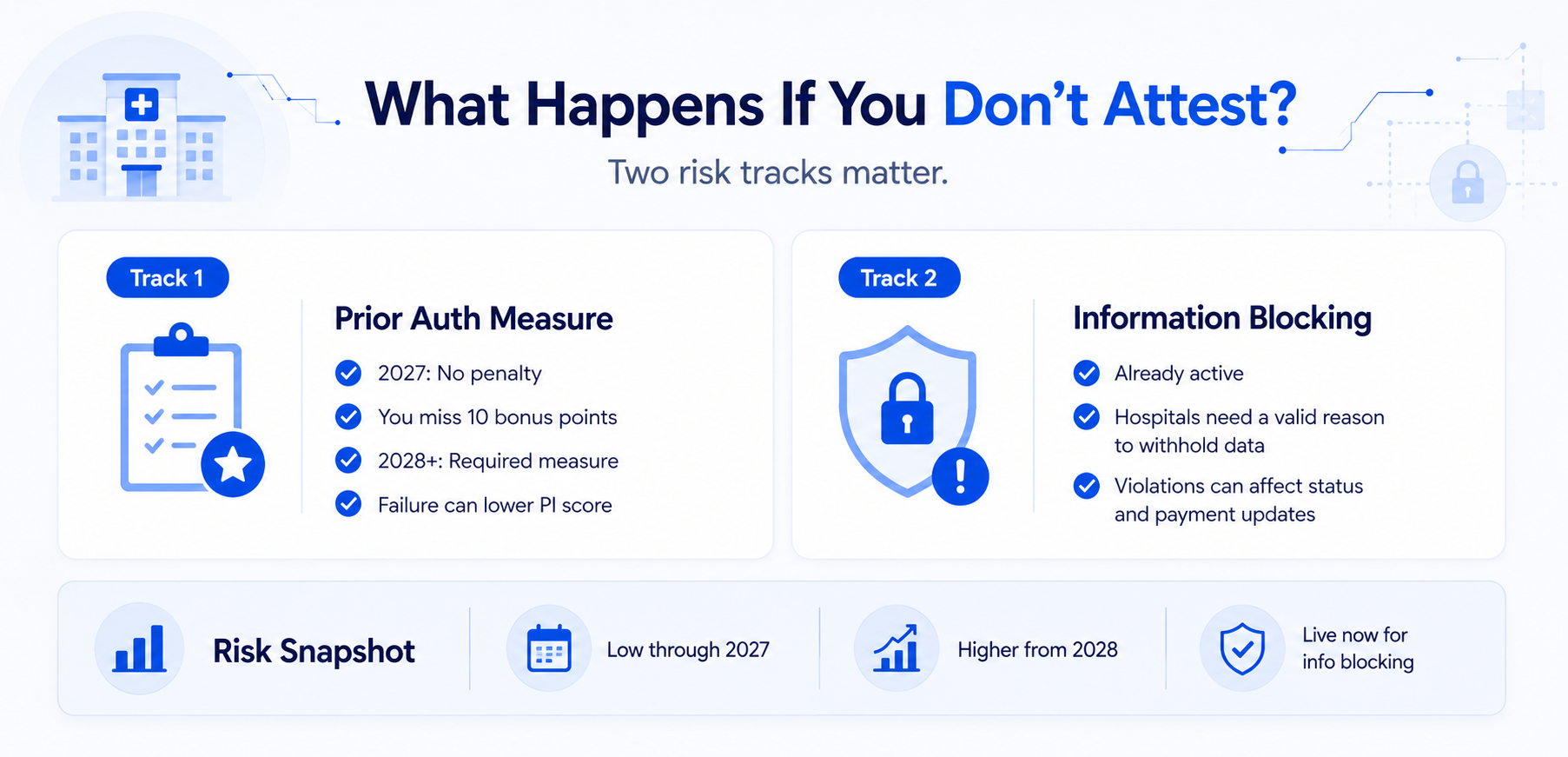
What Happens If You Don't Attest, or Get It WrongTwo separate risk tracks live under this rule, and hospitals routinely conflate them. 

  • Track one: missing the Electronic Prior Authorization measure itself. For CY2027, there is no penalty for skipping it. It is optional, and no exclusion process exists because none is needed, you simply forgo the 10 bonus points. Starting CY2028, that changes. Once it becomes a required measure, failing to attest without a qualifying exclusion counts against your Promoting Interoperability score the same way missing any other required PI measure would, which can affect your standing as a meaningful EHR user and, downstream, your Medicare payment update. 
  • Track two: information blocking. This is the sharper edge, and it does not run through CMS-0057-F directly. It sits under the separate 21st Century Cures Act framework. If your hospital cannot produce a documented, defensible reason for withholding electronic health information from a legitimate Provider Access or Payer-to-Payer request, and OIG investigates and refers a finding to CMS, the consequences are concrete. An eligible hospital loses meaningful EHR user status for that reporting period and forfeits three-quarters of its annual market basket payment increase.  

A CAH gets paid 100% of reasonable costs instead of 101%. HHS’s own estimate put the median financial hit at roughly $394,000, ranging from about $30,000 to $2.4 million depending on the hospital. 

The realistic risk exposure for a hospital that treats CMS-0057-F as someone else’s problem: low on the attestation itself through 2027, real and growing from 2028 forward, and already live today on the information blocking side, which has applied to Medicare-enrolled providers since July 2024.

Should You Voluntarily Attest in 2027 for the Bonus Points? 

Given the compliance risk is genuinely light this year, the more useful question is not a compliance question at all. It is a strategic one.  

Yes, and here is the actual reasoning. The technical build, connecting to a payer’s Prior Authorization API and generating one real submission, is the same work whether you do it as an optional pilot in 2027 or a mandatory rollout in 2028. Doing it now, while the stakes are low and there is no exclusion pressure, means your first real submission happens as a controlled test, instead of scrambling and competing for the same Prior Authorization API bonus points promoting interoperability and the same integration vendors. 

Treat CY2027 as your evidence-generating year. Pick one payer relationship, most likely your highest-volume Medicare Advantage plan, run one clean electronic prior authorization through it, and use that single transaction to validate your workflow, your data quality, and your governance sign-off process before any of it is mandatory. That is a defensible pilot with a real regulatory deadline behind it, which happens to be exactly the kind of proof point a board actually trusts over a vendor demo. 

Frame this correctly and CMS-0057-F stops being a compliance line item. It becomes the budget justification that finally gets digital transformation in healthcare funded as infrastructure.

What Your CIO Should Tell the Board 

Boards do not need the FHIR API taxonomy. They need three things, stated plainly. 

  • This is a data-readiness deadline wearing a compliance disguise. The clean patient identities, governed data lineage, and FHIR-based connectivity CMS-0057-F assumes are the same foundation any serious AI initiative needs. Fund it once, not twice. 
  • The hospital-side deadline moved; the underlying work did not shrink. CY2027 optional, CY2028 mandatory buys a year of runway, not a year of inaction. 
  • Real financial exposure sits in information blocking, not the attestation checkbox. That risk is live now, not in 2028. 
Talk to Our Strategy ConsultantsFrequently Asked Questions 

Data Governance Checklist for Hospital CIOs for Interoperability Compliance

Summary

Interoperability compliance rarely fails at the FHIR endpoint. It fails one layer down, in the governance gaps nobody mapped: unclear data ownership, missing lineage, and access rules built for a paper world. Here is the checklist hospital data teams need in place before the next audit, and before the next AI proposal reaches the board.

Why Data Governance Gaps Are Causing Interoperability Compliance Failures

Your board didn’t ask about your firewall. It asked why the AI pilot stalled.  

Somewhere in that answer sat a governance gap nobody had mapped: who owns the patient identity record, who approved that vendor’s data access, and why nobody could produce a lineage trail when the question came up. 

That pattern is showing up across hospital systems heading into 2026 and 2027. Most compliance conversations start with the wrong question. Teams ask which FHIR APIs they need, when the harder problem sits one layer down: does anyone actually own this data, and can the organization prove it on demand? 

Interoperability in healthcare, the ability to move and use patient data across systems, isn’t new. What’s new is the enforcement. CMS-0057-F pushes payers toward five FHIR-based APIs by January 2027, and starting that performance period, hospitals and clinicians attest under Medicare’s Promoting Interoperability program that they used one electronically. USCDI v3 sets the data classes those exchanges have to carry. Know what CIOs need to know for implementing CMS-0057-F before the deadline with an AI-ready hospital here.

None of it works without governance underneath: a defined steward, a documented access policy, a lineage trail that survives an audit. 

The cost of skipping that layer isn’t theoretical. IBM’s report puts the average healthcare breach at $7.42 million, the highest of any industry it tracks, for the 14th year running, with healthcare organizations taking an average of 279 days to identify and contain an incident. Most of those breaches trace back to access that never should have existed: a role that outlived the employee, a vendor connection nobody reviewed, a system nobody classified as high-risk in the first place. 

Governance itself is fragile right now. 80% of data and analytics governance initiatives will fail by 2027, largely because they launch without a real, or manufactured, crisis forcing the issue. A board demanding an AI comeback plan after a stalled pilot is, uncomfortably, exactly the kind of crisis that tends to get governance funded. Use it while it’s open. 

Data Governance vs. Data Management: The Difference That Decides Whether You Pass an Audit

Auditors and vendors use these terms interchangeably. Don’t. 

Data management refers to the operational layer: pipelines, storage, and integration, the plumbing that moves data from your EHR to your warehouse to your reporting tools. 

Data governance services work on the accountability layer sitting above it: who owns each dataset, who’s allowed to touch it, what quality standard it has to meet, and how you’d prove all of that to a regulator on a Tuesday afternoon with no notice. 

You can run excellent data management and still fail an interoperability audit, because of the lack of data quality, governance, and compliance services rendered by experts. The auditor does not care whether your pipelines run. They’re asking about accountability in every measure. 

Case Study - Building an Enterprise Data Platform from the Ground Up for a Post-Acute Care OrganisationThe Data Governance Checklist for Interoperability Compliance

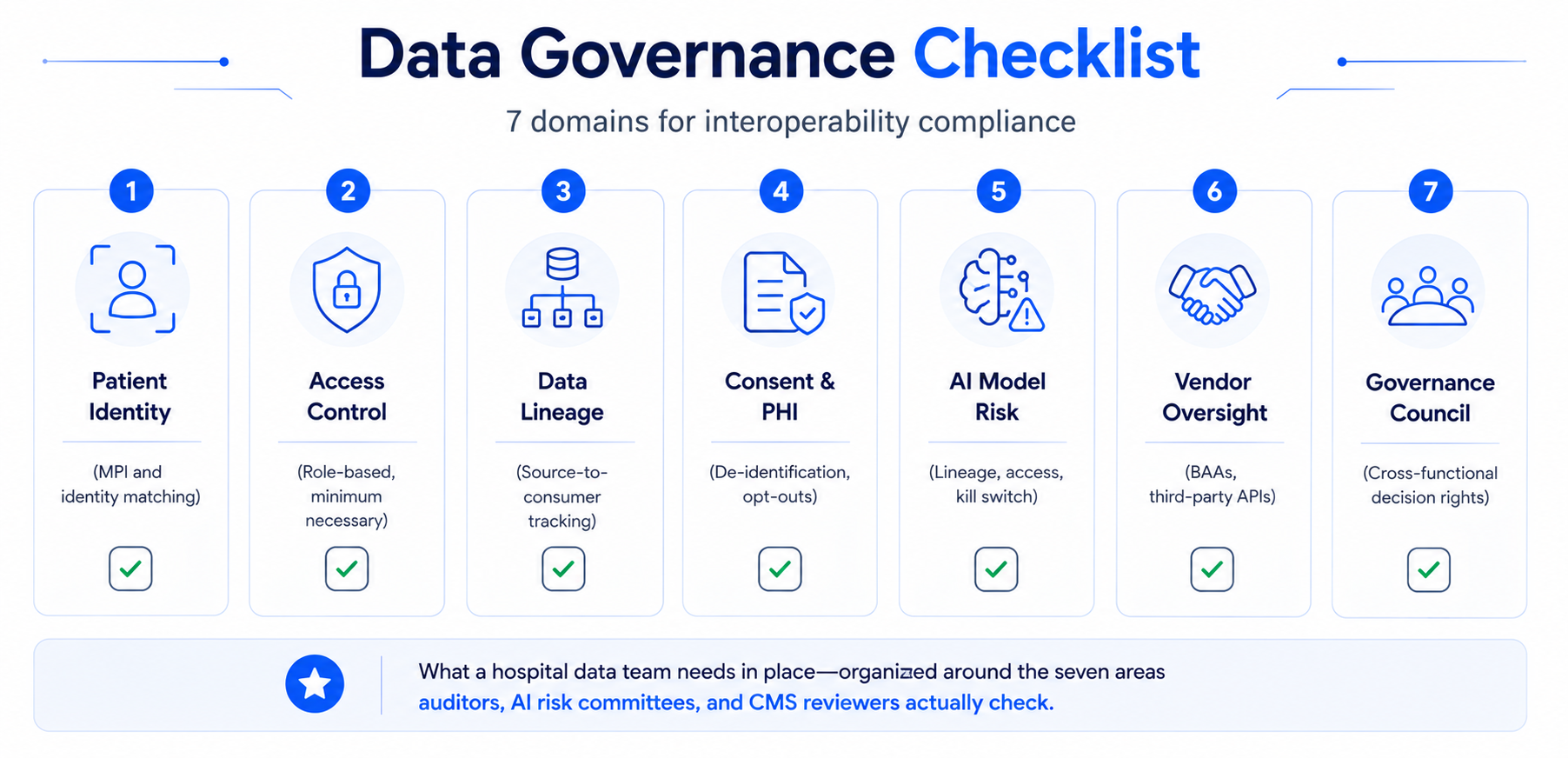
The Data Governance Checklist for Interoperability Compliance

Here is what a hospital data team needs in place, organized around the seven areas auditors, AI risk committees, and CMS reviewers actually check. 

Master Patient Index and Patient Identity Matching Governance

  • A single, deduplicated patient identity across the EHR, billing, and any third-party app connecting through your Patient Access API. 
  • Documented match and merge rules, with one named owner accountable for identity accuracy under a real data stewardship program, not a shared inbox. 
  • A defined process for resolving duplicate or fragmented records before they reach a FHIR endpoint, not after a mismatch reaches a patient. 

This is usually the first gap an interoperability audit finds. Inferenz’s MPI and Patient 360 solution is built around exactly this problem: resolving identity once, at the source, instead of downstream in every report that touches it. 

Role-Based Access Control for PHI: A Practical Checklist

  • Access mapped to role, not individual, with periodic recertification built into the calendar, not left to memory. 
  • The HIPAA minimum necessary access standard applied by default at the point of provisioning, not discovered during an audit. 
  • Automatic access revocation tied to HR offboarding, not a quarterly manual review that runs two months behind reality. 

Data Lineage Tracking and Data Quality Management Under HIPAA 

  • Lineage tracked from the source system to every downstream consumer, including third-party apps pulling through your APIs. 
  • Quality rules for completeness, accuracy, and timeliness defined per data domain, not applied as one blanket rule across every table. 
  • FHIR API data governance readiness confirmed before go-live: source mapping, terminology bindings, and error handling all documented, not assumed. 

Data lineage tracking under HIPAA isn’t a nice-to-have diagram for a slide. It’s the artifact that turns “we believe our data is accurate” into something you can actually show a regulator. 

PHI De-Identification, Redaction, and Consent Management 

  • De-identification and redaction procedures documented and tested against real records, not assumed to work because a vendor said so. 
  • Consent captured, stored, and enforced at the point of exchange, not just at intake and never revisited. 
  • Opt-out mechanisms, including Provider Access API opt-outs, reflected in near real time as part of ongoing consent management for interoperability, not batch-updated overnight. 

Data Governance Requirements Before Deploying Clinical AI Models 

  • Every clinical or operational AI model has documented lineage back to its training data source. 
  • AI model risk management in healthcare applies the same minimum necessary rules to model access as to human access. A model doesn’t get a pass because it’s software. 
  • A named owner and a defined kill switch for every production AI agent, not a data scientist’s laptop as the unofficial control point. 

BAA and Third-Party Data Oversight 

  • Business Associate Agreements reviewed against actual data flows, not boilerplate language nobody has revisited since signing. 
  • Third-party API consumers, meaning apps pulling through your Patient Access API, vetted before connection, not after an incident. 
  • Annual reassessment of vendor access scope tied to what a vendor actually uses, not what they originally requested three renewals ago. 

Building a Cross-Functional Data Governance Council 

  • Representation from clinical informatics, compliance, security, and IT. Not IT alone, and not compliance alone. 
  • Decision rights defined in writing: who can approve a new data flow, and who can block one. 
  • A standing cadence, monthly at minimum, with documented minutes an auditor can actually review. 

Ensure Trusted Data with Data Quality Governance and Compliance Services

How to Build a Data Governance Framework for USCDI v3 and HIPAA Compliance, Together

Trying to satisfy USCDI v3, HIPAA, and CMS-0057-F as three separate projects is how most governance programs balloon in cost and stall in scope. USCDI v3 defines what data classes must move. HIPAA defines who’s allowed to see them and under what conditions. CMS-0057-F defines how fast, and through which technical standard, they move. 

The fix isn’t three parallel workstreams. It’s one governance framework, built around a single data catalog, with three lenses applied to the same classification pass: check every dataset against USCDI v3 scope, HIPAA sensitivity, and CMS-0057-F exchange requirements at the same time. Hospitals that treat these as separate compliance tracks end up documenting the same dataset three times, in three formats, for three different reviewers, and by year two, none of the three documents agree with each other. 

What Auditors Actually Expect to See

Ask any compliance officer who has been through an interoperability review and the documentation requests repeat almost word for word: 

  • A current data inventory mapped to USCDI v3 classes. 
  • An access control policy with evidence of enforcement, not just a written policy sitting in a shared drive. 
  • Lineage diagrams for any data exposed through a FHIR endpoint. 
  • BAAs matched to actual API consumers, updated within the last twelve months. 
  • Incident response records showing governance controls were tested, not only documented. 
  • Minutes from governance council meetings that show decisions were made, not just discussed. 

If your data team can’t produce these inside a week, that’s the gap worth closing first, before the next AI pilot goes to the board, not after. 

How to Prevent Data Breaches Through Better Data Governance

Breach prevention gets framed as a security problem. Most of the time, it’s a governance problem wearing a security costume. Access that outlived its purpose, a vendor connection nobody reviewed, a dataset nobody classified as sensitive: none of those are firewall failures. They’re governance failures that a firewall was never going to catch. 

Healthcare data breach prevention through governance means closing the gap before an attacker finds it: recertifying access on a schedule, classifying data by sensitivity at ingestion, and reviewing vendor scope annually instead of at renewal time only. It’s slower and less dramatic than incident response. It’s also considerably cheaper. 

Data Governance Maturity and Your Ability to Deploy AI Safely at Scale

This is the part that matters most for a transformation leader trying to move past a stalled pilot. A large number of organizations still report little or no formal data governance framework, even as they keep adding AI use cases on top of that same ungoverned data. That gap is exactly where pilots stall. Not because the model performed badly, but because nobody could answer who owns the training data, who approved the access, or how the decision gets audited six months later. 

A governance program built to the checklist above does double duty. It gets a hospital through the interoperability audit, and it gives every future AI proposal a foundation to stand on: defined ownership, traceable lineage, and access rules that already meet minimum necessary. That’s the difference between a pilot that stalls in month four and one that reaches production with the board’s confidence intact. We’ve written more on why 59% of health systems are still AI immature, and what separates them from the ones scaling AI safely.

Build an audit-ready data governance program before your next review

Who Should Actually Sit on Your Data Governance Council

Skip the instinct to hand this entirely to IT. A council that actually functions usually includes: 

  • A clinical informatics or CMIO representative, who understands what the data means at the bedside, not just in the schema. 
  • Compliance and privacy leadership, who understands HIPAA and state law exposure. 
  • Security, who understands where the real attack surface sits. 
  • A data or platform architect, who understands what’s technically enforceable versus aspirational. 
  • An executive sponsor with the authority to say no to a data flow, not only yes.

The Real Deadline Isn’t the API

CMS-0057-F’s January 2027 deadline is a governance deadline wearing a technical disguise. Building an AI-Ready Infrastructure for Hospitals & Ambulatory care starts with establishing the ownership, access, and lineage layer that makes compliance and future AI initiatives sustainable. Hospitals that build this foundation first will find the FHIR compliance work comparatively straightforward. The ones that skip it will end up explaining the same gap to their board twice: once at the audit, and again at the next AI pilot review.

Frequently Asked Questions

CMS-0057-F and the AI-Ready Hospital: What CIOs Must Solve Before January 2027

Summary

CMS-0057-F rewires how payers move data to hospitals and patients, and the compliance work is landing on CIO desks well before the January 2027 deadline. This guide breaks down what the rule actually requires, what is already in force, and why the data foundation it demands is the same one your AI strategy needs.

Somewhere in the past two years, prior authorization stopped being a back-office irritation and became a board agenda item.

That shift has a name: CMS-0057-F, the CMS Interoperability and Prior Authorization Final Rule, finalized in January 2024. It forces Medicare Advantage organizations, Medicaid and CHIP managed care plans, and Qualified Health Plan issuers to build standardized, FHIR-based APIs and cut authorization turnaround times.

Hospitals are not who this rule technically regulates. That distinction rarely survives contact with a real IT roadmap. Your EHR vendor now has to certify against a new data standard. Your Promoting Interoperability attestation changes starting the 2027 performance period. Your denial patterns, your prior authorization workflows, your patient data exchange, all of it sits directly downstream of a rule written for payers.

Here is the part most compliance briefings leave out.

The exact data work this rule demands, clean patient identities, governed data lineage, standardized FHIR resources, is the same work that separates hospitals running safe, working AI from hospitals still explaining a stalled pilot to their board. Building an AI-Ready Infrastructure for Hospitals & Ambulatory care means creating this foundation once and using it across compliance, interoperability, analytics, and AI initiatives. Treat the two as separate projects and you will fund both twice. Treat them as one, and the compliance budget quietly becomes your AI-readiness budget. This guide walks through what CMS-0057-F actually requires, what is already due, and how to use the deadline as the forcing function your AI roadmap has been missing.

What CMS-0057-F Actually Requires, and Who It Is Really Aimed At 

CMS-0057-F directly regulates Medicare Advantage organizations, Medicaid and CHIP managed care plans, state Medicaid and CHIP fee-for-service programs, and Qualified Health Plan issuers on the federally facilitated exchanges. Not hospitals. That is the technical answer, and it is also the least useful one, because three things pull hospitals into the compliance perimeter anyway. 

  1. EHR vendors have to certify against ONC’s updated standards, which means your Epic, Oracle Health, or MEDITECH environment inherits new data requirements whether your compliance team asked for them or not. 
  2. Starting with the 2027 performance period, MIPS eligible clinicians, eligible hospitals, and critical access hospitals must attest under the Medicare Promoting Interoperability Program that they requested at least one prior authorization electronically through a Prior Authorization API. That single line turns a payer-side API into a provider-side reporting obligation. 
  3. Your providers will be pulling and pushing data through the new Provider Access and Payer-to-Payer APIs every day, whether or not your organization ever reads the final rule. 

None of this means you can sit back and wait for your EHR vendor to sort it out. Certification timelines slip, and “on the roadmap” is not the same as “in production.” A vendor’s compliance promise is worth confirming against the ONC Certified Health IT Product List (CHPL), the federal government’s public, authoritative registry of every health IT product that has actually been tested and certified, before it lands anywhere near a board slide.

The Four FHIR APIs Under CMS-0057-F 

API What It Does Production Deadline 
Patient Access API Extends existing patient data access to include prior authorization decisions, so patients can pull claims, clinical, and PA data through third-party apps. January 1, 2027 
Provider Access API Lets in-network providers pull member claims, clinical, and PA data for treatment and care coordination. January 1, 2027 
Payer-to-Payer API Moves up to five years of claims and clinical history when a patient switches health plans. January 1, 2027 
Prior Authorization API Automates PA request submission, decision tracking, and specific denial reasons. January 1, 2027 for the payer’s API.  (Note: For hospital attestation, CY2027 is an optional bonus measure; it becomes mandatory starting CY2028 (per the FY2027 IPPS Final Rule)) 

FHIR Prior Authorization APIs: Build, Buy, or Integrate?The Deadline Math: What Is Already Due and What Is Coming 

Two clocks are running, and hospitals that only watch one of them get caught out.  

The operational provisions, decision turnaround of 72 hours for urgent requests and 7 calendar days for standard ones, specific denial reasons, and five years of retained authorization history, took effect January 1, 2026 for most impacted payers. The heavier lift, the actual production FHIR APIs, is primarily due January 1, 2027, per CMS’s own guidance.  

Running in parallel, ONC finalized a separate but connected deadline: as of January 1, 2026, USCDI v3 became the only certified baseline data standard, replacing USCDI v1 entirely. Any hospital whose EHR vendor has not confirmed USCDI v3 and FHIR US Core alignment is already behind schedule, regardless of what the calendar says about 2027. 

What Happens If Your Hospital isn’t Ready 

CMS-0057-F itself does have no fixed penalty schedule. Enforcement alerts run through each program’s existing mechanisms:  

  • Medicare Advantage organizations face corrective action plans or monetary penalties through CMS’s standard MA oversight process,  
  • Medicaid and CHIP managed care compliance is monitored by individual states through contract approval and renewal, and  
  • Qualified Health Plan issuers on the federal exchange must apply annually if they need an exception.  

None of that is comfortable, but none of it hits your hospital’s Medicare payment directly. 

The exposure that does hit your hospital sits one level over, in information blocking. If your organization cannot produce a documented, defensible reason for withholding electronic health information from a legitimate Provider Access or Payer-to-Payer request, HHS-OIG can investigate. Certified health IT developers, health information networks, and health information exchanges face civil monetary penalties of up to $1 million per violation.  

Hospitals and clinicians face a separate track of “appropriate disincentives” that have been active since July 31, 2024: denial of Promoting Interoperability program credit, negative MIPS payment adjustments, and exclusion from ACO shared savings programs for Medicare Shared Savings Program participants. In September 2025, HHS-OIG and ASTP/ONC jointly announced this is now an active enforcement priority.

Compliance Is the Floor. AI Readiness Is the Bar. 

Recent peer-reviewed research on hospital AI infrastructure makes a point worth sitting with: AI implementation without a solid data and governance foundation tends to produce the same failure pattern everywhere, poor model performance, data silos, and compliance exposure, regardless of how good the underlying model is. Enterprise architecture, IT governance, and FHIR-based data standardization are not parallel tracks to an AI strategy. They are the prerequisite for one. 

That is the real opportunity hidden inside a compliance deadline. A hospital that treats CMS-0057-F as a checkbox exercise will spend 2026 patching interfaces. A hospital that treats it as the forcing function for a genuine data foundation walks into 2027 with clean identities, governed lineage, and standardized FHIR resources already in place, which happens to be exactly what a safe, board-defensible AI initiative needs on day one. 

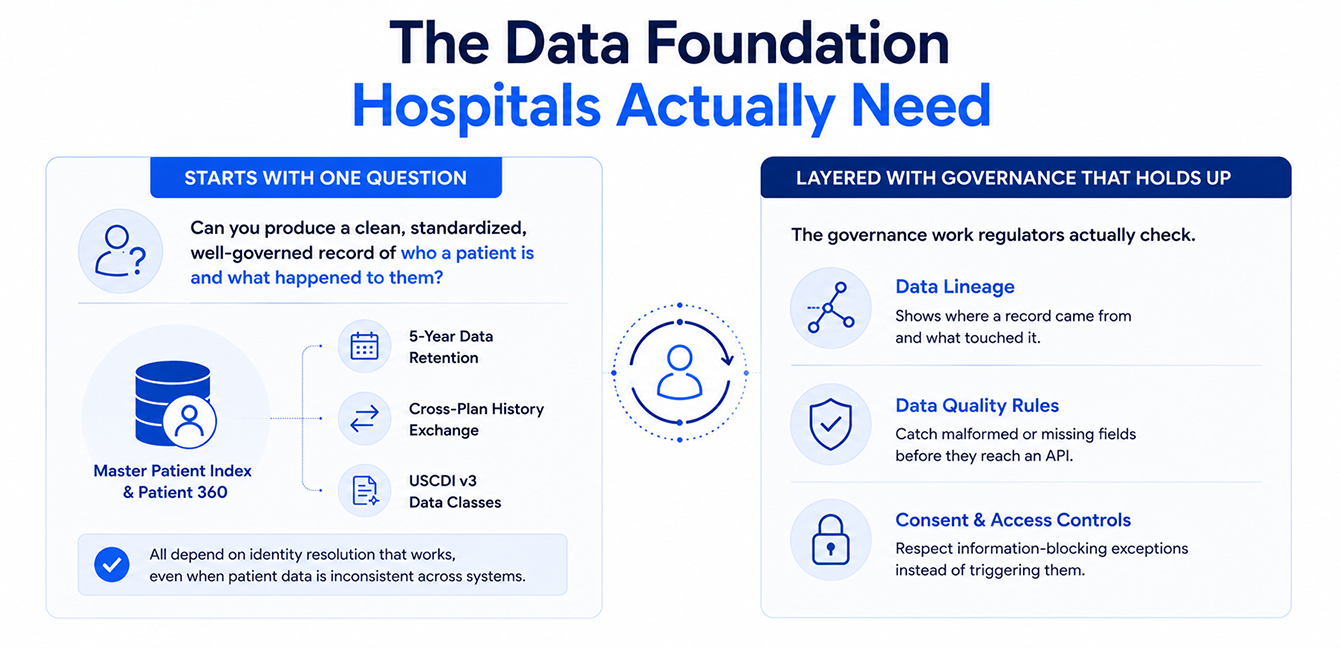
The Data Foundation Hospitals Actually Need 

The Data Foundation Hospitals Actually NeedEvery requirement in CMS-0057-F ultimately traces back to one question: can you produce a clean, standardized, well-governed record of who a patient is and what happened to them? A Master Patient Index and a true Patient 360 view answer that question for regulators and for AI agents at the same time. The five-year data retention requirement, the cross-plan history exchange, the USCDI v3 data classes, all of it depends on identity resolution that does not fall apart when the same patient shows up under three slightly different name spellings across two EHRs and a billing system. 

Layer on top of that the governance work regulators actually check: data lineage that shows where a record came from and what touched it, quality rules that catch malformed or missing fields before they reach an API, and consent and access controls that respect information-blocking exceptions instead of triggering them. 

Inferenz’s MPI and Patient 360 solution is built for exactly this layer. Hospitals also increasingly need a TEFCA and QHIN participation strategy, since national network exchange is becoming the default expectation rather than the exception. Joining early through a QHIN can also do double duty, satisfying Payer-to-Payer style exchange expectations through one connection instead of negotiating separate pipes with every plan.

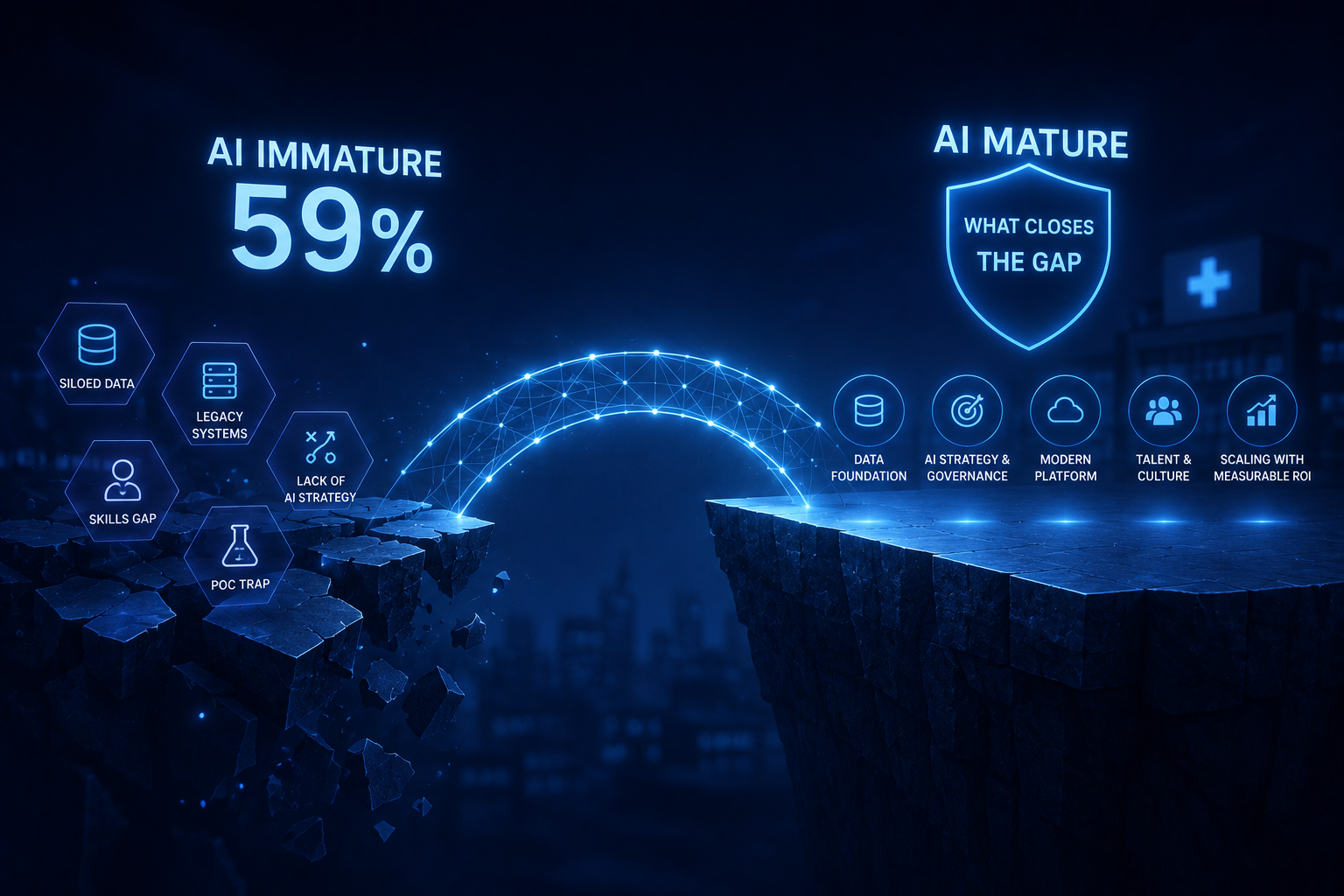
Why 59% of Health Systems Are Still “AI Immature,” and What Closes the Gap

Data Foundation Checklist, Mapped to CMS-0057-F 

Foundation Element Why CMS-0057-F Needs It Why AI Needs It 
Master Patient Index / identity resolution Powers accurate 5-year data retention and cross-plan history exchange. One clean patient record instead of fragmented duplicates feeding every model. 
Data lineage and provenance Required to show where exchanged data originated for audits. Traceability regulators and clinicians can both trust. 
USCDI v3 data class mapping Baseline standard for all certified data exchange from January 2026. Standardized inputs models can actually be validated against. 
Consent and access governance Prevents information-blocking exposure on Provider/Payer-to-Payer requests. Guardrails that keep AI agents inside defined access boundaries. 
Data quality and validation rules Catches malformed records before they reach a production API. Reduces bias and error carried into AI outputs. 

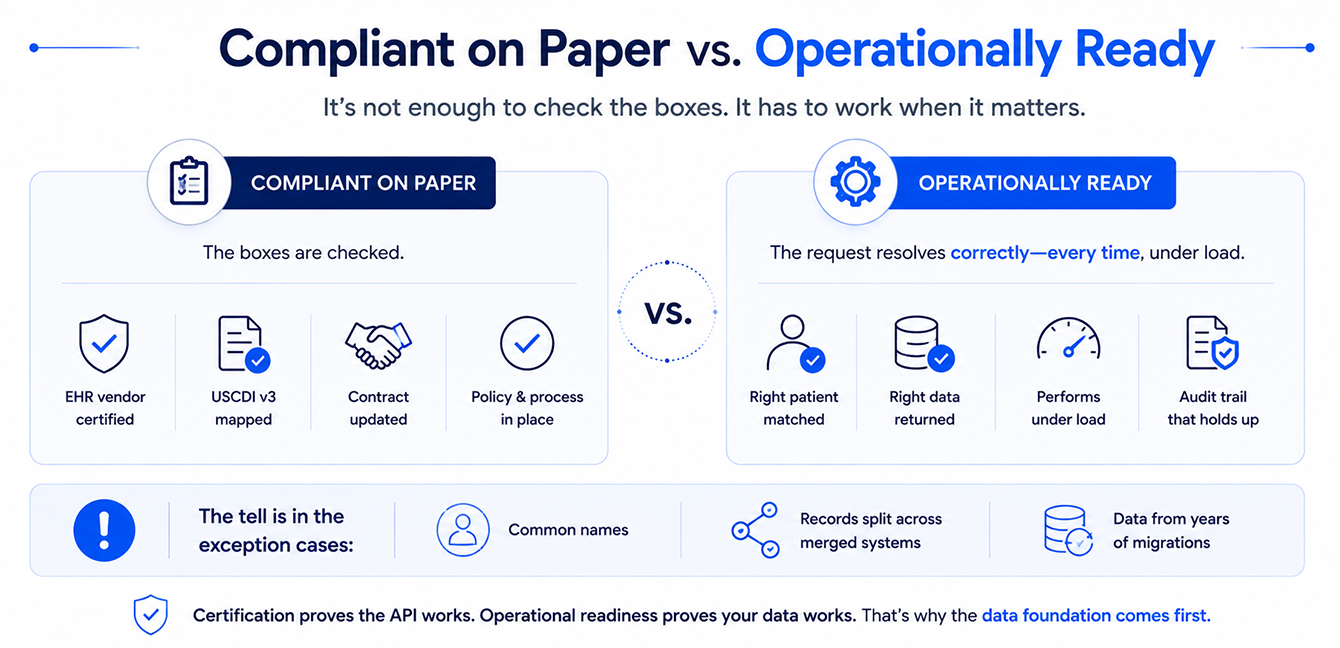
Compliant on Paper vs. Operationally Ready Compliant on Paper vs. Operationally Ready 

There’s a gap almost nobody’s compliance briefing names directly. A hospital can be compliant on paper, EHR vendor certified, USCDI v3 mapped, contract language updated and still fail the moment a real Provider Access request or Payer-to-Payer exchange hits the system. Paper compliance means the boxes are checked. Operational readiness means the request actually resolves correctly under load, with the right patient matched, the right data returned, and an audit trail that survives scrutiny. 

The tell is usually in the exception cases: patients with common names, records split across a merged health system, data that arrived through three different EHR migrations over the last decade. A vendor’s certification says the API works. It doesn’t say your specific data will move through it cleanly. That’s a data quality and identity resolution question, not a certification question, and it’s exactly why the data foundation work above matters more than the API build itself.

Where the FHIR Build Decision Fits 

Once the data foundation question is answered, the next one follows fast: do you build FHIR infrastructure in-house, buy a vendor platform, or integrate an agentic layer on top of what you already run? Most 400-bed hospitals do not have two years and a standing FHIR engineering team to spare, and a full custom build was rarely the right answer even before the deadline moved up. The faster, lower-risk path for most hospitals is an integration layer, one that sits on your existing Epic, Oracle Health, or MEDITECH instance and handles the Prior Authorization API workflow without a rip-and-replace project. 

Information Blocking, TEFCA, and the Governance Layer CIOs Cannot Skip 

Peer-reviewed policy analysis of the rule frames CMS-0057-F as the operational half of a broader prior authorization reform push, one that pairs API-enabled data exchange with real accountability for turnaround time and denial transparency. That framing matters for CIOs because it signals where enforcement attention is heading next: not just whether the APIs exist, but whether hospitals and payers actually use them instead of defaulting to fax and phone workarounds. 

Information blocking rules under the 21st Century Cures Act sit directly underneath this. If your organization cannot produce a defensible, documented reason for withholding electronic health information from a legitimate Provider Access or Payer-to-Payer request, that is an information-blocking exposure, not a data-governance inconvenience. The ONC Certified Health IT Product List remains the reference point for confirming your EHR vendor’s certification status before you take their compliance roadmap at face value. Inferenz’s Data Quality Governance and Compliance practice was built to close exactly this gap. Our data management experts will provide the required support to ensure that your operations are aligned in terms of data governance standards and compliance regulations. 

The Enterprise Master Patient Index Behind Every Patient 360 View

The Comprehensive CMS-0057-F checklist for CIOs 

If you’re starting now, it is recommended to work in this order to meet CMS-0057-F standards: 

  1. Confirm your EHR vendor’s actual certification status against the ONC Certified Health IT Product List, not their roadmap slide. Ask specifically for USCDI v3 and FHIR US Core alignment dates.
  2. Audit your Master Patient Index for duplicate and fragmented identities. Every downstream requirement, data retention, cross-plan history, AI readiness, depends on this being solid first.
  3. Map your current data against USCDI v3 data classes to find where gaps exist before an auditor or a failed API call finds them for you.
  4. Decide your Prior Authorization API path (build, buy, or integrate) with a realistic view of your engineering capacity, not an optimistic one.
  5. Document your information-blocking exception process now, since enforcement is active as of September 2025, not pending.
  6. Use the CY2027 optional bonus window on the Electronic Prior Authorization measure as a low-stakes test run before it becomes mandatory in CY2028. 
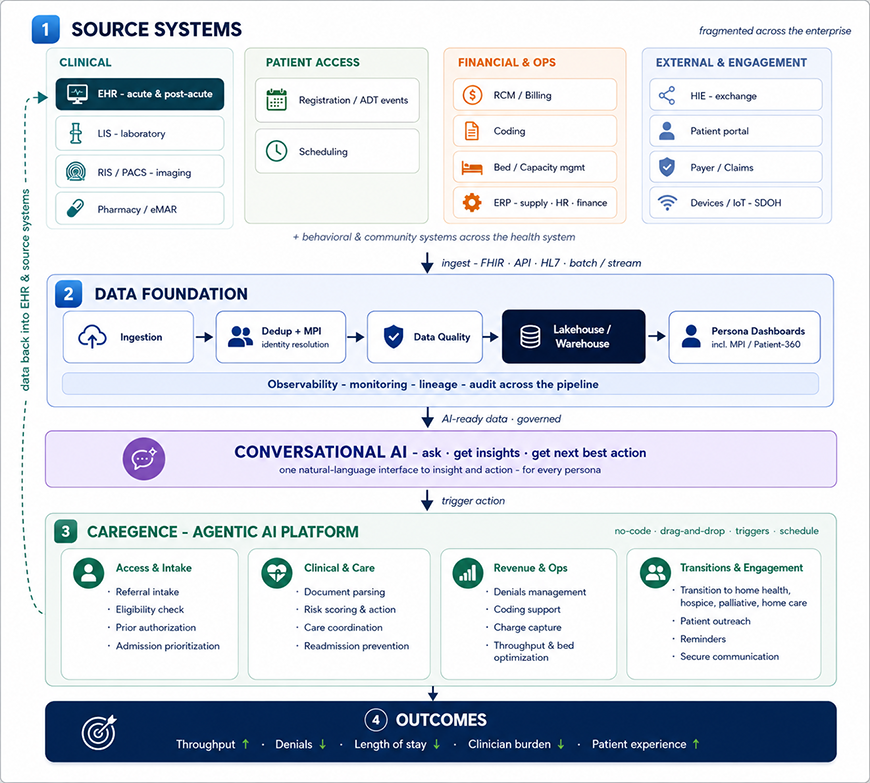
CMS-0057-F was written for payers, but it landed on your desk anyway, and the January 2027 deadline is closer than most 2026 budget cycles account for. The hospitals that come out ahead will not be the ones that treat this as a narrow API integration project. They will be the ones that use the deadline to finally fund the data foundation their AI strategy already needed, one Master Patient Index, one governance framework, one standardized FHIR layer at a time. Explore Inferenz’s data and AI solutions for hospitals to see where your hospital stands today.

Frequently Asked Questions

Why 59% of Health Systems Are Still “AI Immature,” and What Closes the Gap

Summary

59% of U.S. health systems are still stuck in early or developing healthcare AI maturity, and it’s rarely the model’s fault. The real gap sits in fragmented patient data, missing governance, and pilots scoped around a tool instead of a measurable outcome. Close those three gaps first, and the technology stops being the risky part of the story. 

Your last AI pilot didn’t fail exactly. It just didn’t finish. Six months in, the sepsis model was still “validating,” and the ambient documentation tool worked in three units and nowhere else. 

That pattern holds up nationally. Only 19% of health systems have started scaling AI across business units, and just 8% run mature programs with measurable returns, according to the State of AI in Healthcare 2026 survey from Emids and ServiceNow. This piece breaks down what separates that 8% from the 59% still stuck, and the sequence that closes the gap through Building an AI-Ready Infrastructure for Hospitals & Ambulatory care organizations specifically.

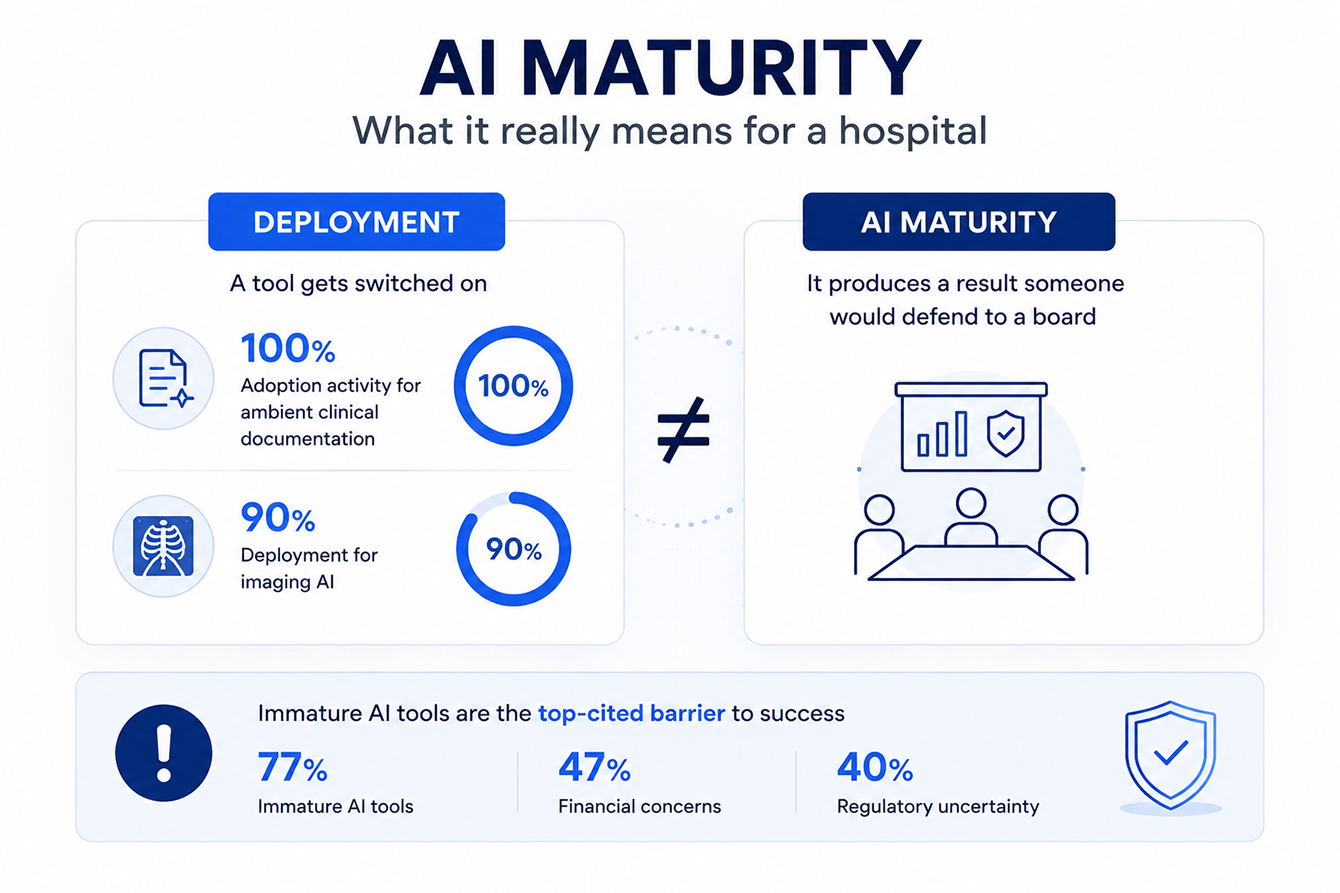
What “AI maturity” actually means for a hospital 

What "AI maturity" actually means for a hospital Most AI maturity models, including the four-stage framework behind the Emids/Service Now survey cited above, sort organizations into stages: early experimentation, developing capability, active scaling, and full maturity, where AI is embedded in workflows and tied to a tracked outcome. 

Deployment isn’t the same as maturity. A 2025 survey of 43 US health systems, published in JAMIA, found ambient clinical documentation had reached 100% adoption activity among respondents, and imaging AI had hit 90% deployment. Sounds mature, right? 

It isn’t. The same survey found immature AI tools were the top-cited barrier to success, named by 77% of respondents, ahead of financial concerns (47%) and regulatory uncertainty (40%). Deployment means a tool got switched on. AI maturity means it produces a result someone would defend to a board. 

Why Healthcare AI Pilots Stall Before They Touch a Patient

Pilots rarely stall because the model is bad. They stall because the tool got scoped before the problem did, and a model that scores well on retrospective data rarely survives a real EHR, a real nursing workflow, and a real on-call schedule. 

The pattern repeats across health systems: 

  • The use case was never tied to one measurable outcome from day one 
  • Data fragmentation made the model’s inputs unreliable outside the pilot unit 
  • Governance and evaluation criteria got written after the pilot stalled, not before 

That gap between “it worked in the pilot” and “it works Tuesday at 3 am” is exactly where hospital AI initiatives stall after the pilot phase, and it’s rarely a modeling problem. 

The Real Bottleneck: Fragmented Data and Missing Governance 

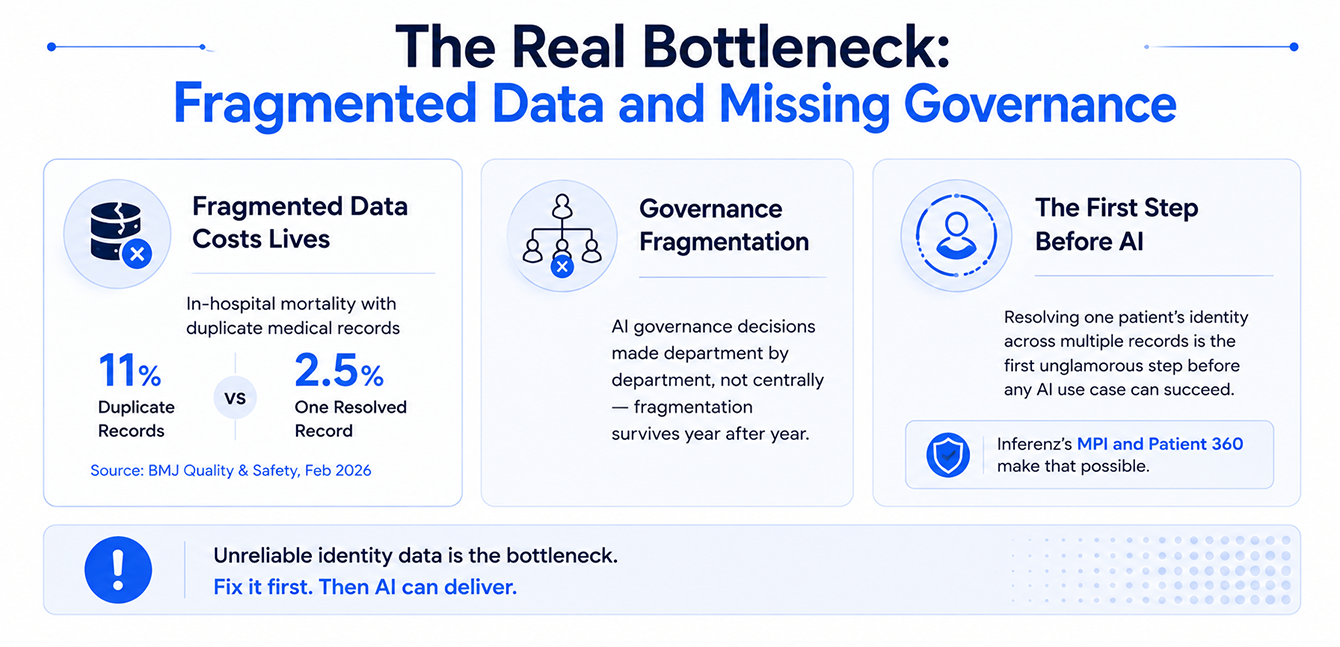
The Real Bottleneck Fragmented Data and Missing GovernanceFragmented data isn’t just an efficiency problem, it’s a mortality one. A February 2026 propensity-matched study in BMJ Quality & Safety followed 12 US hospitals and found in-hospital mortality of 11% among patients with duplicate medical records, versus 2.5% among those with one resolved record. 

That’s what an unreliable master patient index costs before AI ever enters the picture, and it’s the same identity-fragmentation problem that stalls AI business cases long before a model gets involved. AI governance maturity model decisions made department by department, instead of centrally, are how that fragmentation survives year after year. Inferenz’s MPI and Patient 360 work exists because resolving one patient’s identity across four different records is usually the first unglamorous step, before any AI use case can stand on solid ground. 

AI-Mature vs. AI-Immature: What Separates the Systems That Scale 

The same Emids/ServiceNow survey found the top barriers to maturity are legacy infrastructure and technical debt (38%), data quality and governance issues (35%), and talent shortages (32%). None of those are model problems. 

Compare how AI-mature health systems structure their data pipelines versus ones still in pilot mode: 

 AI-Mature AI-Immature 
Tool count Fewer tools, wired into existing workflows One tool per function (scheduling, coding, denials) 
Governance One process, centrally owned Five departmental processes, no single owner 
Patient data Single source of truth A login per tool, no shared identity 
Where it breaks Rarely At the handoff between tools 

 Digital maturity shows up in clinical outcomes, not just IT scores 

This is the argument that lands hardest with a board, because it reframes AI maturity as a patient-safety question, not a technology preference. Hospitals with stronger digital maturity tend to post better safety and patient-experience outcomes in the peer-reviewed literature, and the mechanism is straightforward: clean, current, structured data at the bedside is what lets predictive modeling in healthcare, sepsis and deterioration risk especially, actually change a clinical outcome instead of just validating well on paper. Inferenz’s Caregence Predictive Models are built around that exact handoff, from clean data to a bedside signal a clinician can act on. 

Inferenz's Caregence platform unifies fragmented hospital data, governance, and AI agents into one HIPAA-compliant layer.

Why CMS-0057-F turns “someday” data fixes into a January 2027 deadline 

Under the CMS Interoperability and Prior Authorization Final Rule (CMS-0057-F), eligible hospitals and critical access hospitals must begin attesting, starting with the CY 2027 performance period, that they requested at least one prior authorization electronically through a payer’s FHIR-based Prior Authorization API.  

That single attestation assumes clean master patient data, working FHIR connectivity, and governance that can prove, on request, that the call actually happened. Every gap described above becomes visible the moment a regulator asks for proof.  

If your data foundation isn’t ready for that attestation, it isn’t ready for AI at scale either. They’re the same problem wearing two different deadlines, which is exactly what the main article within this series unpacks comprehensively: CMS-0057-F and the AI-Ready Hospital.

A Practical Roadmap: Moving From AI-Immature to AI-Ready 

None of this needs a two-year program. It needs sequencing: 

  1. Scope the problem before the tool. Name the outcome, the population, and who owns it.
  2. Run a data foundation audit. Test the master patient index and interoperability readiness against the real use case, not a generic checklist.
  3. Design governance and evaluation criteria before build starts. Set agent behavior boundaries, audit trails, and an ROI metric the board can hold you to.
  4. Pilot with a production mindset, so “it worked” and “it’s ready for the floor” become one milestone. 

That sequence is, in effect, an AI readiness assessment any hospital CIO or Chief Innovation Officer can run before committing budget.  

For the two-layer architecture behind it, a governed data platform plus an agentic layer, see Record, Foundation, Action: Building the AI-Ready Hospital on the Systems You Already Own.

What “AI-Ready” looks like in practice 

AI-ready hospitals look less exciting than the demos suggest: documented data governance, a small number of well-integrated tools, and evaluation criteria locked in before the pilot went live, not negotiated after the board starts asking questions. 

That’s also what an agentic AI maturity model requires. Autonomous healthcare ready AI agents that request prior authorizations or flag deterioration risk need clearer behavioral guardrails than a static prediction model ever did, because they’re taking action, not producing a score for a human to review. 

The honest framing for your next board conversation: the 59% still in early or developing maturity aren’t behind because their people are less capable. They started with the AI instead of the problem, the data, and the proof. To read more about the build-versus-buy trade-offs, check out Buy vs. Build: The AI Strategy Debate Every CIO Is Having Wrong. 

Data foundation isn't ready for CMS-0057-F? Our expert team can help you build the readiness roadmap before you commit budget.

Frequently Asked Questions

FHIR Prior Authorization APIs: Build, Buy, or Integrate?

Summary

A practical framework for hospital CIOs deciding whether to build, buy, or integrate a FHIR prior authorization API before the January 2027 CMS-0057-F deadline. Every cost, risk, and governance trade-off below is sourced, not pitched. 

 Ask five vendors how to fix prior authorization and you’ll get five different answers, each one conveniently pointing back to whatever that vendor sells. One recent study found radiologists face a prior authorization request on 91% of the orders they write, the highest rate of any medical specialty. That reality is pushing hospital leaders toward a decision they cannot keep deferring: standing up a FHIR prior authorization API before the CMS-0057-F clock runs out in January 2027. 

Three paths sit on the table right now.  

  1. Build it yourself. 
  2. Buy a point solution. 
  3. Integrate an agentic layer on top of the systems you already run.  

Each one solves a different problem, and each one creates a different risk. 

What a FHIR Prior Authorization API Actually Does

A FHIR prior authorization API is the technical mechanism CMS-0057-F requires payers to expose so providers can check coverage rules, submit documentation, and get a structured answer back, approved, denied with a specific reason, or flagged for more information, without a phone call or a fax. 

It runs on three of HL7 FHIR’s Da Vinci implementation guides working together. CRD checks whether an order needs authorization before it is even placed. DTR gathers the documentation the payer will actually require. PAS submits the request and tracks its status through to a decision. 

The rule applies to Medicare Advantage organizations, state Medicaid and CHIP programs, and Qualified Health Plan issuers on the federal exchanges. Self-insured employer plans and traditional Medicare fee-for-service are not directly covered, though many commercial payers are aligning voluntarily. 

CMS projects the shift will save the healthcare system roughly $15 billion over ten years, mostly by cutting the manual back-and-forth between provider and payer staff. There is a compliance layer for hospitals too: eligible clinicians must attest to submitting at least one electronic prior authorization through a FHIR API to remain MIPS compliant, starting with the 2027 performance period.

The Three Paths on the Table

The Three Paths on the Table 

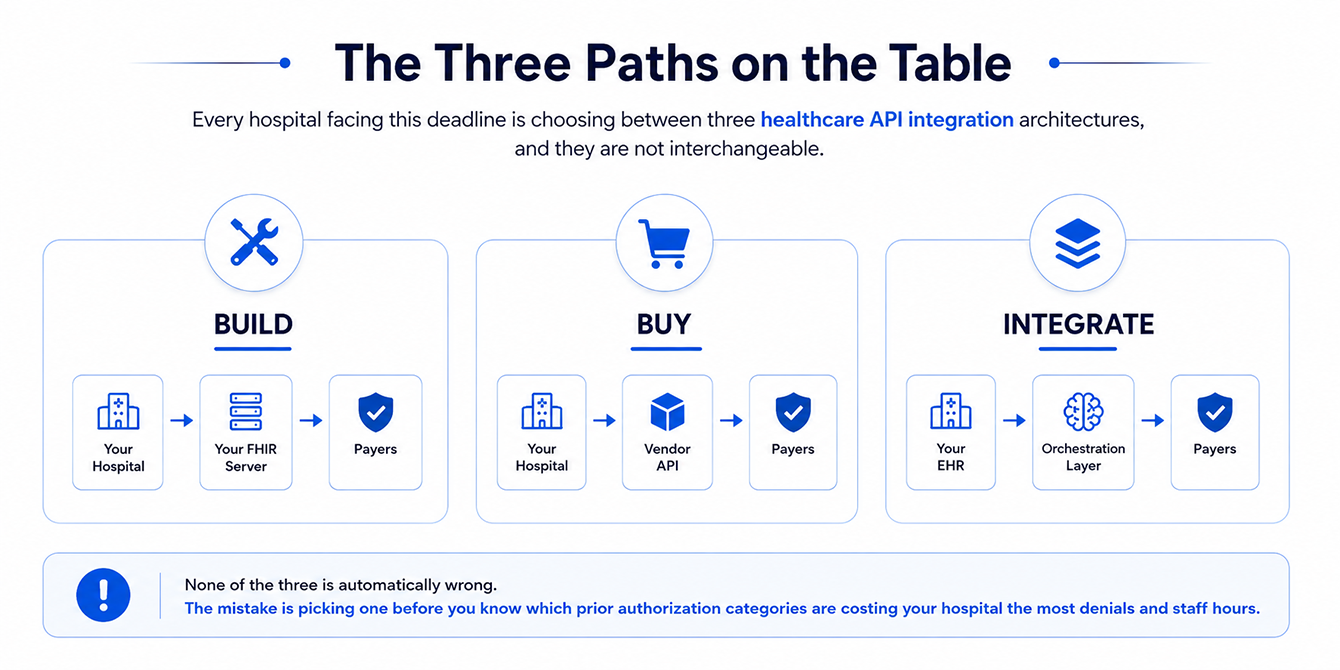
Here are the three healthcare API integration architectures: build, buy and integrate. 

  • Build means standing up your own FHIR server, mapping every payer’s rules by hand, and maintaining the integration with your own team indefinitely. 
  • Buy means licensing a vendor’s packaged prior authorization API, usually scoped to one function like imaging or specialty pharmacy. It is fast to turn on, but it is one more system your IT team now has to babysit. 
  • Integrate means placing an orchestration layer, often an agentic one, on top of the EHR and payer connections you already have. It reads clinical data, checks the CRD, DTR, and PAS rules, and routes anything ambiguous to a human instead of guessing. 

None of the three is automatically wrong. The mistake is picking one before you know which prior authorization categories are costing your hospital the most denials and staff hours. 

Why building in-House Rarely Pays Off for Hospitals

The cost of building a FHIR prior authorization API in-house in hospitals and ambulatory organizations sounds manageable on a slide, until you count the bill. Building an AI-Ready Infrastructure for Hospitals & Ambulatory care requires a data foundation that can support FHIR integration alongside broader analytics and AI initiatives. Enterprise-scale FHIR integration connecting multiple payer and EHR systems runs into six figures before a single payer contract is fully mapped, and the assessment and mapping phase alone often takes six to twelve months before any code ships.

A study of ten health systems that had already deployed patient-facing APIs found the same barriers kept resurfacing across every one of them: security concerns, an immature app ecosystem, EHR vendor hesitation around data sharing, and standards still settling underneath them. 

None of that goes away because your own engineers wrote the code. It just moves in-house, permanently. Unless there is budget for a standing team whose only job is chasing payer rule changes, build tends to consume exactly the three to nine months of executive runway that gets burned when a pilot stalls halfway through integration. 

Why Buying a Point Solution Solves One Problem and Creates Another

Buying a packaged prior authorization API gets one workflow moving fast, usually imaging or specialty medication, since those categories carry the heaviest authorization load. But an AI-ready hospital rarely stops at one use case. 

Five different point tools for five different departments means five vendor contracts, five data models, and five places where a denial can quietly fall through the gap. Published research on agentic prior authorization architecture makes the same point from the engineering side: the real gains come from systems that integrate FHIR, EDI, and legacy interfaces under one governance layer, not from bolting another single-purpose tool onto an already fragmented stack. 

Why an Agentic Integration Layer Is Winning Out

The path gaining the most traction right now is the third one: prior authorization automation built as an agentic AI layer that sits on top of the EHR and payer systems a hospital already runs, instead of replacing them. 

One 2026 study of a multi-payer radiology deployment reported a 65.4% reduction in denials, a 33.9% improvement in authorization cycle time, and 97.4% alignment between payer and practitioner decisions, all without a system replacement. That figure comes from a single early-stage publication rather than a peer-reviewed multi-site trial, so treat it as directional, and ask any vendor citing similar numbers for their own validation data. 

The architectural pattern behind those results shows up across other published research too: an agent extracts the clinical data, validates it against payer rules, assembles the required documentation, and escalates anything ambiguous to a human reviewer instead of guessing on its own.

How to integrate FHIR prior authorization API with existing EHR? 

Integrate means learning how to integrate a FHIR prior authorization API with your existing EHR, rather than replacing it: an orchestration layer, often an agentic one, sits on top of the EHR and payer connections you already have. It reads clinical data, checks the CRD, DTR, and PAS rules, and routes anything ambiguous to a human instead of guessing. 

This is the model behind platforms like Caregence, Inferenz’s HIPAA Compliant Agentic AI Platform for Healthcare. It connects directly to EHR, payer, claims, and RCM systems already in place. The prior authorization agent and the clinical AI documentation agent are both governed and auditable by design. For a CIO who has already lived through one AI pilot that could not explain its own decisions, that auditability tends to matter more than the automation itself. 

Prior Authorization AI Agent for Healthcare

Comparison tables based on cost, risk, governance, and best fit

 Check out the individual tables to assess the best approach to take for your needs, whether you need to build the solution inhouse, buy one outright or integrate with your present systems.  

 Cost & Timeline

 Build Buy Integrate 
Cost profile Runs into six figures before a single payer contract is even fully mapped Lower upfront cost per tool, but cost compounds as departments add more point tools Mid-range; reuses EHR and payer connections you already have instead of building or licensing from zero 
Timeline to value Assessment and mapping alone often takes 6-12 months before any code ships Fastest to turn on for one workflow, weeks not months Faster than build since it layers on existing infrastructure, proven use-case by use-case 
Executive runway risk Consumes 3-9 months of runway when a pilot stalls mid-integration Low risk per tool, but risk compounds across contracts Lower, since it’s validated on one high-volume category before expanding 

Risk Profile 

 Build Buy Integrate 
Primary risk Security concerns, immature app ecosystem, EHR vendor hesitation on data sharing, standards still settling Point-solution sprawl: five tools means five contracts, five data models, five places a denial can fall through the cracks Vendor-trust risk replaces technical risk; depends on how governed the agent layer actually is 
Maintenance burden Stays in-house permanently, team must chase every payer rule change indefinitely Distributed across vendors; IT still has to babysit each one separately Centralized under one orchestration layer 
Failure pattern Pilot stalls halfway through integration Solves one department, doesn’t scale hospital-wide Requires proof of auditability before scaling past the first use case 

 Governance & Control

 Build Buy Integrate 
Audit trail Fully owned and controlled, but resource-intensive to maintain Vendor-defined, varies contract to contract Governed and auditable by design, not retrofitted after deployment 
Decision transparency High, but the burden sits entirely on your team Depends on whether the vendor’s decisioning is black-box or transparent Agent extracts data, validates against payer rules, assembles documentation, and escalates anything ambiguous to a human 
Data scope One system, fully controlled Siloed per point tool FHIR, EDI, and legacy interfaces unified under one governance layer 

Best Fit & Evidence

 Build Buy Integrate 
Best fit when You have budget for a standing team whose only job is chasing payer rule changes One workflow (imaging, specialty pharmacy) needs a fast, single-department fix Multiple departments need orchestration and you want proof before committing further 
Supporting evidence Barriers documented across ten health systems that had already deployed patient-facing APIs Sprawl risk described in published agentic prior authorization architecture research One 2026 multi-payer radiology deployment reported 65.4% fewer denials, 33.9% faster cycle time, 97.4% payer-practitioner alignment (single study, treat as directional) 
Example in market Your own IT team Point-solution vendors scoped to one function Caregence (Inferenz), an agentic layer connecting EHR, payer, claims, and RCM systems 

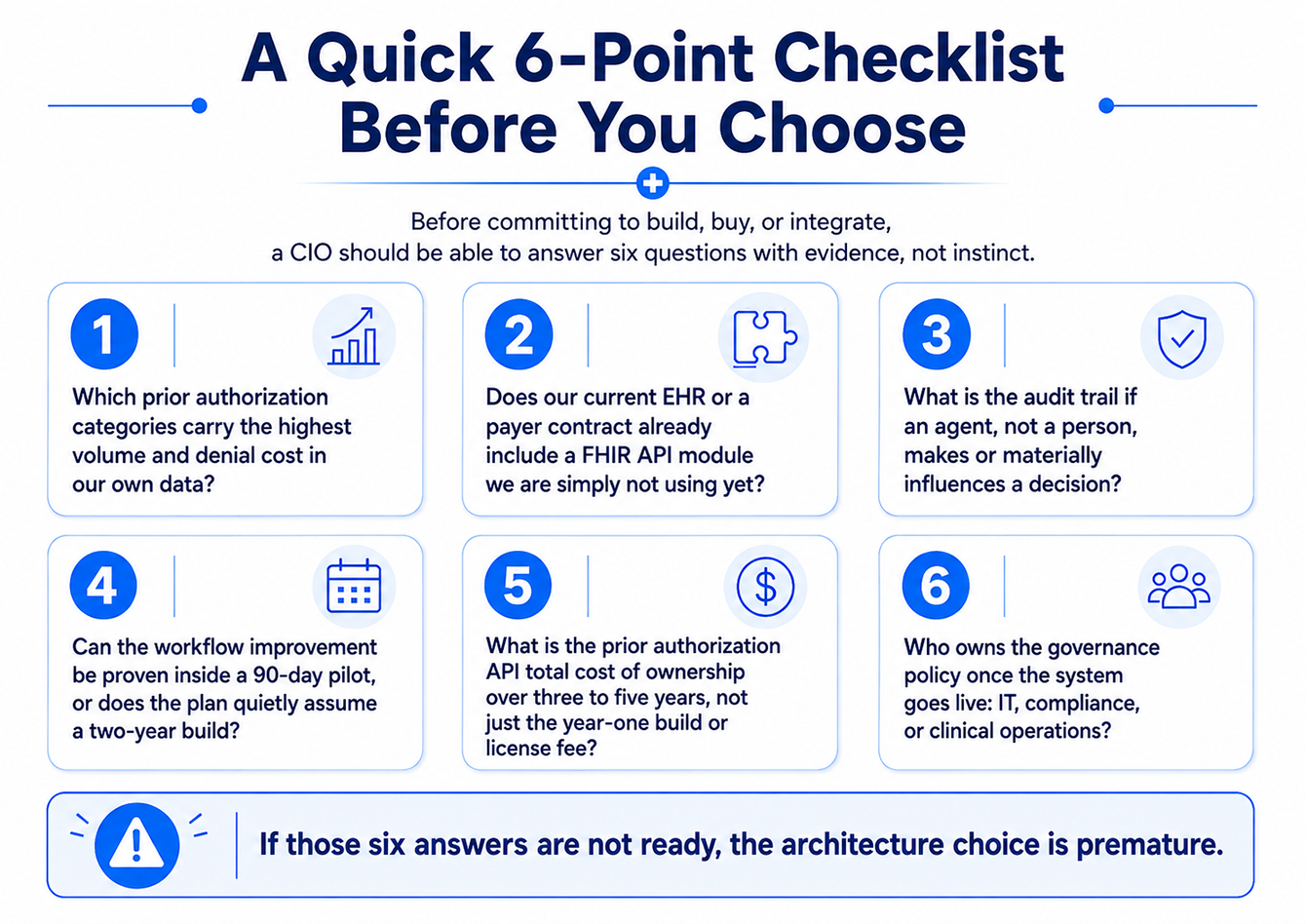
A Quick 6-Point Checklist Before You Choose

A Quick 6-Point Checklist Before You Choose Before committing to build, buy, or integrate, a CIO should be able to answer five questions with evidence, not instinct. 

  1. Which prior authorization categories carry the highest volume and denial cost in our own data?
  2. Does our current EHR or a payer contract already include a FHIR API module we are simply not using yet?
  3. What is the audit trail if an agent, not a person, makes or materially influences a decision?
  4. Can the workflow improvement be proven inside a 90-day pilot, or does the plan quietly assume a two-year build?
  5. What is the prior authorization API total cost of ownership over three to five years, not just the year-one build or license fee?
  6. Who owns the governance policy once the system goes live: IT, compliance, or clinical operations? 

If those six answers are not ready, the architecture choice is premature.

Contact Inferenz for Data & AI Solution-Led Services

Should we build our own prior authorization API or buy one? 

Neither by default. Run the checklist given above first, on your own denial data, before committing. Building suits hospitals with a standing FHIR team and budget for ongoing payer-rule maintenance. Buying suits a single high-volume use case. Most mid-size hospitals land on integrating an agentic layer over what they already have. 

The Bottom Line 

 CMS-0057-F does not leave room to wait for certainty. The hospitals moving fastest are not building everything from scratch, and they are not buying five disconnected tools either. They are the ones layering a governed agentic system over what they already own, proving it on their highest-volume denial category first, then expanding. 

Get the workflow and data readiness questions answered before the architecture conversation starts, and the vendor pitch stops being the thing driving the decision. 

Know how selecting the right path can prove crucial to align with CMS-0057-F for an AI-ready hospital. 

Frequently Asked Questions

Conversational AI in Healthcare: The Fragmentation Problem Hiding Behind Every Healthcare Chatbot

Summary 

Patient-facing agents fix long hold times, clinician-facing agents fix manual charting, and care-coordination agents fix the five-system scramble behind both. Each only works once the data underneath it is clean. 

 A care coordinator needs about ninety seconds to answer one question about one patient. Log into the EHR. Pull up a telehealth dashboard. Scan a wound-care note. Now multiply that by every patient on a caseload, every shift, every day. The real cost of a fragmented tech stack shows up in burnout numbers long before it shows up on a balance sheet.  

Where the friction lives What breaks today What a real agent should do Who owns the fix 
Patient-facing Long hold times, generic bots Book, verify, and answer in one pass COO, CEO 
Clinician-facing Manual charting, alert fatigue Draft notes, surface risk, cite the source CMIO, CNO 
Care coordination Five systems, one question One conversational answer, grounded in real data CIO, COO 

 Conversational AI in healthcare promises to collapse that search into one plain-language question, answered in seconds. Most healthcare firms aren’t there yet. The reason has less to do with the chatbot on the website than with everything sitting behind it.

What is Conversational AI in healthcare, and why “agent” doesn’t mean “chatbot” 

A chatbot answers a question. An agent does something about it. It books the appointment, pulls the chart, or escalates to a nurse when the answer isn’t safe to give on its own.  

Conversational AI in healthcare covers both ends of that spectrum, and the industry has spent a decade treating them as the same thing. They aren’t.  

A scripted bot that can’t see a patient’s real chart is a phone tree with better manners. An agent wired into the EHR and the care team’s actual workflow works more like a colleague who never sleeps and never forgets to check the chart first. 

There’s a third term worth separating out here too: ambient AI. Where conversational AI is interactive, someone asks and it answers, ambient AI listens passively in the background, capturing a visit without anyone prompting it. Healthcare organizations increasingly need both, and the two work best when they feed the same underlying record instead of running as separate tools with separate logins. 

Inside a Conversational AI agent: how it actually works 

A useful mental model treats the agent as three layers stacked on top of each other, not one black box.

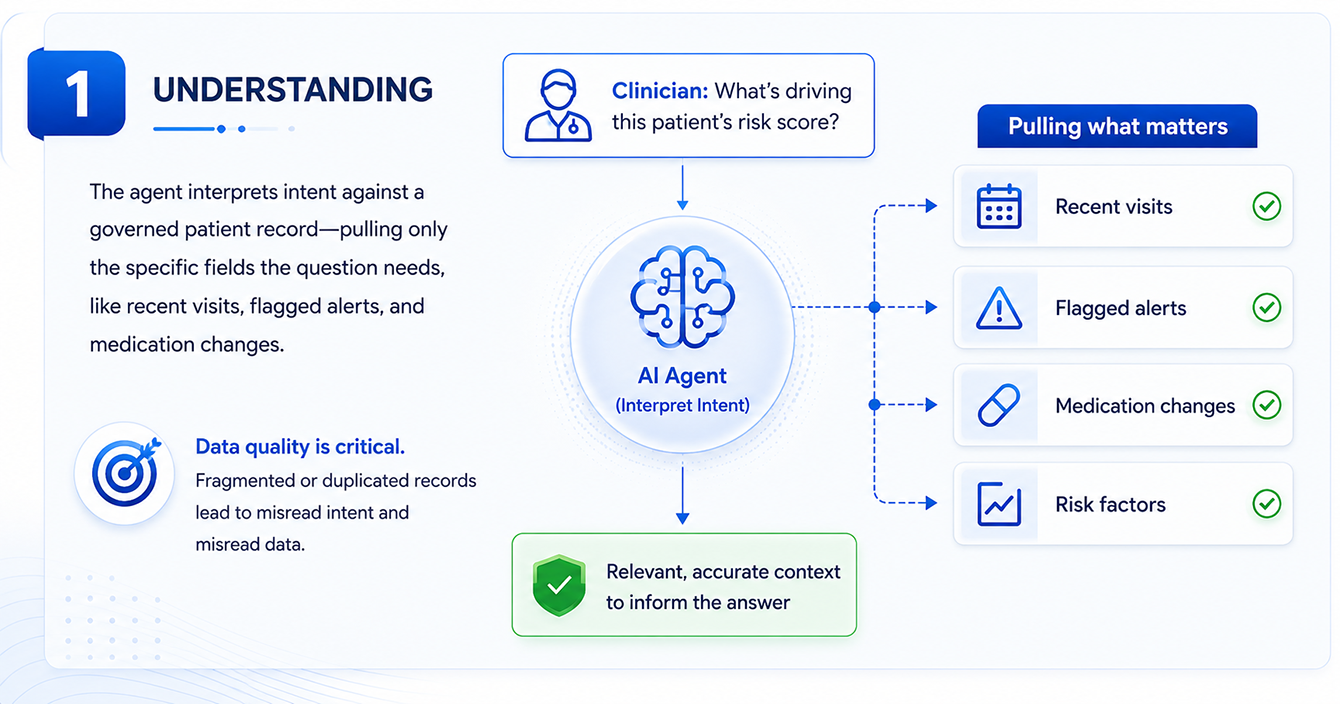
The first layer is understanding. When a clinician asks what’s impacting a patient’s vitals, the agent isn’t matching keywords or walking a decision tree. It’s interpreting intent against a governed patient record, pulling the specific fields the question needs, recent visits, flagged alerts, medication changes, rather than dumping everything based on what is accessible.  

This is also why data quality matters so much. An agent grounded in a fragmented, duplicated record misreads intent almost as often as it misreads the data itself. 

AI agent understanding layer interpreting user intent in a conversational AI system

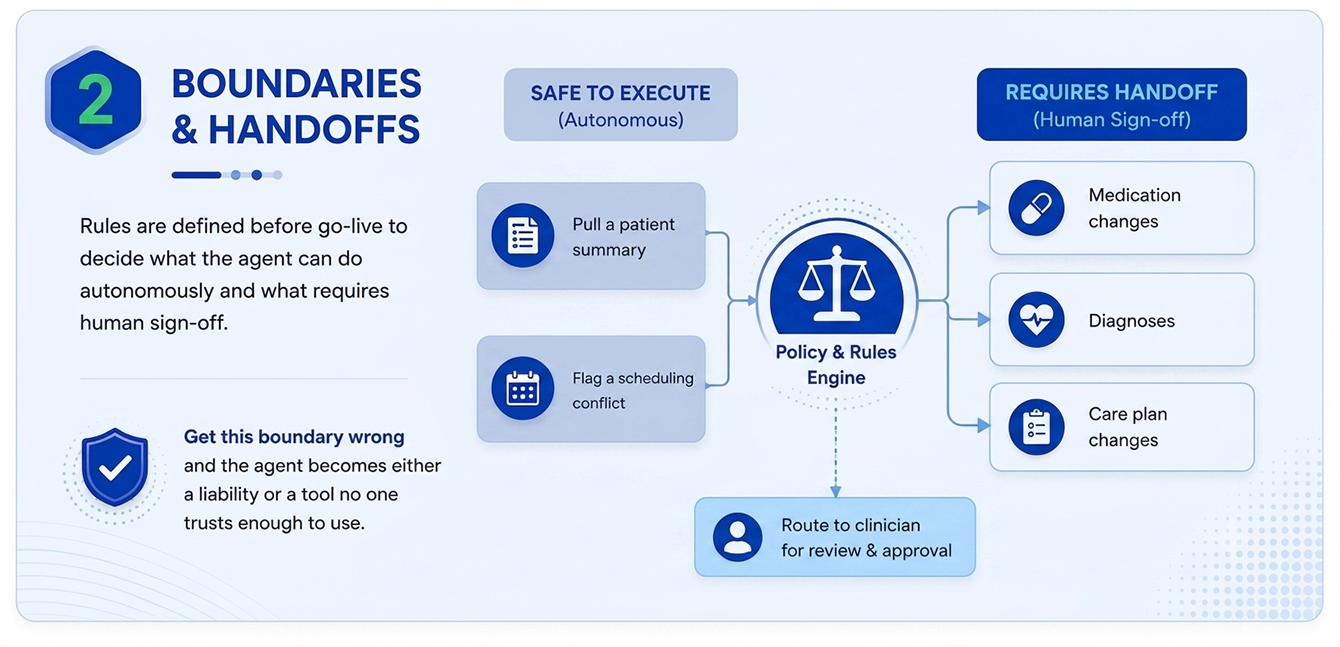
The second layer is the boundary between what the agent can do on its own and what it has to hand off. These rules get defined before the agent ever goes live. Some actions are safe to execute autonomously: pulling a summary or checking on patient record updates. Others always route to a clinician for sign-off: anything touching a medication, a diagnosis, or a care plan change. Get this boundary wrong, either too loose or too conservative, and the agent becomes a liability on one side or a tool that nobody trusts enough to use, on the other. 

Conversational AI agent boundary layer for autonomous actions and human handoffs

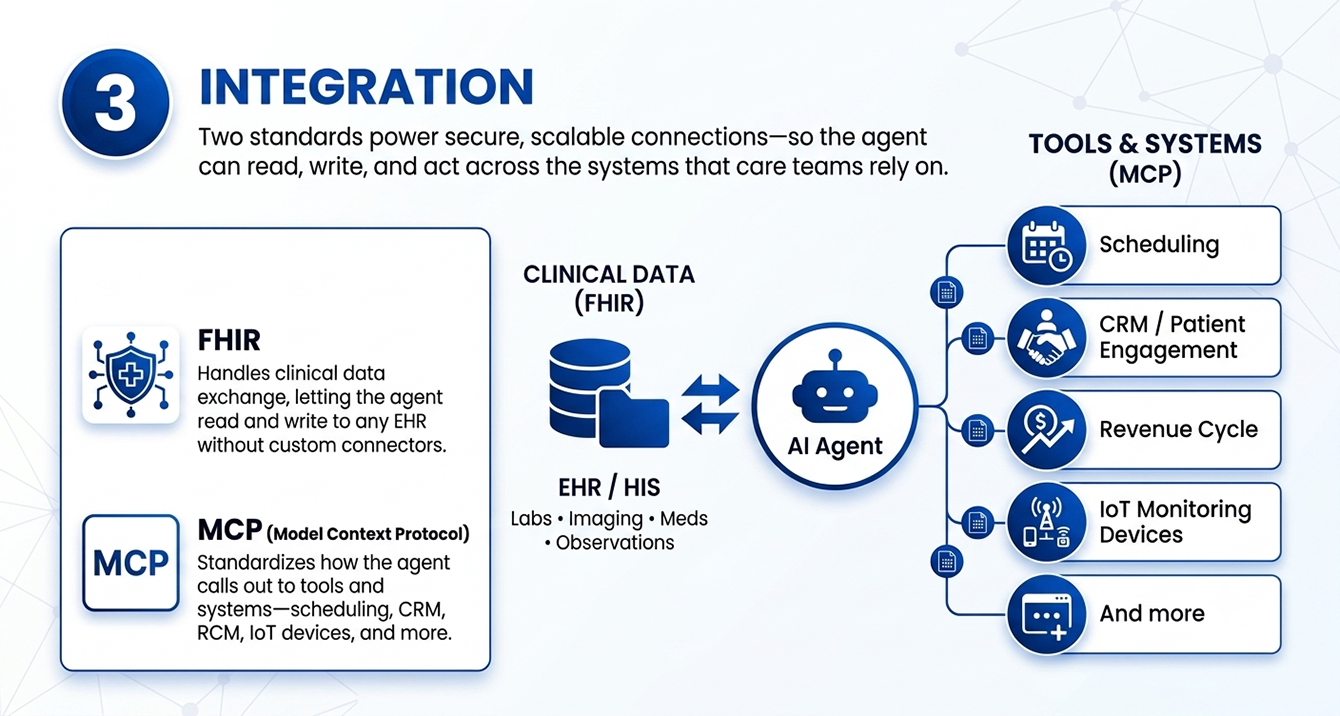
The third layer is integration, and it’s the one most vendors gloss over. Two standards do the real work here. FHIR handles clinical data exchange, letting an agent read and write to an EHR without a custom-built connector for organization’s specific system. The newer piece is MCP, the Model Context Protocol, which standardizes how an AI agent calls out to tools and systems generally: scheduling platforms, CRM, revenue-cycle software, IoT monitoring devices.  

Conversational AI agent integration layer connecting systems, tools, and workflows

Caregence conversational AI agent is built directly on this pattern: an orchestrator-led, multi-agent architecture with several pre-built MCP tool connectors, so adding a new data source becomes a configuration step instead of a months-long integration project. That’s the difference between a pilot that stays a pilot and one that actually scales past a single department.

Why healthcare organizations are adopting Conversational AI agents now 

The math is hard to ignore. One widely cited 2026 market report puts the global conversational AI in healthcare market at $18.8 billion in 2025, growing to roughly $59 billion by 2030, a rate north of 25% a year. Provider organizations are buying because the staffing math ain’t mathing otherwise. 

 The outcomes data is what makes the case to a CFO, not the market-size number. A 2025 systematic review of hybrid chatbot deployments, published in Frontiers in Public Health, found reductions in hospital readmissions of up to 25%, a 30% lift in patient engagement, and consultation wait times cut by 15%.  

 Readmission reduction alone is the number worth sitting with, for CXOs. It’s tied directly to reimbursement penalties, which makes it one of the few AI metrics that shows up on the same spreadsheet a CFO already reads every quarter. 

The real problem is the lack of a common patient identity 

Now conversational AI pitches seem laidback nowadays but some primary points of note before going further on the subject need to be considered.  

A healthcare organization’s clinical documentation, analytics platform, its telehealth monitoring tool, its wound-care software, and its population-health dashboard almost never share one common patient identity.  

 Here is the typical process: 

  1. A care coordinator asking how a patient is doing is really asking five separate systems five separate questions.  
  2. Then it stitches the answer together manually.  
  3. An agent layered on top of that mess doesn’t fix any of it. It just answers faster and sounds more confident, and a fluent wrong answer does more damage than a slow one ever could. 

 When a core piece of data, a patient, a customer, a claim, gets defined differently across systems, no agent built on top of it can be trusted. That holds no matter how good the underlying model is. The agent is only as trustworthy as the identity layer and the governed data sitting beneath it: the same golden record and clean BI foundation that must exist before any of this works. 

Where the value shows up 

Patient-facing agents, the healthcare virtual assistant layer most patients actually see, run the digital front door: scheduling, insurance verification, and prescription refill requests, handled in one conversation instead of a phone tree. A patient asks when their next appointment is and gets a direct answer, not a menu of numbers to press. 

Clinician-facing agents, often named as AI medical scribes, listen to a visit and draft the note. Physicians want their evenings back. Ambient documentation is the fastest path there, modest-savings caveat included. 

Care coordination agents are the newest lane, and the one closest to the fragmentation problem above. Instead of checking a documentation system, a management tool, and a monitoring platform one at a time, a coordinator asks a single question and gets a summary grounded in all three. The source of every fact stays attached, so nobody must take the answer on faith.  

A question that used to mean five browser tabs and a phone call to a colleague now takes one sentence and a few seconds. 

See-what-one-conversational-layer-over-your-existing-data-actually-looks-like

Who should own this in your organization? 

The CFO wants provable call deflection and a real staffing offset. The CIO wants one orchestration layer instead of another integration project. The CMIO needs an answer grounded in the actual chart, because a fluent guess is worse than no answer at all. The CISO wants a full audit trail on anything that touches PHI, no exceptions. The interface changed from a dashboard to a conversation. The underlying demands got sharper now. 

Every agent that touches a clinical decision needs a human in the loop before it acts, not after. That means HIPAA-grade handling by design, a full audit trail, and a clear override path for anything a clinician needs to correct in real time. Once you skip that step, then even the fastest conversational agent on the market would turn into a liability the first time it’s confidently wrong about a medication. 

Where healthcare firms consistently get this wrong 

Across deployments, the same handful of mistakes show up again, regardless of size or which vendor is involved. 

Buying the interface before the foundation 

A polished chat window is the easy part. Teams get excited about the demo, sign the contract, and only discover mid-implementation that the patient record underneath it is fragmented across five systems with no shared identity. The agent launches anyway, and it’s confidently wrong from day one. 

Leaving the human-in-the-loop boundary undefined until something breaks 

Nobody sits down before launch and writes out exactly which actions the agent can take on its own versus which always need a clinician’s sign-off. That conversation tends to happen reactively, right after the first bad answer, which is the most expensive time to have it. 

Measuring success in numbers that don’t mean anything to a CFO.  

Conversations handled and queries answered are activity metrics, not outcomes. They look good in a vendor’s quarterly business review and mean nothing in a budget meeting. The deployments that survive past year one measure call deflection, readmission rate, or documentation hours, numbers that already live on someone’s spreadsheet. 

Rolling out to the whole organization at once.  

Enthusiasm after a good pilot is real, and it’s also how a working solution turns into an unmanageable one. Every department has different questions, different systems, and different risk tolerance. Scaling everywhere at once multiplies every unresolved problem from the pilot instead of fixing it first. 

These are majorly sequencing failures and every one of them is avoidable with the roadmap below. 

A practical roadmap for Conversational AI rollouts 

Most conversational AI agents for businesses fail for the same reason enterprise AI projects fail everywhere else: teams buy the interface before they’ve built the foundation underneath it. A workable sequence for healthcare rollout looks like this: 

  1. Unify the data first. Establish one governed definition of “patient” across every system that touches care. An agent can’t reason well from a fragmented record, no matter how good the language model behind it is.
  2. Pick one high-impact use case, not an enterprise rollout. Find the single question your care teams ask most often and the workflow where the current process visibly wastes the most time. Prove the value there before expanding.
  3. Design human-in-the-loop from day one. Decide up front which actions an agent can take on its own and which ones always route to a clinician for sign-off. Retrofitting oversight after a bad answer ships is the wrong order.
  4. Measure the win in numbers a CFO already tracks. Call deflection, readmission rate, documentation hours, time-to-answer. Skip vanity metrics that don’t map to something already on a budget line.
  5. Expand department by department, using what the first deployment taught you rather than repeating the same assumptions somewhere new. 

Where this leads: Caregence’ conversational AI agent  

This is exactly the direction Caregence’ conversational AI agent for healthcare takes, and it’s aimed squarely at leadership. Any CXO can ask it a plain-language question, which risk drivers are trending across a population, what’s on this week’s visit schedule, whether a medication discrepancy has been flagged, and the answer comes back pulled straight from the EHR, the scheduling system, and the clinical notes sitting underneath it.  

No dashboard to interpret first. Access follows the same care-team assignments already governing the rest of the platform, so a leader never sees data outside what they’re cleared to see, and nobody has to police that separately.  

The agent lives inside a dashboard that pairs a business-KPI view: active patients, high-risk counts, referrals by source, with the full patient and operational picture behind each number, so a metric moving isn’t the end of the question. It’s the start of one a CXO can actually ask.  

And the shape of the answer matches the shape of the question: a summary comes back as a summary, a comparison comes back as a table, a trend comes back as a chart with two lines of context with clarity and precision.

Conclusion 

This article series started with the case for an AI-ready hospital. The next one showed why a golden patient record must exist before any of it works. The one after that turned clean data into dashboards leadership could actually use.  

Conversational AI agents in healthcare are where all three pay off in a form care teams touch every day. A single, plain-language question gets a trustworthy answer, whether that’s a patient checking an appointment, a nurse asking about a risk driver, or a coordinator finding out what to do next. 

Where this goes next matters too. The current generation of healthcare ready AI agents mostly work alone: one bot for scheduling, one scribe for documentation, one risk tool bolted on separately. That’s already starting to change. The more useful pattern is agents that call on each other, a care-coordination agent that pulls in a Next Best Action recommendation mid-conversation instead of sending the coordinator somewhere else to get it.  

That kind of multi-agent orchestration is exactly what standards like MCP were built to support. It’s why Caregence was architected as an orchestration layer from the start instead of a single chatbot with a healthcare skin. The organizations treating conversational AI as a platform decision now are the ones that won’t have to rebuild in two years when a single bot stops being enough. 

What decides whether any of this works in your organization is the same thing it’s been for the entire series: whether the data underneath it is something you’d actually trust a decision to.

Frequently Asked Questions 

AI in Hospice Care: How Agentic AI Is Easing Admissions, Compliance and Documentation

Summary: What Hospice Leaders Need to Know

  • The pressure is real. About 1.72 million Medicare beneficiaries used hospice in 2022, and 49.1% of Medicare decedents were enrolled at death, according to NHPCO Facts and Figures.
  • Compliance got heavier. CMS replaced the Hospice Item Set with the HOPE assessment on October 1, 2025, adding update visits and new data points.
  • AI works best on operations first. Referral intake, eligibility screening, HOPE documentation, IDG prep and billing checks are the highest-return starting points.
  • Clinicians keep the decisions. Agentic AI drafts, flags and routes. People review and sign.
  • Data readiness decides success. Agencies that unify EMR, referral and billing data first see faster results. Our guide on why hospice AI projects fail without data readiness explains why.

Introduction

A referral lands eleven days before a patient dies. The family had been managing symptoms alone for months. Nobody flagged the eligibility signals sooner, because nobody had the hours to look.

That story plays out in hospice agencies every week, and it rarely traces back to clinical skill. It traces back to paperwork, scattered systems and a workforce stretched thin. AI in hospice care is starting to change that, and the agencies moving first are using it on the administrative load, leaving the bedside to people.

This guide walks through where AI earns its place in hospice and palliative care, which workflows to automate first, how HOPE reporting changes the compliance picture, and what to ask before you buy anything. It closes with answers to the questions families and administrators ask most.

Did you know?

What Is AI in Hospice Care?

AI in hospice care means using machine learning, intelligent automation and data analytics to support the work around end-of-life care. Think intake forms read automatically, eligibility signals surfaced early, visit notes turned into audit-ready drafts, and denials caught before they happen.

It does not diagnose, and it does not decide who receives comfort care. It handles the repetitive tasks that eat clinician hours, so nurses, social workers and chaplains spend those hours with patients and families.

A newer wave, agentic AI, goes a step further. An agent plans and carries out a multi-step task, such as collecting referral documents, checking coverage and scheduling the first visit, and escalates to a person when judgment is needed. Our generative and agentic AI services are built around exactly that model, with human oversight designed in from day one.

Why hospice agencies feel the strain first

Ask a program leader what keeps them up at night and clinical care rarely tops the list. The list looks more like this:

  • Late referrals that shrink a patient’s time on service to a handful of days
  • Eligibility documentation that has to hold up under a targeted-probe audit
  • HOPE assessments that raised the compliance bar in October 2025
  • Interdisciplinary group (IDG) meetings prepared by hand, hours before they start
  • Cap exposure and live-discharge risk tracked in spreadsheets

Every one of these is a data and workflow problem. That makes them solvable.

7 Hospice Workflows Where AI Delivers Value Today

7 Hospice Workflows Where AI Delivers Value Today

Start with the workflows that sit closest to revenue and compliance. The order below mirrors how a patient moves through an agency, from first referral to family follow-up.

1. Referral Intake and Eligibility Verification

Referrals still arrive by fax, portal, phone and hospital discharge feeds. Staff re-key details into the EMR, then log in to payer portals to confirm coverage. Hours disappear before a nurse ever visits.

What AI changes

  • Reads referral packets and insurance cards with OCR and machine learning
  • Checks Medicare and Medicare Advantage eligibility automatically
  • Writes verified details back to the EMR and alerts the intake team

Where Caregence fits

The Front Door Agent in Caregence™ Agents automates referral intake, eligibility screening and family outreach, and escalates to a person only when it has to. For a deeper look at the plumbing underneath, read our piece on hospice EMR and referral data integration.

2. Earlier Identification of Hospice-Eligible Patients

Medicare hospice coverage starts when a physician certifies a prognosis of six months or less if the illness runs its normal course. Many eligible patients are identified too late. Predictive models can scan clinical and claims data for hospice-eligible signals around the clock, so the first flag no longer depends on someone noticing.

The Start of Care and Intake Prediction model in Caregence™ Predictive Models flags eligibility complexity and referral urgency so patients enter hospice while there is still time to benefit. It also ties into the wider challenge of referral leakage in post-acute care.

3. Patient Onboarding and Admission

Admission touches scheduling, charting, consents, coding and care-team assignment. Each handoff is a chance for a delay or a data-entry error, and in hospice every day counts.

With AI, the intake team enters diagnoses, demographics and insurance details once. The system then identifies follow-up admission tasks, assigns the right care team by location and acuity, prepares the record and drafts initial notes for clinician review. Inferenz has written about the same pattern in AI-powered patient onboarding, and the Matching and Scheduling Agent applies it to interdisciplinary team assignment.

4. Authorizations and Election Documentation

Notices of election, level-of-care changes and related authorizations all depend on clean clinical and eligibility data. An Authorization Agent retrieves that data, completes the paperwork and tracks status end to end, so nothing sits in a queue unnoticed.

5. HOPE Assessment and Clinical Documentation

HOPE replaced the Hospice Item Set on October 1, 2025. CMS built it to capture patient and family needs in real time and at additional timepoints, and it introduced HOPE Update Visits during the first 30 days after election. Records now flow through iQIES. The full specifications sit on the CMS HOPE technical information page.

More timepoints mean more documentation, and documentation that looks complete can still fail review. We unpacked that risk in when AI documentation looks perfect and still fails a hospice audit.

What AI changes

  • Drafts HOPE documentation from visit notes for the nurse to confirm
  • Flags coding variance and documentation gaps before submission
  • Keeps every suggestion explainable and traceable for surveyors

6. IDG Meeting Preparation

The IDG meeting is a Conditions of Participation requirement, and preparing a defensible one takes hours. An Operational Summarization Agent turns visit notes, prior IDG discussions and family communications into a structured pre-meeting summary, then flags gaps. Prep time drops, and the meeting itself gets sharper.

7. Billing, Cap Management and Family Follow-Up

On the revenue side, a Billing and Claims Agent submits claims, tracks cap-related exposure and flags denials early. Predictive models forecast cap and reimbursement risk tied to level-of-care changes, so revenue-threatening shifts surface before they hit the books.

After a patient dies, the work continues. Bereavement outreach and family follow-up can be timed and triggered automatically through digital patient engagement, so no family slips through a gap during the hardest weeks of their lives.

See AI Built for Hospice Workflows

Manual vs AI-Driven Hospice Operations

Hospice processManual approachAI-driven approach
Referral intakeFax, re-keying, phone follow-upsAutomated extraction, routing and family outreach
Eligibility checksMultiple portal logins per patientAutomated verification written back to the EMR
Admission and team assignmentManual coordination across departmentsTask orchestration and acuity-based matching
HOPE documentationRetrospective chart reviewDrafted from visit notes, gaps flagged early
IDG preparationHours of live chart reviewAuto-generated summaries and gap alerts
Billing and cap trackingSpreadsheets and denial reworkPredictive exposure alerts and proactive claim checks

Benefits of AI in Hospice and In-Home Hospice Care

For patients and families

  • Faster access to hospice services, at home or in a facility
  • Symptom concerns reach the care team sooner
  • More consistent support, including bereavement follow-up

For hospice care teams

  • Less documentation and re-keying
  • Sharper IDG meetings with less prep
  • More hours for direct patient and family time

For hospice organizations

  • Fewer claim errors and avoidable denials
  • Earlier warning on cap exposure and audit risk
  • Room to grow census without adding administrative headcount

Across healthcare deployments, Inferenz reports 45% less administrative load, 5x faster onboarding and 30% better caregiver allocation on Caregence™. Results vary by organization and starting data quality.

The Future of AI in Hospice and End-of-Life Care

Automation is the opening chapter. Over the next few years, expect four shifts.

Predictive care planning

Models that read symptom progression and visit patterns will help teams anticipate pain escalation and level-of-care changes days earlier. Our take on predicting readmission risk before it happens shows the same closed-loop thinking in action.

Agentic workflows with human oversight

Agents will run onboarding, authorization and follow-up sequences end to end. Clinicians stay in control of every clinical decision, and every agent action leaves an audit trail.

Outcome-based measurement

Agencies will judge AI by admission speed, comfort outcomes and clinician time reclaimed. Adoption for its own sake loses appeal.

Governed, human-centered design

Transparency, consent and alignment with patient values will decide which tools earn trust. See how we approach this in building trusted agentic AI beyond HIPAA compliance.

How to Start: A Practical Path for Hospice Agencies

Step 1: Fix the data foundation

AI can only work with what it can see. Agencies running separate EMR, pharmacy, referral and billing systems need a unified layer first. Our data engineering and integration services and MPI and Patient 360 solution connect those sources without forcing a migration.

Step 2: Pick one high-friction workflow

Referral intake or HOPE documentation makes a strong pilot. Both are measurable, and both touch revenue and compliance. A 90-day pilot beats a twelve-month roadmap nobody finishes.

Step 3: Build governance in from day one

Role-based access, encryption and audit trails are baseline requirements for PHI. Review our data quality, governance and compliance services and the guide to PII and PHI protection in healthcare before any agent touches patient data.

Step 4: Measure and expand

Track days from referral to admission, HOPE completion rates, IDG prep time and denial rates. Once the first workflow proves out, extend to the next. Our AI strategy team can help sequence the roadmap.

Our Perspective: Where Caregence™ Fits

Caregence™ is Inferenz’s healthcare-native agentic AI platform. It connects to the EMR, hospice pharmacy, referral network and analytics tools an agency already runs, and turns them into one data layer. On top of that layer sit ready-to-use agents, predictive models and a no-code workflow builder that clinical and compliance leaders can adjust without waiting on a developer.

  • Works with your stack: integrates with platforms such as HCHB, WellSky and MatrixCare, with no forced migration
  • Governed by design: HIPAA-aligned pipelines, explainable outputs and full traceability
  • Purpose-built: designed around hospice and palliative workflows, then extended across home health, home care and hospitals

Explore the full set of Caregence™ use cases or browse all healthcare solutions from Inferenz.

Final Thoughts

Hospice teams already give everything they have. The agencies pulling ahead are the ones giving that effort back its time: fewer forms, earlier referrals, cleaner audits, calmer IDG meetings.

If you are weighing where to begin, start with the data, pick one workflow, and keep a clinician in the loop. Then talk to people who have built it. Our team is ready when you are, and you can browse our case studies or contact us to plan a first step.

Let's Connect Hospice to the Moment It Matters Most

Frequently Asked Questions

Record, Foundation, Action: Building the AI-Ready Hospital on the Systems You Already Own

Summary   

Hospitals have a complete electronic health record, but two gaps remain: data scattered across multiple source systems, and work that nothing acts on. This piece lays out a two-layer fix: a governed healthcare data platform and a no-code agentic AI layer, joined by one conversational interface, built on the systems a hospital already owns.

A decade of investment made the electronic health record the undisputed system of record. Whether the platform is Epic, Oracle Health, MEDITECH, or another major EHR, the chart is complete.  

That was the achievement of the last era. It is also its ceiling; for two reasons every CIO, CMIO, and informatics leader feels daily. 

First, the EHR was never the whole picture.  

The record sits alongside laboratory, imaging, pharmacy, revenue cycle, coding, bed management, an ERP, a patient portal, health-information exchange, and a stream of device data – and, across a real health system, post-acute and community systems too. Some are modules of the EHR; many are separate, and true healthcare interoperability across them is rare. None, alone, tells the full story of a patient or a service line, and manual healthcare data integration, stitching records together by hand, is where reliable insight goes to die. 

Second, the EHR records work but rarely does it.  

Between the records sits an enormous layer of human effort: reading a referral and keying it in, chasing a prior authorization, reconciling a document, following up on an order, moving a patient through the building and out to the next setting of care.  

The chart captures the result. But it performs almost none of the labor. 

So, the modern hospital carries two structural gaps: data it cannot see whole, and work nothing acts on. The AI-ready hospital closes both, in order, without touching the EHR it depends on.

Layer One Source Systems Fragmented Across the Enterprise

Three layers over the systems you already own, joined by one conversational interface. Data flows up into the foundation; a natural-language assistant turns it into insight and next best actions; the agentic AI layer executes and writes back into the EHR and source systems for continuous EHR data integration, signifying a closed, observable loop. 

Layer one: a healthcare data platform that makes data whole 

Before any AI is trustworthy, the data must be. The foundation ingests from every source: clinical, financial, operational, external, and the post-acute and community systems in the health system. It uses FHIR where it exists, native APIs where it does not, and HL7 where it must.  

It resolves duplicate identities into a single master patient index, the foundation of a true Patient 360 view, enforces data quality and healthcare data governance, and lands everything in a governed lakehouse-warehouse, with observability across the whole pipeline. What leaders see is not raw plumbing but persona-specific dashboards, an operations view for the CIO, a clinical view for the CMIO, a service-line view for the leader who owns the P&L, including a unified Master Patient Index / Patient-360 view that finally shows one patient as one record. 

The way in with conversational AI 

Dashboards answer the questions you already know to ask. A hospital needs more than that. So, the foundation and the agentic layer share one conversational AI interface built for healthcare teams: ask a question in plain language, get an insight drawn from your own data, and get the next best action – which the platform can then carry out. A service-line leader can ask why to length-of-stay drifted last month; a case manager can ask which discharges are highest-risk today and set the follow-up in motion. One way in, for every persona. 

Layer two: agentic AI that acts 

On that foundation, a no-code orchestration platform for agentic AI in healthcare turns the record into action across the care continuum and the back office alike: automating access and intake – including prior authorization automation, supporting clinical work and care coordination, tightening revenue and operations with denials management software and coding support, and engaging patients directly. Workflows are built by drag-and-drop, run on schedules or event triggers, and every action is logged, observable, and written back into the EHR and source systems, so the system of record stays current while the work finally gets done. 

The step most hospitals still do manually; the transition out 

One use case deserves singling out, because it sits at the boundary of the hospital’s control and its accountability: the transition of care at discharge. Referrals to home health, hospice, palliative care, and home care are still largely faxed, keyed, and sent into the dark, even as readmissions and value-based contracts make what happens next the hospital’s problem. Automating that hand-off, and monitoring risk after it closes the seam between the hospital and the next setting of care. 

Keep your EHR. Add the three things it was never built to be: whole, conversational, and active.

Why AI stalls without these layers 

  • Fragmented data, unreliable AI. Models built on scattered, duplicated, uneven data cannot be trusted, and leaders know it, so nothing ships. 
  • A high safety bar, rightly. HIPAA, clinical risk, and audit obligations make automation without governance and observability a non-starter. 

Every layer here is additive. None disrupts the EHR. That is what makes the path realistic for a live health system rather than a slide. 

Contact us

Where Inferenz stands 

We are a healthcare-native Data & AI company driving healthcare workflow automation, building these layers is what we do. Three things let us do it quickly and safely: 

  • Proven delivery for healthcare. We design, build, and run production data platforms and AI for healthcare organizations unifying dozens of source systems into a single source of truth, master data and patient indexing, predictive risk models, conversational AI assistants, and agentic workflows. 
  • Partnerships that de-risk the platform. Deep partnerships and alliances with Databricks, Snowflake, Azure, and AWS mean the foundation runs on the cloud and data platforms your teams already trust – no exotic stack to maintain, and a clear path to scale. 
  • Accelerators and frameworks that compress time-to-value. A library of 30+ production accelerators: ingestion, deduplication, data quality, observability; a lakehouse-warehouse blueprint; a Master Patient Index; and pre-built Caregence tools, turns months of build into weeks of configuration. 

Caregence brings it together in one no-code, MCP-based agentic platform. Pre-built healthcare AI agents span access, clinical care, revenue cycle management, operations, care transitions, and engagement.  

Connectors reach FHIR-native EHRs across acute and post-acute settings, plus API-based and custom integrations for systems without full FHIR and healthcare interoperability solutions for every environment. Secure communication; a conversational assistant; and full observability round it out, HIPAA-compliant by design.  

The result: the AI-ready hospital is not a research project. It is an engagement with a partner who has built the hard parts before. 

See how the department-by-department rollout plan looks for a hospital CIO piloting this today. 

Contact our Healthcare AI Expert

Frequently Asked Questions 

When AI Documentation Looks Perfect and Still Fails a Hospice Audit

Summary  

Most AI clinical documentation tools produce hospice notes that read well and fail audits. Generic AI was never built to reason through jurisdiction-specific Local Coverage Determinations or the clinical-regulatory logic Medicare Administrative Contractors actually use.  

This article breaks down why that gap exists and what compliance-first documentation actually needs. 

documentation-still-open

Introduction 

A hospice nurse wraps up a home visit at 9pm. She is exhausted, the family is anxious, and she still has to finish tonight’s note before tomorrow’s IDT meeting. She opens the AI-generated draft. Clean sentences, professional tone, not a typo in sight. She signs off and moves on. 

Six months later, that exact note comes back flagged in a Targeted Probe and Educate (TPE) audit. 

The prose was fine. The compliance case was not there. 

The note never established, in language a Medicare Administrative Contractor (MAC) could point to, why this specific patient is expected to have six months or less to live. That is not a formatting problem. That is a fundamental misunderstanding of what AI clinical documentation for hospice requires to be defensible. 

This is not an isolated case. It is the pattern. 

Why general AI clinical documentation tools cannot handle hospice compliance 

Why general AI clinical documentation tools cannot handle hospice compliance

Hospice News recently reported that hospice leaders across the country are converging on the same finding: most AI documentation tools were built for home health broadly, not hospice specifically. 

They do not understand: 

  • Local Coverage Determination (LCD) criteria and how they vary by jurisdiction 
  • The clinical logic separating a hospice recertification narrative that is well-written from one that is genuinely audit-ready 
  • The comparative decline language CMS reviewers are trained to look for 
  • What the new HOPE quality-reporting framework expects in terms of person-centred nuance 

One of the hospice CEOs summarized it directly: general AI models can produce narratives that are clinically polished and still fail an audit, because polish and compliance are not the same thing. 

More than half of hospices nationwide are already managing multiple simultaneous audits. TPE audit rates keep climbing. This is not a hypothetical risk for future planning. It is an operational reality for most hospice organizations today. 

The LCD problem no one is talking about 

Here is what makes AI clinical documentation for hospice harder than it looks on the surface level. 

Medicare hospice eligibility is not governed by a single national standard. Despite being a federal benefit, terminal-status criteria are published as jurisdiction-specific LCDs, written separately by three different Medicare Administrative Contractors: 

  • CGS 
  • NGS 
  • Palmetto GBA 

These three MACs use different logic: 

  • CGS and NGS diverge substantively on ALS and renal disease, applying different lab thresholds and different qualifying criteria other than terminology. 
  • Palmetto GBA abandons the itemized-checklist approach entirely for five of its seven disease categories, replacing it with a narrative “structural and functional impairment” standard that carries no numeric thresholds at all 

A generic AI model trained on general clinical notes has no mechanism for knowing which of these three regulatory regimes governs the patient in front of it, let alone applying the right one correctly. 

The result is documentation that may satisfy one MAC’s expectations while failing another’s entirely, with no warning to the clinician who signed off on it.

What compliance-first hospice AI needs? 

The fix for a compliance-first hospice AI is not a larger language model. It is a system built from the regulation outward, not from the sentence inward. 

A documentation tool built for hospice compliance needs to do four things that most general AI tools currently do not: 

  • Resolve jurisdiction before screening begins. The system must identify the patient’s state, MAC assignment, and governing LCD before it touches a single eligibility criterion. 
  • Walk through disease-specific pathways item by item. Required criteria and supporting criteria must be kept distinct and evaluated separately, not summarized into a generic “probably eligible” assessment. 
  • Distinguish between a criterion that is not met and one that is simply not yet documented. Real gaps need to surface for clinical follow-up. They should never be quietly absorbed into a narrative that reads as complete when it is not. 
  • Know its role in the clinical workflow. The tool screens eligibility. It does not diagnose. The physician certifies. That boundary is not optional, and it cannot be designed around. 

These are not feature requests. They are the minimum viable architecture for AI clinical documentation in hospice that can withstand a TPE audit or a Comprehensive Error Rate Testing (CERT) review. 

Is-your-AI-clinical-documentation-built-for-a-hospice-audit-or-just-pretending

How Caregence approaches AI Clinical Documentation for hospice 

 The Caregence clinical documentation AI engine was designed around the compliance logic described above. It is not a general documentation tool adapted for hospice. It is built from the regulatory structure outward. 

How Caregence approaches AI Clinical Documentation for hospice 

Here is how it works in practice: 

  • Jurisdiction resolution first. Before screening begins, Caregence identifies the patient’s state, MAC assignment, and the specific LCD that governs their diagnosis. An ALS or renal patient in an NGS jurisdiction is measured against NGS thresholds, not CGS’s or Palmetto’s. 
  • Disease-specific pathway screening. The system works through each diagnosis pathway the way a compliance-minded clinician would: required criteria evaluated separately from supporting criteria, documentation gaps flagged explicitly rather than inferred around. 
  • Certification-ready narrative output. A completed screen translates directly into narrative language built around the “paint a picture with evidence” standard that CMS reviewers and MACs are trained to apply. The documentation is defensible, not just readable. 
  • Physician certification remains the physician’s call. The system supports the clinical and compliance case. It does not make the determination. That boundary is architectural, not a disclaimer. 

If your current AI clinical documentation tool can produce a well-structured note but cannot tell you which LCD it screened against, it is not a compliance tool. It is a drafting tool. In a benefit this audit-heavy, that distinction carries real financial and regulatory risk.

What this means for hospice organizations right now 

The hospice sector is operating in an environment where audit pressure is structural, not cyclical. 

TPE rates are climbing. The HOPE framework is adding new quality-reporting requirements. Payers are scrutinizing hospice recertification narratives more carefully than at any prior point. And the cost of a failed audit is not just the recoupment. It is the retrospective review that follows, the staff hours consumed by response documentation, and the referral relationships that erode when a provider’s compliance record comes into question. 

The organizations that will navigate this environment most effectively are not the ones with the most advanced general AI tools. They are the ones whose AI understands: 

  • Which MAC governs each patient 
  • Which hospice LCD applies to each diagnosis 
  • What the difference is between a well-written note and an audit-ready one 
  • Where the documentation gaps are before the auditor finds them 

That is bar you need to set for AI implementations.

Hospice-Audits-Are-Not-Slowing-Down.-Your-Documentation-Needs-to-Be-Ready

Frequently Asked Questions 

Beyond HIPAA Compliance: Building Trusted Agentic AI for Modern Healthcare with Caregence

Summary

Caregence is a HIPAA compliant healthcare native agentic AI platform from built by Inferenz that treats HIPAA compliant AI as an architectural principle, not a final checklist. Every AI agent operates on minimum-necessary access, every action is logged, and the infrastructure is isolated and governed by design, so healthcare organizations can adopt agentic AI healthcare workflows without trading away patient privacy or security. 

Introduction 

Healthcare is entering a new era where artificial intelligence goes beyond answering questions and generating summaries. Modern AI systems can reason, coordinate workflows, retrieve information from multiple systems, and execute tasks autonomously. As a result, this new paradigm, agentic AI, has the potential to transform healthcare operations by freeing providers to focus on patient care while intelligent agents handle repetitive administrative and clinical work.

 Yet this transformation raises an important question: how do healthcare organizations embrace autonomous AI without compromising patient privacy, regulatory compliance, or security? 

The Caregence platform, by Inferenz, revolves around trust. Innovation alone is not enough in healthcare. Every AI interaction must be built on a foundation of security, accountability, and responsible data governance. HIPAA compliance is woven into the architecture of our agentic AI platform from the very beginning. 

Why security must evolve alongside AI 

 Healthcare organizations manage some of the world’s most sensitive information. Medical histories, diagnostic reports, insurance details, prescriptions, and laboratory results aren’t just data points they represent deeply personal aspects of an individual’s life. 

 Traditional software applications typically process information in predictable ways. Agentic AI introduces dynamic decision-making instead. Within a healthcare workflow automation environment, AI agents: 

  • Retrieve data from connected systems EHR/EMR, payer platforms, claims, CRM, HR/payroll, and RCM 
  • Reason across multiple sources to determine the right next step in a workflow 
  • Interact with healthcare systems to complete tasks like intake, authorization, or documentation 
  • Collaborate with other agents, coordinated through an orchestration layer, to complete complex, multi-step workflows 

 This expanded capability raises the bar for governance. Healthcare providers need assurance that AI agents access only the information necessary for a specific task, that every interaction is recorded, and that patient information stays protected throughout the process. Security, therefore, must evolve alongside intelligence. 

HIPAA as an architectural principle 

 Many organizations treat HIPAA as a compliance checklist completed near the end of software development. Caregence takes a different approach. 

 HIPAA principles influence architectural decisions from day one. Our approach begins with secure design principles, ensuring every feature – from the core platform to individual pre-built agents – is built with privacy, governance, and regulatory requirements in mind from the outset. That philosophy embeds security into every layer of the platform: infrastructure, application design, AI orchestration, and operational monitoring. 

Designing agentic AI with privacy in mind 

 An autonomous healthcare agent should never have unrestricted access to patient information simply because it ‘can’ perform a task. Each AI agent operates with carefully defined responsibilities instead. 

 Consider an AI agent assisting a clinician with discharge documentation. It doesn’t require unrestricted access to every record in the Electronic Health Record (EHR). It retrieves only the information relevant to that patient’s discharge, processes it within a secure environment, records its activity for auditing, and completes the workflow without retaining unnecessary data. 

 This principle of minimum necessary access sits at the center of responsible healthcare AI, and it aligns directly with HIPAA’s privacy expectations. 

How Caregence protects healthcare data 

 Protecting healthcare information takes more than encryption or authentication alone – it takes multiple layers of defense working together across the entire AI lifecycle. Within Caregence, sensitive healthcare information is protected through a security-first architecture built around confidentiality, integrity, and availability. 

Caregence security architecture

The platform’s four protective layers, at a glance: 

  • Secure identity and controlled access: every request from an AI agent or authorized user is validated before access is granted. Role-based permissions ensure clinicians, administrators, and support staff interact only with the information their role requires, using secure identity management rather than shared credentials. 
  • Secure infrastructure by design: Caregence operates within enterprise cloud environments using isolated networking, secure storage, managed databases, secret management, and Infrastructure as Code (IaC), minimizing public exposure and enforcing controlled communication between services. 
  • Comprehensive audit trails: every meaningful interaction is traceable. Authentication events, AI agent activity, administrative actions, and system operations are all logged to support monitoring, incident investigation, and compliance reporting. 
  • Continuous monitoring: observability practices give visibility into application health, infrastructure performance, and AI workload behavior, with automated alerting so technical teams can respond before an issue touches a clinical workflow. 

 Trust cannot exist without transparency, and uptime alone isn’t the goal, the goal is patient services that stay reliable and secure.

Explore Caregence Platform

Responsible AI beyond compliance 

 Regulatory compliance sets the minimum standard. Responsible AI demands more. 

 At Caregence, we believe healthcare AI should be transparent, accountable, and explainable wherever possible. Our platform supports AI governance healthcare practices that include: 

Responsible AI beyond compliance

These practices help healthcare organizations deploy AI confidently while keeping oversight of every automated decision. 

Enabling healthcare innovation without increasing risk 

 Healthcare organizations often face a difficult choice between adopting innovative technologies and maintaining strict regulatory compliance. Agentic AI changes that conversation. 

 When security and governance are embedded into the platform itself, organizations can accelerate digital transformation without adding operational risk. Administrative workflows become more efficient, clinicians spend less time on repetitive documentation, and healthcare teams gain intelligent assistance while maintaining confidence that patient information stays protected. 

 Innovation and compliance no longer compete. They reinforce each other. 

The Caregence Vision 

 The future of healthcare will be defined not simply by smarter AI, but by trustworthy AI. As autonomous systems grow more capable, patients and providers will expect healthcare AI platforms to demonstrate accountability, transparency, and security by design. 

 At Caregence, our mission is to build agentic AI that healthcare organizations can trust. Every architectural decision reflects our commitment to protecting sensitive healthcare information while empowering providers to deliver faster, more efficient, and more personalized care. 

 HIPAA compliance is an important milestone, but our vision extends beyond meeting regulatory requirements. We strive to build an AI platform where security enables innovation, governance strengthens automation, and trust becomes the foundation for every intelligent healthcare interaction. 

 Because in healthcare, the most valuable outcome isn’t just smarter technology, it’s the confidence that every patient interaction is handled with the care, privacy, and responsibility it deserves. 

Ready-to-deploy-Agentic-AI-your-compliance-team-will-actually-approve

Frequently Asked Questions