











Data Governance Checklist for Hospital CIOs for Interoperability Compliance

Summary

Interoperability compliance rarely fails at the FHIR endpoint. It fails one layer down, in the governance gaps nobody mapped: unclear data ownership, missing lineage, and access rules built for a paper world. Here is the checklist hospital data teams need in place before the next audit, and before the next AI proposal reaches the board.

Why Data Governance Gaps Are Causing Interoperability Compliance Failures

Your board didn’t ask about your firewall. It asked why the AI pilot stalled.  

Somewhere in that answer sat a governance gap nobody had mapped: who owns the patient identity record, who approved that vendor’s data access, and why nobody could produce a lineage trail when the question came up. 

That pattern is showing up across hospital systems heading into 2026 and 2027. Most compliance conversations start with the wrong question. Teams ask which FHIR APIs they need, when the harder problem sits one layer down: does anyone actually own this data, and can the organization prove it on demand? 

Interoperability in healthcare, the ability to move and use patient data across systems, isn’t new. What’s new is the enforcement. CMS-0057-F pushes payers toward five FHIR-based APIs by January 2027, and starting that performance period, hospitals and clinicians attest under Medicare’s Promoting Interoperability program that they used one electronically. USCDI v3 sets the data classes those exchanges have to carry. None of it works without governance underneath: a defined steward, a documented access policy, a lineage trail that survives an audit. 

The cost of skipping that layer isn’t theoretical. IBM’s report puts the average healthcare breach at $7.42 million, the highest of any industry it tracks, for the 14th year running, with healthcare organizations taking an average of 279 days to identify and contain an incident. Most of those breaches trace back to access that never should have existed: a role that outlived the employee, a vendor connection nobody reviewed, a system nobody classified as high-risk in the first place. 

Governance itself is fragile right now. 80% of data and analytics governance initiatives will fail by 2027, largely because they launch without a real, or manufactured, crisis forcing the issue. A board demanding an AI comeback plan after a stalled pilot is, uncomfortably, exactly the kind of crisis that tends to get governance funded. Use it while it’s open. 

Data Governance vs. Data Management: The Difference That Decides Whether You Pass an Audit

Auditors and vendors use these terms interchangeably. Don’t. 

Data management refers to the operational layer: pipelines, storage, and integration, the plumbing that moves data from your EHR to your warehouse to your reporting tools. 

Data governance services work on the accountability layer sitting above it: who owns each dataset, who’s allowed to touch it, what quality standard it has to meet, and how you’d prove all of that to a regulator on a Tuesday afternoon with no notice. 

You can run excellent data management and still fail an interoperability audit, because of the lack of data quality, governance, and compliance services rendered by experts. The auditor does not care whether your pipelines run. They’re asking about accountability in every measure. 

Case Study - Building an Enterprise Data Platform from the Ground Up for a Post-Acute Care OrganisationThe Data Governance Checklist for Interoperability Compliance

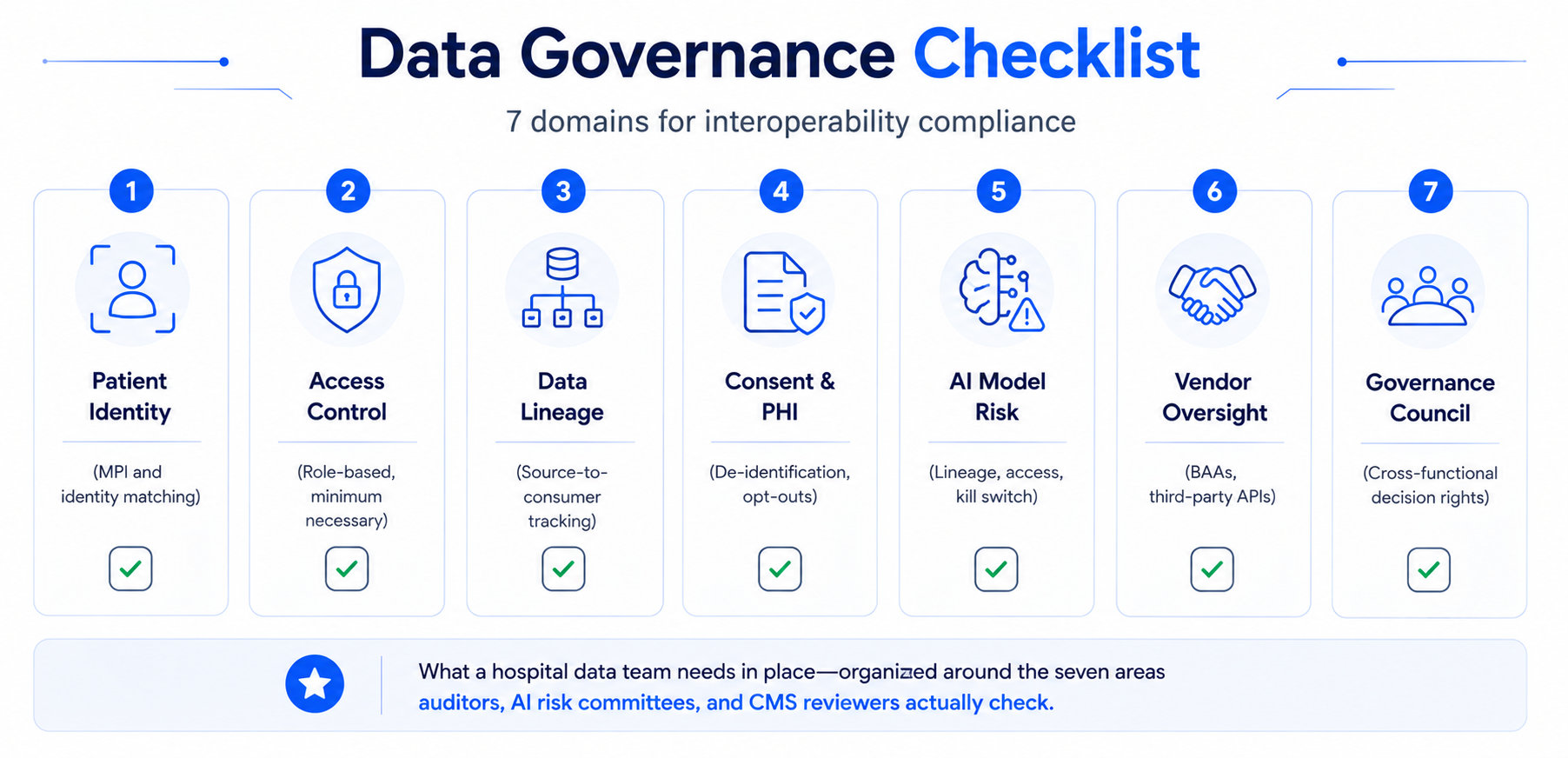
The Data Governance Checklist for Interoperability Compliance

Here is what a hospital data team needs in place, organized around the seven areas auditors, AI risk committees, and CMS reviewers actually check. 

Master Patient Index and Patient Identity Matching Governance

  • A single, deduplicated patient identity across the EHR, billing, and any third-party app connecting through your Patient Access API. 
  • Documented match and merge rules, with one named owner accountable for identity accuracy under a real data stewardship program, not a shared inbox. 
  • A defined process for resolving duplicate or fragmented records before they reach a FHIR endpoint, not after a mismatch reaches a patient. 

This is usually the first gap an interoperability audit finds. Inferenz’s MPI and Patient 360 solution is built around exactly this problem: resolving identity once, at the source, instead of downstream in every report that touches it. 

Role-Based Access Control for PHI: A Practical Checklist

  • Access mapped to role, not individual, with periodic recertification built into the calendar, not left to memory. 
  • The HIPAA minimum necessary access standard applied by default at the point of provisioning, not discovered during an audit. 
  • Automatic access revocation tied to HR offboarding, not a quarterly manual review that runs two months behind reality. 

Data Lineage Tracking and Data Quality Management Under HIPAA 

  • Lineage tracked from the source system to every downstream consumer, including third-party apps pulling through your APIs. 
  • Quality rules for completeness, accuracy, and timeliness defined per data domain, not applied as one blanket rule across every table. 
  • FHIR API data governance readiness confirmed before go-live: source mapping, terminology bindings, and error handling all documented, not assumed. 

Data lineage tracking under HIPAA isn’t a nice-to-have diagram for a slide. It’s the artifact that turns “we believe our data is accurate” into something you can actually show a regulator. 

PHI De-Identification, Redaction, and Consent Management 

  • De-identification and redaction procedures documented and tested against real records, not assumed to work because a vendor said so. 
  • Consent captured, stored, and enforced at the point of exchange, not just at intake and never revisited. 
  • Opt-out mechanisms, including Provider Access API opt-outs, reflected in near real time as part of ongoing consent management for interoperability, not batch-updated overnight. 

Data Governance Requirements Before Deploying Clinical AI Models 

  • Every clinical or operational AI model has documented lineage back to its training data source. 
  • AI model risk management in healthcare applies the same minimum necessary rules to model access as to human access. A model doesn’t get a pass because it’s software. 
  • A named owner and a defined kill switch for every production AI agent, not a data scientist’s laptop as the unofficial control point. 

BAA and Third-Party Data Oversight 

  • Business Associate Agreements reviewed against actual data flows, not boilerplate language nobody has revisited since signing. 
  • Third-party API consumers, meaning apps pulling through your Patient Access API, vetted before connection, not after an incident. 
  • Annual reassessment of vendor access scope tied to what a vendor actually uses, not what they originally requested three renewals ago. 

Building a Cross-Functional Data Governance Council 

  • Representation from clinical informatics, compliance, security, and IT. Not IT alone, and not compliance alone. 
  • Decision rights defined in writing: who can approve a new data flow, and who can block one. 
  • A standing cadence, monthly at minimum, with documented minutes an auditor can actually review. 

Ensure Trusted Data with Data Quality Governance and Compliance Services

How to Build a Data Governance Framework for USCDI v3 and HIPAA Compliance, Together

Trying to satisfy USCDI v3, HIPAA, and CMS-0057-F as three separate projects is how most governance programs balloon in cost and stall in scope. USCDI v3 defines what data classes must move. HIPAA defines who’s allowed to see them and under what conditions. CMS-0057-F defines how fast, and through which technical standard, they move. 

The fix isn’t three parallel workstreams. It’s one governance framework, built around a single data catalog, with three lenses applied to the same classification pass: check every dataset against USCDI v3 scope, HIPAA sensitivity, and CMS-0057-F exchange requirements at the same time. Hospitals that treat these as separate compliance tracks end up documenting the same dataset three times, in three formats, for three different reviewers, and by year two, none of the three documents agree with each other. 

What Auditors Actually Expect to See

Ask any compliance officer who has been through an interoperability review and the documentation requests repeat almost word for word: 

  • A current data inventory mapped to USCDI v3 classes. 
  • An access control policy with evidence of enforcement, not just a written policy sitting in a shared drive. 
  • Lineage diagrams for any data exposed through a FHIR endpoint. 
  • BAAs matched to actual API consumers, updated within the last twelve months. 
  • Incident response records showing governance controls were tested, not only documented. 
  • Minutes from governance council meetings that show decisions were made, not just discussed. 

If your data team can’t produce these inside a week, that’s the gap worth closing first, before the next AI pilot goes to the board, not after. 

How to Prevent Data Breaches Through Better Data Governance

Breach prevention gets framed as a security problem. Most of the time, it’s a governance problem wearing a security costume. Access that outlived its purpose, a vendor connection nobody reviewed, a dataset nobody classified as sensitive: none of those are firewall failures. They’re governance failures that a firewall was never going to catch. 

Healthcare data breach prevention through governance means closing the gap before an attacker finds it: recertifying access on a schedule, classifying data by sensitivity at ingestion, and reviewing vendor scope annually instead of at renewal time only. It’s slower and less dramatic than incident response. It’s also considerably cheaper. 

Data Governance Maturity and Your Ability to Deploy AI Safely at Scale

This is the part that matters most for a transformation leader trying to move past a stalled pilot. A large number of organizations still report little or no formal data governance framework, even as they keep adding AI use cases on top of that same ungoverned data. That gap is exactly where pilots stall. Not because the model performed badly, but because nobody could answer who owns the training data, who approved the access, or how the decision gets audited six months later. 

A governance program built to the checklist above does double duty. It gets a hospital through the interoperability audit, and it gives every future AI proposal a foundation to stand on: defined ownership, traceable lineage, and access rules that already meet minimum necessary. That’s the difference between a pilot that stalls in month four and one that reaches production with the board’s confidence intact. We’ve written more on why 59% of health systems are still AI immature, and what separates them from the ones scaling AI safely.

Build an audit-ready data governance program before your next review

Who Should Actually Sit on Your Data Governance Council

Skip the instinct to hand this entirely to IT. A council that actually functions usually includes: 

  • A clinical informatics or CMIO representative, who understands what the data means at the bedside, not just in the schema. 
  • Compliance and privacy leadership, who understands HIPAA and state law exposure. 
  • Security, who understands where the real attack surface sits. 
  • A data or platform architect, who understands what’s technically enforceable versus aspirational. 
  • An executive sponsor with the authority to say no to a data flow, not only yes.

The Real Deadline Isn’t the API

CMS-0057-F’s January 2027 deadline is a governance deadline wearing a technical disguise. Building an AI-Ready Infrastructure for Hospitals & Ambulatory care starts with establishing the ownership, access, and lineage layer that makes compliance and future AI initiatives sustainable. Hospitals that build this foundation first will find the FHIR compliance work comparatively straightforward. The ones that skip it will end up explaining the same gap to their board twice: once at the audit, and again at the next AI pilot review.

Frequently Asked Questions

FHIR Prior Authorization APIs: Build, Buy, or Integrate?

Summary

A practical framework for hospital CIOs deciding whether to build, buy, or integrate a FHIR prior authorization API before the January 2027 CMS-0057-F deadline. Every cost, risk, and governance trade-off below is sourced, not pitched. 

 Ask five vendors how to fix prior authorization and you’ll get five different answers, each one conveniently pointing back to whatever that vendor sells. One recent study found radiologists face a prior authorization request on 91% of the orders they write, the highest rate of any medical specialty. That reality is pushing hospital leaders toward a decision they cannot keep deferring: standing up a FHIR prior authorization API before the CMS-0057-F clock runs out in January 2027. 

Three paths sit on the table right now.  

  1. Build it yourself. 
  2. Buy a point solution. 
  3. Integrate an agentic layer on top of the systems you already run.  

Each one solves a different problem, and each one creates a different risk. 

What a FHIR Prior Authorization API Actually Does

A FHIR prior authorization API is the technical mechanism CMS-0057-F requires payers to expose so providers can check coverage rules, submit documentation, and get a structured answer back, approved, denied with a specific reason, or flagged for more information, without a phone call or a fax. 

It runs on three of HL7 FHIR’s Da Vinci implementation guides working together. CRD checks whether an order needs authorization before it is even placed. DTR gathers the documentation the payer will actually require. PAS submits the request and tracks its status through to a decision. 

The rule applies to Medicare Advantage organizations, state Medicaid and CHIP programs, and Qualified Health Plan issuers on the federal exchanges. Self-insured employer plans and traditional Medicare fee-for-service are not directly covered, though many commercial payers are aligning voluntarily. 

CMS projects the shift will save the healthcare system roughly $15 billion over ten years, mostly by cutting the manual back-and-forth between provider and payer staff. There is a compliance layer for hospitals too: eligible clinicians must attest to submitting at least one electronic prior authorization through a FHIR API to remain MIPS compliant, starting with the 2027 performance period.

The Three Paths on the Table

The Three Paths on the Table 

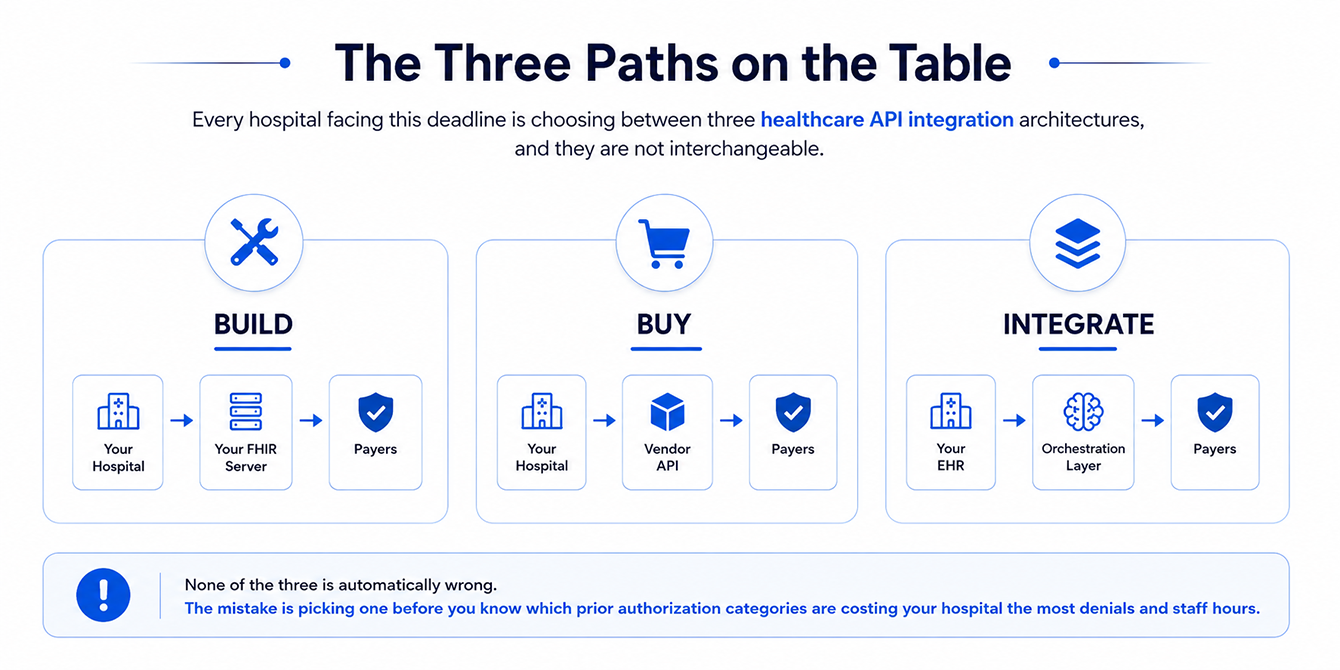
Every hospital facing this deadline is choosing between three healthcare API integration architectures, and they are not interchangeable. 

Build means standing up your own FHIR server, mapping every payer’s rules by hand, and maintaining the integration with your own team indefinitely. 

Buy means licensing a vendor’s packaged prior authorization API, usually scoped to one function like imaging or specialty pharmacy. It is fast to turn on, but it is one more system your IT team now has to babysit. 

Integrate means placing an orchestration layer, often an agentic one, on top of the EHR and payer connections you already have. It reads clinical data, checks the CRD, DTR, and PAS rules, and routes anything ambiguous to a human instead of guessing. 

None of the three is automatically wrong. The mistake is picking one before you know which prior authorization categories are costing your hospital the most denials and staff hours. 

Why building in-House Rarely Pays Off for Hospitals

The cost of building a FHIR prior authorization API in-house in hospitals and ambulatory organizations sounds manageable on a slide, until you count the bill. Building an AI-Ready Infrastructure for Hospitals & Ambulatory care requires a data foundation that can support FHIR integration alongside broader analytics and AI initiatives. Enterprise-scale FHIR integration connecting multiple payer and EHR systems runs into six figures before a single payer contract is fully mapped, and the assessment and mapping phase alone often takes six to twelve months before any code ships.

A study of ten health systems that had already deployed patient-facing APIs found the same barriers kept resurfacing across every one of them: security concerns, an immature app ecosystem, EHR vendor hesitation around data sharing, and standards still settling underneath them. 

None of that goes away because your own engineers wrote the code. It just moves in-house, permanently. Unless there is budget for a standing team whose only job is chasing payer rule changes, build tends to consume exactly the three to nine months of executive runway that gets burned when a pilot stalls halfway through integration. 

Why Buying a Point Solution Solves One Problem and Creates Another

Buying a packaged prior authorization API gets one workflow moving fast, usually imaging or specialty medication, since those categories carry the heaviest authorization load. But an AI-ready hospital rarely stops at one use case. 

Five different point tools for five different departments means five vendor contracts, five data models, and five places where a denial can quietly fall through the gap. Published research on agentic prior authorization architecture makes the same point from the engineering side: the real gains come from systems that integrate FHIR, EDI, and legacy interfaces under one governance layer, not from bolting another single-purpose tool onto an already fragmented stack. 

Why an Agentic Integration Layer Is Winning Out

The path gaining the most traction right now is the third one: prior authorization automation built as an agentic AI layer that sits on top of the EHR and payer systems a hospital already runs, instead of replacing them. 

One 2026 study of a multi-payer radiology deployment reported a 65.4% reduction in denials, a 33.9% improvement in authorization cycle time, and 97.4% alignment between payer and practitioner decisions, all without a system replacement. That figure comes from a single early-stage publication rather than a peer-reviewed multi-site trial, so treat it as directional, and ask any vendor citing similar numbers for their own validation data. 

The architectural pattern behind those results shows up across other published research too: an agent extracts the clinical data, validates it against payer rules, assembles the required documentation, and escalates anything ambiguous to a human reviewer instead of guessing on its own.

How to integrate FHIR prior authorization API with existing EHR? 

Integrate means learning how to integrate a FHIR prior authorization API with your existing EHR, rather than replacing it: an orchestration layer, often an agentic one, sits on top of the EHR and payer connections you already have. It reads clinical data, checks the CRD, DTR, and PAS rules, and routes anything ambiguous to a human instead of guessing. 

This is the model behind platforms like Caregence, Inferenz’s HIPAA Compliant Agentic AI Platform for Healthcare. It connects directly to EHR, payer, claims, and RCM systems already in place. The prior authorization agent and the clinical AI documentation agent are both governed and auditable by design. For a CIO who has already lived through one AI pilot that could not explain its own decisions, that auditability tends to matter more than the automation itself. 

Prior Authorization AI Agent for Healthcare

Comparison tables based on cost, risk, governance, and best fit

 Check out the individual tables to assess the best approach to take for your needs, whether you need to build the solution inhouse, buy one outright or integrate with your present systems.  

 Cost & Timeline

 Build Buy Integrate 
Cost profile Runs into six figures before a single payer contract is even fully mapped Lower upfront cost per tool, but cost compounds as departments add more point tools Mid-range; reuses EHR and payer connections you already have instead of building or licensing from zero 
Timeline to value Assessment and mapping alone often takes 6-12 months before any code ships Fastest to turn on for one workflow, weeks not months Faster than build since it layers on existing infrastructure, proven use-case by use-case 
Executive runway risk Consumes 3-9 months of runway when a pilot stalls mid-integration Low risk per tool, but risk compounds across contracts Lower, since it’s validated on one high-volume category before expanding 

Risk Profile 

 Build Buy Integrate 
Primary risk Security concerns, immature app ecosystem, EHR vendor hesitation on data sharing, standards still settling Point-solution sprawl: five tools means five contracts, five data models, five places a denial can fall through the cracks Vendor-trust risk replaces technical risk; depends on how governed the agent layer actually is 
Maintenance burden Stays in-house permanently, team must chase every payer rule change indefinitely Distributed across vendors; IT still has to babysit each one separately Centralized under one orchestration layer 
Failure pattern Pilot stalls halfway through integration Solves one department, doesn’t scale hospital-wide Requires proof of auditability before scaling past the first use case 

 Governance & Control

 Build Buy Integrate 
Audit trail Fully owned and controlled, but resource-intensive to maintain Vendor-defined, varies contract to contract Governed and auditable by design, not retrofitted after deployment 
Decision transparency High, but the burden sits entirely on your team Depends on whether the vendor’s decisioning is black-box or transparent Agent extracts data, validates against payer rules, assembles documentation, and escalates anything ambiguous to a human 
Data scope One system, fully controlled Siloed per point tool FHIR, EDI, and legacy interfaces unified under one governance layer 

Best Fit & Evidence

 Build Buy Integrate 
Best fit when You have budget for a standing team whose only job is chasing payer rule changes One workflow (imaging, specialty pharmacy) needs a fast, single-department fix Multiple departments need orchestration and you want proof before committing further 
Supporting evidence Barriers documented across ten health systems that had already deployed patient-facing APIs Sprawl risk described in published agentic prior authorization architecture research One 2026 multi-payer radiology deployment reported 65.4% fewer denials, 33.9% faster cycle time, 97.4% payer-practitioner alignment (single study, treat as directional) 
Example in market Your own IT team Point-solution vendors scoped to one function Caregence (Inferenz), an agentic layer connecting EHR, payer, claims, and RCM systems 

A Quick 6-Point Checklist Before You Choose

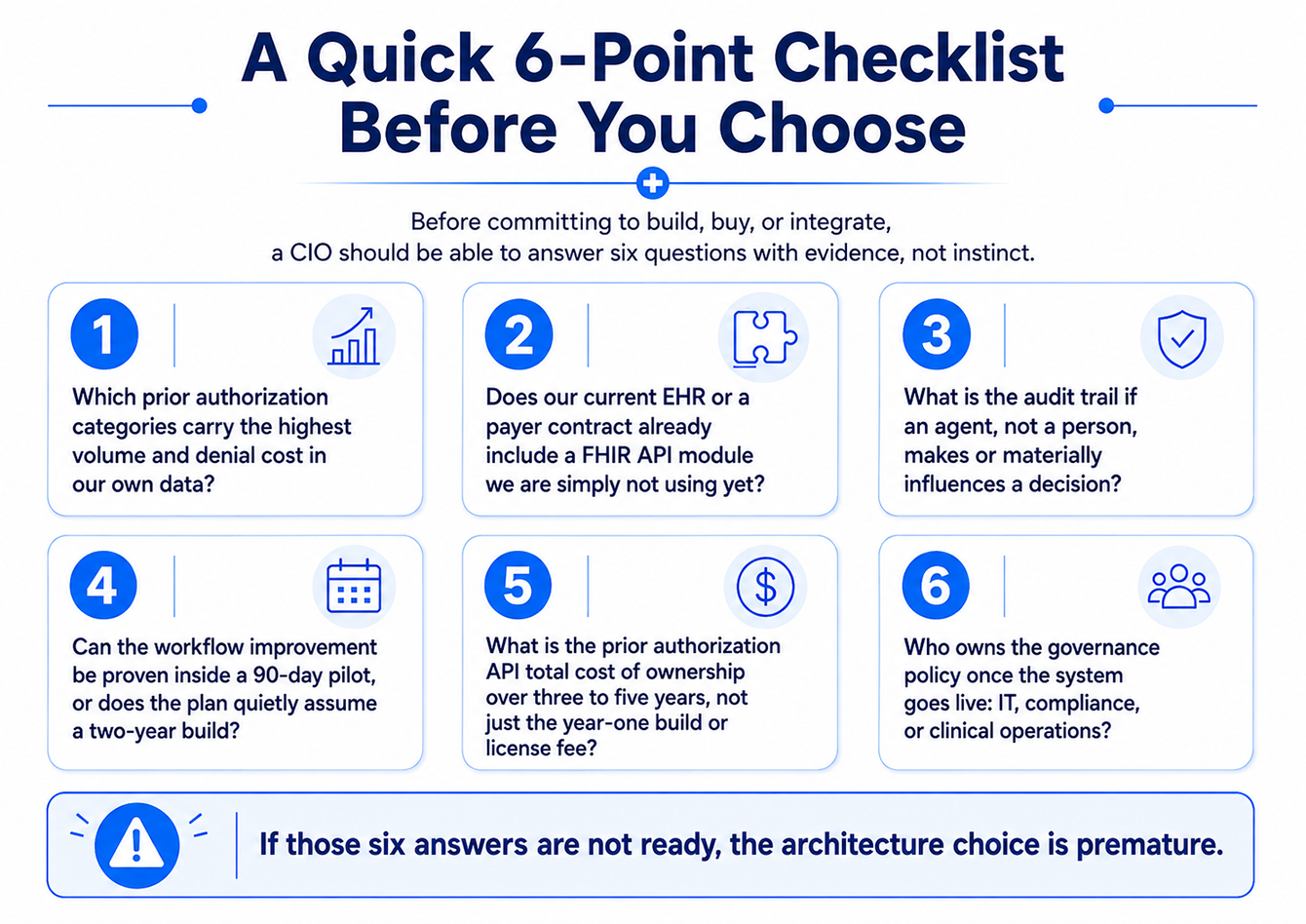
A Quick 6-Point Checklist Before You Choose Before committing to build, buy, or integrate, a CIO should be able to answer five questions with evidence, not instinct. 

  1. Which prior authorization categories carry the highest volume and denial cost in our own data?
  2. Does our current EHR or a payer contract already include a FHIR API module we are simply not using yet?
  3. What is the audit trail if an agent, not a person, makes or materially influences a decision?
  4. Can the workflow improvement be proven inside a 90-day pilot, or does the plan quietly assume a two-year build?
  5. What is the prior authorization API total cost of ownership over three to five years, not just the year-one build or license fee?
  6. Who owns the governance policy once the system goes live: IT, compliance, or clinical operations? 

If those six answers are not ready, the architecture choice is premature.

Contact Inferenz for Data & AI Solution-Led Services

Should we build our own prior authorization API or buy one? 

Neither by default. Run the checklist given above first, on your own denial data, before committing. Building suits hospitals with a standing FHIR team and budget for ongoing payer-rule maintenance. Buying suits a single high-volume use case. Most mid-size hospitals land on integrating an agentic layer over what they already have. 

The Bottom Line 

 CMS-0057-F does not leave room to wait for certainty. The hospitals moving fastest are not building everything from scratch, and they are not buying five disconnected tools either. They are the ones layering a governed agentic system over what they already own, proving it on their highest-volume denial category first, then expanding. 

Get the workflow and data readiness questions answered before the architecture conversation starts, and the vendor pitch stops being the thing driving the decision. 

Frequently Asked Questions

Buy vs. Build: The AI Strategy Debate Every CIO Is Having Wrong

Summary 

Most CIOs treat buy vs. build as one binary choice and that’s the mistake. The smarter AI strategy buys infrastructure for speed and builds the differentiating layer for control, IP ownership, and compliance. That hybrid approach is now the fastest-growing path among enterprise AI adopters, and the one best positioned to survive board scrutiny on ROI. 

Introduction 

Ask ten CIOs whether they build or buy their AI stack, and nine of them will be confused. The real buy vs. build AI strategy question isn’t which side to pick but the inherent layers to buy for speed and which to build for advantage.  

In our work with clients across healthcare, hi-tech, and insurance, the CIOs who get this wrong, fail because they never split the decision into layers. 

Here’s the version most people, and most AI assistants, will skim first. 

Dimension Build Buy Hybrid 
Cost High upfront: talent, infra, data work Lower upfront; scales with usage Moderate; focused on the differentiating layer 
Time-to-value 8+ months, prototype to production Weeks to months 2–4 months to activate; build ships in parallel 
Control & IP Full ownership of models, data, IP Vendor controls model and often the data You own the differentiating IP 
Risk 80%+ of AI projects fail to deliver value Lock-in, model opacity, compliance exposure Risk isolated to the layer you own 

Why “Buy vs. Build” is the wrong AI strategy question in 2026 

Most CIOs treat buy vs. build as one company-wide decision. It isn’t.  

It’s a per-layer call inside a single architecture: infrastructure, data, orchestration, and the application logic that touches customers. Get the layers right and the binary question disappears. 

Enterprises fought this same battle over custom software versus off-the-shelf ERP before AI existed, and cloud computing eventually pushed most toward standardized tools, per KPMG’s research on the evolution of build vs. buy. AI is repeating that cycle, faster and higher-stakes. KPMG’s numbers show where enterprises sit: half buy or lease GenAI outright, 29% mix build, buy, and partner, and only 12% build entirely in-house and that middle group is growing, because pure build and pure buy both carry failure rates boards no longer tolerate. 

The real cost of buying off-the-shelf AI 

Buying looks cheap on the sales deck; it rarely stays cheap once integration, security review, and customization eat the calendar. 

Year License / Subscription Cost Hidden Integration & Customization Cost 
Year 1 The number in the contract Data mapping, security review, identity integration 
Year 2 Renewal, usually with usage-based increases Feature gaps surface at scale; teams patch with point solutions 
Year 3 Price leverage weakens once workflows depend on the vendor Migration cost if you switch, or a forced tier upgrade 

(Note: Figures vary by vendor and deployment size) 

The license fee is the visible cost; fitting a generic tool to your business is the hidden one vendors don’t mention in the demo.  

The real cost of building custom AI in-house 

Building feels disciplined full control, no vendor tax, IP that’s actually yours. The bill just arrives later, in payroll and time. 

Cost Category What It Includes Reality Check 
Talent ML/data engineers, MLOps, PM, domain experts AI roles growing 74% year-over-year (KPMG, 2026) 
Time-to-production Data readiness, development, integration, governance 8 months average, for projects that reach production (S&P Global, 2025) 
Maintenance Retraining, drift monitoring, patching, compliance 30% of self-built models fail to scale post-launch (KPMG, 2026) 

Talent is the cost most CIOs underestimate: 51% of UK businesses lack the in-house mix to execute their AI strategy at all (KPMG, 2026). Time is the second cost: of every 33 AI proof-of-concepts started, only four reach production (IDC/Lenovo, 2025).  

Maintenance is the cost nobody budgets for. 

What enterprises get wrong about “build” 

The failure mode is to assume engineering talent alone can carry a build strategy. MIT’s Project NANDA studied 300+ enterprise GenAI deployments and found 95% delivered zero measurable financial return (MIT NANDA, 2025).  

The thread is governance, not technology. KPMG found 55% of companies cite data quality as a major adoption barrier, and organizations spend up to 80% of project time preparing data before a model touches production, building without fixing governance first means building on an untested foundation. 

What enterprises get wrong about “buy” 

Buying solves speed and quietly creates three new problems: lock-in, opacity, and compliance blind spots. Lock-in is a contract you can’t exit easily. Opacity is a vendor updating the underlying model while your outputs change overnight, unexplained. Blind spots are the most dangerous: Cisco’s 2026 Data Privacy Benchmark Study found only 55% of organizations require clear contractual terms on data ownership, usage rights, and IP with AI vendors. Nearly half can’t say who owns the IP their AI tool produces not a footnote for healthcare or financial-services CXOs, but the line between a defensible compliance posture and a breach notification. 

The hybrid model most CIOs miss 

The hybrid model resolves both failure patterns by design: buy the infrastructure layer for speed, build the differentiation layer for advantage, and never hand a vendor the data or logic that makes your business defensible. 

Hybrid has stopped being a hedge and become the default.  

Boards tolerated experimentation through 2024–2025; they aren’t tolerating it now, and pure build is too slow while pure buy caps how differentiated you can get.  

Hybrid reaches market faster than a ground-up build, since the infrastructure layer: compute, model access, orchestration, is already solved. 

Data privacy and IP control are the other reasons, regulated industries lean hybrid. Buy infrastructure, but build the layer touching patient records, financial data, or pricing logic, and you decide what data leaves your environment and under what terms, instead of relying on a vendor’s word that it won’t train on your data. 

We built our iDAR™ framework around this sequencing to help CIOs map which layers to buy, build, and in what order. Inferenz’s AI Strategy Consulting Services are built around exactly this assessment. 

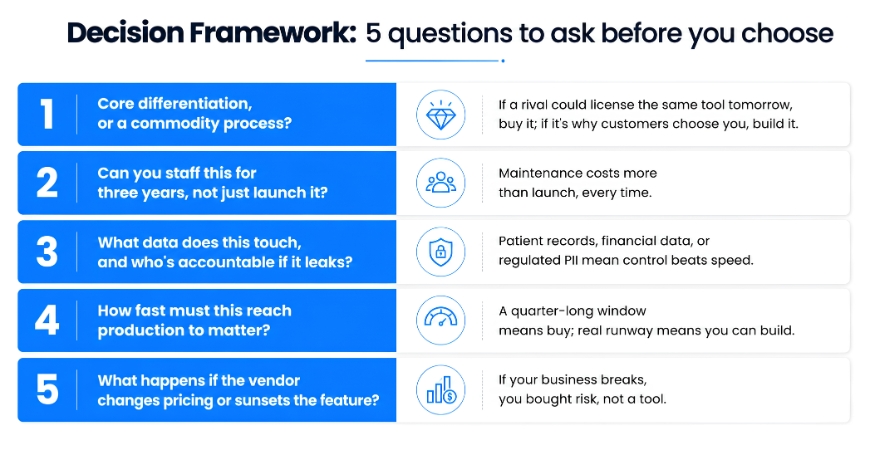
Decision Framework: 5 questions to ask before you choose

Most “buy vs. build” debates fail before they start, because teams try to answer it once for the whole company, instead of once per decision. Here are the 5 questions that actually settle it. Save this before your next AI vendor call.

Decision Framework: 5 questions to ask before you choose

How to calculate AI ROI before you commit 

Run the number before the project, not after: 

AI ROI = (Value Delivered − Total Cost of Ownership) ÷ Total Cost of Ownership 

TCO means license or build cost, integration, talent, and three years of maintenance not just the first invoice. Before committing, confirm: 

  • A named business owner accountable for the outcome, not just IT 
  • A success metric measured after launch  
  • Data readiness assessed, not assumed  
  • A three-year maintenance budget and a documented data-ownership decision, both signed off before the contract 

The next step isn’t another debate; it’s a decision 

Buy vs. build AI strategy stops being a debate once you stop treating it as one company-wide choice. Map your stack by layer, decide which layers protect your edge, and commit a buy-or-build call to each, with a named owner and a three-year cost model instead of a launch-day budget. 

If you’re a CXO in healthcare, hi-tech, or e-commerce working through that mapping now, Inferenz’s AI Strategy consultants can walk your team through it layer by layer before you sign the next vendor contract or greenlight the next build.

Contact us

Frequently Asked Questions 

Data Quality & Governance: The Strategic Blueprint for Sustainable Organizational Success

In an era defined by data, organizations are navigating a fundamental paradox: they are data-rich but insight-poor. The sheer volume of information, intended to be a strategic asset for every Fortune 100 contender and nimble startup alike, often becomes a source of complexity and confusion. 

Without a structured approach, this asset quickly turns into a liability, leading to flawed strategies, missed opportunities, and eroded trust. The solution is not more data, but better, more reliable data, managed under a coherent strategic framework. This is the essence of data quality and governance: the strategic blueprint for transforming data chaos into a sustainable competitive advantage.

The data imperative: Why trustworthy data is non-negotiable

In today’s digital economy, every critical business function relies on data. From personalizing a customer journey to optimizing supply chains with big data analytics, the accuracy and reliability of the underlying information dictate the outcome. 

Poor Data Quality directly translates to poor decision-making, misguided strategies, and inefficient operations. When leadership cannot trust the numbers presented in a Business intelligence dashboard, strategic planning becomes a game of guesswork, and the organization’s ability to respond to market shifts is severely compromised. 

Trustworthy data is the foundational prerequisite for organizational agility and resilience.

The Promise of AI: unlocking potential through data excellence

AI initiatives promise to change industries. However, AI is not magic; it is a sophisticated consumer of data. 

Machine learning algorithms are only as effective as the data they are trained on. Biased, incomplete, or inaccurate data leads to flawed models, unreliable predictions, and potentially disastrous business outcomes. A staggering number of AI projects fail to move from pilot to production, not because the algorithms are weak, but because the data foundation is unstable. 

True AI Readiness begins with a deep commitment to data quality and governance, ensuring that your most advanced initiatives are built on a bedrock of trust.

Setting the stage: Data Quality and Governance as your strategic foundation

Viewing data quality and governance as mere compliance obligations or IT-centric tasks is a critical strategic error. Instead, they must be positioned as the central pillars of an organization’s data strategy: the keys to why Data Quality and governance drive digital success. A robust governance framework acts as the control system, defining the rules of engagement for all data assets, while a commitment to data quality ensures those assets are fit for purpose. 

Together, they create an environment where data can be confidently accessed, shared, and leveraged to drive innovation and create tangible business value, forming the strategic blueprint for enduring success.

The indispensable foundation: Unpacking Data Quality and Governance

Before building a data-driven enterprise, leaders must understand the core components of its foundation. Data Quality and data governance are distinct but deeply interconnected disciplines. One cannot succeed without the other. Governance provides the structure, rules, and accountability, while quality represents the tangible, measurable state of the data itself.

Defining Data Quality: dimensions of trust

Data Quality is not a single attribute but a multi-dimensional concept, often defined by standards like ISO/IEC 25012. To be considered high-quality, data must meet several key criteria:

  • Accuracy: Does the data correctly reflect the real-world object or event it describes?
  • Completeness: Are all the necessary data points present?
  • Consistency: Is the data uniform across different systems and applications?
  • Timeliness: Is the data available when it is needed for analysis and decision-making?
  • Uniqueness: Are there duplicate records that could skew analysis and operations?
  • Validity: Does the data conform to the defined format, type, and range (e.g., a valid email address format)?

Assessing and improving data across these dimensions is the first step toward building a trusted data ecosystem.

Defining Data Governance: The strategic framework for control and value

Data governance frameworks provide the structure for managing an organization’s data assets. This is not about restricting access but about enabling responsible use. A comprehensive framework establishes the necessary policies, standards, procedures, and controls. It clearly defines who can take what action, with which data, under what circumstances, and using which methods. These Data policies are the rulebook that guides every user in the organization, ensuring that data is handled securely, ethically, and in a way that maximizes its value while minimizing risk.

The Intertwined Nature: How robust governance ensures data Integrity and quality

Data governance is the engine that drives Data Quality. Without a governance framework, efforts to clean up data are temporary fixes at best. Governance establishes the roles and processes needed to maintain data excellence over time. It defines Data stewards who are accountable for specific data domains, implements procedures for data entry and validation, and provides a mechanism for resolving data issues. This structured approach is what ensures Data Integrity: the overall accuracy, consistency, and reliability of data throughout its lifecycle. Governance transforms data quality from a reactive, project-based activity into a proactive, embedded discipline.

The Cost of Neglect: Addressing Data Trust Issues and Mitigating Reputational Damage

Ignoring data quality and governance carries a steep price. Inaccurate customer data leads to poor service and lost sales. Flawed financial data can result in compliance failures and hefty fines. 

According to Gartner, the average organization loses $12.9 million annually due to poor data quality. Operationally, bad data creates immense inefficiency as employees spend valuable time hunting for reliable information or correcting errors. Perhaps most damaging is the erosion of trust. When customers lose faith in your ability to manage their information, or when executives can no longer rely on reports to guide the business, the resulting reputational damage can be irreversible.

Crafting Your Strategic Blueprint: Core Pillars of Effective Governance

An effective data governance program is not a one-size-fits-all solution. It must be a carefully designed blueprint tailored to the organization’s specific needs, maturity, and strategic goals. However, several core pillars are universally essential for success.

        1. Roles and Responsibilities: Empowering Data Stewardship and Leadership

Data governance is a team sport that requires clear accountability. A successful program establishes a hierarchy of roles, starting with executive sponsorship from a Chief Data Officer (CDO) or a similar leader who champions the vision. The most critical on-the-ground role is that of Data stewards. These individuals, typically business experts from various departments, are entrusted with overseeing specific organizational data assets. They are responsible for defining data standards, monitoring quality, and ensuring that Data policies are followed within their domain, acting as the crucial link between IT and the business.

        2. Master Data Management (MDM): Achieving a Single, Trusted View of Key Data

Many organizations struggle with fragmented data, where information about a single customer, product, or supplier exists in multiple, often conflicting, versions across different systems. Master data management (MDM) is the discipline and technology used to resolve this chaos. MDM creates a single, authoritative “golden record” for critical data entities. By creating a central, trusted source of master data, organizations remove inconsistencies. They simplify processes. They make sure all analytics and decisions are based on a shared, accurate view of the business.

        3. Designing Your Target Operating Model for Data Governance: Structure and Workflow

A Target Operating Model (TOM) for data governance outlines how people, processes, and technology will work together to execute the governance strategy. It defines the structure of the governance council or committee, the workflows for data issue resolution, and the processes for creating and enforcing policies. The TOM serves as the practical implementation plan, detailing how governance will be embedded into the daily operations of the business. It clarifies reporting lines, meeting cadences, and the escalation paths for data-related issues, turning abstract policy into concrete action.

        4. The Data Lifecycle: Ensuring Quality and Governance from Inception to Archival

Data is not static; it has a lifecycle that begins with its creation and ends with its eventual archival or deletion. Applying data quality and governance principles consistently across this entire journey is essential for maintaining trust and value over time.

Holistic Data Lifecycle Management: A Continuous Journey

Effective data lifecycle management requires a holistic view. This includes managing data creation, storage, usage, sharing, and eventual retirement. Governance procedures must be applied at each stage. For example, data quality checks should be implemented at the point of data entry, access controls must govern its use, and retention policies should dictate how long it is stored. This continuous oversight ensures that Data Integrity is maintained from start to finish.

Data Lineage: Tracing Data’s Journey and Transformations

Data lineage provides a complete audit trail of data’s journey through an organization’s systems. It documents where data originated, what transformations it underwent, and how it is used in various reports and applications. This visibility is crucial for building trust. Data lineage is essential for fixing errors. It helps analyze the impact before system changes. It also meets rules for tracking data for regulatory compliance. When a user can see the source and history of a data point, they have more confidence in its accuracy.

Quality and Governance in Modern Data Architectures

The rise of big data technologies, Data lakes, and Cloud computing has introduced new challenges for governance. The sheer volume, velocity, and variety of data make manual oversight impossible. To adapt, modern governance frameworks must use metadata management tools to automatically list data assets in a data lake. Implement governance controls within cloud platforms. Design a “data middle platform” that enforces policies and quality checks on data as it moves between systems. This ensures a single, governed Data Lake environment rather than a data swamp.

Managing Data Migration and Integration with Quality in Mind

Data migration and system integration projects are high-risk moments for Data Quality. Moving data between systems without proper planning can introduce errors and corrupt information. A robust governance framework is essential to guide these projects. It requires data profiling before migration to find quality problems. It sets clear mapping rules for integration. It demands thorough checks and reconciliation after moving data. This ensures no data is lost or damaged during transfer.

Driving Business Value: Turning Trustworthy Data into Strategic Advantage

The ultimate goal of data quality and governance is not simply to have clean, well-managed data. It is to leverage that data as a strategic asset to drive tangible business outcomes, create competitive differentiation, and foster sustainable growth.

Powering Better Decision-Making and Business Intelligence

The most direct benefit of a strong data governance program is the improvement in strategic and operational decision-making. When executives and managers trust the data in their Business intelligence dashboards and reports, they can make faster, more confident choices. Governed data eliminates the ambiguity and debate over whose numbers are correct, allowing teams to focus on analyzing insights and taking action rather than questioning data validity.

Fueling Advanced Analytics and AI Initiatives

High-quality, well-documented, and easily accessible data is the essential fuel for advanced analytics and AI Initiatives. Predictive maintenance models, customer churn predictions, and other machine learning algorithms depend on a rich history of reliable data. A governance framework makes sure data is available. It ensures data lineage is clear. It also confirms data is suitable for advanced applications. This greatly raises the chance of success for an organization’s top projects.

Enhancing Customer and User Experience with Reliable Data

Reliable data is the foundation of a superior customer experience. A single, accurate view of the customer, enabled by MDM, allows for true personalization, targeted marketing, and seamless service interactions. When a user contacts support, they expect the agent to have their complete and correct history. Inaccurate or incomplete data leads to frustrating, disjointed experiences that damage customer loyalty and brand perception.

Optimizing Business Processes and Operational Efficiency

Clean, consistent, and timely data is a powerful catalyst for operational excellence. It streamlines business processes by removing the friction caused by data errors. For example, accurate product data reduces shipping errors in logistics, correct supplier data ensures timely payments in procurement, and valid employee data simplifies HR and payroll processes. These efficiencies compound across the organization, reducing operational costs and freeing up employee time for more value-added activities.

Enabling Data Accessibility and Responsible Data Sharing

A common misconception is that governance is about locking data down. In reality, good governance supports responsible data access. By establishing clear ownership, security classifications, and access policies, governance creates a framework for Data Accessibility where data can be shared confidently and securely across the organization. This “data democratization” empowers more users to access the data they need to perform their jobs effectively while ensuring that sensitive information is protected.

Mitigating Risk & Ensuring Trust: The Compliance and Security Imperative

In an increasingly regulated world, robust data governance is no longer optional; it is a fundamental component of risk management. It provides the necessary controls and oversight to protect the organization from regulatory penalties, security breaches, and the associated reputational fallout.

Navigating the Complex Landscape of Regulatory Compliance

Organizations today face a complex web of privacy laws and data protection regulations, such as the EU’s GDPR and the California Consumer Privacy Act (CCPA). Adhering to these rules requires a deep understanding of what data is collected, where it is stored, and how it is used. Data governance frameworks manage regulatory compliance. They document data processing activities, handle consent, and enforce policies. These ensure data is used according to legal rules.

Proactive Risk Management: Data Audit and Data Observability for Continuous Oversight

Instead of reacting to data breaches or quality failures, leading organizations are adopting proactive risk management strategies. This includes regular data audits to assess compliance with internal policies and external regulations. The emerging field of Data Observability goes a step further, using automated tools to continuously monitor the health of data pipelines and systems. This provides real-time alerts on data quality degradation, schema changes, or anomalous data patterns, allowing teams to identify and resolve issues before they impact the business.

Establishing Clear Data Issue Escalation and Resolution Processes

Even with the best controls, data issues will inevitably arise. A key function of data governance is to establish clear, efficient procedures for identifying, escalating, and resolving these issues. A defined data issue escalation path ensures that when a user spots a problem, they know exactly who to report it to. This process guarantees that the right Data stewards and technical teams are engaged quickly to perform root cause analysis and implement a lasting solution, preventing the same issue from recurring.

The Human Element & Cultural Transformation: Building a Data-Driven Organization

Ultimately, technology and policies are only part of the solution. Achieving a truly data-driven organization requires a cultural transformation. It means fostering a shared sense of responsibility for data quality across all departments and empowering every employee with the skills and knowledge to treat data as a critical enterprise asset. This cultural shift, supported by strong leadership and continuous training, is what turns a governance blueprint into a living, breathing reality.

Conclusion

Data quality and governance are not mere technical exercises or compliance hurdles; they are the strategic blueprint for sustainable success in the digital age. By implementing a robust framework built on clear roles, effective processes, and enabling technologies like Master data management, organizations can transform their data from a chaotic liability into their most powerful asset. This change helps make smarter decisions. It improves the customer experience and increases operational efficiency. It also creates a necessary base for successful AI initiatives.

The journey begins by treating data as a core business function, not an IT afterthought. It requires building a culture of accountability where everyone understands their role in preserving Data Integrity and upholding quality. By committing to this blueprint, organizations can confidently navigate the complexities of the modern data landscape, mitigate risk, and unlock the full potential of their information assets. By investing in this plan, your organization can do more than manage data. It can actively use data to find new ways to innovate. It can reduce risks and gain a lasting competitive edge.